Showing posts with label CILIP. Show all posts

Friday, 27 November 2015

CILIP NE visit

Our archives had a lot of attention during Explore Archive Week, we think that its about time that we talked about books. 

Anne Sharp writes about her visit to Seven Stories Collection Store, along with 8 other North East based Library staff, as part of an event organised by CILIP NE (The Chartered Institute of Library and Information Professionals).

A visit to Seven Stories, National Centre for Children’s Books had been on my wish list for some time, so I wasted no time in responding to an invitation to do so, sent out through the CILIP NE network.  The visit was not to the wonderful visitor centre on the Ouseburn in Newcastle, but to the less visible, but equally wonderful Seven Stories Collection Store, which is housed at Design Works Business Centre, across the River Tyne, in Felling.  

©Damien Wootten for Seven Stories, The National Centre for Children's Books. 
Visiting a warehouse of books may not sound particularly exciting however, Collections Officer, Paula Wride, who hosted the visit, had taken great care to select and display items which represent the range, scope and purpose of the book and archive collections.  As well as books, she included examples of hand-written notes and notebooks, typed manuscripts annotated with amendments (or comments and doodles), story-boards, sketches, engravings and water-colours.  These demonstrated some of the creative processes and stages, authors (including Enid Blyton, David Almond, Philip Pullman, Martin Waddell, and Katherine Holabird), illustrators (including Helen Craig, Faith Jaques, Polly Dunbar, Barbara Firth, Edward Ardizzone, and John Lawrence) and publishers work through, and the challenges of effectively conserving and storing different formats.  Correspondence between authors and publishers provided an insight into the formal nature of communications in the past, and prompted discussion on the less formal and more ephemeral nature of communication that email generates. 

Although the collecting policy focuses on children’s literature and illustration from 1930 onwards, earlier books are kept in the context of specific archives donated to the collection, and include a copy of one of the earliest children’s books, (Comenius’ Orbis Sensualism Pictus or Visible World in pictures, written in Latin and English) in its 12th edition published in 1777. 


Great care is taken to conserve, store and catalogue each item in the collection, with formats ranging from handwritten notes to floppy-disk, and combine the expertise, perceptions and insights, of Librarian, Archivist, Conservator and Curator, to support in turn the Learning and Participation teams at the visitor centre, and the needs of researchers and schools.   In addition to collections donated by specific authors, illustrators, or book collectors, several library collections have also been saved, preserving examples of works by less well-known authors and illustrators, book jackets, library bindings and practices.  Among the book collections there are special collections of ABC books, paper engineered (Pop-up) books for children, counting and number books, a relatively small collection of factual books, and so on.   In addition to being used in exhibitions and school visits (at the Visitor Centre), the book collections are used by researchers for a wide range of purposes – tracking the history of the book (paper, print, binding), book publishing, marketing, and specifically children’s books illustration; the works of a particular author or illustrator, period or genre; and even ballet and theatre companies for costume and set design.
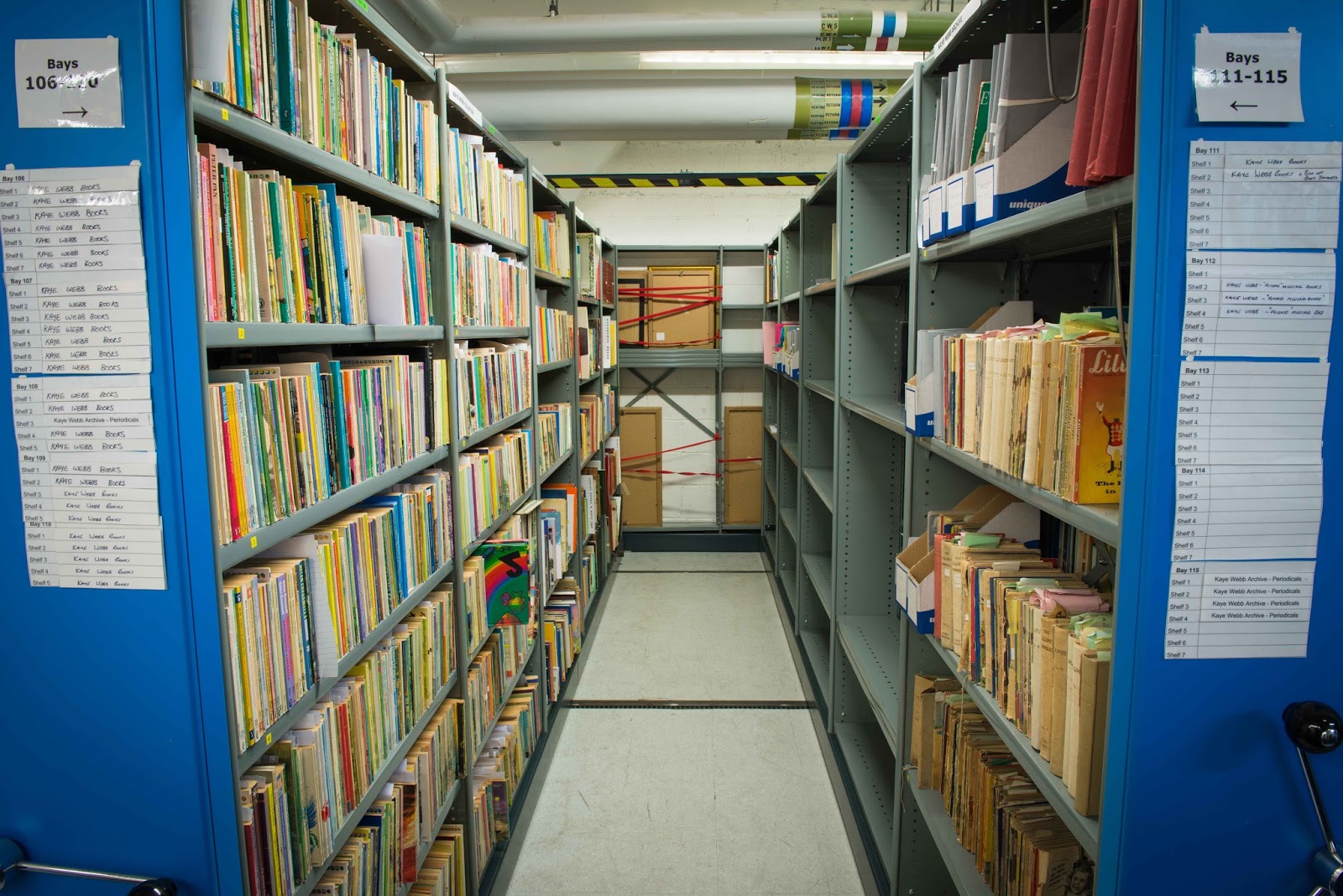
                               
©Damien Wootten for Seven Stories, The National Centre for Children's Books. 
From my perspective, I studied Childhood and Children’s Literature and Public Library Services to Children at Loughborough Library School, and as a Children’s Librarian working in libraries and on mobile library services, I witnessed the sheer joy that books bring to children – as pleasing objects to handle, with pages to turn, lovely illustrations to draw you in and stories to engage and absorb you.  I’d see their confidence grow week on week – confidence in choosing, handling, reading and enjoying the journeys and worlds that books drew them into. Does that still happen?  I love the digital world, but I still love books.  Are children still getting that opportunity and responding as they did before?  Or differently?

A former Children’s Specialist in Public Libraries, Paula volunteered many hours before landing a paid role at the Centre, and now coordinates the work of a number of loyal volunteers (including ex-librarians) with the book collections.  She clearly cares about the collection, her colleagues and the volunteers, the authors and illustrators, and the needs of researchers and schools.  Her talk demonstrated a clear passion and dedication to her role, and was enlivened with anecdotes, which I would share with you here… but who am I to spoil a good story, for you really should visit yourself:  http://www.sevenstories.org.uk/collection

Thanks again to CILIP NE, and in particular to Jennie Hillyard, Librarian at the North of England Institute of Mining and Mechanical Engineers, for organising an excellent visit.  

Here’s a link to Jennie’s own blog post about the visit: https://mininglibrarian.wordpress.com/

- Anne Sharp


If you'd like to find out more about the Seven Stories Collection, then 

email: collections@sevenstories.org.uk or leave a comment. 

Tuesday, 23 June 2015

Carnegie and Kate Greenaway Medal Winners

Yesterday the big announcement was made!  

The 2015 winner of the Kate Greenaway medal was William Grill for Shackleton’s Journey and this years Carnegie Medal went to Tanya Landman for Buffalo Soldier.  Over the past weeks our steering group have enjoyed reading and discussing all of the books shortlisted for the awards; here they are enjoying words, illustration, tea and biscuits.  

Carnegie and Kate Greenaway medal steering group at Seven Stories

To fill the gap in our reading lists, I thought it would be a great chance to delve into the Carnegie and Greenaway treasure chest to the show you some of the items in our collections that have won prizes in the past. Our book and archive collections at Seven Stories represent work by hundreds of authors and illustrators and among them are many Carnegie and Greenaway prize winners.

This is a very small selection, if you’d like to see some more, or you have a Carnegie and Greenaway favourite that isn’t featured, let us know!

The second ever Carnegie winner was Eve Garnett in 1937 with The Family from One End Street, which was quite ground-breaking for its portrayal of a working class family.  It may not be considered anything revolutionary today but in 1937, children’s literature was dominated by middle-class children.  We don’t hold any original material but we do have multiple editions in our book collections.  

Eve Garnett's Family from One End Street (Puffin Books, 1945)

In 1961 Antony Maitland won the Kate Greenaway prize for his portrayal of Mrs Cockle’s Cat.  This image only demonstrates a small amount of material that we hold in our Antony Maitland Collection; we have the whole dummy book, original illustrations and a draft of the cover for Mrs Cockle’s Cat.  We also hold artwork from his other books.

Original artwork for Mrs Cockle's Cat, Anthony Maitland c. 1961 ©Anthony Maitland 


Seven Stories Visitor centre is based in Ouseburn Valley in Newcastle and our Collections are held at our Gateshead office so, this next winner is close to home.  Set in the fictional Garmouth, quite like our own Tynemouth, is Robert Westall’s 1975 Carnegie winner The Machine Gunners.  Westall wrote his draft for The Machine Gunners by hand in notebooks. Six years later Robert won the Carnegie again for The Scarecrows. We hold a selection of original work within our Robert Westall collection which includes material from the majority of his published books. Alongside the archive we also have an extensive Westall book collection, which includes some interesting translations.   
Draft of Machine Gunners, Robert Westall c. 1975 © Robert Westall Estate

Peter Dickinson also won the Carnegie prize two years running. Tulku won in 1979.  Here is an early, incomplete typescript manuscript which is a possible first draft of Tulku.  There is also preliminary material for City of Gold in our archive, which was Peter’s Dickinson’s second book to win the Carnegie in 1980.  City of Gold was illustrated by Michael Forman whose work you can see in our upcoming exhibition. 

Typescript draft of Tulku, Peter Dickinson c. 1978 © Peter Dickinson 


There are very few authors who have won the Carnegie prize more than once, Berlie Doherty is another.  Her first prize was for Granny was a Buffer Girl in 1986 and the second for Dear Nobody in 1991.  Berlie's books can be found in a number of our book collections and our archive collection includes material from her published books, story books and radio broadcasts. The original material for Granny was a Buffer Girl includes these drafts and photographs which we think were used for inspiration. 

Drafts and photographs for Granny was a Buffer Girl c. 1984 © Berlie Doherty


Anthony Browne won the Kate Greenaway in 1992 with Zoo, at Seven Stories we hold one preliminary sketch from the book which shows the zoo visitors looking into the orang-utan’s cage.  We also have a preliminary sketch from Gorilla which won Browne his first Kate Greenaway prize in 1983.

Original Illustration for Zoo c. 1992  © Anthony Browne

A lot of Philip Pullman’s collection is digital but this is a typescript draft from the 1995 Carnegie winner His Dark Materials: Northern Lights.  Some of my favourite items in our collections are Philip Pullman’s handwritten notes and drafts which show his doodling and thought process. Philip’s name is very popular, particularly within our ex-library book collections, it’s great to see how the artwork for ‘His Dark Materials’ developed over time into what is the very recognisable Philip Pullman cover. 

Typescript draft for His Dark Materials: Northern Lights c. 1995 © Philip Pullman 

Emily Gravett’s Little Mouse’s Big Book of Fears won the Greenaway prize in 2008.  In our collection we have some original artwork of mice, these drawings were used to create the final artwork digitally.  The drawings were scanned and then digitally positioned into the relevant spreads like a collage.  

Original artwork for Little Mouse's Big Book of Fears c. 2007 © Emily Gravett


Come along to Seven Stories Visitor Centre after our grand reopening in August and you may be able to spot some of Emily’s mice in our Rhyme Around the World exhibition or...If you'd like to find out more about the Seven Stories Collection, then email: collections@sevenstories.org.uk or phone: 0191 495 2707 or comment on this blog.


Friday, 7 November 2014

Edward Ardizzone artwork donation at the CILIP Youth Libraries Group conference

On 17th and 18th October I was delighted to attend the CILIP Youth Libraries Group, National Conference in Durham.  It was wonderful to meet so many enthusiastic Local Authority and School Librarians, who despite current financial challenges, are excited about children’s books and eager to enthuse their users about books and reading.  Over the two days, we were treated to a great line-up of speakers from the children's literature world including: authors such as Elizabeth Laird, Jackie Morris, and David Almond (all of whom are represented in Seven Stories’ archive collection); Prue Goodwin (lecturer and author of books about children’s literature); and Wendy Cooling (former head of the Children’s Book Foundation now known as ‘Book Trust’).


The magnificent Conference Gala Dinner was attended by a whole host of librarians, local dignitaries, publisher representatives, authors and illustrators.  Impassioned speeches about the importance of libraries were given by both Carnegie Medal 2014 winner author Kevin Brooks, and author Mal Peet (a former Carnegie medal winner).  During the proceedings I was presented, on behalf of Seven Stories, with a delightful piece of signed original artwork by Edward Ardizzone.  Apparently, in 1957, it was decided to have a special bookplate designed for items in the Library Association Youth Libraries Section (now known as CILIP Youth Libraries Group) collection.  Edward Ardizzone agreed to design the bookplate, and a fee of 10 guineas was accepted.


This is a lovely addition to our existing Ardizzone holdings which include artwork for two of his titles 'Tim in Danger', ’Tim and Charlotte' and his artwork for Graham Greene's, 'The Little Train'.

Tea and lunch breaks throughout the conference were sponsored by different Publishers during which delegates were treated to an amazing array of ‘book themed’ cupcakes!  One batch that particularly took my eye, were those provided by Macmillan Children's Books in celebration of eight titles in a new Classics edition, which include two titles by Ursula Moray Williams which are represented in our archive collection - Gobbolino the Witch’s Cat and Adventures of the Little Wooden Horse.


One of the conference Workshop sessions was led by Seven Stories, and centred on our recently announced book list, ‘Diverse Voices – 50 of the Best Children’s Books celebrating cultural diversity in the UK’.   Here are Debbie Beeks (Learning & Participation Manager) and Jake Hope (Freelance Children's Book Consultant) leading the workshop.


To find out more about ‘Diverse Voices’ and to see the list of 50 titles follow this link:


I thoroughly enjoyed my time at the conference and even came back to work with 48 Proof copies of books (due to be published in 2015) for our Staff Library as well!


By Paula Wride - Seven Stories Collections Officer


To find out more about the Seven Stories Collection click here. To contact us click here.