Showing posts with label picture books. Show all posts

Monday, 1 December 2014

All About: Christmas Animals

Now it's the first of December, we can officially start celebrating Christmas here in the Seven Stories Collection. To start off our celebrations, we have a series of Christmas animals to show you, all taken from the material held in our store. This is the start of a new series, next year, on the first of each month we will be bringing you a post on a different feature animal! Leave a comment below with your favourite and we will see what we can do...


Original artwork by Helen Craig for Angelina Ice Skates, story by Katharine Holabird (Puffin, 1993)

Angelina uses her beautiful ballet skills to dance across the ice instead of a stage.

Illustration © Helen Craig
Original artwork by Helen Craig for Angelina's Christmas, story by Katharine Holabird (Puffin, 1985)

This is a heart warming story of Angelina bringing some Christmas cheer to Mr Bell, who has retired from being the village post man. To see more artwork from this book, and many other Angelina Ballerina titles, visit 'Twists and Tails - the Story of Angelina Ballerina' at the Seven Stories Visitor Centre until April 2015.

                                                                                             Illustration © Helen Craig
Original artwork for Tim Mouse and Father Christmas by Judy Brook (World’s Work Press, 1971)
Tim Mouse and children find a little old man with a long white beard lying in the snow.  They know nothing about Christmas, but the old man soon tells them all about Christmas Day, who he was, and how he got lost.  Tim, with the help of his wife, his children and his friends, comes to the rescue and makes sure that no one is disappointed on Christmas Day.
Illustration © Judy Brook's Estate
Original artwork for Tim Mouse and Father Christmas by Judy Brook (World's Work Press, 1971)                                                                                   Illustration © Judy Brook's Estate
Original artwork for Mog’s Christmas by Judith Kerr (William Collins Sons & Co. Ltd., 1976) 

Christmas come to Mog’s household and Mog finds it a little unsettling. There are lots of new people and a walking tree!
                                                     Illustration ©Kerr-Kneale Productions Limited
Original artwork for Mog’s Christmas by Judith Kerr (William Collins Sons & Co. Ltd., 1976) 
                                                           Illustration ©Kerr-Kneale Productions Limited

Original artwork for The Good Little Christmas Tree by Ursula Moray Williams (George G. Harrap, 1943)
Two parents bring home a Christmas tree for their children for Christmas day, but they cannot afford to decorate it with candles and sparkle. When they go to sleep, the Christmas tree goes on a journey to find decorations to delight the children on Christmas morning. He loses many of his needles, and only Santa Claus can help. 
                                                         Illustration © Ursula Moray Williams Estate
Original artwork for The Good Little Christmas Tree by Ursula Moray Williams (George G. Harrap, 1943)How many different animals can you spot in these pictures?
                                                                  Illustration © Ursula Moray Williams Estate

To find out more about any of the items shown in this post, visit the Seven Stories Catalogue. You can also call on 0191 495 2707 or email at collections@sevenstories.org.uk.

Friday, 10 October 2014

'Illustration and Inspiration' at the Granary Gallery, Berwick

Over the past few months, we have been working with the curator of the Granary Gallery in Berwick, on their new exhibition 'Illustration and Inspiration'. 
Opening to the public on Saturday 11 October, and running until Sunday 18th January 2015, the display celebrates the extraordinary wealth of acclaimed children’s book illustrators from Northumberland and the Scottish Borders and the artists who have inspired them.

The exhibition includes works by Vanessa Cabban, Olivia Gill, Brita Granstrom & Mick Manning, Cara Lockhart Smith, Helen Stephens and Gerry Turley. Each of the illustrators have also selected work from the Seven Stories collection by illustrators who have inspired them or had an impact on their creative practice.

Artwork on loan includes work from the archives of some of our most prestigious illustrators, and it has been an interesting exercise looking at our collections through the eyes of practising illustrators, to see what and how certain artists have inspired them over their career.


Lindsey, the Seven Stories conservator, putting the final touches to one of the display mounts.
So as not to ruin the visit to the exhibition, I'll not say who chose what, but these are the artists whose artwork was chosen from our collections:
  • Edward Ardizzone - artwork for 'The Little Train' by Grahame Greene
  • George Him - artwork for 'The Giant Alexander' series by Frank Hermann
  • Angela Barrett - artwork and sketchbook for 'The Snow Queen' by Hans Christian Anderson
  • Tove Jansson - a letter with picture of 'Little My', written to her publisher Kaye Webb
  • John Lawrence - artwork for 'Tiny's Big Adventure' by Martin Waddell
  • Michael Rosen - preparatory notes for 'We're Going on a Bear Hunt'

    Artwork by John Lawrence for 'Tiny's Big Adventure' by Martin Waddell. These two pieces on display offer the opportunity to try and match up the images - the mice in the left picture should fill the voids in the right!
    Stunning artwork for 'The Snow Queen' by Angela Barrett, on display are a finished original piece of artwork, a first edition copy of the book, and Angela's fantastic sketchbook.
To find out more about visiting the exhibition, click here and to find out more about the Berwick Literature Festival click here.

If you want to find out more about this collection, or about any other of our archives then 
email: collections@sevenstories.org.uk
phone: 01914952707 
visit: http://www.sevenstories.org.uk/collection 

Tuesday, 9 September 2014

Tony Mitton and John Lawrence’s 'Wayland'

Congratulations to Tony Mitton who last month won the CLPE award, for his wonderful epic poem, Wayland. This beautiful poem, a retelling of a little-known northern tale brought to Britain by the Vikings, is accompanied by stunning illustrations by John Lawrence, created through engravings on vinyl. Awarding the prize, the CLPE judges said: ‘Wayland was chosen for the mastery of the form, its epic nature and its beauty as a complete piece of art, poetry and legend. This verse retelling of the legend of a master blacksmith who fashions such ‘wonderful ware’ that he is captured by a king is a tour de force.’

The story of Wayland, his faithful love for his swan wife, his skill as a craftsman, his years of servitude under King Nidud and his glorious flight to freedom are compellingly conveyed in this gem of a book.  Cover, end-papers, page design, type-face have an intrinsic gloss and richness that compel a reader to turn the title page and enter the story.


Original print for Wayland by John Lawrence. © John Lawrence
Told in resoundingly rhythmic four line stanzas, using a mix of archaic and modern forms of expressive language, Wayland is a story of love, hope, greed and vengeance and as such it confronts readers with some grisly situations and some adult themes. In setting out to uncover ‘the perennial truth’ that underpins this ancient tale Tony Mitton does not compromise readers by side-stepping its unsettling elements or subduing its tough impact. Believing that ‘moments in traditional tales cry out to be harnessed to contemporary issues’ he implies in the ardent tone of his writing that parallels can be drawn between the greed of King Nidud and aspects of present-day behaviour:

And greed will breed harshness and cruelty.
And wealth is a maze to confuse.
Once a person is warm and well-suppered,
 how much of such wealth can they use?


Original print for Wayland by John Lawrence. © John Lawrence


Words and images work in tandem to such striking effect that the energy and creativity of Wayland’s forge seem recreated in this present day partnership of wordsmith and illustrator.


Tony Mitton's notebook in which he drafted his ideas for Wayland

Earlier this year Seven Stories was delighted when Tony chose to donate his archive, including his original drafts of Wayland, to the National Collection. We were also thrilled when John Lawrence gave a selection of Wayland prints as well as his preparatory sketches, to add to our already substantial collection of his work. Together this fantastic material offers a wonderful insight into the work and creativity that has gone into making this stunning book of poetry and illustration.


Tony Mitton's notebook in which he drafted his ideas for Wayland


Tony first began drafting ideas for Wayland years before the eventual 2013 publication (an earlier, shorter poem ‘The Heart Song of Wayland Smith’ is included in the book). The notebooks in Tony’s collection here at Seven Stories offer a glimpse behind the scenes of this labour of love, giving a wonderful insight into the work that goes into revising and refining a poem of such scale.


In 2011 David Fickling chose to publish Wayland (it was to be one of the first books published by the newly independent publisher) and John Lawrence was approached to illustrate the book. John’s beautifully detailed and crafted vinyl engravings suited the poem perfectly. The early sketches and layouts in the Seven Stories archive show John’s careful process laying out every page in order to create images that match the scale and tone of Tony’s words and turn the book into a visually stunning work of art and poetry.

Rough illustration for Wayland © John Lawrence


By Catriona Nicholson (Seven Stories Trustee) and Kristopher McKie (Seven Stories Archivist)


If you want to find out more about either of these collections or about any other of our archives then
email: collections@sevenstories.org.uk, phone: 01914952707 or visit: http://www.sevenstories.org.uk/collection.

You can buy a copy of Wayland from the Seven Stories Bookshop (http://www.sevenstories.org.uk/shop).


Wednesday, 3 September 2014

Classic children's illustrations find a new home at Seven Stories

Last month saw the arrival at Seven Stories of two sets of classic children's illustrations which have been given a new home in the national collection. 

Thanks to a hugely generous response to a recent appeal we have managed to acquire five of Susan Einzig's wonderful original illustrations for Phillippa Pearce's Tom's Midnight Garden (read more about the appeal here: http://www.sevenstories.org.uk/news/latestnews/save-tom). In addition to this fantastic acquisition we were also delighted to acquire Harold Jones's original (and near complete) artwork for the classic book of nursery rhymes Lavender's Blue. The purchase of this artwork was made possible thanks to grants from ArtFund (http://www.artfund.org/) and the Victoria and Albert Museum/Arts Council England Purchase Grant Fund (http://www.vam.ac.uk/purchasegrantfund).

Late last month, Lindsey (Seven Stories conservator) and I had a trip to London to collect both of our new acquisitions and bring them back to the national collection up in Newcastle.

Our first visit was to the Piers Feetham gallery in Fulham to pick up the Susan Einzig artwork. 


The artwork has recently been on display here and is still freshly mounted.


Next we made the short trip to Putney (where illustrator Harold Jones used to live) to pick up the artwork for Lavender's Blue. There was much more of this artwork (over 160 pieces altogether!) so careful repackaging was required before we could take the artwork away.


This is Lindsey carefully deframing some of the artwork
This is the artwork being transferred to its new acid free, archival packaging

For any fans of Harold Jones we were also introduced to the original 'Bunby' (the character from A Happy Christmas, There and Back Again, and other of Jones's books):


'Bunby'

We rounded our day of classic children's illustration off with a quick stop off to see our friends at the fantastic House of Illustration where we saw (but unfortunately couldn't take!) some wonderful Quentin Blake illustrations.


On our way to the House of Illustration

To celebrate the arrival of Lavender's Blue at Seven Stories there'll be a feature length blog post coming up all about the life and work of Harold Jones. There'll also be a special post looking at Susan Einzig and Tom's Midnight Garden. So keep an eye out for these. The artwork for Lavender's Blue will be featuring in a new Seven Stories exhibition on nursery rhymes next summer.

If you want to find out more about either of these collections or about any other of our illustration collections then
email: collections@sevenstories.org.uk, phone: 01914952707 or visit: http://www.sevenstories.org.uk/collection.


Thursday, 17 July 2014

The making of 'Twists and Tails - The Story of Angelina Ballerina'

When Helen Craig and Katharine Holabird donated their archives of work for the Angelina Ballerina series, the exhibition team wanted to put the material on display as quickly as possible. Not only does the archive represent one of the most popular children's series of the past thirty years, but the level of detail available from both sides of the page is wonderful.

Kris (Seven Stories Archivist) and I (Alison, Curator) identified three main themes visible in the archive and stories.

How to make an Angelina book

The first was 'How to make an Angelina book'. One of the most crucial parts of the archive, and Seven Stories mission, is to make visible the process of creating a book. This material gives us the chance to show the long development that goes in to creating each book; showing the involvement of not just author and illustrator, but editor too. 


Section of draft for Angelina and the Princess, written by Katharine Holabird with comments from Helen Craig, c.1983
Kris and I worked through all the books represented in the collection, and chose Angelina and the Princess as the most visual example of this process. The second book in the series, published in 1984, it was written while the concepts behind Angelina and the world of Mouseland were still being developed. There is also a complete run of preparatory work, in which alterations to the story are clearly visible. What we found most intriguing was the evolution of the original story from Angelina performing for 'The Duchess of Mouseberry', to performing for the Princess. The material on display allows the viewer to track the changes made through the whole process. 

To represent the illustration side, we chose to focus on one particular scene from the book - the double page spread of Angelina performing for the Princess. For this there were many rough illustrations created by Helen Craig, complete with notes to herself about composition. It is an interesting exercise to decipher which elements have changed between each draft, and work out which came first.


Early rough for final double page spread by Helen Craig, for Angelina and the Princess, written by Katharine Holabird (Aurum Press, 1984)
Colour rough for final double page spread by Helen Craig, for Angelina and the Princess, written by Katharine Holabird (Aurum Press, 1984)

Angelina's Journey

The second theme most apparent in the archive is that of Angelina's journey, both within the books, but also from initial picture book to global star.

The archive holds the very first illustrations and manuscript created by Helen and Katharine. Although different to the final version, these show the very beginnings of Angelina, and are on display alongside each other. Showing Angelina's journey within the books led us to choosing some of our favourite Angelina moments, including when she is preparing to go to her first ballet lesson, performs for royalty, and when she meets her new baby sister for the first time. We also have on show an illustration from the (as yet unpublished) latest book in the series Angelina's Big City Ballet, of Angelina and her family arriving in the Big Cheese (aka New York).


Small section of the first draft, which later became Angelina Ballerina. Katharine Holabird, 1982.
The set of stand up illustrations Helen Craig sent to Katharine Holabird, as her idea's for 'Primrose', c. 1982
We also follow Angelina's journey to international fame. The archive contains material from Katharine and Helen's initial and ongoing discussions with HiT entertainment, who hold the licence for the Angelina Ballerina brand. This correspondence often shows the frustrations of allowing other people to work on a character the creators care deeply about. There is also an opportunity to display material from the many different spin-off's, such as the English National Ballet adaptation, much of the merchandise produced over 30 years, and examples of the two television animations.


A sample of some of the Angelina Ballerina merchandise, these were created in 2002 for HIT Entertainment

Mouseland

Probably the most fun we had was choosing content for this section. The world Angelina inhabits is called 'Mouseland', and comes set with certain rules. It was wonderful to explore this within the illustrations and Helen's rough work, uncovering hitherto unseen floorplans of Angelina's home, and choosing pieces which help to show the detailed world the mice inhabit.


Small section of 'Angelina's House', by Helen Craig, 1982

Cross section of a house in Mouseland, with Angelina peering through the window. Final illustration by Helen Craig, for Angelina's Christmas, written by Katharine Holabird (Aurum Press, 1985)
If you would like to visit the exhibition, it will be on display from Saturday 19th July 2014 until April 2015, at Seven Stories, National Centre for Children's Books. Click here to find out more details about visiting the centre.

If you would like to book a visit to research the archives within our collection store, click here for further details.

Interested in other posts about the Storylab Gallery at Seven Stories? Click here or here.

Angelina Ballerina is now published by Puffin Books, and are available for sale from the Seven Stories bookshop, one of the largest independent children's bookshops in the UK.

Thursday, 10 July 2014

The Wonderful World of Kate Petty

In April, Newcastle University Museums Studies students Sarah Seeley and Maria Gkelmpoura joined the Seven Stories Collections team on placement. As part of her time with us Sarah has been exploring the archive of the editor, writer and publisher Kate Petty (donated to Seven Stories in 2012). Here Sarah talks about Kate's work and the range of interesting items she has found:

In 2012, a collection of work by the author and publisher Kate Petty was kindly donated to Seven Stories by Kate’s daughter, Rachel.  Kate Petty, who sadly died from cancer in 2007, wrote and published hundreds of children’s books on a huge range of topics.  The collection here at Seven Stories contains a wealth of material including notebooks, drafts, preliminary art and layouts, dummy books and correspondence, giving an enlightening and extensive insight into how she worked and developed her ideas.

Kate Petty began her career as an editor of adult books for Jonathan Cape and Phaidon. She carried out various editing, copyediting and proofreading jobs for other publishers, working on titles such as Rites of Passage by P.D. James and The Restaurant at the End of the Universe by Douglas Adams.  Her own writing career of children’s books began with a series of non-fiction titles for 5-8 year olds on subjects such as animals, transport and planets.  From this, she went on to write various non-fiction books specialising in the 5-8 age range.


Selection of books from Kate Petty's early writing career


Kate is perhaps best known for her pop-up books.  While working at Random House Publishers, she had the idea of writing a grammar book for children.  Kate had always loved grammar as a child and together with illustrator Jennie Maizels and paper engineer Damian Johnston set about creating a book “as much fun as the wackiest of today’s ABCs” to fill a gap she felt was present in children’s education.  The Great Grammar Book, published in 1996, was an astounding success, providing a fun and interesting introduction to what is considered a dull and complicated subject, and it enjoyed many weeks on the Times Bestseller List.


The Great Grammar Book (Bodley Head, 1996) with Spanish co-edition


Kate and Jennie developed a strong friendship and together went on to produce a series of wonderfully detailed pop-up books full of intricate paper engineering and facts, ranging from music and science to the environment.  Jennie’s preparatory work for many of the books can be found throughout the collection, as well as mock-ups of paper engineering mechanisms and dummy books.  One book for which Seven Stories has some of her original rough artwork is The Global Garden.


Artwork and notes from Global Garden (Eden Children's Books, 2005)


The Global Garden was published through the Eden Project for which Kate was the editor of the Children’s Publishing List, and won the Royal Society’s Aventis Prize for Science Books, Junior Prize 2006.  In the collection here at Seven Stories we find a wonderful range of material, from the initial proposal with Transworld Publishers all the way through to the finished, published book.  Kate’s notebook and numerous drafts alongside her rough layout sketches, Jennie’s artwork, and plans and draft work by the paper engineer for Global Garden, Corina Fletcher, provide an amazing look into how pop-up books are made.


Preparatory handmade dummy book for Global Garden alongside the published book


Aside from non-fiction, Kate also wrote what she called “soft non-fiction”, children’s books that were informative but used fictional characters, which created an engaging way for children to learn about and identify with topics such as road safety and bullying.  She also wrote a small amount of fiction, most notably her teen novels Girls Like You, a series of eight books following the well-known struggles of eight different girls navigating life between childhood and becoming a teenager over a summer holiday.  This series was compiled into two volumes by Dolphin/Orion Publishers: Summer Heat and Summer Cool.

In Seven Stories’ book collection can be found two of these books which are particularly interesting.  Also donated by Kate’s family, Holly and Alex are full of post-it notes on which are scribbled Kate’s own notes and edits she wanted made to the books.  Some of the edits can be found in the compiled versions of the novels and are possibly the only evidence we have of these changes.  Among Kate’s handwriting we find that of another person’s, possibly her editor, and in a folder containing material for another of Kate’s teenage books, Makeover, we find letters written by teenage girls reviewing the book pre-publication.  Here, and indeed with her non-fiction also, it is clear that Kate took great care with the research and realism of her work.


Kate's copy of Holly (Orion Children's, 2000) with post-it notes


Kate had a great talent for writing in such a way that was educational but never patronising or judgemental.  The popularity of her books is evidenced by the fan mail she received from readers and teachers alike, and she is a sadly missed voice in the genre of children’s non-fiction.


Sarah Seeley (postgraduate student in Museum Studies at Newcastle University, International Centre for Cultural and Heritage Studies)


If you'd like to find out more about the Kate Petty archive, the Seven Stories Collection, or the pop-up (and other!) books we hold, then 
email: collections@sevenstories.org.uk or phone: 01914952707.

Wednesday, 2 July 2014

All about pop-up books! (2 of 2)

In this post our guest blogger on pop-up books, Lena Kleine Bornhorst, looks through the Seven Stories Collection and picks out examples of pop-ups featuring some very well known children's characters:


Winnie the Pooh, Noddy, Peter Rabbit, Paddington Bear and The Tiger who Came to Tea are all well-known children’s book characters who have featured in pop-up books. Popular figures or famous stories have often been published in pop-up editions – with varying results!  Pop-up books can be used to raise the popularity of a book or character. They can be used as a merchandising product (like soft toys or board games) and they’re a clever way for publishers to reuse already existent material.

The reuse of established characters in pop-up books is not a new concept: as we saw in the last post, one of the key partnerships in the history of pop-up books was that between US publisher Blue Ribbon and the Walt Disney Company in the 1930s. Pop-up books are a convenient medium to bring film characters or themes into a book version. The movement in the pages and the dynamics can fill the gap between a film and an ordinary book: like a film in a book format.


However, pop-up books with well-known characters shouldn't only be seen as merchandising products. The results are very often quite exciting and it’s interesting how diverse the pop-up editions can be. We can take a look at an example from the Seven Stories Collection: three Thomas the Tank Engine pop-up books produced in the 1990s.

Thomas’s Party Pop-up (Heinemann, 1999) tells in five double-pages a short story about Thomas Birthday Party. The paper engineering is kept very simple and the technique of the pop-ups is always the same. The back of the book is located at the top. Each double-page contains a 90 degree pop-up-element which unfolds when you held the book in a 90 degree angle.

Thomas's Big Railway Pop-up Book (Heinemann, 1992) features seven double-page spreads about seven adventures had by Thomas and his friends throughout a week.  In contrast to Thomas’s Party Pop-up, this book includes different and complex paper engineering. All the included pop-up elements are 180 degree pop-ups, which work when the book is completely open. The reader is encouraged to turn the book in different directions to see all of the pop-up elements and there are many interactive pull-tabs. Two of the interactive elements feature string, which is used to demonstrate rope – the text says: “On Wednesday James runs away. Edward and an Inspector chase him and stop him with a rope.” The other string is integrated in a pull-tab, which makes it possible to lift the Tank Engine after an accident.

Spread from Thomas's Big Railway Pop-up Book (Heinemann, 1992)


Thomas’s Amazing Pop-Up Train Set Book (Heinemann, 1995) contains only four double pages, but the format has a bigger size than the other two books. This book contains detailed 180 degree pop-ups and there are many interactive elements – in particular, a detachable paper engineered Tank Engine, which can use for a free play with the book.  The book is the base for the play as it contains railway lines, over which the Tank Engine can find the way (via a house and over a bridge) through the book. The story is told on little story-stops on every page: Thomas has to deliver a parcel in time, but is too late so he follows further story-stops which bring him back through the book till he catches a paper engineered helicopter which brings the parcel safe to his owner. The story and the interactive part with the detachable Tank Engine are cleverly combined and show another aspect of how pop-up elements can be used.


Spread from Thomas’s Amazing Pop-Up Train Set Book (Heinemann, 1995)

The Thomas the Tank Engine examples show how different paper engineering can look and how different the functions of pop-up books can be. If pop-up books are cleverly made, they can make a story more alive and intensive. Interactive elements let the reader be part of the story and join in.

Other examples of innovative pop-ups featuring well-known characters include the Winnie-the-Pooh Pop-up Theatre Book (Methuen, 1992), for which the paper engineering was done by Helen Balmer and Jose R. Seminario.  The book contains five double pages and every right side is covered by a big flap which can be lifted with a small ribbon. The enfolded paper engineering shows a scene of the story. With the included character puppets these scenes can be used for a free theatre play and pull-flaps bring movement to the scene.


Spread from Winnie-the-Pooh Pop-up Theatre Book (Methuen, 1992)

The amount of work required to make a pop-up book can be seen in the archive at Seven Stories. For example, Angelina Ballerina illustrator, Helen Craig’s collection includes extensive material from two Angelina pop-up books. This material shows the entire process of the development of a pop-up-book, in this case Angelina Ballerina’s Pop-up and Play Musical Theatre (Penguin, 2008) and Angelina Ballerina’s Pop-up Dancing School (Puffin, 2007). Looking at this archive, we can see that the production of a pop-up-book is very different to that of a normal book.

Dummy book of Angelina Ballerina’s Pop-up and Play Musical Theatre (Penguin, 2008) ©  Helen Craig and Katharine Holabird

Dummy book of Angelina Ballerina’s Pop-up and Play Musical Theatre (Penguin, 2008) ©  Helen Craig


The Angelina Ballerina material shows how important and precise the arrangements between the illustrator and the paper engineer must be. Helen Craig’s collection includes paper engineering dummies of different stages, original illustrations, work plans about necessary illustration parts, letters, emails and many designs and construction sheets with handwritten comments by Helen and paper engineers Ian Smith and Maggie Bateson. In their correspondence they talk about things such as the right sizes of the illustrations, so that they fit perfectly on a particular flap. In one email exchange they speak about the size of miniature coat hangers so that the press-out clothes hold perfectly on the small clothes rail!
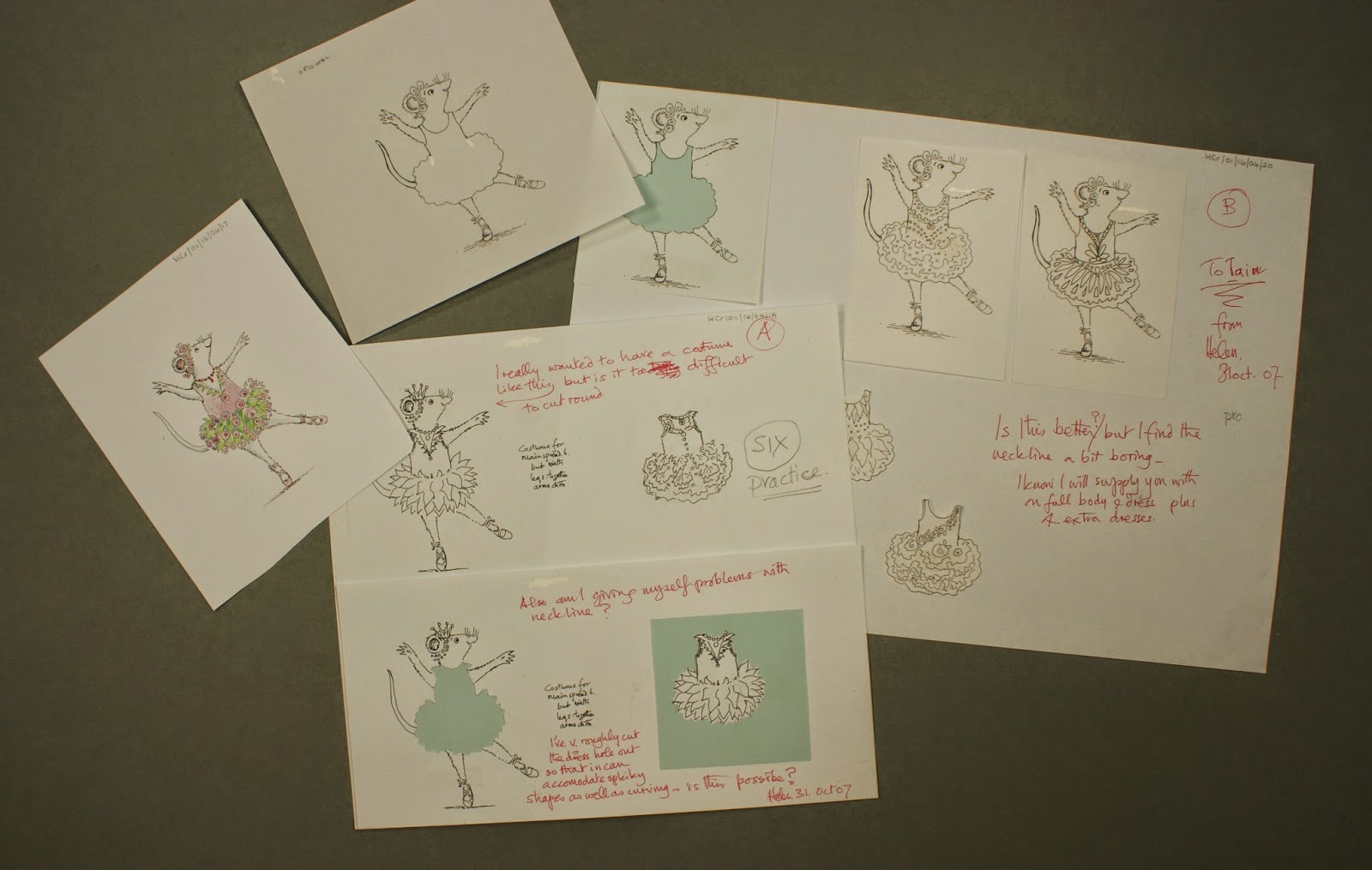

Preliminary drawings for Angelina Ballerina’s Pop-up Dancing School (Puffin, 2007) ©  Helen Craig


The dummies seem to be a very important resource for this process. They make it understandable for the illustrator which areas can be seen at the end and which illustrations or added decorations are needed, so that at the end a wonderful pop-up book can be published.


Part of early dummy book of Angelina Ballerina’s Pop-up Dancing School (Puffin, 2007) 

Part of later dummy book of Angelina Ballerina’s Pop-up Dancing School (Puffin, 2007) 


The creation of pop-up books and bringing well-known characters into this new format demands a lot of creativity and knowledge. A successful pop-up-book that can offer something interesting and different to a traditional book is much more than a simple reuse of existing characters and illustrations. It can be an exciting new artwork. Pop-up books provide multifarious opportunities to create something special and new with already well-known characters and stories.


If you'd like to find out more about the Seven Stories Collection, the Helen Craig archive, or the pop-up (and other!) books we hold, then 
email: collections@sevenstories.org.uk or phone: 01914952707.

Monday, 23 June 2014

Dragons, Diaries and the Gruffalo, Seven Stories Touring in Summer 2014

Every year Seven Stories tour's our exhibitions all around the country. So far this year we have already shown exhibitions in Chatham Historic Dockyard in Kent and Leeds City Museum. In Summer 2014, Seven Stories is accessible to people all over the country by displaying exhibitions in Wolverhampton, Bradford and London.

Daydreams and Diaries, the Story of Jacqueline Wilson
V&A: Museum of Childhood from April 5th - 2nd November 2014


This very special exhibition, curated with the help of Jacqueline Wilson and Nick Sharratt themselves, showcases their well known books. Jacqueline is a trustee of the Museum of Childhood, so it was a particularly fantastic partnership to team up with the museum again. This is not the first time Seven Stories have sent exhibitions to the Museum of Childhood, both the 'Happy Birthday Miffy, a Celebration of the Work of Dick Bruna' and 'From the Tiger Who Came to Tea to Mog and Pink Rabbit, a Judith Kerr Exhibition' travelled here in previous years.

Visit the website here to find out more details.

A Vikings Guide to Deadly Dragons
Wolverhampton Art Gallery from June 14th - August 30th 2014


This is another venue that has enjoyed a Seven Stories exhibition before, also hosting the Judith Kerr Exhibition over the Summer of 2012. A beautiful venue set right in the heart of Wolverhampton, there have been plenty of marauding new Vikings visiting the exhibition already!

Visit the website here to find out more details.

A Squash and a Squeeze, Sharing Stories with Julia Donaldson
Cartwright Hall, Bradford June 28th - November 2014


This venue is brand new to the Seven Stories touring programme. Set in the gorgeous Lister Park, north of Bradford and south of Saltaire, this gallery is a complete day out for all visitors with young families. Opening next Saturday and running until November, this is your last chance to see the Gruffalo and the Julia Donaldson Exhibition before the end of the tour.

Visit the website here to find out more details.

Keep an eye on the Seven Stories website here for more details on upcoming tours.