Showing posts with label Robert Westall. Show all posts

Wednesday, 7 October 2015

Robert Westall’s North East


Last month marked the 40th anniversary of the publication of The Machine Gunners and today would have been Robert Westall's 86th birthday.  To commemorate the occasion we thought we'd share a post from one of our volunteers.  Grace created a brilliant online resource for the Westall Collections which explores his connection to the North East. 

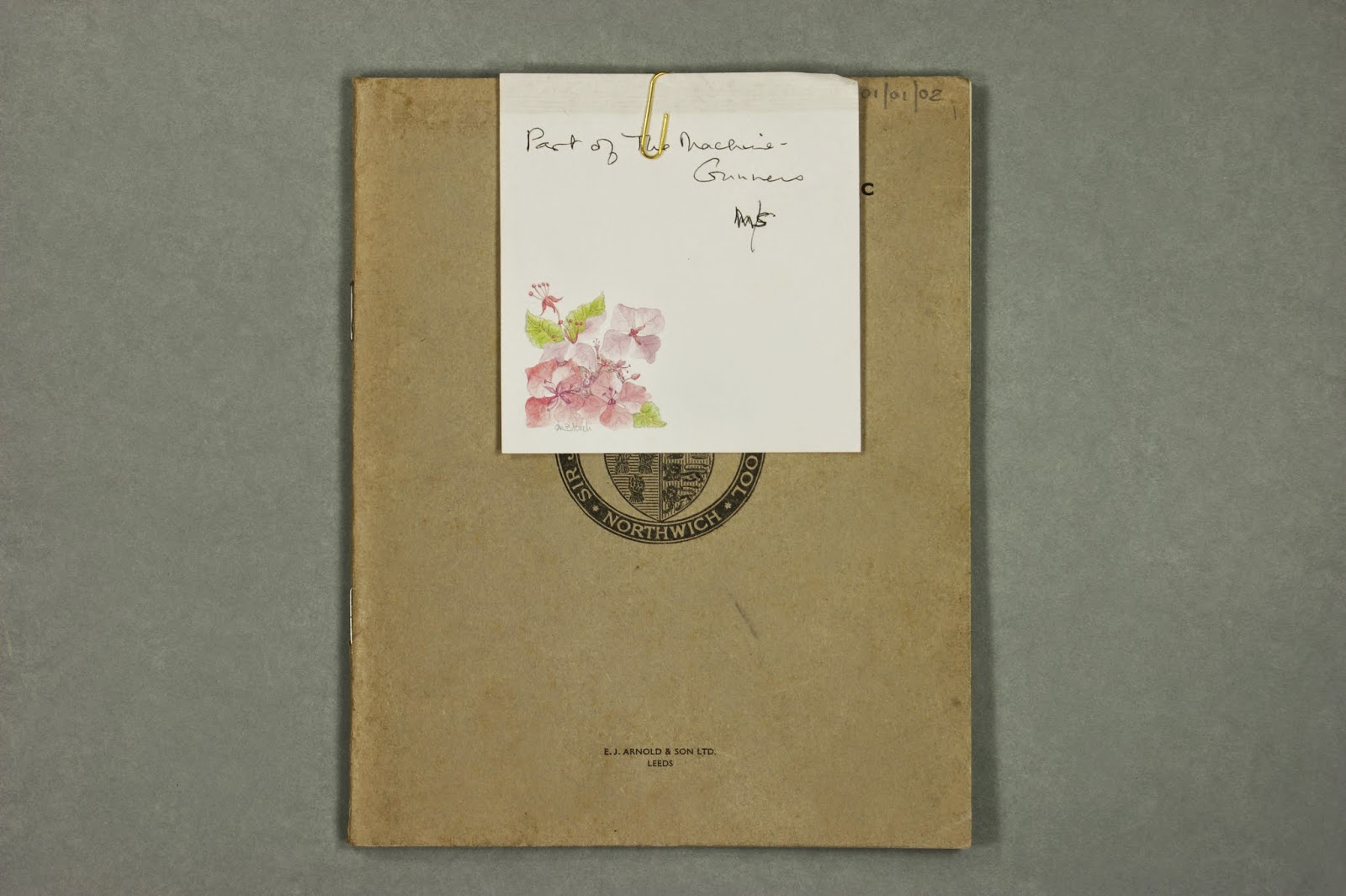
The first page of the first draft of Robert Westall's The Machine Gunners. Published 40 years ago, Westall won the 1975 Carnegie Prize for Machine Gunners.
I have been uncovering Robert Westall’s intriguing archive for a project with Newcastle University. This project’s aim was to highlight the archive and make it even more accessible through a digital platform. Each member of the project simply had to pick an archive to publish online. As a student at Newcastle University studying an MLitt specialising in children’s literature, as well as a volunteer at Seven Stories archives, I knew where I would look for material…

I chose to work with Robert Westall’s archive, the first archive to call Seven Stories home, not only because visually it is very aesthetic (gorgeous handwriting, entertaining notes and doodles…) but because I felt his unpublished personal writing was, quite frankly, stunning. He wrote in large sketchbooks about his home county, Northumberland, in such an honest and poetic manner that I felt it was a resource worth making more accessible to the public. His children’s books often feature the North East, The Machine Gunners (1975) is set in Garmouth (a fictional town based upon Tyneside) and The Kingdom by the Sea (1990) follows a young boy as he travels up the coast too. In his published works the North East is a solid setting, it creates the backdrop to his dramatic tales and it defines the dialects of the characters. However, in his unpublished works, we see the North East as Westall saw it, with pride of place as the focus of his writing.

Westall wrote;

‘If you attempt to drive up the coast of Northumberland, something goes wrong after Seaton Sluice; twist and turn as you will, you get caught in a maze of spoil heaps, and roads cracked and patched after mining subsidence’.

He takes you on a journey through the seaside towns and villages, discussing the fishing traditions, the tourism trade and the mining past. His love of the North East is at times at odds with his sadness over the changes that are taking over and changing his childhood landscape.

Selection of notes about the North East of England in the Robert Westall Collection

I photographed the sketchbooks and created a website to display each page separately. If you click on one of the items, scroll past the item information, you can click on the selected page and zoom in on each one individually, reading every word he has written. Whilst it is not quite as fun as trooping to Newcastle and digging into the Seven Stories Archive yourself, it is not a bad way of accessing a quietly, fascinating collection. Westall recalls his childhood home, a landscape which despite causing him grief through the inevitable changes happening to the traditions of the communities, was also given a significant presence in children’s literature due to his work.


- Grace Owens


If you'd like to find out more about the Seven Stories Collection, then 
email: collections@sevenstories.org.uk or phone: 0191 495 2707 or comment on this blog.

Tuesday, 23 June 2015

Carnegie and Kate Greenaway Medal Winners

Yesterday the big announcement was made!  

The 2015 winner of the Kate Greenaway medal was William Grill for Shackleton’s Journey and this years Carnegie Medal went to Tanya Landman for Buffalo Soldier.  Over the past weeks our steering group have enjoyed reading and discussing all of the books shortlisted for the awards; here they are enjoying words, illustration, tea and biscuits.  

Carnegie and Kate Greenaway medal steering group at Seven Stories

To fill the gap in our reading lists, I thought it would be a great chance to delve into the Carnegie and Greenaway treasure chest to the show you some of the items in our collections that have won prizes in the past. Our book and archive collections at Seven Stories represent work by hundreds of authors and illustrators and among them are many Carnegie and Greenaway prize winners.

This is a very small selection, if you’d like to see some more, or you have a Carnegie and Greenaway favourite that isn’t featured, let us know!

The second ever Carnegie winner was Eve Garnett in 1937 with The Family from One End Street, which was quite ground-breaking for its portrayal of a working class family.  It may not be considered anything revolutionary today but in 1937, children’s literature was dominated by middle-class children.  We don’t hold any original material but we do have multiple editions in our book collections.  

Eve Garnett's Family from One End Street (Puffin Books, 1945)

In 1961 Antony Maitland won the Kate Greenaway prize for his portrayal of Mrs Cockle’s Cat.  This image only demonstrates a small amount of material that we hold in our Antony Maitland Collection; we have the whole dummy book, original illustrations and a draft of the cover for Mrs Cockle’s Cat.  We also hold artwork from his other books.

Original artwork for Mrs Cockle's Cat, Anthony Maitland c. 1961 ©Anthony Maitland 


Seven Stories Visitor centre is based in Ouseburn Valley in Newcastle and our Collections are held at our Gateshead office so, this next winner is close to home.  Set in the fictional Garmouth, quite like our own Tynemouth, is Robert Westall’s 1975 Carnegie winner The Machine Gunners.  Westall wrote his draft for The Machine Gunners by hand in notebooks. Six years later Robert won the Carnegie again for The Scarecrows. We hold a selection of original work within our Robert Westall collection which includes material from the majority of his published books. Alongside the archive we also have an extensive Westall book collection, which includes some interesting translations.   
Draft of Machine Gunners, Robert Westall c. 1975 © Robert Westall Estate

Peter Dickinson also won the Carnegie prize two years running. Tulku won in 1979.  Here is an early, incomplete typescript manuscript which is a possible first draft of Tulku.  There is also preliminary material for City of Gold in our archive, which was Peter’s Dickinson’s second book to win the Carnegie in 1980.  City of Gold was illustrated by Michael Forman whose work you can see in our upcoming exhibition. 

Typescript draft of Tulku, Peter Dickinson c. 1978 © Peter Dickinson 


There are very few authors who have won the Carnegie prize more than once, Berlie Doherty is another.  Her first prize was for Granny was a Buffer Girl in 1986 and the second for Dear Nobody in 1991.  Berlie's books can be found in a number of our book collections and our archive collection includes material from her published books, story books and radio broadcasts. The original material for Granny was a Buffer Girl includes these drafts and photographs which we think were used for inspiration. 

Drafts and photographs for Granny was a Buffer Girl c. 1984 © Berlie Doherty


Anthony Browne won the Kate Greenaway in 1992 with Zoo, at Seven Stories we hold one preliminary sketch from the book which shows the zoo visitors looking into the orang-utan’s cage.  We also have a preliminary sketch from Gorilla which won Browne his first Kate Greenaway prize in 1983.

Original Illustration for Zoo c. 1992  © Anthony Browne

A lot of Philip Pullman’s collection is digital but this is a typescript draft from the 1995 Carnegie winner His Dark Materials: Northern Lights.  Some of my favourite items in our collections are Philip Pullman’s handwritten notes and drafts which show his doodling and thought process. Philip’s name is very popular, particularly within our ex-library book collections, it’s great to see how the artwork for ‘His Dark Materials’ developed over time into what is the very recognisable Philip Pullman cover. 

Typescript draft for His Dark Materials: Northern Lights c. 1995 © Philip Pullman 

Emily Gravett’s Little Mouse’s Big Book of Fears won the Greenaway prize in 2008.  In our collection we have some original artwork of mice, these drawings were used to create the final artwork digitally.  The drawings were scanned and then digitally positioned into the relevant spreads like a collage.  

Original artwork for Little Mouse's Big Book of Fears c. 2007 © Emily Gravett


Come along to Seven Stories Visitor Centre after our grand reopening in August and you may be able to spot some of Emily’s mice in our Rhyme Around the World exhibition or...If you'd like to find out more about the Seven Stories Collection, then email: collections@sevenstories.org.uk or phone: 0191 495 2707 or comment on this blog.


Tuesday, 19 August 2014

Robert Westall: a Writer and His World Exhibition at Weaver Hall Museum, Cheshire

In 2013, Tom Hughes of Weaver Hall Museum in Cheshire got in touch with Seven Stories about a possible loan of work by Robert Westall. The exhibition explore's Westall's connections with the area local to the museum, and on show are a number of items from the Seven Stories collection never before displayed.

Robert Westall, as well as being a fantastically well loved children's author, was also incredibly active in his local community, working as a head teacher for a number of years, writing a column for the local paper, as well as being instrumental in the saving of historic parts of Northwich. Weaver Hall Museum is one of the buildings Westall helped save, and it is only apt that he is recognised in this special exhibition.

This is an article about saving Weaver Hall, written and illustrated by Robert Westall, c. 1967 and saved in an educational book on town planning he was working on. It was part of a campaign to save the Hall from being demolished.
Tom, curator of the exhibition, is incredibly knowledgeable about Robert Westall, and added some fascinating local details to parts of the collection. Although Westall is known for many of his books set in the North East, he lived much of his life in Cheshire.

Self portrait by Robert Westall. Although not known for illustrating children's books, the Seven Stories Collection shows the impressive graphic posters he made for school plays, personal sketches and illustrations for articles in the local newspaper.
The exhibition has been on display since 12th April, and is on display until Sunday 14th September at Weaver Hall Museum in Cheshire. Click here for more details about visiting the museum.

Watch this space for more details of Seven Stories loans, we are currently working with the Granary Gallery in Berwick on a display linked to the new Berwick Book Festival. Works have been chosen from the Seven Stories Collection to display alongside illustrators from the area, including Mick Manning & Brita Granstrom, Helen Stephens, Gerry Turley, and Cara Lockhart Smith.

Wednesday, 28 May 2014

Moving Stories in the archive: 'The Machine Gunners' and the BBC

In this special blog post to coincide with our current exhibition Moving Stories: Children's Books from Page to Screen, we look at another children's book featured in our collection that has been adapted for the screen, Robert Westall's The Machine Gunners.

First published in 1975, The Machine Gunners was Robert Westall’s very first novel. The story follows a group of north east school children during the Second World War who manage to take the machine gun from a crashed German aircraft. Originally written for Westall’s son, Christopher (who later died in a tragic motorcycle accident), the book draws heavily upon Westall's own childhood on the north east coast (the book is set in fictional 'Garmouth', largely based on Tynemouth where Westall spent the war as a boy). Upon its release, The Machine Gunners was critically acclaimed and brought Westall the first of his two Carnegie Awards. The novel is still a much-loved classic and in 2007 made the list of top ten all time Carnegie winners.


One of the notebooks in which Robert Westall wrote his manuscript for The Machine Gunners,
from the collection here at Seven Stories


In 1981, six years after the book's publication the production rights were bought by the BBC. Television drama made for children and young people was becoming increasingly popular at this time (Grange Hill had only just made its first appearance three years earlier in 1978) and television companies were eager for stories that had potential for serialisation. The much-loved and critically acclaimed, The Machine Gunners, presented an ideal opportunity for the BBC and they set out to secure the rights for a six part drama.


Letters from the BBC to Robert Westall about The Machine Gunners,
from the Robert Westall collection here at Seven Stories


The first episode aired on 23 February 1983. The script was written by another well-known writer originally from the north east, William Corlett - who, as well as being a script writer and playwright, produced a number of successful novels for children and adults. The series director was Colin Cant, a specialist in children's drama who, as well as serving for many years on Grange Hill, went on to direct other children's book adaptations including Moondial (by Helen Cresswell) and The Children of Green Knowe (by Lucy M. Boston).

The series was well received by audiences and is even now fondly remembered by many. Of the adaptation Robert Westall himself wrote:

"I quite approve of the TV serial made from 'The Machine Gunners'.   The script writer was William Corlett, who also writes children's novels.   He loved the book very much – perhaps too much, for he could not bear to leave many incidents out, and at times (as in the Mrs. Spalding incident with her knickers), things got a little rushed and blurred.   The fault lies with the BBC producers, who did not allow more than six episodes.   It takes about ten episodes to do justice even to a children's book, and they just don't seem to have the nerve to allow this many episodes."

('About 'The Machine Gunners'', http://www.robertwestall.com/the_machine_gunners_by_robert_westall.html)


Another of the notebooks in which Robert Westall wrote his manuscript for The Machine Gunners,
from the collection here at Seven Stories

In 2002, The Machine Gunners was again adapted by the BBC but this time for radio. The story has also appeared on stage - in 2011 a stage version was performed at Polka Theatre in London, commissioned by the Imperial War Museum.


The Robert Westall collection is available to consult by appointment at Seven Stories Collections Department. If you'd like to find out more about this collection or others that we hold you can
email: collections@sevenstories.org.uk or phone: 01914952707.

Material from the Seven Stories archive is currently on display at  an exhibition looking at the work of Robert Westall at the Friends of Weaver Hall Museum in Northwich, Cheshire: http://www.fowhm.org.uk/events/exhibition-robert-westall-a-writer-and-his-world/ 

If you'd like to find out more about other children's books adapted for the screen then why not visit our exhibition Moving Stories: Children's Books from Page to Screen at the Seven Stories visitor centre, Newcastle upon Tyne, until April 2015