
This month's mode of transport isn't technically a mode of transport but it does get people to where they need to be. Walking is a very prominent feature in Beverley Naidoo's Journey to Jo’burg, a story that delivers a subtle and powerful message about apartheid South
Africa.
The story is about two children, Naledi and Tiro, who are frightened that their sick baby sister, Dineo, might die. They need their Mma’s help to get Dineo to a hospital but Mma works and lives far away in Johannesburg. To get there Naledi and Tiro begin a 300 kilometre journey. Of course, the children don't walk the entire distance but, the journey is long and one where they begin to realise the impact and injustice of apartheid law.
In a country with a history of Pass Laws – which required black South Africans to carry passes to regulate and control movement – this action of walking to Johannesburg is very significant. Out of an innocent desire to find their Mma the children embark on a journey that is politically dangerous. The book encourages child readers to discover for themselves the wrongs and injustice of apartheid. Naidoo doesn't explain the issues of South Africa but portrays them in a way that encourages us to ask questions. Why does Mma live far away from her children? Why can't they just take Dineo to hospital? Why do the children avoid the police in Johannesburg, aren't police there to help? Why can't Mma help them straight away? These questions alone make the differences between Tiro, Naledi and Naidoo's young British readers striking. These two young innocent children, who just want their Mma, become political beings. It then seems unsurprising that Journey to Jo'burg was banned in South Africa until 1991:
You may remember that we received Beverley Naidoo's collection early last year and almost as soon as it was unpacked and listed we took some of the Journey to Jo’burg files to a school in County Durham – you can read about the resulting event here.
This summer we took a much smaller selection of Journey to Jo'burg material to our Team Creative summer school attendees; this time we only used a selection of Naidoo's research and her drafts. It was a great reminder of how moving the story can be with one of Team Creative explaining to us that the session left him feeling sad and angry that people aren't treated equally.
Research material from Journey to Jo’burg includes newspaper clippings, notes on plot and language, British children's perceptions of South Africa and correspondence. This material demonstrates just how meticulous Naidoo is in getting her stories and their message just right.
The file of research is like a snippet from time; it shows us what Naidoo, and indeed what the rest of Britain, were reading in the papers and what people were writing and thinking about South Africa at the time. Printed at the beginning of the book are two newspaper articles which draw Naidoo's fiction into reality. These newspaper reports are very similar to the story of Tiro and Naledi - they are the seed of truth from which her fiction grows. Her fictional characters almost share the same space as these real newspaper stories. It presents a very interesting interweaving of real vs. unreal which has its roots in all of this research material. Journey to Jo'burg is a good story but most of all it is informative. Regarding her own experiences Naidoo has written:
The associations from school children, a small selection of which you can see in the above photograph, are a very interesting way to look at perceptions of South Africa. Many paint a picture of South Africa as a sunny place with awesome animals but, many also refer to racism and/or to a division of people. What Naidoo did with Journey to Jo'burg was to make the reality of apartheid South Africa accessible to a younger audience, and it is sadly a story with persevering relevance.
The story is about two children, Naledi and Tiro, who are frightened that their sick baby sister, Dineo, might die. They need their Mma’s help to get Dineo to a hospital but Mma works and lives far away in Johannesburg. To get there Naledi and Tiro begin a 300 kilometre journey. Of course, the children don't walk the entire distance but, the journey is long and one where they begin to realise the impact and injustice of apartheid law.
 |
| Notes by Beverley Naidoo for Journey to Jo'burg which outlines the exact journey Tiro and Naledi take to find their mother. In the first edition of Journey to Joburg (Longman, 1985) there is a map of the journey. According to Google maps it would take over 60 hours on foot! BN/01/01/01/27 Photograph © Seven Stories – The National Centre for Children’s Books. |
In a country with a history of Pass Laws – which required black South Africans to carry passes to regulate and control movement – this action of walking to Johannesburg is very significant. Out of an innocent desire to find their Mma the children embark on a journey that is politically dangerous. The book encourages child readers to discover for themselves the wrongs and injustice of apartheid. Naidoo doesn't explain the issues of South Africa but portrays them in a way that encourages us to ask questions. Why does Mma live far away from her children? Why can't they just take Dineo to hospital? Why do the children avoid the police in Johannesburg, aren't police there to help? Why can't Mma help them straight away? These questions alone make the differences between Tiro, Naledi and Naidoo's young British readers striking. These two young innocent children, who just want their Mma, become political beings. It then seems unsurprising that Journey to Jo'burg was banned in South Africa until 1991:
Thousands of children were reading the book around the world but the apartheid government refused to let South African children read it until 1991, the year after Nelson Mandela was released from jail. Today, it’s not just a story from the past. It’s a universal story where two children, faced with great injustice, do something very brave as they try to save their little sister (quote from Beverley Naidoo, http://www.beverleynaidoo.com/)
 |
| This is the notice sent to Beverley's sister-in-law from the Doeane en Aksyns Customs and Excise to inform of the seizure of prohibited material. Journey to Jo'burg was considered an 'undesirable' import and was seized when Naidoo sent copies of the book to South Africa. BN/01/01/08/03 Photograph © Seven Stories – The National Centre for Children’s Books. |
You may remember that we received Beverley Naidoo's collection early last year and almost as soon as it was unpacked and listed we took some of the Journey to Jo’burg files to a school in County Durham – you can read about the resulting event here.
 |
| Beverley Naidoo and local school children for a Journey to Jo'burg event. |
This summer we took a much smaller selection of Journey to Jo'burg material to our Team Creative summer school attendees; this time we only used a selection of Naidoo's research and her drafts. It was a great reminder of how moving the story can be with one of Team Creative explaining to us that the session left him feeling sad and angry that people aren't treated equally.
Research material from Journey to Jo’burg includes newspaper clippings, notes on plot and language, British children's perceptions of South Africa and correspondence. This material demonstrates just how meticulous Naidoo is in getting her stories and their message just right.
 |
| Newspaper articles from Beverley's collection with a copy of Journey to Jo'burg which includes two real newspaper articles at the beginning of the story. BN/01/01/08/03 Photograph © Seven Stories – The National Centre for Children’s Books. |
The file of research is like a snippet from time; it shows us what Naidoo, and indeed what the rest of Britain, were reading in the papers and what people were writing and thinking about South Africa at the time. Printed at the beginning of the book are two newspaper articles which draw Naidoo's fiction into reality. These newspaper reports are very similar to the story of Tiro and Naledi - they are the seed of truth from which her fiction grows. Her fictional characters almost share the same space as these real newspaper stories. It presents a very interesting interweaving of real vs. unreal which has its roots in all of this research material. Journey to Jo'burg is a good story but most of all it is informative. Regarding her own experiences Naidoo has written:
"...I became very angry at all the injustice around me - and how I was part of it. I had been brought up with blinkers. Later, when I began to write, I wanted to write stories that would challenge narrow ways of seeing." (http://www.beverleynaidoo.com/faqs.htm)
 |
| Children's perceptions of South Africa. Photography © Seven Stories – The National Centre for Children’s Books |
The associations from school children, a small selection of which you can see in the above photograph, are a very interesting way to look at perceptions of South Africa. Many paint a picture of South Africa as a sunny place with awesome animals but, many also refer to racism and/or to a division of people. What Naidoo did with Journey to Jo'burg was to make the reality of apartheid South Africa accessible to a younger audience, and it is sadly a story with persevering relevance.
 |
| The first draft of Journey to Jo'burg which is untitled and heavily annotated (BN/01/01/02). Photography by Damien Wooten © Seven Stories – The National Centre for Children’s Books |
There are eight full drafts of Journey to Jo'burg in our collection. Most of these drafts include extensive annotation, changes and significant developments which give us insight into how Naidoo works as an author. We may say it a lot on this blog, but everybody has a different approach to writing and Beverley Naidoo's collection is so rich with development work - there are post it notes, letters from her many proof readers and lots and lots of draft material.
The draft material also gives us an interesting insight into Beverley's intentions and some of the choices she made whilst drafting. In the image below the post it note reads:
'Essential that in the extract the strength of the black characters is revealed otherwise one just exposes pain' (BN/01/01/02/04/01)
 |
| A subsequent draft of Journey to Jo'burg (then titled HELP! A South African Story) however, this is a full draft of the story, the earlier draft is in bullet-point form. This draft is also annotated. Photography by Damien Wooten © Seven Stories – The National Centre for Children’s Books |
Naidoo's fictional books are built on a foundations of experience and research. In addition to the research files that complement each of her typescript novels we also have material for her non-fiction work. Her first published work 'Censoring Reality' analysed the image of South Africa being presented to school children in the 1980s. Naidoo found misleading portrayals of South Africa, racist perceptions and a very limited, one sided view of a country under apartheid law. The files we hold for 'Censoring Reality' demonstrate Niadoo's active stance against biased literature for children, working towards an informed portrayal of world issues and equality. These principles form the basis of Beverley's fictional writing.
Naidoo's later study, 'Through Whose Eyes', aimed to address racist issues and perceptions in books for young people through dramatic workshops. Naidoo's interest in education is a thread that can be easily followed through her collection. We have files of material relating to educational workshops and educational resources. Through letters, resources and school feedback we can see how Journey to Jo'burg (and many of Naidoo's other books) was used from its publication in 1985 to today. It shows priorities in teaching and how issues of racism, diversity and multiculturalism have been addressed over almost four decades.
There are also boxes and boxes of fan mail.
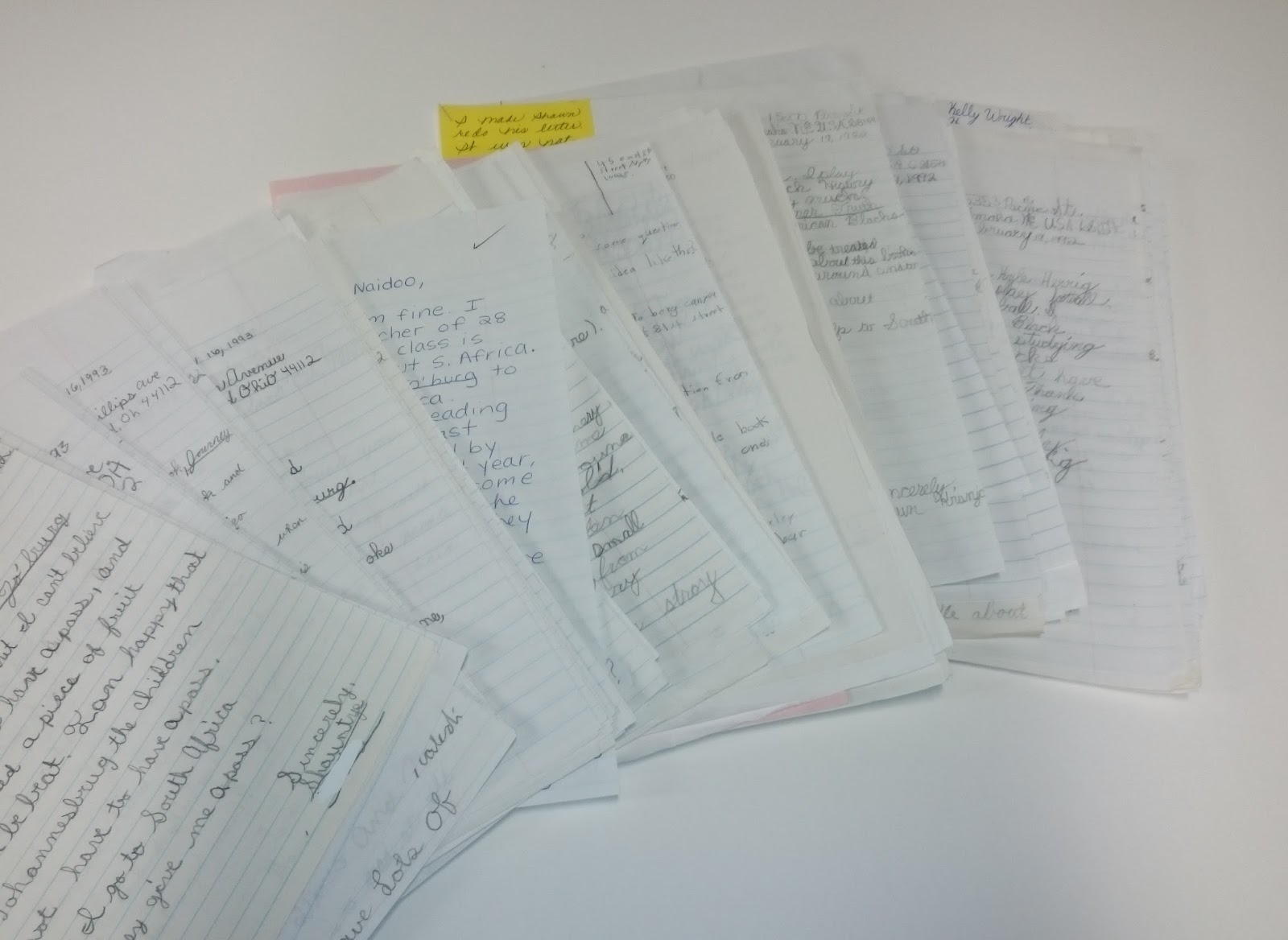 |
| Letters from American children to Beverley about Journey to Jo'burg (BN/12/02/01/03) © Seven Stories – The National Centre for Children’s Books |
Fan mail is something that we would sometimes consider sampling (keeping only a representative selection of material), particularly when there is so much of it but Naidoo's fanmail, as well as being lovely to look at, is particularly interesting in terms of looking at social opinion and reaction to her work over the span of her career. Letters are sent from schools, individuals, children and adults from all over the world. According to Naidoo the 'Most exciting for me is when I feel my writing has really touched a nerve' (http://www.beverleynaidoo.com/faqs.htm).
In some cases its clear where Naidoo's fiction has changed and challenged opinion.
From the first notes to the last batch of fan letters it has been a long journey for Naledi and Tiro. It has been a political journey, a one of social history and opinion, and hopefully a step towards a more equal world.
Journey to Jo’burg is only one novel in a list of many. Naidoo's collection covers a large proportion of her career and includes her PhD thesis, novels, short stories, picture books, professional and personal correspondence. There is a vast amount of information with a great potential for research and learning projects - if you have any questions about the collection
 |
| Our many editions of Journey to Jo'burg including translated versions© Seven Stories – The National Centre for Children’s Books |
Journey to Jo’burg is only one novel in a list of many. Naidoo's collection covers a large proportion of her career and includes her PhD thesis, novels, short stories, picture books, professional and personal correspondence. There is a vast amount of information with a great potential for research and learning projects - if you have any questions about the collection
email: collections@sevenstories.org.uk or phone: 0191 495 2707 or comment on this blog.
Seven Stories was able to support the acquisition of the Beverley Naidoo collection through support from a Heritage Lottery Fund ‘Collecting Cultures’ grant. This has been awarded to Seven Stories in recognition of the museum’s national role in telling a comprehensive story of modern British children’s literature. For more information on our HLF Collecting Cultures project see: http://www.sevenstories.org.uk/news/latestnews/hlf.

Seven Stories was able to support the acquisition of the Beverley Naidoo collection through support from a Heritage Lottery Fund ‘Collecting Cultures’ grant. This has been awarded to Seven Stories in recognition of the museum’s national role in telling a comprehensive story of modern British children’s literature. For more information on our HLF Collecting Cultures project see: http://www.sevenstories.org.uk/news/latestnews/hlf.


