Monday, 16 June 2014

Looking at radical children's literature, no. 2: 'The Magic of Coal'

Our second post on radical children’s literature looks at the Puffin picturebook, The Magic of Coal (1945). The first books ever produced under the Puffin imprint, the Puffin picture book series began at the beginning of the Second World War with War on Land (immediately followed by War at Sea and War in the Air). The series was devised by Noel Carrington – then editor of Country Life – who approached the founder of Penguin books, Allen Lane, with the idea in 1939.  An educational and mostly non-fiction series, the Puffin picture books were largely inspired by Soviet mass-produced educational books for children. This Soviet inspiration is clearly apparent in The Magic of Coal – the 49th book in the Puffin series. Here Newcastle University English students, Lucy Campbell Woodward and Clara Heathcock look at the Soviet inspiration behind The Magic of Coal and the book’s Socialist message.


Cover from The Magic of Coal (© Penguin Books)


The Magic of Coal as a ‘production book’ (Clara Heathcock):

"Following the 1917 Bolshevik revolution, soviet Russia identified the field of children’s literature as a highly charged political milieu in which the potential lay to educate the populace about communist ideology. The production book genre developed as an attempt to do just this.

Production books detailed the production process of economically essential resources such as coal or steel. Emphasis was placed on the difference between the capitalist and communist machinery used to create these resources; where capitalist machinery was shown to feed greed and overproduction, communist machinery provided a helping hand in creating a prosperous future everyone could enjoy. Thus production books clearly directed the child reader’s attention to a wider political narrative beyond the specificities of the text.

Production books were aesthetically modernist, combining ideas from abstract painting with typography to create a visual language strikingly different from what had gone before. Pictures held a machine-like appearance, using straight lines and elementary forms. By championing newness, it was conveyed to the child reader that they had the potential to be aesthetically innovative. Rather than simply encouraging them to learn to copy what was already seen as beautiful, aesthetic modernism puts more at stake for the child; if whatever they create has the potential to be considered beautiful, there is more incentive for them to attempt to create. Similarly, if a transformed communist society is shown to be a plausible alternative to today’s society, there is a greater incentive for the child to become an activist to help bring this society about. 

The Magic of Coal was published in Great Britain in 1945 and contains all of the features of a production book here discussed. Reference is made to, ‘our gas works’ and ‘our community, implying collective ownership, and all images are aesthetically modernist. Thus it is an example of the attempts of a popular front of left-wing publishers to bring the production book genre and its associated radicalism to Britain in the interwar period."


Internal spread from The Magic of Coal (© Penguin Books)


The Magic of Coal and Socialist ideology (Lucy Campbell-Woodward):

"The Magic of Coal introduces readers to the admirably technical and industrious world of coal mining. Taking the child on a journey, it tells not only of the production of coal but also elevates the miner as an important and  respectable member of society. In doing so, the text and its illustrations point towards a political goal.

The text focusses on the production process rather than around any one character. Each role within the mine is shown through illustrations and accompanying text, implying that there is something for everybody. Every individual has a skill set to offer in the production of coal and is a valuable cog in the machinery of the mine. A sense of a community at work is created and when combined with impressionist illustrations of tiny black figures and miners whose faces are blurred or have their backs to the reader, this sense of community solidifies into the socialist theory of collectivism.

The text informs the reader that the miners can attend the ‘pitbaths’ before or after work, challenging class boundaries as it suggests that before he enters the mine, a working-class man looks like, and therefore is like, any other man going about any other business. The text also tells us of the miner’s life outside of work, mentioning societies, theatre visits and higher education, indicating that the miners are not only important members of coal-fueled, modern society, but also respectable citizens with good standards of living and a thirst for culture.

The Magic of Coal presents the world of the working-class man as being not only respectable but also desirable. It implies that coal mining is important to a progressive society, thus the miners are as important as the ‘treasure’ they dig up. For many middle-class children this would have been a radically different literary theme in itself, however its advocation of  left-wing ideology further bolsters The Magic of Coal’s radical message."


Internal spread from The Magic of Coal (© Penguin Books)


Seven Stories Collections Department has a large collection of original Puffin picturebooks (including The Magic of Coal) as well as other Puffin-related material such as the Kaye Webb archive. If you'd like to find out more about these collections or others that we hold you can
email: collections@sevenstories.org.uk or phone: 01914952707.

Tuesday, 10 June 2014

All about pop-up books! (1 of 2)

In the first of our series on pop-up books, our guest blogger Lena Kleine Bornhorst, browses through the Seven Stories book collection and looks at some of the milestones in the history of moveable books:

On the bookshelves in the Seven Stories Collection Department you can find lots of copies of a very special kind of book: pop-up books. These books – full of surprises and wonderful 3D elements – are worth having a closer look at. Pop-up books have a very long tradition and had their beginning in the area of ‘toy books’ – also called ‘movable books’. All of them have special interactive functions or attributes, which make them different to a traditional book. The first known toy books date from the thirteen century. Rotating discs were included for example in mathematics books, where they were used for changing a maths formula when the disc was turned.

The years 1880 – 1910 were seen as the first enormous height of toy books. One of the big names in the field at this time was the British publisher and printer, Ernest Nister, who used different interactive elements in his books. The Seven Stories Collection holds reproductions of some of his titles. For example, his book Revolving Pictures, which was originally published in 1892. When you revolve the tabs around the illustration in this book, you can see a hidden picture appear.


Detail from Ernest Nister's Revolving Pictures (1892)


A significant person at this time, and an important figure in the development of paper-engineering books, was the German illustrator Lothar Meggendorfer. He used many different techniques in clever ways and published numerous books – for example Internationaler Circus (International Circus) in 1887. Meggendorfer's books were translated into many languages. His German Publisher house J.F. Schreiber Verlag exists today under the name Esslinger Verlag (http://www.esslinger-verlag.de/) and many of his great books have been reprinted. The Seven Stories Collection includes a copy of his title Das Puppenhaus (The doll’s house). Meggendorfer’s wide and lasting influence on the pop-up industry is demonstrated by the fact that the American Movable Book Society (http://www.movablebooksociety.org/) named their prize for outstanding paper engineering after him.


Cover of Lothar Meggendorfer's Das Puppenhaus (1889)


Internal spread from Lothar Meggendorfer's Das Puppenhaus (1889)


The first book with the definition ‘pop-up’ on the cover was already published in 1912. Very often, though, the beginnings of the term ‘pop-up’ is associated with Jack the Giant Killer, which was published by the New York publishing house Blue Ribbon in 1932. It became a big success and Blue Ribbon published other pop-up fairy tales which developed as a big seller.

The Blue Ribbon pop-up books were based on a British example. In 1929 publisher, S. Louis Giraud in his publisher house Strand Publications in London, produced the first book of his successful series Bookano Stories. The books contained five coloured double pages with 3D-elements, which Giraud called “pictures that spring up in model form”. The books were printed in a large run and became a big success. At the Seven Stories Collection you can find a copy of a later volume of the Bookano Stories from 1947.


Front cover of S. Louis Giraud's Bookano Stories no. 16 (1947)


Paper engineered Tower Bridge from S. Louis Giraud's Bookano Stories no. 16 (1947)


Blue Ribbon worked closely with Walt Disney to create pop-up books of Disney characters beginning in 1933 with four Micky Mouse pop-up books. A lot of Walt Disney-Pop-ups followed and the licenses were sold all over the world. There have been numerous Disney themed pop-up-books over the years.  At Seven Stories you can find for example a copy of Pocahontas – Meeko’s Busy Day from 1996 or The Aristocats from 1971 – made by (but not credited to) the internationally regarded pop-up artist Vojtěch Kubašta.

Internal spread from The Aristocats (1971)


Kubašta’s characteristic style is obvious throughout this book: the spine of the book is at the top rather than the left, the paper engineering-elements emerge at the left and right side of the book when you open the pages, and the pull-tabs are cleverly integrated. These characteristics can all be seen in The Aristocats as well as in his many other books. Kubašta produced over 70 titles and his particular style makes him another important person in the history of paper engineering.

In the middle of the 60s began the so-called second golden age of pop-up books.  In 1974 the American Waldo Hunt, set up the pop-up production company Intervisual Communications. Hunt produced also the pop-up book Haunted House by the British author and illustrator Jan Pieńkowski (paper engineering for this book was created by Tor Lokvig). In 1979 this became the first pop-up-book to win the Kate Greenaway Award – a very remarkable honour for a pop-up-book. A signed copy of this special book is available at the Seven Stories Collection Department.


The cover of Jan Pienkowski's Haunted House (1979)

Internal spread from Jan Pienkowski's Haunted House (1979)


Waldo Hunt also worked with some other great known paper engineers, like David Pelham, David A. Carter, and Robert Sabuda. Many of their books can be found in the Seven Stories Collection.

Beyond the well-known paper-engineers, many successful illustrators and authors, such as Anthony Browne and Maurice Sendak, have worked with paper engineers to make wonderful pop-up books. Animal Fair (2002) by Anthony Browne is available at the Seven Stories Collection Department and here you can see a short film about a conversation about Maurice Sendaks Mommy? http://vimeo.com/32596506, published 2006.


There have been a lot more exciting and creative pop-up-books over the last years and some very innovative paper engineers like Robert Crowther, Ron van der Meer (who specialises in pop-ups for adults), and the paper engineer Matthew Reinhardt.  But why not come along and explore all the wonderful books here yourself?


If you'd like to find out more about the Seven Stories Collection, the pop-up books we hold, or our extensive library of children's books and related literature, then 
email: collections@sevenstories.org.uk or phone: 01914952707.

Monday, 2 June 2014

Looking at radical children's literature, no. 1: Olive Dehn's 'Come In'

Earlier this year a group of undergraduate students studying at Newcastle University's English department visited Seven Stories to find inspiration for a project looking at radical children's literature. The students looked at a range of material from the collection including: material from the archive of the anarchist poet and children's writer, Olive Dehn; items from the collection of the prolific left-wing children's writer, Geoffrey Trease; and some of the very earliest Puffin picturebooks, inspired by Soviet educational books for children. We'll be posting extracts from some of the studies over the next two weeks.

The first of our posts looks at Come In (1946) written by Olive Dehn and illustrated by Kathleen Gell. Very obviously based on Dehn's own experiences (the name of the family in the book is even Markham - Dehn's own married name), Come In is the story of a day in the life of a suburban housewife. In its depiction of the dull and monotonous routine of the housewife (in contrast to her husband's exciting work as an actor), the book shares an explicitly feminist message and pokes fun at traditional family 'roles'. Here Newcastle students Isabel Ashton and Olivia Bland look at how the book challenges the traditional role of the housewife and the idea of the nuclear family.


Come In and the idea of the nuclear family (Isabel Ashton):

"Come In exposes the serious hard work that life as a housewife entails.  Dehn is urging her child readers to appreciate the difficulties that their own mothers face in daily life.  Come In lends a voice to women in society who were expected to fulfil their duties of domesticity and motherhood gladly and without complaint. Written and illustrated by two women, the book focuses on the home as a principally female domain, and Mr Markham is notably absent for most of the story.  His job as an actor is depicted as self-indulgent and frivolous in comparison to the stress of Mrs Markham’s day. Her endless list of menial tasks and the illustrations of her black and white outfit, complete with apron, infer that there is little differentiation between being a housewife and being a maid.  Dehn is creating an authentic representation of family roles by rebelling against the idealisation of the mother figure.

Come In criticises the “nuclear family” as an imposed ideal on society. Following the devastating effect of World War 2 on so many households, the institution of the family was promoted as more significant than ever. However, the Markhams undermine this romanticized image of the “nuclear family”, and Mrs Markham’s fallibility relieves the pressure that women were under to create a perfect home life.  Dehn’s radicalism is evident as she is unafraid to articulate ideas that other, more conventional writers would not. Come In reveals what really goes on behind closed doors in the apparently conformist family home."


Internal spread from Come In (illustrations © Kathleen Gell estate)


'The housewife speaks out’ (Olivia Bland):

"At the start of the book, after complaining about how dull her life is, Mrs Markham (the mother) is asked by her husband to write an account of her day, so that he ‘could read exactly how dull it was’; this she undertakes without objection. Throughout the day the reader bears witness to the unending list of chores and challenges that Mrs Markham undertakes. She is the cook, cleaner and nanny, and appropriately is illustrated to be wearing an apron, and the black and white of a maid’s outfit. The whole text is punctuated by illustrations of, and references to, clocks, drawn by an artist who is requested to portray the day’s events. These show how regulated Mrs Markham’s day is, implying a machine-like routine, though without the expected order of a mechanised environment. Kathleen Gell’s modernist images serve to complement Dehn’s words and add to the radical theme running through the book.


Final page from Come In (illustration © Kathleen Gell estate)


Whilst implying to the child reader that a deeper appreciation for their mother’s work is necessary, there is also a slightly satirical tone, which perhaps only the adult reader would detect. References such as: ‘it’s time somebody began to think about getting dinner ready’, seem to be a wink to the mother reader, as if to say, ‘I wonder who that might be?’ Being that this text was written and illustrated by two women, Dehn and Gell, this outlook is to be expected, thus making it all the more radical.

Dehn challenges the expectation that being a 1940s housewife was a happy and rewarding role, and encourages her readers, whether children or adults, to see that this job alone does not allow for a life of sufficient fulfilment. Although people were conscious that life in the typical suburban home was not necessarily as perfect as it seemed, Dehn’s perspective would have been considered controversial, as, unlike other writers for children, she expresses its realities, thus making this a particularly radical text."

Inscription by Olive Dehn in the cover of the copy of Come In at Seven Stories Collections Department


Olive Dehn's original manuscript of Come In at the Seven Stories archive


The Olive Dehn collection is available to consult by appointment at Seven Stories Collections Department. If you'd like to find out more about this collection or others that we hold you can
email: collections@sevenstories.org.uk or phone: 01914952707.

Wednesday, 28 May 2014

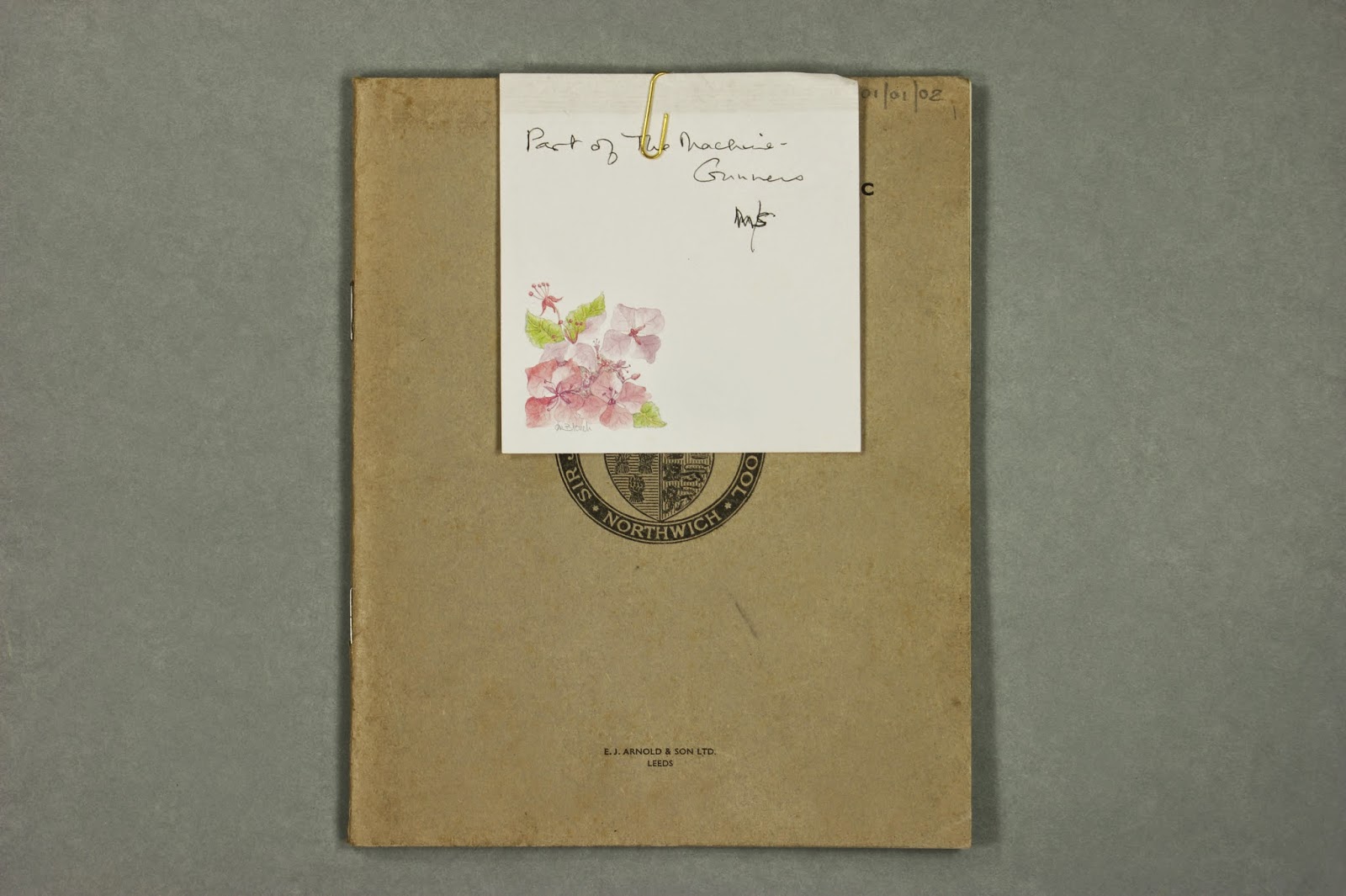
Moving Stories in the archive: 'The Machine Gunners' and the BBC

In this special blog post to coincide with our current exhibition Moving Stories: Children's Books from Page to Screen, we look at another children's book featured in our collection that has been adapted for the screen, Robert Westall's The Machine Gunners.

First published in 1975, The Machine Gunners was Robert Westall’s very first novel. The story follows a group of north east school children during the Second World War who manage to take the machine gun from a crashed German aircraft. Originally written for Westall’s son, Christopher (who later died in a tragic motorcycle accident), the book draws heavily upon Westall's own childhood on the north east coast (the book is set in fictional 'Garmouth', largely based on Tynemouth where Westall spent the war as a boy). Upon its release, The Machine Gunners was critically acclaimed and brought Westall the first of his two Carnegie Awards. The novel is still a much-loved classic and in 2007 made the list of top ten all time Carnegie winners.


One of the notebooks in which Robert Westall wrote his manuscript for The Machine Gunners,
from the collection here at Seven Stories


In 1981, six years after the book's publication the production rights were bought by the BBC. Television drama made for children and young people was becoming increasingly popular at this time (Grange Hill had only just made its first appearance three years earlier in 1978) and television companies were eager for stories that had potential for serialisation. The much-loved and critically acclaimed, The Machine Gunners, presented an ideal opportunity for the BBC and they set out to secure the rights for a six part drama.


Letters from the BBC to Robert Westall about The Machine Gunners,
from the Robert Westall collection here at Seven Stories


The first episode aired on 23 February 1983. The script was written by another well-known writer originally from the north east, William Corlett - who, as well as being a script writer and playwright, produced a number of successful novels for children and adults. The series director was Colin Cant, a specialist in children's drama who, as well as serving for many years on Grange Hill, went on to direct other children's book adaptations including Moondial (by Helen Cresswell) and The Children of Green Knowe (by Lucy M. Boston).

The series was well received by audiences and is even now fondly remembered by many. Of the adaptation Robert Westall himself wrote:

"I quite approve of the TV serial made from 'The Machine Gunners'.   The script writer was William Corlett, who also writes children's novels.   He loved the book very much – perhaps too much, for he could not bear to leave many incidents out, and at times (as in the Mrs. Spalding incident with her knickers), things got a little rushed and blurred.   The fault lies with the BBC producers, who did not allow more than six episodes.   It takes about ten episodes to do justice even to a children's book, and they just don't seem to have the nerve to allow this many episodes."

('About 'The Machine Gunners'', http://www.robertwestall.com/the_machine_gunners_by_robert_westall.html)


Another of the notebooks in which Robert Westall wrote his manuscript for The Machine Gunners,
from the collection here at Seven Stories

In 2002, The Machine Gunners was again adapted by the BBC but this time for radio. The story has also appeared on stage - in 2011 a stage version was performed at Polka Theatre in London, commissioned by the Imperial War Museum.


The Robert Westall collection is available to consult by appointment at Seven Stories Collections Department. If you'd like to find out more about this collection or others that we hold you can
email: collections@sevenstories.org.uk or phone: 01914952707.

Material from the Seven Stories archive is currently on display at  an exhibition looking at the work of Robert Westall at the Friends of Weaver Hall Museum in Northwich, Cheshire: http://www.fowhm.org.uk/events/exhibition-robert-westall-a-writer-and-his-world/ 

If you'd like to find out more about other children's books adapted for the screen then why not visit our exhibition Moving Stories: Children's Books from Page to Screen at the Seven Stories visitor centre, Newcastle upon Tyne, until April 2015


Friday, 16 May 2014

The 40th anniversary of 'The Trouble with Donovan Croft' - with guest contributor, Bernard Ashley

This month marks the 40th anniversary of The Trouble with Donovan Croft, a book that has remained a children’s classic ever since it was first published in 1974. Bernard Ashley’s first novel appeared at a time when children’s writers were increasingly creating books that challenged ideologies and addressed real issues affecting real children. Firmly in the vanguard of this movement, the novel is well known for addressing a number of big issues including racism, isolation and the challenges faced by foster families. Though the book has taught many children valuable lessons on the destructive impact of prejudice, it is the brilliantly accurate depiction of the key relationships that capture the imagination, particularly the wordless relationship between the selectively mute Donovan and his friend and foster brother, Keith.

The book won The Other Award (an alternative to the Carnegie medal) in 1976 and, since publication, has never been out of print. In 2005 Bernard chose Seven Stories as the home for his original manuscript, which gives a wonderful insight into the creative development of the book. In this special Seven Stories blog post Bernard Ashley talks to us about the real life inspiration for Donovan Croft, the challenges of finding a publisher, and of writing as a means of escape:


Author, Bernard Ashley (photo © Norman Smith)


'I started writing The Trouble with Donovan Croft a year or so after I took up the headship of a junior school in East London in 1971. The school was big and multi-cultural with a large percentage of its children described by the Home Office as ‘immigrants’ because their parents had come to Britain in the previous ten years. One such London-born boy gave us cause for concern: his mother had gone home to the West Indies on family business where she stayed longer than expected. There were no mobile phones, texts, and easy-to-make international calls in those days, and, despite letters from her and whatever his father said to him, the eleven-year-old fretted and seemed to think she was never coming back. He became depressed and shrank into himself.

At about the same time my wife Iris, an Infant teacher, told me of a six-year-old girl in her class who had stopped speaking to everyone: firstly to the adults at school, then to the children, and finally to her family at home.

Since the mid-sixties I had been writing for an educational publisher who published ‘readers’ I’d written for the ‘D’ stream children in my class, and two non-fiction ‘social science’ titles I’d researched for secondary schools. Now, in a difficult job which left neither time nor energy for research, I really needed to start writing again. I had discovered the truth of what Graham Greene says in Ways of Escape: ‘Writing is a form of therapy; sometimes I wonder how all those who do not write, compose, or paint can manage to escape the madness, the melancholia, the panic fear which is inherent in the human situation. Auden noted: “Man needs escape as he needs food and deep sleep.”’ Having a personal life outside work is essential, although for teachers it has become harder and harder in recent years. Perhaps I could write a piece of fiction without the need for research? I knew of two unusual situations no one had written about before. So I started on my first novel, with little planning except knowing there’d be a climax that hinged on whether or not elective mute Donovan could break his silence in a crisis.


A page from the original manuscript of The Trouble with Donovan Croft
by Bernard Ashley, here at Seven Stories


I wrote paragraphs in the car on Saturday mornings while waiting for one of my sons to run out onto a football pitch, and I made time some evenings, often merely revising my weekend efforts be swapping one word of phrase for another.

Although I based the start of my story on his situation, I didn’t write about my troubled eleven-year-old, nor about my wife’s silent pupil - but I did get the girl’s parents’ permission to write a story based on a child suffering from elective mutism. And of course, fired up, I had research to do after all.

As I finished each chapter I’d leave it on the pillow of my eldest son Chris – now also a children’s writer – whose enthusiasm spurred me on.

That was the time when the old quarto paper was being replaced by A4. With the book finished I went to a stationer in East Ham to buy a pack but he hadn’t any in stock; however, I was shown a special box of cream-woven, rounded-corner paper with reinforced binding edges. ‘It’s not quite your A4, sir, but it’s very close.’ And it had a very superior binder to go with it. So I bought it and typed up my story; but my wife, kissing the package for good luck as it went off to Oxford University Press, told me they’d probably reject the story but accept the binder. Which turned out to be halfway true. Having published the book OUP had an office clear-out when they moved from Ely House to Great Clarendon Street and they sent the manuscript back to me. Sans binder.


A page from the original manuscript of The Trouble with Donovan Croft
by Bernard Ashley, here at Seven Stories

The eleven-year-old boy in our school had by now gone on to secondary education, and I came very clean about my book with the staff and children, one of whom, Donovan Richards, willingly lent me his first name for the eponymous central character.

The book received generally good reviews. It was welcomed not only as one of the first school stories to be set in the state system – with which more readers could identify - but for having a black central character and a strong subtext against racism. Its paperback edition went on to win the ‘Other’ Award, an alternative to the Carnegie Medal, which was given annually for non-racist, non-sexist, non-classist children’s literature. And happily it has survived in print for forty years.

The Trouble with Donovan Croft started me on a serious writing career that I managed alongside my teaching, eschewing agents and insisting on long deadlines in order to enjoy my way of escape – writing books that would excite and entertain while giving some reassurance to children going through troubled times that they’re not the only ones. Like real-life Donovans. 
Within a few weeks of ‘Donovan’s’ fortieth anniversary in May my twenty-fourth novel will be published: The Shadow of the Zeppelin (Orchard), a story of the First World War. I’m halfway through my twenty-fifth, and I’ve planned the one after that. So I say thank you to Donovan, to OUP, and to the UK children’s books world for giving me my fruitful way of escape.'


Bernard Ashley's twenty-fourth novel, The Shadow of the Zeppelin (Orchard), is available to buy now. If you'd like to come and see the original manuscript of The Trouble with Donovan Croft or learn more about the Seven Stories Collection, email: collections@sevenstories.org.uk or phone: 01914952707.

Tuesday, 29 April 2014

Picturebook in Progress at Edinburgh College of Art

Last November a group of illustration students from Edinburgh College of Art visited the Seven Stories collections department and visitor centre as part of the Picturebook in Progress project.

The students viewed a range of archive material relating to how homes and families are represented in picturebooks, including work by Sarah Garland, Shirley Hughes and Kim Lewis, amongst others.

After returning to University, the students set to work on a brief to take a secondary character from one of the books they studied and illustrate a new home for them to inhabit. The project culminated in an exhibition of the new work that ran from 4 – 21 April at the College of Art.

There were some fantastically creative responses to the collection on display, including some surprising reinterpretations of classic picturebooks.

Yasmine Pirouz reworked Jan Ormerod’s Sunshine into a contemporary comic book, told from the point of view of a toy.


Laura Darling took a character from David Almond’s My Dad’s a Birdman and developed a new subplot in which he struggles to find a new job after the culmination of the book. In the ambiguous ending to her story, the character seems to be in the verge of a new life in the theatre.


After viewing artwork by Angela Barrett for The Snow Queen, Wenjin Lu took a minor character and imagined how their story might unfold.


Judith Kerr’s classic picturebook The Tiger Who Came To Tea has been interpreted in many ways. Maria Stoian’s version presents the tiger as a metaphor for depression, visiting the character of the mother unannounced.


As well as the illustrators featured here, other students took inspiration from work by Leila Berg, Helen Craig and Faith Jaques.

To see further examples of how the Seven Stories Collection has inspired illustration students, visit the Picturebook in Progress exhibition, on show at the Seven Stories visitor centre until June.

Wednesday, 2 April 2014

Gillian McClure Visits Seven Stories

Last week saw a visit to the Seven Stories Collections Department from author / illustrator Gillian McClure.

Gillian McClure at the Seven Stories Collections Department

Over the years Gillian has donated finished and preliminary artwork for many of her titles to the Seven Stories Collection, giving a comprehensive insight into her creative process, from first ideas through to finished artwork.
Her archive also displays a wonderful mastery of different media, including watercolour, acrylic and coloured glazes.

Gillian was visiting to be interviewed as part of the Picturebook in Progress project, with her insights to be used as part of a digital learning resource currently in development for aspiring illustrators.

One of the main topics of discussion was Gillian’s illustrations for Tog the Ribber, a uniquely scary and innovative picturebook written by her father Paul Coltman.

While discussing the origins of the book, Gillian surprised us all by revealing her early artwork for the first draft of the book which stands in complete contrast to the version which hit the shelves in 1985.


Artwork from the first draft of Tog the Ribber

The black and white crosshatching and colour wash give the first draft a completely different texture to the published artwork, while Gillian went onto explain that the final version’s wonderful depth came from constant experimentation with masking fluid and acrylic paint.

Most interestingly of all, the first draft lacks the outright nightmarish quality of the final artwork, Gillian herself admitting that she felt too protective towards the main character in this early version. A combination of allowing the skeletal character of Tog more prominence in the story and the introduction of page borders dividing safety and peril give the finished book a genuinely haunting quality.

Artwork from the first draft of Tog the Ribber

Final artwork for Tog the Ribber

Gillian has kindly donated the artwork for the first draft of Tog the Ribber to the Seven Stories Collection where it will sit alongside the final artwork, providing a deeper insight into an endlessly interesting book.

Learn more about Gillian McClure by visiting her website http://www.gillianmcclure.com and blog http://gillianmcclure.blogspot.co.uk


To book a visit to Seven Stories Collection department or learn more about the forthcoming Picturebook in Progress Digital Learning Resource, please contact collections@sevenstories.org.uk

Limited Copies of Tog the Ribber signed by Gillian McClure are available to buy in the Seven Stories Bookshop. Please email bookshop@sevenstories.org.uk or call 0191 261 2000 to order.