Thursday, 24 July 2014
Installing Angelina
Welcome to the Storylab Gallery and the exhibition 'Twists and Tails - The Story of Angelina Ballerina'. My name is Sarah McGlynn, and I'm the new Exhibitions Assistant, newest member of the Collections Team. I was excited to get started on the installation of this exhibition, we had been working on it since before I arrived in May and now the date had arrived.
For three days last week most of the Collections Team were involved in the hanging of this exhibition. On Monday, after dismantling and packing the Picturebook in Progress exhibition we then prepared the gallery by filling in holes and repainting the walls so that the space looked brand new again. Hanging exhibitions is best done methodically and the team worked closely according to our schedules, we did invite some extra helpers but they remained firmly seated on the sofa.
I spent Tuesday customising a large mirror and transforming it into what would hopefully become the centrepiece of every little mouse's experience of visiting the exhibition. Due to the delicate nature of the artwork, we have to keep light levels at 50 LUX; this meant that the photopoint, which has recently become a prerequisite for exhibitions, had to be placed well away from any original artworks. We decided to have the mirror as a central part of this area so that visitors could dress up, see themselves in the mirror and then have their photo taken in front of the Angelina wall graphics.
The original artwork and correspondence from Helen Craig and Katherine Holabird had been framed and was ready to be mirror plated before installation could take place. Whilst mirror plating, we were able to take the measurements of the frames and prepare to make the calculations required for hanging. The exhibition had been carefully curated in advance and the layout went according to plan, using some double hanging, there would be exactly the right amount of wallspace for the works chosen.
At the same time as we were hanging the artworks, Lindsey, the Seven Stories conservator, was carefully placing objects in the display cases on mounts specifically made from archival mount board.
Simultaneously the graphics both large and small were being sited and fixed to the walls. The original artwork is very beautiful, tiny and detailed so we used large graphics to complement the artwork and give Angelina a presence in the room from a distance.
With the addition of pink labels crediting the artwork, a sprinkling of pink stars, generous piles of Angelina picture books and drawing activities, a plain room had been transformed into a delightful space filled with gems of information and a truly wonderful place to spend time.
If you would like to visit the exhibition, it will be on display from Saturday 19th July until April 2015 at Seven Stories, National Centre for Children's Books. Click here to find out details about visiting the Centre.
If you'd like to find out more about the Helen Craig archive or would like to arrange a research visit to the Seven Stories Collection then
email: collections@sevenstories.org.uk, phone: 01914952707 or visit: http://www.sevenstories.org.uk/collection.
Interested in other posts about Storylab Gallery at Seven Stories? Click here or here.
Angelina Ballerina books are now published by Puffin Books and are available for sale from the Seven Stories Bookshop.
Thursday, 17 July 2014
The making of 'Twists and Tails - The Story of Angelina Ballerina'
When Helen Craig and Katharine Holabird donated their archives of work for the Angelina Ballerina series, the exhibition team wanted to put the material on display as quickly as possible. Not only does the archive represent one of the most popular children's series of the past thirty years, but the level of detail available from both sides of the page is wonderful.
Kris (Seven Stories Archivist) and I (Alison, Curator) identified three main themes visible in the archive and stories.
How to make an Angelina book
The first was 'How to make an Angelina book'. One of the most crucial parts of the archive, and Seven Stories mission, is to make visible the process of creating a book. This material gives us the chance to show the long development that goes in to creating each book; showing the involvement of not just author and illustrator, but editor too.
Kris and I worked through all the books represented in the collection, and chose Angelina and the Princess as the most visual example of this process. The second book in the series, published in 1984, it was written while the concepts behind Angelina and the world of Mouseland were still being developed. There is also a complete run of preparatory work, in which alterations to the story are clearly visible. What we found most intriguing was the evolution of the original story from Angelina performing for 'The Duchess of Mouseberry', to performing for the Princess. The material on display allows the viewer to track the changes made through the whole process.
To represent the illustration side, we chose to focus on one particular scene from the book - the double page spread of Angelina performing for the Princess. For this there were many rough illustrations created by Helen Craig, complete with notes to herself about composition. It is an interesting exercise to decipher which elements have changed between each draft, and work out which came first.
Angelina's Journey
The second theme most apparent in the archive is that of Angelina's journey, both within the books, but also from initial picture book to global star.
The archive holds the very first illustrations and manuscript created by Helen and Katharine. Although different to the final version, these show the very beginnings of Angelina, and are on display alongside each other. Showing Angelina's journey within the books led us to choosing some of our favourite Angelina moments, including when she is preparing to go to her first ballet lesson, performs for royalty, and when she meets her new baby sister for the first time. We also have on show an illustration from the (as yet unpublished) latest book in the series Angelina's Big City Ballet, of Angelina and her family arriving in the Big Cheese (aka New York).
We also follow Angelina's journey to international fame. The archive contains material from Katharine and Helen's initial and ongoing discussions with HiT entertainment, who hold the licence for the Angelina Ballerina brand. This correspondence often shows the frustrations of allowing other people to work on a character the creators care deeply about. There is also an opportunity to display material from the many different spin-off's, such as the English National Ballet adaptation, much of the merchandise produced over 30 years, and examples of the two television animations.
Mouseland
Probably the most fun we had was choosing content for this section. The world Angelina inhabits is called 'Mouseland', and comes set with certain rules. It was wonderful to explore this within the illustrations and Helen's rough work, uncovering hitherto unseen floorplans of Angelina's home, and choosing pieces which help to show the detailed world the mice inhabit.
If you would like to visit the exhibition, it will be on display from Saturday 19th July 2014 until April 2015, at Seven Stories, National Centre for Children's Books. Click here to find out more details about visiting the centre.
If you would like to book a visit to research the archives within our collection store, click here for further details.
Interested in other posts about the Storylab Gallery at Seven Stories? Click here or here.
Angelina Ballerina is now published by Puffin Books, and are available for sale from the Seven Stories bookshop, one of the largest independent children's bookshops in the UK.
Kris (Seven Stories Archivist) and I (Alison, Curator) identified three main themes visible in the archive and stories.
How to make an Angelina book
The first was 'How to make an Angelina book'. One of the most crucial parts of the archive, and Seven Stories mission, is to make visible the process of creating a book. This material gives us the chance to show the long development that goes in to creating each book; showing the involvement of not just author and illustrator, but editor too.
![]() |
| Section of draft for Angelina and the Princess, written by Katharine Holabird with comments from Helen Craig, c.1983 |
To represent the illustration side, we chose to focus on one particular scene from the book - the double page spread of Angelina performing for the Princess. For this there were many rough illustrations created by Helen Craig, complete with notes to herself about composition. It is an interesting exercise to decipher which elements have changed between each draft, and work out which came first.
![]() |
| Early rough for final double page spread by Helen Craig, for Angelina and the Princess, written by Katharine Holabird (Aurum Press, 1984) |
![]() |
| Colour rough for final double page spread by Helen Craig, for Angelina and the Princess, written by Katharine Holabird (Aurum Press, 1984) |
Angelina's Journey
The second theme most apparent in the archive is that of Angelina's journey, both within the books, but also from initial picture book to global star.
The archive holds the very first illustrations and manuscript created by Helen and Katharine. Although different to the final version, these show the very beginnings of Angelina, and are on display alongside each other. Showing Angelina's journey within the books led us to choosing some of our favourite Angelina moments, including when she is preparing to go to her first ballet lesson, performs for royalty, and when she meets her new baby sister for the first time. We also have on show an illustration from the (as yet unpublished) latest book in the series Angelina's Big City Ballet, of Angelina and her family arriving in the Big Cheese (aka New York).
![]() |
| Small section of the first draft, which later became Angelina Ballerina. Katharine Holabird, 1982. |
![]() |
| The set of stand up illustrations Helen Craig sent to Katharine Holabird, as her idea's for 'Primrose', c. 1982 |
![]() |
| A sample of some of the Angelina Ballerina merchandise, these were created in 2002 for HIT Entertainment |
Mouseland
Probably the most fun we had was choosing content for this section. The world Angelina inhabits is called 'Mouseland', and comes set with certain rules. It was wonderful to explore this within the illustrations and Helen's rough work, uncovering hitherto unseen floorplans of Angelina's home, and choosing pieces which help to show the detailed world the mice inhabit.
![]() |
| Small section of 'Angelina's House', by Helen Craig, 1982 |
![]() |
| Cross section of a house in Mouseland, with Angelina peering through the window. Final illustration by Helen Craig, for Angelina's Christmas, written by Katharine Holabird (Aurum Press, 1985) |
If you would like to book a visit to research the archives within our collection store, click here for further details.
Interested in other posts about the Storylab Gallery at Seven Stories? Click here or here.
Angelina Ballerina is now published by Puffin Books, and are available for sale from the Seven Stories bookshop, one of the largest independent children's bookshops in the UK.
Thursday, 10 July 2014
The Wonderful World of Kate Petty
In April, Newcastle University Museums Studies students Sarah Seeley and Maria Gkelmpoura joined the Seven Stories Collections team on placement. As part of her time with us Sarah has been exploring the archive of the editor, writer and publisher Kate Petty (donated to Seven Stories in 2012). Here Sarah talks about Kate's work and the range of interesting items she has found:
In 2012, a collection of work by the author and publisher Kate Petty was kindly donated to Seven Stories by Kate’s daughter, Rachel. Kate Petty, who sadly died from cancer in 2007, wrote and published hundreds of children’s books on a huge range of topics. The collection here at Seven Stories contains a wealth of material including notebooks, drafts, preliminary art and layouts, dummy books and correspondence, giving an enlightening and extensive insight into how she worked and developed her ideas.
Kate Petty began her career as an editor of adult books for
Jonathan Cape and Phaidon. She carried out various editing, copyediting and proofreading
jobs for other publishers, working on titles such as Rites of Passage by P.D. James and The Restaurant at the End of the Universe by Douglas Adams. Her own writing career of children’s books
began with a series of non-fiction titles for 5-8 year olds on subjects such as
animals, transport and planets. From
this, she went on to write various non-fiction books specialising in the 5-8
age range.
![]() |
| Selection of books from Kate Petty's early writing career |
Kate is perhaps best known for her pop-up books. While working at Random House Publishers, she
had the idea of writing a grammar book for children. Kate had always loved grammar as a child and
together with illustrator Jennie Maizels and paper engineer Damian Johnston set
about creating a book “as much fun as the wackiest of today’s ABCs” to fill a
gap she felt was present in children’s education. The
Great Grammar Book, published in 1996, was an astounding success, providing
a fun and interesting introduction to what is considered a dull and complicated
subject, and it enjoyed many weeks on the Times Bestseller List.
![]() |
| The Great Grammar Book (Bodley Head, 1996) with Spanish co-edition |
Kate and Jennie developed a strong friendship and together
went on to produce a series of wonderfully detailed pop-up books full of
intricate paper engineering and facts, ranging from music and science to the
environment. Jennie’s preparatory work
for many of the books can be found throughout the collection, as well as
mock-ups of paper engineering mechanisms and dummy books. One book for which Seven Stories has some of
her original rough artwork is The Global
Garden.
![]() |
| Artwork and notes from Global Garden (Eden Children's Books, 2005) |
The Global Garden
was published through the Eden Project for which Kate was the editor of the
Children’s Publishing List, and won the Royal Society’s Aventis Prize for
Science Books, Junior Prize 2006. In the
collection here at Seven Stories we find a wonderful range of material, from
the initial proposal with Transworld Publishers all the way through to the
finished, published book. Kate’s
notebook and numerous drafts alongside her rough layout sketches, Jennie’s
artwork, and plans and draft work by the paper engineer for Global Garden, Corina Fletcher, provide
an amazing look into how pop-up books are made.
![]() |
| Preparatory handmade dummy book for Global Garden alongside the published book |
Aside from non-fiction, Kate also wrote what she called
“soft non-fiction”, children’s books that were informative but used fictional
characters, which created an engaging way for children to learn about and
identify with topics such as road safety and bullying. She also wrote a small amount of fiction,
most notably her teen novels Girls Like
You, a series of eight books following the well-known struggles of eight
different girls navigating life between childhood and becoming a teenager over
a summer holiday. This series was
compiled into two volumes by Dolphin/Orion Publishers: Summer Heat and Summer Cool.
In Seven Stories’ book collection can be found two of these
books which are particularly interesting.
Also donated by Kate’s family, Holly
and Alex are full of post-it notes on
which are scribbled Kate’s own notes and edits she wanted made to the
books. Some of the edits can be found in
the compiled versions of the novels and are possibly the only evidence we have
of these changes. Among Kate’s
handwriting we find that of another person’s, possibly her editor, and in a
folder containing material for another of Kate’s teenage books, Makeover, we find letters written by
teenage girls reviewing the book pre-publication. Here, and indeed with her non-fiction also, it
is clear that Kate took great care with the research and realism of her work.
![]() |
| Kate's copy of Holly (Orion Children's, 2000) with post-it notes |
Kate had a great talent for writing in such a way that was
educational but never patronising or judgemental. The popularity of her books is evidenced by
the fan mail she received from readers and teachers alike, and she is a sadly
missed voice in the genre of children’s non-fiction.
Sarah Seeley (postgraduate student in Museum Studies at Newcastle University, International Centre for Cultural and Heritage Studies)
If you'd like to find out more about the Kate Petty archive, the Seven Stories Collection, or the pop-up (and other!) books we hold, then
email: collections@sevenstories.org.uk or phone: 01914952707.
Wednesday, 2 July 2014
All about pop-up books! (2 of 2)
In this post our guest blogger on pop-up books, Lena Kleine Bornhorst, looks through the Seven Stories Collection and picks out examples of pop-ups featuring some very well known children's characters:
Winnie the Pooh, Noddy, Peter Rabbit, Paddington Bear
and The Tiger who Came to Tea are all well-known
children’s book characters who have featured in pop-up books. Popular figures
or famous stories have often been published in pop-up editions – with varying
results! Pop-up books can be used to
raise the popularity of a book or character. They can be used as a
merchandising product (like soft toys or board games) and they’re a clever way
for publishers to reuse already existent material.
The reuse of established characters in pop-up books is not a
new concept: as we saw in the last post, one of the key partnerships in the
history of pop-up books was that between US publisher Blue Ribbon and the Walt
Disney Company in the 1930s. Pop-up books are a convenient medium to bring film
characters or themes into a book version. The movement in the pages and the
dynamics can fill the gap between a film and an ordinary book: like a film in a
book format.
However, pop-up books with well-known characters shouldn't only be seen as merchandising products. The results are very often quite
exciting and it’s interesting how diverse the pop-up editions can be. We can
take a look at an example from the Seven Stories Collection: three Thomas the Tank Engine pop-up books
produced in the 1990s.
Thomas’s Party Pop-up (Heinemann, 1999) tells in five double-pages a short
story about Thomas Birthday Party. The paper engineering is kept very simple
and the technique of the pop-ups is always the same. The back of the book is
located at the top. Each double-page contains a 90 degree pop-up-element which
unfolds when you held the book in a 90 degree angle.
Thomas's Big Railway
Pop-up Book (Heinemann, 1992) features seven double-page spreads about seven
adventures had by Thomas and his friends throughout a week. In contrast to Thomas’s Party Pop-up,
this book includes different and complex paper engineering. All the included
pop-up elements are 180 degree pop-ups, which work when the book is completely
open. The reader is encouraged to turn the book in different directions to see
all of the pop-up elements and there are many interactive pull-tabs. Two of the
interactive elements feature string, which is used to demonstrate rope – the
text says: “On Wednesday James runs away. Edward and an Inspector chase him and
stop him with a rope.” The other string is integrated in a pull-tab, which
makes it possible to lift the Tank Engine after an accident.
| Spread from Thomas's Big Railway Pop-up Book (Heinemann, 1992) |
Thomas’s Amazing
Pop-Up Train Set Book (Heinemann, 1995) contains only four double pages, but the format
has a bigger size than the other two books. This book contains detailed 180
degree pop-ups and there are many interactive elements – in particular, a
detachable paper engineered Tank Engine, which can use for a free play with the
book. The book is the base for the play
as it contains railway lines, over which the Tank Engine can find the way (via a
house and over a bridge) through the book. The story is told on little
story-stops on every page: Thomas has to deliver a parcel in time, but is too
late so he follows further story-stops which bring him back through the book till
he catches a paper engineered helicopter which brings the parcel safe to his
owner. The story and the interactive part with the detachable Tank Engine are
cleverly combined and show another aspect of how pop-up elements can be used.
![]() |
| Spread from Thomas’s Amazing Pop-Up Train Set Book (Heinemann, 1995) |
The Thomas the Tank
Engine examples show how different paper engineering can look and how
different the functions of pop-up books can be. If pop-up books are cleverly
made, they can make a story more alive and intensive. Interactive elements let the
reader be part of the story and join in.
Other examples of innovative pop-ups featuring well-known
characters include the Winnie-the-Pooh
Pop-up Theatre Book (Methuen, 1992), for which the paper engineering was done by Helen
Balmer and Jose R. Seminario. The book
contains five double pages and every right side is covered by a big flap which
can be lifted with a small ribbon. The enfolded paper engineering shows a scene
of the story. With the included character puppets these scenes can be used for
a free theatre play and pull-flaps bring movement to the scene.
![]() |
| Spread from Winnie-the-Pooh Pop-up Theatre Book (Methuen, 1992) |
The amount of work required to make a pop-up book can be
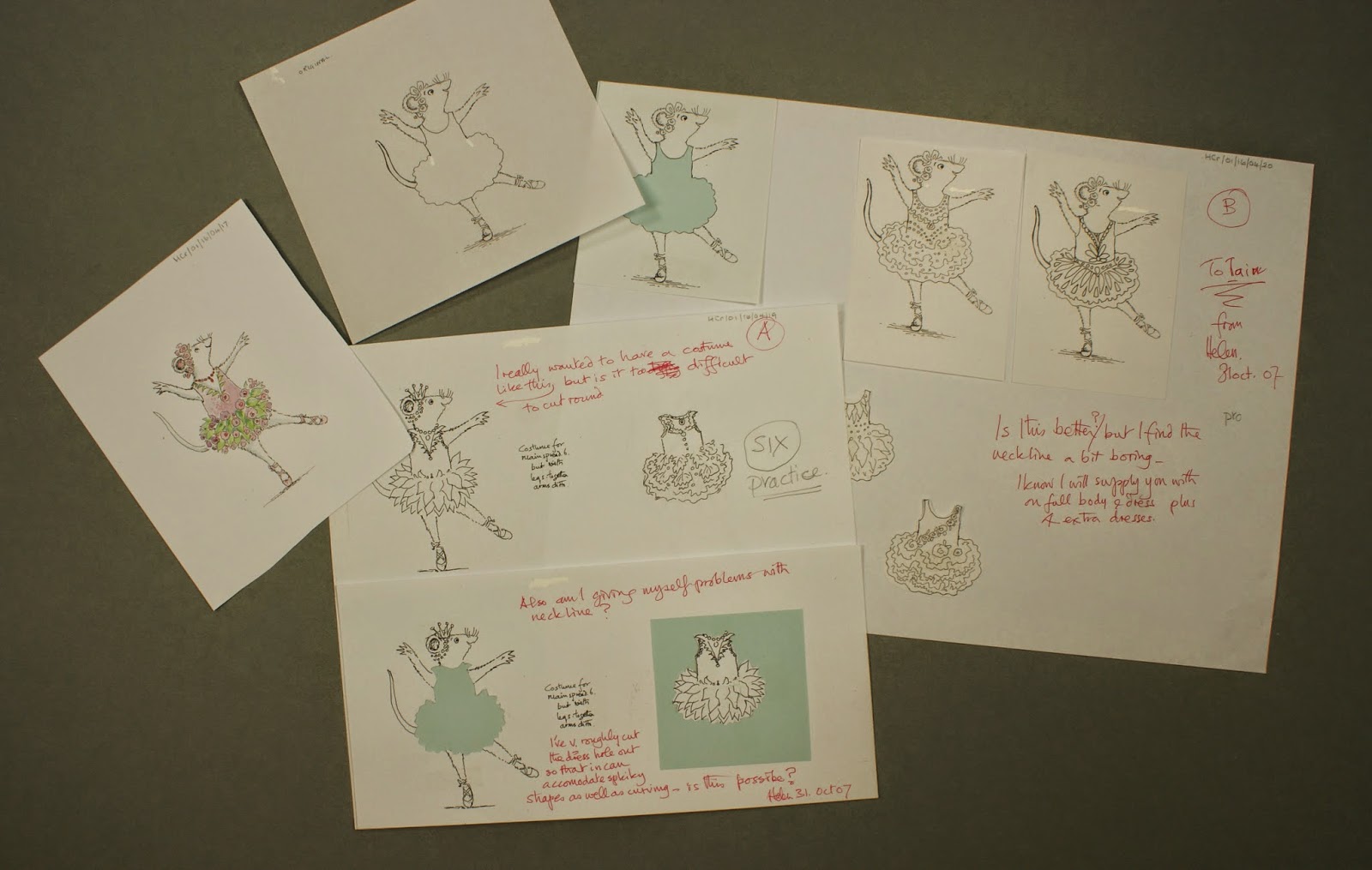
seen in the archive at Seven Stories. For example, Angelina Ballerina illustrator, Helen Craig’s collection includes extensive
material from two Angelina pop-up
books. This material shows the entire process of the development of a
pop-up-book, in this case Angelina Ballerina’s
Pop-up and Play Musical Theatre (Penguin, 2008) and Angelina
Ballerina’s Pop-up Dancing School (Puffin, 2007). Looking at this archive, we can
see that the production of a pop-up-book is very different to that of a normal
book.
![]() |
| Dummy book of Angelina Ballerina’s Pop-up and Play Musical Theatre (Penguin, 2008) © Helen Craig and Katharine Holabird |
![]() |
| Dummy book of Angelina Ballerina’s Pop-up and Play Musical Theatre (Penguin, 2008) © Helen Craig |
The Angelina Ballerina
material shows how important and precise the arrangements between the
illustrator and the paper engineer must be. Helen Craig’s collection includes
paper engineering dummies of different stages, original illustrations, work
plans about necessary illustration parts, letters, emails and many designs and
construction sheets with handwritten comments by Helen and paper engineers Ian
Smith and Maggie Bateson. In their correspondence they talk about things such
as the right sizes of the illustrations, so that they fit perfectly on a
particular flap. In one email exchange they speak about the size of miniature
coat hangers so that the press-out clothes hold perfectly on the small clothes
rail!
![]() |
| Preliminary drawings for Angelina Ballerina’s Pop-up Dancing School (Puffin, 2007) © Helen Craig |
The dummies seem to be a very important resource for this process. They make
it understandable for the illustrator which areas can be seen at the end and
which illustrations or added decorations are needed, so that at the end a
wonderful pop-up book can be published.
![]() |
| Part of early dummy book of Angelina Ballerina’s Pop-up Dancing School (Puffin, 2007) |
![]() |
| Part of later dummy book of Angelina Ballerina’s Pop-up Dancing School (Puffin, 2007) |
The creation of pop-up books and bringing well-known
characters into this new format demands a lot of creativity and knowledge. A
successful pop-up-book that can offer something interesting and different to a traditional
book is much more than a simple reuse of existing characters and illustrations.
It can be an exciting new artwork. Pop-up books provide multifarious
opportunities to create something special and new with already well-known
characters and stories.
If you'd like to find out more about the Seven Stories Collection, the Helen Craig archive, or the pop-up (and other!) books we hold, then
email: collections@sevenstories.org.uk or phone: 01914952707.
Monday, 30 June 2014
Looking at radical children's literature, no. 3: H. G. Wells 'Little Wars'
In the last of our guest blog posts by English Literature students at Newcastle University we look at H. G. Wells' Little Wars (1913). In this book Wells offered a set of rules for playing with toy soldiers whilst also providing philosophical commentary on the nature of war. Here Newcastle student, Catherine Parkinson, looks at Wells' intentions for offering a simulation of war:
"H. G. Wells’ Little Wars (1913) elaborates a miniature war game played between two opponents according to a complex set of rules. Britain was enraptured by military glory, and boyish enthusiasm in the form of a table top game, was not an inappropriate sentiment to bring to the contemplation of war. Wells, famous for his conception of the science fiction genre, created the handbook, which was aesthetically innovative in the world of war gaming and children’s literature. It took Kriegsspiel’s core concept of war simulation and stripped it of its sterile rule set, offering a “homeopathic remedy for the imaginative strategist”.
Wells shifted his focus from young boys and girls in Floor Games (1911) to “boys of every age from twelve to one hundred and fifty”. He used his celebrity to correspond with politicians and military figures, and recognised the danger facing young boys in 1913. He felt it necessary to educate them on the realities of war, “smashed […] sanguinary bodies, […] shattered fine buildings […] devastated country sides” before they were sent to the frontline. In the spirit of the age, Little Wars was offered a wide audience. Cheap metals, such as tin and inexpensive production, were readily available in continental Europe, making it possible for boys across the socioeconomic spectrum to equip themselves with the materials to play, “the game of kings- for players in an inferior social position.”
Within the rules, the notion of a fantasy world is suspended and the reality of war is accentuated by macabre vocabulary, “murder” “death” and “slaughtered”, transcending the child player into an adult reality. These rules, illustrated through a detailed retelling of a conflict orchestrated by Wells, “Blue then pounds Red's right with his gun to the right of the farm and kills three men” informs and instructs on the destructive power of twentieth century artillery. This notion of aggressive militarism, embodied by the bombastic General, is undermined because all toy soldiers in the game are equal, “We decided that every man should be as brave and skilful as every other man… they would inevitably kill each other.” Hence, no army is better than their leader.
The marginal illustrations depict toy soldiers being decapitated and some being lassoed by their superiors, representing the gap between the innocent world, usually depicted by toys, and the truth. This truth is revealed in the chapter entitled “Ending With a Sort of Challenge”. It adopts a more didactic voice in its prophetic warnings and preaches Wells’ 1913 manifesto on war, “you only have to play at Little Wars three or four times to realise just what a blundering thing Great War must be.” Thus, Little Wars was not a practice for war, it was an interpretation of it, “saner by reason of its size”.
The book worked as a catharsis, recreationally quenching the war lust entrenched into youth by contemporary jingoistic literature. It sharpened visions on warfare and militarisation, and created a shared play space, for adults and children, in a simultaneously nihilistic and joyous world."
To find out about Seven Stories extensive library of children's books and related literature, then
email: collections@sevenstories.org.uk or phone: 01914952707.
"H. G. Wells’ Little Wars (1913) elaborates a miniature war game played between two opponents according to a complex set of rules. Britain was enraptured by military glory, and boyish enthusiasm in the form of a table top game, was not an inappropriate sentiment to bring to the contemplation of war. Wells, famous for his conception of the science fiction genre, created the handbook, which was aesthetically innovative in the world of war gaming and children’s literature. It took Kriegsspiel’s core concept of war simulation and stripped it of its sterile rule set, offering a “homeopathic remedy for the imaginative strategist”.
Wells shifted his focus from young boys and girls in Floor Games (1911) to “boys of every age from twelve to one hundred and fifty”. He used his celebrity to correspond with politicians and military figures, and recognised the danger facing young boys in 1913. He felt it necessary to educate them on the realities of war, “smashed […] sanguinary bodies, […] shattered fine buildings […] devastated country sides” before they were sent to the frontline. In the spirit of the age, Little Wars was offered a wide audience. Cheap metals, such as tin and inexpensive production, were readily available in continental Europe, making it possible for boys across the socioeconomic spectrum to equip themselves with the materials to play, “the game of kings- for players in an inferior social position.”
Within the rules, the notion of a fantasy world is suspended and the reality of war is accentuated by macabre vocabulary, “murder” “death” and “slaughtered”, transcending the child player into an adult reality. These rules, illustrated through a detailed retelling of a conflict orchestrated by Wells, “Blue then pounds Red's right with his gun to the right of the farm and kills three men” informs and instructs on the destructive power of twentieth century artillery. This notion of aggressive militarism, embodied by the bombastic General, is undermined because all toy soldiers in the game are equal, “We decided that every man should be as brave and skilful as every other man… they would inevitably kill each other.” Hence, no army is better than their leader.
The marginal illustrations depict toy soldiers being decapitated and some being lassoed by their superiors, representing the gap between the innocent world, usually depicted by toys, and the truth. This truth is revealed in the chapter entitled “Ending With a Sort of Challenge”. It adopts a more didactic voice in its prophetic warnings and preaches Wells’ 1913 manifesto on war, “you only have to play at Little Wars three or four times to realise just what a blundering thing Great War must be.” Thus, Little Wars was not a practice for war, it was an interpretation of it, “saner by reason of its size”.
The book worked as a catharsis, recreationally quenching the war lust entrenched into youth by contemporary jingoistic literature. It sharpened visions on warfare and militarisation, and created a shared play space, for adults and children, in a simultaneously nihilistic and joyous world."
To find out about Seven Stories extensive library of children's books and related literature, then
email: collections@sevenstories.org.uk or phone: 01914952707.
Monday, 23 June 2014
Dragons, Diaries and the Gruffalo, Seven Stories Touring in Summer 2014
Every year Seven Stories tour's our exhibitions all around the country. So far this year we have already shown exhibitions in Chatham Historic Dockyard in Kent and Leeds City Museum. In Summer 2014, Seven Stories is accessible to people all over the country by displaying exhibitions in Wolverhampton, Bradford and London.
Daydreams and Diaries, the Story of Jacqueline Wilson
V&A: Museum of Childhood from April 5th - 2nd November 2014
This very special exhibition, curated with the help of Jacqueline Wilson and Nick Sharratt themselves, showcases their well known books. Jacqueline is a trustee of the Museum of Childhood, so it was a particularly fantastic partnership to team up with the museum again. This is not the first time Seven Stories have sent exhibitions to the Museum of Childhood, both the 'Happy Birthday Miffy, a Celebration of the Work of Dick Bruna' and 'From the Tiger Who Came to Tea to Mog and Pink Rabbit, a Judith Kerr Exhibition' travelled here in previous years.
Visit the website here to find out more details.
A Vikings Guide to Deadly Dragons
Wolverhampton Art Gallery from June 14th - August 30th 2014
This is another venue that has enjoyed a Seven Stories exhibition before, also hosting the Judith Kerr Exhibition over the Summer of 2012. A beautiful venue set right in the heart of Wolverhampton, there have been plenty of marauding new Vikings visiting the exhibition already!
Visit the website here to find out more details.
A Squash and a Squeeze, Sharing Stories with Julia Donaldson
Cartwright Hall, Bradford June 28th - November 2014
This venue is brand new to the Seven Stories touring programme. Set in the gorgeous Lister Park, north of Bradford and south of Saltaire, this gallery is a complete day out for all visitors with young families. Opening next Saturday and running until November, this is your last chance to see the Gruffalo and the Julia Donaldson Exhibition before the end of the tour.
Visit the website here to find out more details.
Keep an eye on the Seven Stories website here for more details on upcoming tours.
Daydreams and Diaries, the Story of Jacqueline Wilson
V&A: Museum of Childhood from April 5th - 2nd November 2014
This very special exhibition, curated with the help of Jacqueline Wilson and Nick Sharratt themselves, showcases their well known books. Jacqueline is a trustee of the Museum of Childhood, so it was a particularly fantastic partnership to team up with the museum again. This is not the first time Seven Stories have sent exhibitions to the Museum of Childhood, both the 'Happy Birthday Miffy, a Celebration of the Work of Dick Bruna' and 'From the Tiger Who Came to Tea to Mog and Pink Rabbit, a Judith Kerr Exhibition' travelled here in previous years.
Visit the website here to find out more details.
A Vikings Guide to Deadly Dragons
Wolverhampton Art Gallery from June 14th - August 30th 2014
This is another venue that has enjoyed a Seven Stories exhibition before, also hosting the Judith Kerr Exhibition over the Summer of 2012. A beautiful venue set right in the heart of Wolverhampton, there have been plenty of marauding new Vikings visiting the exhibition already!
Visit the website here to find out more details.
A Squash and a Squeeze, Sharing Stories with Julia Donaldson
Cartwright Hall, Bradford June 28th - November 2014
This venue is brand new to the Seven Stories touring programme. Set in the gorgeous Lister Park, north of Bradford and south of Saltaire, this gallery is a complete day out for all visitors with young families. Opening next Saturday and running until November, this is your last chance to see the Gruffalo and the Julia Donaldson Exhibition before the end of the tour.
Visit the website here to find out more details.
Keep an eye on the Seven Stories website here for more details on upcoming tours.
Tuesday, 17 June 2014
Yasmeen Ismail winner of Best Book Illustrator at the V&A Illustration Awards!
Congratulations to Yasmeen Ismail who, earlier this month, won the V&A Book Illustration Award for her debut picture book, Time for Bed, Fred! (2013). You can read all about the judges’ response to Yasmeen’s illustrations (and find out a bit more about her technique) here: http://www.vam.ac.uk/b/villa-2014/book-illustrations.
The annual V&A Illustration Awards celebrate the best illustration published over the last year. First established in 1972, the awards have rocketed in popularity in recent years: this year saw over 800 entrants over all four categories. Though not exclusively for children’s picture books, the Book Illustration award regularly showcases work by many highly regarded illustrators for children. This year’s list featured artwork by over 120 artists, including a number of noted children’s illustrators such as Levi Pinfold, Oliver Jeffers, Jackie Morris, Chris Riddell, Catherine Rayner, and Jane Ray.
At the end of last year, Yasmeen kindly donated artwork – including a selection of preliminary and finished work for Time for Bed, Fred! – to the Seven Stories Collection. The material gives a real insight into Yasmeen’s process and her original sketches and illustrations are simply a delight to look at. You can find out more about artwork that Yasmeen donated to the Seven Stories Collection here: http://sevenstoriescollection.blogspot.co.uk/2014/01/yasmeen-ismail-at-seven-stories-archive.html.
Yasmeen’s illustrations for Time for Bed, Fred!, along with artwork by the other four Illustration Award winners will be on display at the National Art Library Landing Gallery (part of the Victoria and Albert Museum) Kensington, West London until 2nd July.
To find out more about Seven Stories illustration collections or to arrange a research visit to the Seven Stories Collections Department, please email: collections@sevenstories.org.uk or phone: 0191 495 2707.
The annual V&A Illustration Awards celebrate the best illustration published over the last year. First established in 1972, the awards have rocketed in popularity in recent years: this year saw over 800 entrants over all four categories. Though not exclusively for children’s picture books, the Book Illustration award regularly showcases work by many highly regarded illustrators for children. This year’s list featured artwork by over 120 artists, including a number of noted children’s illustrators such as Levi Pinfold, Oliver Jeffers, Jackie Morris, Chris Riddell, Catherine Rayner, and Jane Ray.
![]() |
| Preliminary artwork for Time for Bed, Fred! in the Seven Stories Collection |
At the end of last year, Yasmeen kindly donated artwork – including a selection of preliminary and finished work for Time for Bed, Fred! – to the Seven Stories Collection. The material gives a real insight into Yasmeen’s process and her original sketches and illustrations are simply a delight to look at. You can find out more about artwork that Yasmeen donated to the Seven Stories Collection here: http://sevenstoriescollection.blogspot.co.uk/2014/01/yasmeen-ismail-at-seven-stories-archive.html.
Yasmeen’s illustrations for Time for Bed, Fred!, along with artwork by the other four Illustration Award winners will be on display at the National Art Library Landing Gallery (part of the Victoria and Albert Museum) Kensington, West London until 2nd July.
To find out more about Seven Stories illustration collections or to arrange a research visit to the Seven Stories Collections Department, please email: collections@sevenstories.org.uk or phone: 0191 495 2707.
Subscribe to:
Posts (Atom)
.jpg)
.jpg)
.jpg)
.jpg)
.jpg)
.jpg)
.jpg)
.jpg)
.jpg)
.jpg)


