Tuesday, 18 November 2014

Harold Jones's 'Lavender's Blue' comes to Seven Stories

To celebrate the recent arrival of Harold Jones's original illustrations for the classic volume of nursery rhymes, Lavender's Blue (1954), here is a special blog post all about the life and work of Harold Jones.


A chest painted by Harold Jones in his South London home


Harold Jones


Harold Jones (1904-1992) was a painter, wood engraver and printmaker, widely known as one of the twentieth century’s most significant and original illustrators of books for children. He began his career in the 1930s as a freelance illustrator and cover illustrator adding his distinctive style to many children’s books, including M. E. Atkinson’s Lockett series. Jones’s first picture book was a collaboration with the renowned children’s poet, Walter de la Mare which resulted in This Year, Next Year (1937). From then, until his death, Jones’s output was prolific and his idiosyncratic style remains instantly recognisable. His most notable and critically acclaimed work was, and remains, Lavender’s Blue (1954).


Artwork for This Year Next Year (1937), illustrated by Harold Jones, written by Walter De La Mare (Seven Stories Collection)

Ever since his early career Jones has won acclaim for his unique, seemingly simplistic, though haunting illustrations. His lithographs for This Year, Next Year marked him out as a fresh talent; the book itself received wide critical acclaim and was included in the First Editions Club’s annual exhibition of “the fifty books of the year”. Children’s book critic for The Times, Brian Alderson describes Jones as “the most original illustrator of the period” adding of Jones’s style:

‘On the surface… there seems to be only a rather stylised, rather wooden, rather traditional pictorialism. But within the hatched, pastel-shaded frames of his pictures there lurks a silent, eerie world – glimpsed or hinted at under the dark arches of the Serpentine bridge, in the eyes of a pensive dog, or behind a half opened door.’  (1)

Harold Jones had a broad range of artistic training before embarking on a career as an illustrator. He began with evening classes at Goldsmith’s College before moving on to Camberwell School of Arts and Crafts, where he studied under Albert Rutherston. He later studied at Royal College under Rutherston’s brother, William Rothenstein, and Arthur Rackham’s teacher, Edward Sullivan. Following his training Jones went on to teach. In 1930 he took a job as an art master at Bermondsey Central School for Boys. However, he quit the job in 1934 as it provided little outlet for his creativity. After leaving Bermondsey, Jones pursued work as a freelance illustrator whilst continuing to work as an art teacher. Between 1937 and 1940 he worked as a visiting lecturer at both the Ruskin School of Drawing in Oxford and the Chelsea School of Art. He also enjoyed a steady income from his work as a freelance illustrator; among other commissions, he illustrated the last three books written by H. G. Wells.


Some of the books illustrated by Harold Jones


During the Second World War, Jones worked for the Royal Engineers as a lithographic draughtsman. He ‘spent his days in a disused Pimlico garage drawing maps for the Supreme headquarters of the Allied Expeditionary Force. He used to recall how he had “the great fortune to draw the D-Day maps. We knew about everything months before the generals.”’ (2)

In 1945 Jones resumed teaching, taking up a post at Sunningdale School of Ballet, and continued to take commissions as an illustrator. The publication of Lavender’s Blue in 1954, and its wide and substantial critical acclaim, cemented his place as one of the foremost illustrators in Britain. In the proceeding decades he illustrated numerous picture books by various authors – generally favouring traditional, biblical and folkloric tales over more modern stories. In 1961 Jones gained further recognition when he was hired to illustrate the first children’s book published by the major British publishing house, Gollanzc: a new edition of Charles Kingsley’s The Water Babies. Throughout his career he also wrote and illustrated a number of his own stories including The Visit to the Farm (1939) and Enchanted Night (1947).


Harold Jones's studio at his South London home


Though foremost an illustrator, throughout his life Jones also continued to pursue an interest in fine art, producing a number of paintings. Both his art and his illustration have had significant appeal far beyond the world of children’s books, and the decorative and artistic merits of Jones’s work have been widely acclaimed:

His drawings function at a high level both spatially and decoratively, and at their best possess a quality of stillness and timelessness reminiscent of Italian quattrocento painting.’ (3)

While still a student, he sold his first picture in a Royal College of Art student exhibition to the influential art patron, Lady Ottoline Morrell. His work has been exhibited at venues including the Tate Gallery and the Royal Academy. Tate owns Jones’s early work ‘The black door’ which it purchased in 1940 and work by Jones featured in The Modern British Paintings, Drawings and Sculpture (Chamot, Farr and Butlin, 1964).


About Lavender's Blue


Copy of Lavender's Blue (Oxford: Oxford University Press, 1954) compiled by Kathleen Lines and illustrated by Harold Jones


Upon its release, Lavender’s Blue won substantial critical acclaim and its publication can be seen as something of a landmark in the history of children’s illustration. It received an honourable mention by the Hans Christian Andersen Award (this award remains the highest international recognition given to an author or illustrator of children’s books) and Jones was given a ‘special commendation’ by the British Library Association at the awarding of that year’s prestigious Carnegie Award. Though members of the Carnegie selection committee had for some time planned to introduce a separate illustration award, at this time there was still no major award honouring illustrators. However, it was decided that, due to the quality and originality of Jones’s illustrations, Lavender’s Blue deserved a high commendation and it is generally regarded that, had events ‘moved more quickly, [Jones] would have been the first recipient of the Kate Greenaway Medal’ – the illustration companion to the Carnegie award, introduced in 1956 (4). Since its establishment, the Kate Greenaway Medal (the first winner of which was Edward Ardizzone in 1956) has remained by far the most coveted award for illustration in Britain. On its release in the United States Lavender’s Blue was also met with strong critical praise. It received the American Library Association Award, and was included on the list of winners of the Lewis Carroll Shelf Award (5).


Artwork by Harold Jones for Lavender's Blue (1954)


First published by Oxford University Press in 1954, Lavender’s Blue is by far the most noted and celebrated of Harold Jones works. The book’s illustrations epitomise the seemingly bright and innocent, though slightly eerie style that sets Jones work apart. Each picture offers a world to explore full of rich depth and detail. As The Times Literary Supplement said of Jones at the time:

Among artists who specialise in books for children, Harold Jones is pre-eminent. Since Jean de Brunhoff’s incomparable Babar series, no artist has understood more successfully than he that a picture has little meaning for a child if he cannot step inside it.(6)

Lavender’s Blue was compiled by the noted librarian, critic and editor, Kathleen Lines who brought to the project her considerable knowledge and expertise on children’s literature. Lines had previously won acclaim for her critical survey of children's books, Four to Fifteen (1950) (also illustrated by Jones). Through her series of Fairytale Picture Books produced throughout the 1960s and 1970s, Lines would later go on to work with some of the leading children’s illustrators including Edward Ardizzone. The Times Literary Supplement noted of Kathleen Lines’s compilation of Lavender’s Blue that: ‘…as could be expected of someone so knowledgeable in the field of children’s books, [Kathleen Lines] has done her part with great thoroughness. No traditional favourite seems to be missing and sticklers can be sure, too, of finding the traditional verses.’ (7)


The Kathleen Lines book collection here at Seven Stories includes many of the books Lines used to research rhymes for Lavender's Blue


Throughout its 60 years, Lavender’s Blue has remained with Oxford University Press and enjoys the distinction of never once having been out of print. Rather uniquely, although the printing quality has varied, Jones’s original design of the book has never been substantially altered. In 2004, a special 50th anniversary edition was published which saw the book and its illustrations restored to their original quality.

Lavender’s Blue is still regarded as a classic by many children’s authors and illustrators working today. Former Children’s Laureate and author, Jacqueline Wilson, lists the book in her top ten all time children’s books. Of the illustrations, she has said: “[Harold Jones] uses a wonderful delicate colour palette of blue, sage green, lilac and apricot to create his own quirkily detailed dream-like world. You could pore over the pages every day for a year and still find fresh delights.” (8) The well renowned illustrator and author, Ian Beck, regularly cites Harold Jones as one of his foremost influences. He describes Jones illustrations as: “…never fail[ing] to delight. Even when tackling a simple line drawing of a water pump something delectable emerges. He would be my choice of desert island illustrator, even above Ardizzone.” (9)


The fantastic collection of artwork for Lavender's Blue came to Seven Stories in August to join our already significant collection of Jones's original illustrations. The purchase was made possible thanks to grants from ArtFund (http://www.artfund.org/) and the Arts Council England/Victoria and Albert Museum Purchase Grant Fund (www.vam.ac.uk/purchasegrantfund).
Harold Jones's Lavender's Blue illustrations will soon be available to view by appointment at the Seven Stories Collections Department. The work will also be featuring in future exhibitions at the Seven Stories Visitor Centre. If you'd like to know more about the Harold Jones Archive or work by other illustrators in the Seven Stories Collection then contact us.


Notes and references from the text:

1) Alderson, B., ‘Some notes on children’s book illustration 1915-1985’, in Horne, A. (ed), The Dictionary of 20th Century British Book Illustrators (Suffolk: Antique Collectors’ Club, 1994)

2) Harold Jones’s obituary, The Daily Telegraph (London, England), 13th June 1992

3) Peppin, B. (ed) and Micklethwaite, L. (ed), Dictionary of British Book Illustrators: twentieth century, (London: John Murray Publishers, Ltd., 1984)

4) Barker, Keith, In the Realms of Gold: the story of the Carnegie Medal, (London: Julia MacRae Books, 1986)

5) The Lewis Carroll Shelf Award (1958-1979) was an annual American literary award granted by the University of Wisconsin–Madison School of Education to books deemed to "belong on the same shelf" as Alice's Adventures in Wonderland and Through the Looking-Glass

6) Serraillier, Ian, ‘Pen, Brush and Pencil’, Times Literary Supplement, (London, England), 19th November, 1954

7) Dowding, K. M., ‘Rhymes and jingles’, Times Literary Supplement, (London, England), 19th November, 1954

8) Wilson, Jacqueline, ‘The great books giveaway’, The Guardian, (London: England), 4th March, 2011

9) ‘Harold Jones’ on Ian Beck’s blog – http://ianbeckblog.wordpress.com/2011/03/27/harold-jones-2/ (accessed 4th June 2014)

Wednesday, 12 November 2014

Two Exhibitions Come to an End

In the last two weeks, two of our most popular exhibitions have finished their runs at their final venues. It is quite sad for the team at Seven Stories to say goodbye to these exhibitions, as we have been working on them both since early 2011 - nearly 4 years!

The Jacqueline Wilson exhibition - Daydreams and Diaries, the Story of Jacqueline Wilson, has been on display at Seven Stories in Newcastle for a full year, then travelled to Hove Museum and Gallery, Ferens Gallery in Hull, The Dick Institute in Kilmarnock, and finally the Museum of Childhood in London.

A Squash and a Squeeze, Sharing Stories with Julia Donaldson, first was on display in Newcastle at Seven Stories, and then did a very busy tour first to Birmingham Museum and Art Gallery, then to Chatham Historic Dockyard, and finally to Bradford's Cartwright Hall, where it closed on Sunday 9th November 2014.

Touring our exhibitions enables them to be seen around the country by hundreds of thousands more people than possible in our own venue. We are continually working on new exhibitions (with new and repeat venues!), and it is very exciting to see how the exhibitions work in new spaces, and link to their collections and visitors.

Daydreams and Diaries at the Museum of Childhood, London
Lindsey, our paper conservator checking Nick Sharratt's artwork as it leaves its final venue in London. 
Artwork crates all packed and ready to return to Seven Stories

Cartwright Hall in Bradford, on a beautifully sunny day when I visited to talk about the exhibition with the curators and learning team.
Entrance to the main gallery, although there was also a few breakout spaces in the rest of the museum, including Julia's Jukebox in the atrium area!

Packing up to send everything back up to Seven Stories, this is the cow from the Squash and the Squeeze house - he deserves a rest don't you think! You can see some of the fantastic artwork by Emily Gravett and David Roberts in the background too.


To find out more about our upcoming touring programme, to see if there is anything coming to a venue near you, please click here, and you can find out where we have been in the past by clicking here. Our next exhibition will be the first venue for the Enid Blyton exhibition tour - Beaney Art Museum and Library in Canterbury, opening in late January 2015.

If you are interested in booking an exhibition for your venue, please email sarah.mcglynn@sevenstories.org.uk.

Friday, 7 November 2014

Edward Ardizzone artwork donation at the CILIP Youth Libraries Group conference

On 17th and 18th October I was delighted to attend the CILIP Youth Libraries Group, National Conference in Durham.  It was wonderful to meet so many enthusiastic Local Authority and School Librarians, who despite current financial challenges, are excited about children’s books and eager to enthuse their users about books and reading.  Over the two days, we were treated to a great line-up of speakers from the children's literature world including: authors such as Elizabeth Laird, Jackie Morris, and David Almond (all of whom are represented in Seven Stories’ archive collection); Prue Goodwin (lecturer and author of books about children’s literature); and Wendy Cooling (former head of the Children’s Book Foundation now known as ‘Book Trust’).


The magnificent Conference Gala Dinner was attended by a whole host of librarians, local dignitaries, publisher representatives, authors and illustrators.  Impassioned speeches about the importance of libraries were given by both Carnegie Medal 2014 winner author Kevin Brooks, and author Mal Peet (a former Carnegie medal winner).  During the proceedings I was presented, on behalf of Seven Stories, with a delightful piece of signed original artwork by Edward Ardizzone.  Apparently, in 1957, it was decided to have a special bookplate designed for items in the Library Association Youth Libraries Section (now known as CILIP Youth Libraries Group) collection.  Edward Ardizzone agreed to design the bookplate, and a fee of 10 guineas was accepted.


This is a lovely addition to our existing Ardizzone holdings which include artwork for two of his titles 'Tim in Danger', ’Tim and Charlotte' and his artwork for Graham Greene's, 'The Little Train'.

Tea and lunch breaks throughout the conference were sponsored by different Publishers during which delegates were treated to an amazing array of ‘book themed’ cupcakes!  One batch that particularly took my eye, were those provided by Macmillan Children's Books in celebration of eight titles in a new Classics edition, which include two titles by Ursula Moray Williams which are represented in our archive collection - Gobbolino the Witch’s Cat and Adventures of the Little Wooden Horse.


One of the conference Workshop sessions was led by Seven Stories, and centred on our recently announced book list, ‘Diverse Voices – 50 of the Best Children’s Books celebrating cultural diversity in the UK’.   Here are Debbie Beeks (Learning & Participation Manager) and Jake Hope (Freelance Children's Book Consultant) leading the workshop.


To find out more about ‘Diverse Voices’ and to see the list of 50 titles follow this link:


I thoroughly enjoyed my time at the conference and even came back to work with 48 Proof copies of books (due to be published in 2015) for our Staff Library as well!


By Paula Wride - Seven Stories Collections Officer


To find out more about the Seven Stories Collection click here. To contact us click here.

Friday, 31 October 2014

Spooky goings on in Store

To celebrate the first Halloween we have had since the Collections Blog began, we have pulled out some of our favourite spooky items from the archive. We present you with a mix of eery illustrations, terrifying typescripts and disquieting dummy books - enjoy!


Original artwork by Anthony Maitland for 'The Ghost of Thomas Kempe', by Penelope Lively, 1973

© Anthony Maitland
Typescript page from 'Howl's Moving Castle' by Diana Wynne Jones, Methuen 1986

© Diana Wynne Jones Estate
Typescript page for 'The Haunting of Hiram C. Hopgood' by Eva Ibbotson, 1987

© Eva Ibbotson Estate
Finished artwork by Gillian McClure for 'Tog the Ribber' written by Paul Coltman, Andre Deutsch 1985

© Gillian McClure
Page from dummy book by Helen Craig, for 'Angelina at the Fair', written by Katharine Holabird, Aurum Press 1985

© Helen Craig
Letter from Jill Murphy, author of 'The Worst Witch', to Kaye Webb, editor of Puffin Books, c. 1982

©Jill Murphy 
Print by Jan Pieńkowski, commissioned by Seven Stories for the launch of the visitor centre in 2005

© Jan PieÅ„kowski
Final illustrations for 'Gobbolino, the Witch's Cat', by Ursula Moray Williams, 1942

© Ursula Moray Williams Estate

To find out more about the terror-ific goings on at Seven Stories this Halloween, click here.


If you'd like to find out more about the Seven Stories Collection, then 
email: collections@sevenstories.org.uk or phone: 0191 495 2707 or comment on this blog.

Friday, 24 October 2014

Guest Post: Brian Selznick gives a behind the scenes look at 'The Invention of Hugo Cabret'

Seven Stories current exhibition, Moving Stories, children's books from page to screen, has been on show since April 2014, and features some of the most well loved and innovative adaptations to grace our screens.

One of our absolute favourites is the Martin Scorsese adaptation of the beautiful book The Invention of Hugo Cabret!, written and illustrated by Brian Selznick. This area of the exhibition has been captivating visitors to the building for months, and the stunning display of costume and behind the scenes photos from the film has been a real highlight.


On the blog today, Brian has very kindly shared some new pictures of the creation of Hugo exclusively with the readers of the Seven Stories Collection blog. All the images and comments below are straight from Brian.

This is a view of the inside of my flat files, where I keep most of the Hugo drawings and dummies. This is dummy with a rough draft of the drawing of Isabelle. You can see how small they are by comparing them to the size of my hand in the photo. They are about 1/4 size of the book.
Image © Brian Selznick
This is the dummy with a sketch of Hugo from the beginning of the book.
Image © Brian Selznick
This is an actual drawing done by the real eighteenth century automaton that I researched for Hugo. The automaton can be found at the Franklin Institute, and when I first discovered him, he was no longer on display, as he'd broken many years earlier. While writing Hugo I met a mechanical genius named Andy Baron who helped me get all the clock and machine descriptions correct. I introduced Andy to the curators at the museum, and now the automaton is fixed and on display again.
Image © Brian Selznick
To find out more about the original automaton, named 'Maillardet's Automaton' click here 

And to see a film of Brian and Andy demonstrating the automaton actually drawing, click here
This is a rough sketch of Hugo winding the clocks. You can see notes I've written to Andy Baron asking if they machinery is correct, along with several other notes to my editor.
Image © Brian Selznick
Here is a sketch cut from the end of early drafts of Hugo, along with an early cover design. You can see that the title wasn't always The Invention of Hugo Cabret!
Image © Brian Selznick
Very few final pieces of art are cut from the finished book. Usually I remove drawings while they are still in the rough draft stage. But here is a finished drawing that didn't make it to the final story. Originally, when Hugo was walking across the graveyard to Melies's house, he was going to pass this gravestone with his own name on it. I hoped the reader might think for a moment that Hugo was a ghost, which would add to the mystery, and only later would we find out that Hugo's father had had the same name as him, and this Hugo Cabret was the dad's grave. But for obvious reasons I thought this might get a little confusing, so I cut it.
Image © Brian Selznick

To find out more about Brian Selznick, visit these websites www.theinventionofhugocabret.com and www.wonderstruckthebook.com.

For more information about the Moving Stories, Children's Books from Page to Screen exhibition, click here. The exhibition runs until April 2015.

Moving Stories was curated in partnership with the National Media Museum, to find out more about them, visit this link.

Friday, 17 October 2014

Diverse Voices at Seven Stories

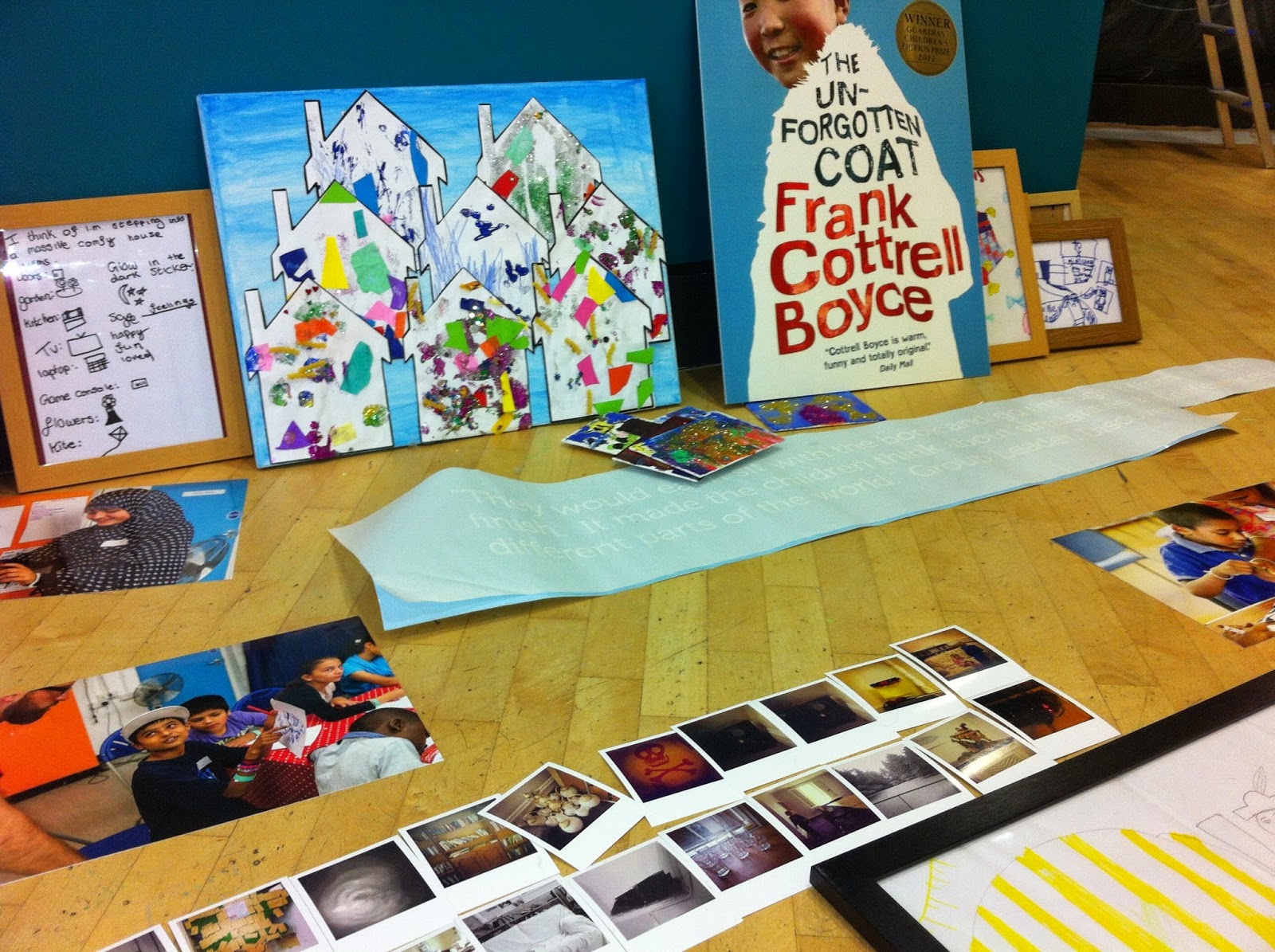
Earlier this summer I was offered the amazing opportunity to work on an exhibition to showcase the Diverse Voices Project, putting the spotlight on the 50 best children's books since the 1950s. Four groups, New Writing North, The Reader Organisation, Gem Arts and the Discover Project  immersed themselves in books from this list with support from our Learning and Participation team and made their own artistic responses.  I spent an illuminating afternoon visiting Gem Arts in Bensham taking part in a wonderful book sharing exercise and working with a multi-generational group led by artist Jayamini de Silva. We created art works inspired by the books around the theme of 'home'.

Last week our Bookshop set up a display to celebrate these inspiring books and I began to install the exhibition.

The groups' responses to the books were amazing and diverse. It was fascinating to see the artwork all together and begin to collate it visually.


Although the books are childrens' books, not all the people involved in the project were children. These journals were written by young adults from New Writing North.


After several months of careful planning the artwork was framed, the props chosen, the Bookden repainted and it was time for the work to go on the wall.  


The exhibition is on display in Bookden until Summer 2015, with copies of all the books ready to read. Visit the exhibition and dive into the wonderful world of Diverse Voices.

To find out more about events linked to Diverse Voices, visit out What's On page here.

Friday, 10 October 2014

'Illustration and Inspiration' at the Granary Gallery, Berwick

Over the past few months, we have been working with the curator of the Granary Gallery in Berwick, on their new exhibition 'Illustration and Inspiration'. 
Opening to the public on Saturday 11 October, and running until Sunday 18th January 2015, the display celebrates the extraordinary wealth of acclaimed children’s book illustrators from Northumberland and the Scottish Borders and the artists who have inspired them.

The exhibition includes works by Vanessa Cabban, Olivia Gill, Brita Granstrom & Mick Manning, Cara Lockhart Smith, Helen Stephens and Gerry Turley. Each of the illustrators have also selected work from the Seven Stories collection by illustrators who have inspired them or had an impact on their creative practice.

Artwork on loan includes work from the archives of some of our most prestigious illustrators, and it has been an interesting exercise looking at our collections through the eyes of practising illustrators, to see what and how certain artists have inspired them over their career.


Lindsey, the Seven Stories conservator, putting the final touches to one of the display mounts.
So as not to ruin the visit to the exhibition, I'll not say who chose what, but these are the artists whose artwork was chosen from our collections:
  • Edward Ardizzone - artwork for 'The Little Train' by Grahame Greene
  • George Him - artwork for 'The Giant Alexander' series by Frank Hermann
  • Angela Barrett - artwork and sketchbook for 'The Snow Queen' by Hans Christian Anderson
  • Tove Jansson - a letter with picture of 'Little My', written to her publisher Kaye Webb
  • John Lawrence - artwork for 'Tiny's Big Adventure' by Martin Waddell
  • Michael Rosen - preparatory notes for 'We're Going on a Bear Hunt'

    Artwork by John Lawrence for 'Tiny's Big Adventure' by Martin Waddell. These two pieces on display offer the opportunity to try and match up the images - the mice in the left picture should fill the voids in the right!
    Stunning artwork for 'The Snow Queen' by Angela Barrett, on display are a finished original piece of artwork, a first edition copy of the book, and Angela's fantastic sketchbook.
To find out more about visiting the exhibition, click here and to find out more about the Berwick Literature Festival click here.

If you want to find out more about this collection, or about any other of our archives then 
email: collections@sevenstories.org.uk
phone: 01914952707 
visit: http://www.sevenstories.org.uk/collection