Friday, 13 November 2015

David Fickling Collection continued

You may have read our recent blog posts by our volunteer, Grace, about foraging for archival treasure in the David Fickling Collection.  I thought it would be a nice idea to continue the story.   

Stuck to the wall above my desk is a postcard of David Fickling. I have no idea where it came from but it was there when I arrived at Seven Stories in February.  It shows David Fickling pointing at us readers - ‘Readers: your DFB needs you’. I think this is definite incentive to keep on cataloging: the DFB collection needs me, and our volunteers too. 


David Fickling is a big name in Children’s literature, he is an editor and his name has lent itself as an imprint for both Scholastic and Random House. But, in 2014 David Fickling Books became an independent publishing house.  David seems to be a magnet for talent, he and his team have an eye for spotting amazing books and authors. 

Many of our collections at Seven Stories are from authors and illustrators which is fantastic but this collection shows another side to the story.  It helps to complete the picture, offering us a different insight into how those pencil scribbles, research materials and early drafts develop into neat more complete stories, and how an editor contributes to the creation of the final book that will fill the shelves of bookshops, homes and libraries. David Fickling’s collection represents a large number of author’s work including proof and draft manuscripts, often with editor’s comments.  It’s a goldmine of information and presents a great cross section of the industry in representing approximately 75 different writers.  As the collection unfolds we’re hoping to find cross over material with some of our other collections. However, we still have a lot of work to do in managing all of this information. I haven't even opened the boxes of correspondence that Grace discussed in her last post.


There are currently forty two archive boxes in the David Fickling Collection and as I work through each box the number is steadily increasing.  It is vast, and one of our largest collections at Seven Stories. The collection arrived earlier in the year and since then has undergone serval stages of archival processing by two of our wonderful volunteers.  

Firstly, Grace listed the materials and created a spreadsheet of content so that Kris (our Archivist) and I (the Collections and Exhibitions Assistant) had a better idea of what we had.  Listing a collection as it arrives makes it easier not only to locate material, but to see patterns of how materials are organised, what themes occur and what types of documents make up the bulk of the collection.  This information makes it easier to start thinking about how the final catalogue will be structured.

Then Jen came along as a student placement from Newcastle University's International Centre for Cultural and Heritage.  She used Grace’s original list to repackage everything. This is a very important stage, the original files and boxes need to be replaced with acid free materials, all corrosive metals are replaced with brass paperclips and the original file labels are recorded.  

Jen lending a hand and sorting the David Fickling Collection
Whilst repackaging Jen also reorganised.  She organised all of the files alphabetically by author, and arranged work by each author chronologically. This was a huge task and Jen spent much of her time at Seven Stories surrounded by files and boxes.  She also made the next step in processing much easier.  Jen had created a structure! 

All I have to do now is work my way through the lovely neat repackaged boxes and add everything to CALM.  For those of you not familiar with our archive-y terminology CALM (Collections Management for Archives, Libraries and Museums) is a massive database where we record everything that happens to our collections and every exhibition loan that comes through our door.  It’s also what we use to catalogue our collections.  

When we start to catalogue it’s really important that we keep people in mind.  It’s not just us archive-y folk and our volunteers that will use this catalogue but you -the researchers, the academics, and the enthusiasts - and our Seven Stories teams, our curators and our learning and participation team. There are a lot of uses for a collection like David Fickling’s and we need to have an idea of what they are, and what language and structures we need to use to make all of the important information easy to find.  At Seven Stories nothing sits on a shelf for too long. We believe that all of this work created and gathered by incredibly creative people should be shared with other creative people but this has to start with a comprehensive catalogue.

So, at the moment I am twenty-five boxes in and working hard.  It’s great fun to catalogue a collection like David Fickling’s because there is so much variation between files and though I know what is coming in a very practical sense (thanks to Grace’s listings and Jen’s labelling), there are still fun surprises. 


Original artwork by Paddy Mounter and book proofs for Tony Mitton's Riddledy Piggledy
When the catalogue is finished it’ll be made available online. However, if there are any interested researchers out there please do get in touch.


If you’re late to the exploration of the David Fickling collection check out the other diary entries written by our volunteer Grace.

Next week is The National Archives Explore your Archive Week.  So come explore our archives and join in the #exploreachives conversation.  Join us on Twitter, and Instagram using the handle @7stories and on Facebook by searching for 'Seven Stories, National Centre for Children's Books'.

If you'd like to find out more about the Seven Stories Collection, then 
email: collections@sevenstories.org.uk or leave a comment.


Seven Stories was able to support the acquisition from David Fickling through support from a Heritage Lottery Fund ‘Collecting Cultures’ grant, which has been awarded to Seven Stories in recognition of the museum’s national role in telling a comprehensive story of modern British children’s literature. For more information on our HLF Collecting Cultures project see: http://www.sevenstories.org.uk/news/latestnews/hlf.


Thursday, 12 November 2015

Foraging through Fickling’s Archive Part 3

If you’re late to the exploration check out the other diary entries written by our volunteer Grace .  This is Grace’s final forage into the Fickling collection. 

Next week is The National Archives Explore your Archive Week.  So come explore our archives and join in the #exploreachives conversation.  Join us on Twitter, and Instagram using the handle @7stories and on Facebook by searching for 'Seven Stories, National Centre for Children's Books'.

Part 3

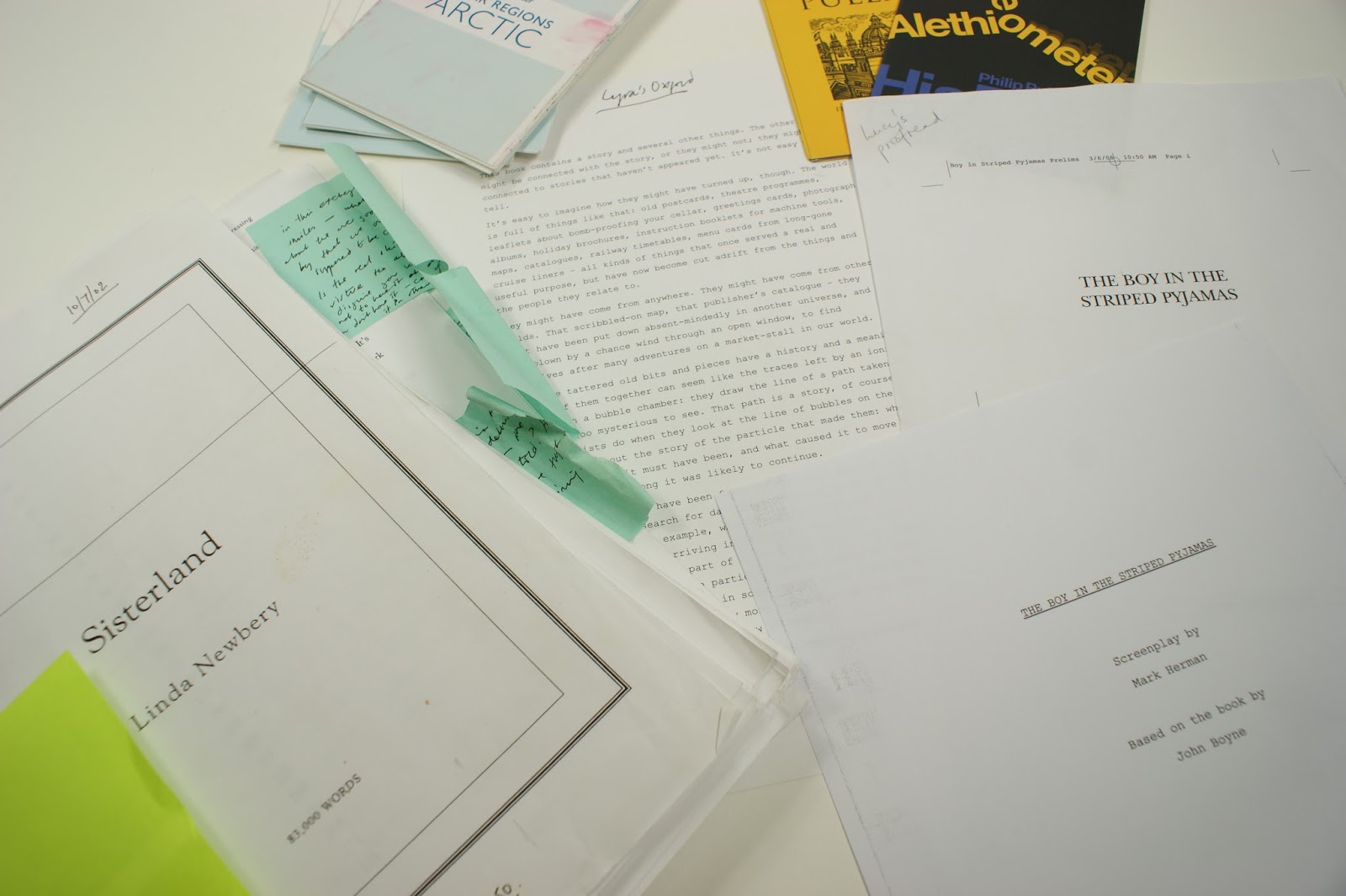
I managed to sort through the final few boxes today - they contained a massive array of little surprises. One box contained cover ideas, mock-ups and all the little extra bits of promotional material to go with several books such as Philip Pullman’s Lyra’s Oxford and Mark Haddon’s The Curious Incident of the Dog in the Night Time. In amongst these little gems were personal letters of Fickling’s that will have to be weeded out before the cataloguing process. 


The archive team have to ensure that all personal data is removed before making the archive available to the public. My main role in sorting through these boxes has been to gain an understanding, for the archivist, about what is actually there. The boxes were entirely unsorted and had not been looked at in some time, so it is no wonder there was so much interesting stuff. I have to say, although it is fantastic that Fickling donated so much material to Seven Stories, I can’t imagine, if I ever became famous enough, that I would be able to just hand over all my work! When looking I can clearly see the hours of work dedicated to the drafts, the time and effort dedicated to the editorial notes, the many letters between all the parties and I just feel like the archive contains a huge part of Fickling and his team’s life.  

- Grace Owens


Seven Stories was able to support the acquisition of David Fickling's archive through support from a Heritage Lottery Fund ‘Collecting Cultures’ grant. This has been awarded to Seven Stories in recognition of the museum’s national role in telling a comprehensive story of modern British children’s literature. For more information on our HLF Collecting Cultures project see: http://www.sevenstories.org.uk/news/latestnews/hlf.


Wednesday, 11 November 2015

Foraging through Fickling’s Archive Part 2

Our volunteer Grace continues her exploration of our David Fickling Collection. If you haven’t seen it yet, take a look at her first blog here. 

Next week is The National Archives Explore your Archive Week.  So come explore our archives and join in the #exploreachives conversation.  Join us on Twitter, and Instagram using the handle @7stories and on Facebook by searching for 'Seven Stories, National Centre for Children's Books'.


Part 2

Delving deeper into the boxes this week I came across a pile of papers which I personally thought were a bit boring – some of Fickling’s financial documents. Nothing major just a few bits of correspondence between illustrator and publisher with some figures nestled in there. I was a bit dismissive, these were not as exciting as the original material with lovely scribbles all over it, so I just sorted it into a box and labelled it. However later I discussed this with my tutor, just an off-the-cuff comment, and she illuminated how valuable this information can be. Apparently when it comes to actual facts and figures about who was paid what, how many books were published at the time and anything else of that nature, they are really hard to get hold of. As a researcher you need this kind of information to back up your claims, or to shed light on a particular book or author. Not so boring!

Letters, notebook and floppy discs from David Fickling's correspondence files
The day continued as before, I have probably enjoyed the rifling through letters, comments by editors, ideas by authors and illustrators a bit too much. I feel very nosy! I found some of the John Boyne The Boy in the Striped Pyjamas drafts and ideas for screenplay. I think it is really interesting to see the agent promoting John Boyne as an unknown author to the publishers – seeing how the dialogue works between the agent and publisher, how they advertise their client.  I found it quite funny to read the agent’s positivity about Boyne’s distressing story! This story was marketed at children and yet contains ideas and themes that are considered by many as controversial. However, it is still undeniably a highly successful book and now a film too. All of this is in post-it notes, letters and emails between all the parties, are all part of the story behind the story. 

- Grace Owens


Seven Stories was able to support the acquisition of David Fickling's archive through support from a Heritage Lottery Fund ‘Collecting Cultures’ grant. This has been awarded to Seven Stories in recognition of the museum’s national role in telling a comprehensive story of modern British children’s literature. For more information on our HLF Collecting Cultures project see: http://www.sevenstories.org.uk/news/latestnews/hlf.


Tuesday, 10 November 2015

Foraging through Fickling’s Archive Part 1


This has been an extraordinarily busy year for our collections team with the arrival of so many new collections. We are very pleased that among the new arrivals is the David Fickling collection. 

Over the next few days we'll be posting the archival adventures of our fantastic volunteer Grace.  She was one of the first to get to know David Fickling's collection.  Grace is something of a children's literature expert after completing her MLitt in Children's Literature so it seemed fitting that she should work on a collection that represents such a wide range of children's book titles. Her insight and perspective into our collections has been invaluable and we are very thankful for the work that Grace has done for us.  We wish her the best of luck in her new job, spreading the love of children’s books as a teacher.  

Part 1

Today I was delving deep into the higgledy-piggledy piles of David Fickling’s archive, which had just arrived in the collection department, essentially looking for treasure. David Fickling, for those who don’t know, is a children’s editor and publisher. He has worked for a wide range of publishers including Oxford University Press and Scholastic, subsequently setting up David Fickling Books as an imprint under Random House, before finally becoming an independent publisher. He’s published authors such as Linda Newbery, John Boyne and Philip Pullman – big names, so you can see why I was intrigued by the pile of papers before me.


To be honest though, I was equally intrigued by the process the pieces in the archive had to go through before they arrived mounted and framed perfectly preserved on Seven Stories’ exhibition walls. They had arrived in the past few days in plastic storage boxes, and we knew there would be some valuable stuff in there, but I was the lucky person who was allowed to explore. I literally had to find out what was in there, and sort, the boxes so that the team knew what they were dealing with. Someone once mentioned to me that often archives have a backlog of work that is measured in years and after seeing this one collection I can see why. The boxes held drafts and drafts of work hoping to be published. For example, Varjak Paw The Outlaw by SF Said had over 8 drafts, all slightly different, many with yellow sticky notes all over with edits, all of which will have to be stored and preserved carefully. The sorting out was just the start.

I am very interested, as a researcher of children’s literature, in how the author and the editor work together to be published. I want to know what children are allowed to read, what is deemed acceptable, who is more adventurous - the author or the editor? Consequently, the yellow sticky notes fascinate me!

Many of the typescript drafts have post-it note comments from editors.  This is a typescript of John Dickinson's A Cup of the World (David Fickling Books, 2004). The post-its will all be removed and flattened in melinex sleeves for preservation. 

Anyway what did I find…? I found, in amongst one of the preliminary drafts for Tony Mitton’s Wayland and a short story of Jamila Gavin’s, several documents relating to the film The Golden Compass. Aha – pure gold!

- Grace Owens.

Next week is The National Archives Explore your Archive Week.  So come explore our archives and join in the #exploreachives conversation.  Join us on Twitter, and Instagram using the handle @7stories and on Facebook by searching for 'Seven Stories, National Centre for Children's Books'.


Seven Stories was able to support the acquisition of David Fickling's archive through support from a Heritage Lottery Fund ‘Collecting Cultures’ grant. This has been awarded to Seven Stories in recognition of the museum’s national role in telling a comprehensive story of modern British children’s literature. For more information on our HLF Collecting Cultures project see: http://www.sevenstories.org.uk/news/latestnews/hlf.


Sunday, 1 November 2015

All About: Mice

The Seven Stories Collection holds the entire archive of one particularly famous mouse, Angelina Ballerina. However, we have written so much about Angelina recently, we thought it would be nice to explore some of the many other mice we have in the store (purely literary mice, no real ones!). If you are feeling inspired to explore more Seven Stories mice, click here to see all our Angelina posts.


Draft material by Martin Waddell for The Great Green Mouse Disaster, illustrated by Phillipe Dupasquier (Andersen Press, 1981)
November's first mouse, or hoard of mice, is the fantastically imaginative book by Martin Waddell and Phillipe Dupasquier. The book is virtually wordless, and as each page unfolds, the viewer is presented with a cross section of a hotel. Turn the page again and the action has moved on slightly, as you follow the progress of the rampaging hoard of green mice scattering throughout the hotel, causing chaos!

The archival material we hold runs to one, reasonably large, A4 file, full of Waddell's plans and notes for how the book should work. It being a particularly unusual book, I was very curious to work out how someone would go about planning it. It turns out that Waddell had some fairly concrete ideas about how he would like the book to look, and created a detailed 'story' for each characters progression on each page. The book is full of some brilliant detail, and it would take anyone a very long time to really find every different element. At the end of the book, there is even a list of things that Waddell thinks the reader might not have noticed!

Below is a sample of 'Story 4 The Mouseman', who is responsible for all this calamity:


'He is in the pursuit of the Mice and the Cat. In the cover illustration he will scoop up a milk bottle and this should be about his person as he runs. In 1 he is in the dining room, level 3, catching a glass of wine in mid air as it tumbled of the tray of the shocked waiter, who has been knocked aside by the jumping cat and cascading mice. Has has scooped a chicken from the table in passing, and is clambering over it - the table, not the chicken - to the stairs from 3 to 5.'

The Martin Waddell Collection, kindly donated by the author in 2008, consists of drafts and pre-publication material for 53 picture books and 63 educational books, including those published under the pseudonym Catherine Sefton. Several of the picture books have artwork represented elsewhere in the collection, such as Can't You Sleep Little Bear, illustrated by Barbara Firth, Tiny's Big Adventure, illustrated by John Lawrence and The Pig in the Pond, illustrated by Jill Barton. The collection also includes a series of notebooks and appointment diaries, and a series of printed books written by Waddell. 

Artwork by Emily Gravett for Little Mouse's Big Book of Fears, (Macmillan, 2007), inlaid with picture of title page of the Seven Stories copy of the book. Artwork © Emily Gravett, 2007
This artwork is an example of a much smaller collection than the one mentioned above, as it consists of just this one piece of artwork! These mice are final pieces of artwork used in the end papers, and  the 'Phagophobia (Fear of being eaten)' page. Another incredibly imaginative mouse led tale, this follows our hero, Little Mouse, on his journey through a book exploring all his different fears - entomophobia, clinophobia, acrophobia - amongst others. The pages are covered in little mouse 'nibble' marks, with several fold out pages of additional sumptuous detail, such as the 'Visitor's Map of the ISLE OF FRIGHTS'.

This collection may only contain one piece of artwork, executed in pencil, acrylic, and watercolour, but there is also an additional mouse illustration on the reverse of the card. The wider Seven Stories Collection actually does contain other work by Emily Gravett, also, by strange coincidence, of mice. Gravett kindly donated the piece above, and also her preliminary artwork, final pieces and prints of the final work for 'A was an apple pie' in Elizabeth Hammill's Over the Hills and Far Away. Some of this work is currently on display in Rhyme Around the World, at Seven Stories in Newcastle.

A Counting Book by Helen Craig, published by Aurum Press Ltd. c.1980
This month’s printed book featuring mice is A Counting Book by Helen Craig. Of course this tiny little mouse-filled book is by the illustrator of that other famous mouse Angelina Ballerina – oops!  We weren’t meant to mention her this month but this is too good an opportunity to showcase a less familiar book by Helen Craig, and one which was published before Angelina burst into the world in 1983.

This printed book comes from Pat Garrett’s Counting Book collection and is one of the smallest books in our collection, measuring just 5.5 cm square.  It comes in its own little slipcase which physically constrains the long concertina of pages.  Each double-page spread features colour illustrations of mice amusingly constructing the numbers 0 to10 out of a variety of handy objects including balloons, string, flowers, bubbles, and (as in the photo) a jigsaw puzzle ‘7’ which looks suspiciously like it’s made from pieces of cheese! The final 3 double spreads somehow accommodates 100 tiny mice!

Pat Garrett kindly donated her Counting Book collection to Seven Stories in 2006.  It consists of over 640 counting and number related books, mostly published between 1960 and 2000. Whilst this collection is made up mainly of picture books, it also includes books in a variety of formats such as board books, rag books, pop-up books, activity books, as well as three 19th Century mathematics text books and even friezes, an advent calendar, and plastic counting blocks.

To find out about Pat Garrett’s Alphabet book collection, check out our ‘Bird’ blog in May earlier this year by clicking here.

If you'd like to find out more about the Seven Stories Collection, then 
email: collections@sevenstories.org.uk or phone: 0191 495 2707 or comment on this blog.

Thursday, 22 October 2015

The Michael Morpurgo Archive

This month, Seven Stories is celebrating the donation of Michael Morpurgo’s archive and the announcement of the forthcoming Morpurgo retrospective exhibition, which will open on 1st July 2016.  To help inform the exhibition the  museum has teamed up with Newcastle University to appoint a Research Associate, funded through the Knowledge Transfer Partnership scheme– the first appointment of its kind in the field of literature.  In this blog, the KTP Research Associate, Dr Jessica Medhurst, introduces the Morpurgo collection and gives a sneak preview of her research.

I was delighted to join Seven Stories the National Centre for Children’s Books in September, not least because the KTP Research Associate post offers me the chance to work on an as yet unseen collection: Michael Morpurgo’s papers, which were donated in May of this year.


Later typescript draft of War Horse annotated by Michael Morpurgo with a first edition copy of the book

My research is exploring Morpurgo’s published and unpublished works, including a large pile of orange notebooks in which many of his famous novels were first drafted, as well as early adaptations of War Horse and material from his early life.  I’ll be considering the ways in which his works fits in with, and sometimes goes against, traditions in children’s literature and I’m interested in thinking closely about what kinds of childhood we can read in Morpurgo’s work, particularly in relation to the places and spaces he constructs such as the Scilly Isles, Devon and further afield in novels like Kensuke’s Kingdom and Alone on a Wide, Wide Sea.  I’m also hoping to do some work on the human-animal relationship that characterises many of his books, such as The Butterfly Lion, Why the Whales Came and The Dancing Bear.  This will be no small job: Morpurgo has written more than 130 books and we’ve got some unpublished material in the collection too so there is plenty of reading to be done.


Morpurgo's early handwritten drafts in notebooks

Intriguingly, Morpurgo doesn’t think of himself as a writer but rather as a storyteller.  In Singing for Mrs Pettigrew he writes of his need to ‘allow the story time to find its own voice to weave itself, to dream itself out of my head’ (p26) and in her recent authorised biography of him, Maggie Fergusson writes that ‘[h]e began as a classroom storyteller, and he has remained much more confident about the spoken than the written word’ (p315).  Ideas of storytelling also crop up in lots of his books: you might have read about Tomas and the librarian in I Believe in Unicorns, or the story Paulo Levi tells the journalist in The Mozart Question, or even the stories told about The Birdman in Why the Whales Came, which turn out not to be the whole truth. 

Many of the manuscripts donated as part of the collection also produce ideas of how stories are told, including the difficulties that even established authors like Morpurgo have: among the many orange notebooks is one for Kensuke’s Kingdom, the beginning of which is rewritten four times, with each attempt at beginning it slightly different and slightly longer than the last.  The first handwritten version has the lead character called Paul rather than Michael, puts his birthday as 6th February 1988 rather than 28th July 1988 and introduces a newspaper cutting headlined ‘Tragedy strikes round the world yachting family’, constructing a part of the story that happens in Paul/Michael’s absence, which is not present in the published version.


The first draft page for the beginning of Kensuke's Kingdom
Morpurgo re-drafted the beginning of Kensuke's Kingdom many times

Having this KTP funding means that I can spend time researching into this archive to inform the curation of the exhibition, led by Gill Rennie (Senior Curator), as well as to attract more adult audiences to the galleries, including researchers.  The collection often gets visits from students and academics who are interested in the manuscripts held at Seven Stories and we hope to be welcoming even more people to explore the gems held in the archive as well as in the children’s book collection; if you’re thinking of visiting you can find out more here.  I’ll be sharing some of my findings on the blog over the next nine months as the exhibition develops; if you’ve got any questions for me you can leave them in the comments section below.


Seven Stories was able to support the acquisition of David Fickling's archive through support from a Heritage Lottery Fund ‘Collecting Cultures’ grant. This has been awarded to Seven Stories in recognition of the museum’s national role in telling a comprehensive story of modern British children’s literature. For more information on our HLF Collecting Cultures project see: http://www.sevenstories.org.uk/news/latestnews/hlf.


For More information on our KTP project with Newcastle University see here: http://www.ncl.ac.uk/press/news/2015/10/sevenstoriesktp/


Wednesday, 7 October 2015

Robert Westall’s North East


Last month marked the 40th anniversary of the publication of The Machine Gunners and today would have been Robert Westall's 86th birthday.  To commemorate the occasion we thought we'd share a post from one of our volunteers.  Grace created a brilliant online resource for the Westall Collections which explores his connection to the North East. 

The first page of the first draft of Robert Westall's The Machine Gunners. Published 40 years ago, Westall won the 1975 Carnegie Prize for Machine Gunners.
I have been uncovering Robert Westall’s intriguing archive for a project with Newcastle University. This project’s aim was to highlight the archive and make it even more accessible through a digital platform. Each member of the project simply had to pick an archive to publish online. As a student at Newcastle University studying an MLitt specialising in children’s literature, as well as a volunteer at Seven Stories archives, I knew where I would look for material…

I chose to work with Robert Westall’s archive, the first archive to call Seven Stories home, not only because visually it is very aesthetic (gorgeous handwriting, entertaining notes and doodles…) but because I felt his unpublished personal writing was, quite frankly, stunning. He wrote in large sketchbooks about his home county, Northumberland, in such an honest and poetic manner that I felt it was a resource worth making more accessible to the public. His children’s books often feature the North East, The Machine Gunners (1975) is set in Garmouth (a fictional town based upon Tyneside) and The Kingdom by the Sea (1990) follows a young boy as he travels up the coast too. In his published works the North East is a solid setting, it creates the backdrop to his dramatic tales and it defines the dialects of the characters. However, in his unpublished works, we see the North East as Westall saw it, with pride of place as the focus of his writing.

Westall wrote;

‘If you attempt to drive up the coast of Northumberland, something goes wrong after Seaton Sluice; twist and turn as you will, you get caught in a maze of spoil heaps, and roads cracked and patched after mining subsidence’.

He takes you on a journey through the seaside towns and villages, discussing the fishing traditions, the tourism trade and the mining past. His love of the North East is at times at odds with his sadness over the changes that are taking over and changing his childhood landscape.

Selection of notes about the North East of England in the Robert Westall Collection

I photographed the sketchbooks and created a website to display each page separately. If you click on one of the items, scroll past the item information, you can click on the selected page and zoom in on each one individually, reading every word he has written. Whilst it is not quite as fun as trooping to Newcastle and digging into the Seven Stories Archive yourself, it is not a bad way of accessing a quietly, fascinating collection. Westall recalls his childhood home, a landscape which despite causing him grief through the inevitable changes happening to the traditions of the communities, was also given a significant presence in children’s literature due to his work.


- Grace Owens


If you'd like to find out more about the Seven Stories Collection, then 
email: collections@sevenstories.org.uk or phone: 0191 495 2707 or comment on this blog.