Showing posts with label #explorearchives. Show all posts

Friday, 25 November 2016

Wombat goes walk about to the Seven Stories Collection

For #archiveanimals Wombat decided to take a break from the Michael Morpurgo exhibition: 


Our Wombat lives in our Visitors Centre in Ouseburn, Newcastle
One day Wombat woke up and thought, 


‘I think I’ll go to the Collections today. I’ve been in this Gallery for a few months and I have seen all sorts of things. I’ve been picked up by many children and cuddled, I’ve been drawn and I have had stories written about me, I have wondered around and looked at a lot of pictures and a lot of beautiful words, but where did I come from?’ 

Wombat loves exploring, so with one of the Seven Stories Story Catchers as his guide (because Wombats don’t know how to use metros) he set off to find out where he came from and what he could learn from the archive that is the heart of Seven Stories, his new home.


‘Why am I a wombat and not a kangaroo?’


Wombat knows that Michael Morpurgo did alot of research to create him - some of it is included in the exhibition and some, like the draft and print outs below, are in the Seven Stories collection.  

In our Michael Morpurgo exhibition we hold draft and research material for 'Wombat goes Walkabout' (Collins, 1995). Photography © Seven Stories – The National Centre for Children’s Books

But wombat wanted to meet the other animals of Seven Stories – who are they and what can they do?

Wombat sat on the Story Catchers lap as they trundled along on the metro. She lifted him up to look out of the window and he saw the great expanse of river below. They travelled over the Queen Elizabeth II Bridge from Newcastle to Felling and walked the short little walk from the station to Design Works, where the collection lives. Wombat had seen all of the amazing pieces of artwork in the galleries and the old, coffee stained pages that have been written on by authors with scribbly blotchy pens and knew that the collections would be filled to the ceiling with so many of these. 


You can find out what we have in our store via the online catalogue, highlights page and alphabetical list of people 

However, he did not expect to see so many books too; thousands and thousands and thousands of books given to the collection by authors and publishers and illustrators over many years.

To little Wombat the shelves were so big and so long and seem to stretch on forever. He didn’t know where to start! But then his Story Catcher guide suddenly remembered an old friend she really wanted to see again; someone who had been in Seven Stories before she started working there and who had led her around the building many times. So they went to visit the Cat that once lived at Seven Stories. 

His name is Browser and the man who drew him is called Satoshi Kitamura.


Meeting the Cat


Original artwork by Satoshi Kitamura depicting the character Browser the cat.  Browser was designed for Seven Stories by Kitamura to appear on signage in Seven Stories' visitor centre, as a familiar mascot to guide visitors through the building.  The series includes artwork relating to Kitamura's original commission in 2004; a second commission for new signage in 2008; and a third commission relating to a website redesign in 2010. Photography © Seven Stories – The National Centre for Children’s Books


‘Hello. I am Wombat and I think a lot and dig a lot and explore a lot. Who are you and what can you do?’

‘Hello. I am Browser the cat. 

Black and white, pen and ink line drawings by Satoshi Kitamura depicting Browser the cat as a storyteller, in various poses.  The drawings were all inserted into an envelope, labelled in Kitamura's hand 'storyteller'.   SS/SK/01/07 Photography © Seven Stories – The National Centre for Children’s Books

I can do lots of things. I used to guide children and parents around Seven Stories. I liked tearing tissue paper with my claws to make collage crafts in the creation station and I liked dressing up in the Artist’s Attic under all of the flying books. I liked drawing and telling stories and eating in the café. 


Black and white, pen and ink line drawings by Satoshi Kitamura depicting Browser the cat as an illustrator, in various poses.  The drawings were all inserted into an envelope, labelled in Kitamura's hand 'illustrator'. SS/SK/01/06 Photography © Seven Stories – The National Centre for Children’s Books

But that was when I was young. Now I’m old and I prefer to snooze in my box and read all of the stories on all of the shelves. There are enough in here to read for many lifetimes.’

‘That sounds nice.’ Said Wombat, ‘But did you know the Creation Station is now the Studio and the Attic has been transformed into Diagon Alley?’

‘No I didn’t.’ Said Browser thoughtfully, ‘I wondered how much would change without me. I would like to visit again one day.’

‘I’m sure you will. I live there now, but one day I’ll come to live here with you. We can share lots of stories then.’

‘I would like that.’

In the second comission of artwork there are eight pieces of colour artwork by Satoshi Kitamura featuring Browser the cat, executed in pen and ink and watercolour.  This piece shows Browser reading in the winged chair SS/SK/02/02 Photography © Seven Stories – The National Centre for Children’s Books

Meeting the Bears

Wombat walked and walked, and everywhere he looked he saw something more interesting than the last. Then he heard someone saying 

‘We’re going on a bear hunt. We’re going to catch a big one. What a beautiful day! We’re not scared.’ 

The Exhibition team were hunting for everything they could find about bears! And Wombat soon learned that it was because there will be a bear exhibition arriving at Seven Stories in February. They were all looking in one particular box marked Martin Waddell so wombat nudged his Story Catchers foot and she lifted him up to get a closer look at the box. Inside there were two very smiley bears and Wombat went over to the smallest one to investigate.


We have material in the Collection by author Martin Waddell and illustrator Babara Firth for 'Can't you Sleep Little Bear' (Walker, 1988). Seven Stories recently acquired a full suite of final artwork for this iconic book and develop work by Barbara Firth.  Photograph © Seven Stories – The National Centre for Children’s Books


Hello. I am Wombat. Who are you and what can you do?’
‘Hello! I’m little bear and I can do a lot of things I think, like bounce around and play, but what I can’t do is sleep because I am too excited! Soon we will be in Seven Stories and we can meet loads of little boys and girls!’
‘Ah.’ Wombat said, ‘I can show you around. I know that place very well.’

Wombat looked at finished artwork from the bears story and typescripts and sketches and preliminary artwork and rough work. It was all very beautiful and Wombat felt that it helped him get to know little bear very well as he could see all the ideas that went into creating him. He waved goodbye to little bear and big bear and together they walked off into the watercolour night to look at a beautiful huge moon. He looked forward to seeing them again.


Meeting the Tiger

Next Wombat went to visit one of his favourite stories. A story that had been around for quite a long time and that his Story Catcher friend had grown up with. So they hunted out the box marked Judith Kerr.


We hold finished artwork and a small amount of preparatory material relating to 'The Tiger Who Came to Tea', written and illustrated by Judith Kerr and first published in 1968. This image shows final artwork obscured by the original overlay JK/03/01/02  Artwork © Judith Kerr Photograph © Seven Stories – The National Centre for Children’s Books

Inside was a grinning tiger. There were all sorts of things in this box. Judith Kerr had spent time observing real tigers to draw her sketches so there were lots of tigers that were certainly not grinning. But Wombat was keen to meet the Tiger of his favourite story, so with white gloves on, they carefully took him out of the box.


‘Hello. I am Wombat. Who are you and what can you do?’


‘I am Tiger. I can eat a lot. I used to live in Seven Stories too, but I ate all the sandwiches in the café and all the soup from the kitchen and drank all the sweet drinks until there was nothing for all of the customers to eat or drink. And then I went on tour across the country and met loads of new people.  I got to see Judith too, she was the lady who created me. When I finished visiting different Museums and Galleries they thought it best that I come to live here. There are still lots of biscuits and tea here, but at least I’m not eating food made for the visitors.’
‘That sounds like they made a wise decision. They now make white hot chocolates and Seven Stories…’ said Wombat, and his eyes glazed over as he remembered how sweet they were.


Our Judith Kerr exhibition included a large model tiger ready for tea. The exhibition finished touring earlier in 2016. You can see more items from the Judith Kerr highlight pagePhotograph © Seven Stories – The National Centre for Children’s Books

‘Oh really?’ said the Tiger, trying to imagine them. ‘Hmmm. I might have to visit Seven Stories again some time.’

Meeting the Wolf

Then wombat thought about all of the books on all of the shelves in the collections. 
‘These are so wonderful, but most people can read these books in shops everywhere. Why are these more special than the ones I can buy in the shop?’


This is a section of Robert Westall book collection which includes a number of translated editions.  Our book collections are often donated alongside collections but we also hold ex-library and standalone collections.

‘Well’
 said the Collections Officer called Paula, ‘These books span hundreds of years. The oldest book in this collection is from 1770. We also house different versions of a lot of children’s books. You can see how the artwork on the covers change as time goes by and styles alter as different art forms become popular. You can also find books signed and collected by authors and publishers, books that were given as gifts from one illustrator to another which reveals friendships and connections across the literature world. You can find books you love in different languages and find out how important British Children’s Literature is to countries around the world. Context connects these books in a very magical way which makes this collection very important'

Then Wombat heard a snarl coming from a box.


‘Oh yes..’ Said Paula quietly, ‘And some books in here you would never find in a book shop.’

Paula pulled the box carefully from the shelf and opened it, lifting sheets of protective paper to reveal a very small, very delicate looking, hand-made book. The cover was made of soft black velvet-y material. There was no title. No writing on the spine. It all looked very ominous.


They heard another muffled growl coming from within the pages. So together they opened the book and looked inside. It was a story about Polly and the hungry wolf by Catherine Storr, but the pages were all written in pen and Wombat could see where illustrations had been rubbed out and drawn over. After a few pages, they happened upon the Wolf.


Our Catherine Storr collections includes handmade books and dummy books like this one about Clever Polly and the wolf. If you are interested in learning more about Catherine Storr you can explore the The Catherine Storr Experience.  CS/02/02 Photograph © Seven Stories – The National Centre for Children’s Books

‘Hello. Who are you and what can you do…’
Wombat asked, keeping his distance.

‘Well, hello. I am The Hungry Wolf, and I can gobble you up!’ Said the tiny little wolf from the tiny little book. He certainly did look mean and scary, but he was also smaller than Wombat’s paw.
‘He can’t really hurt you.’ said Paula ‘This is what we call a Dummy Book. Writers and Illustrators make these little books to know how the words and the pictures will look on the page when the finished book is put together. Many authors such as Judy Brook, Helen Craig and Katherine Holabird create dummy books and we have lots of them in our collection. You would never find these in a bookshop.’

Wombat was very curious. He looked at the Wolf’s angry little eyes and thought it’s a very good thing he didn’t live at Seven Stories. 
‘Thank you for showing me these.’ He said. ‘But I think we should put him away now.’


Time to go Home

Wombat let out a rather large yawn and then found himself being scooped up by his Story Catcher guide. ‘Time to head home I think’ she said. Wombat nodded. He had met a lot of interesting characters on his journey and felt that he had learned a lot. He had a lot to think about now, and a lot to tell the other animals in his gallery when he got home.


Yes. Wombats do like to sleep a lot, and I think it is time for me to do just that. But I am looking forward to our next adventure!’

- Charlotte Brumby, Story Catcher (and Wombat). 

You can find Wombat in our Michael Morpurgo exhibition

Thursday, 24 November 2016

All About: #autoarchives

We've held onto this month's All About Transport blog post to bring you a selection of the Collection and Exhibition Team's favorite modes of transport for #autoarchives.  It is #ExploreArchives week afterall.  Don't forget to let us know your favorite mode of transport in children's books. 

Original artwork by Helen Craig for 'Angelina's Birthday'. HCr/01/04/04 Artwork © Helen Craig. Photography © Seven Stories – The National Centre for Children’s Books

I love the red bike that Angelina gets for her birthday, the excitement of getting a shiny new bike is phenomenal, Helen Craig conveys that so well through her beautiful illustrations.  We gave our daughter a bike basket just like Angelina’s when she was 7 and decorated our garden in much the same way that Angelina did with streamers and balloons.
Sarah McGlynn – Touring Coordinator

Section about materials in the Ladybird Book 'How to Make: Flying Models Photography © Seven Stories – The National Centre for Children’s Books

Spotting the difference between Ladybird books has become a habit of mine. There are just so many editions, so many similar titles and just so many books.  I had started to count editions of Ladybirds about motorcars to make this point.  I counted ten and then got distracted by a huge pile of ‘Tootles the Taxi’, before I finally realised how arbitrary such a count would be because I couldn’t decide when to draw the line.  Then I decided I wanted to write about Hovercrafts in Ladybird books before stumbling on this gem: ‘How to Make: Flying Models’. Ladybird have written about everything.  This book teaches us not only how to make the PERFECT paper aeroplane but how to make planes from wood – really committed crafting.  What this little task has made me realise is that people survived without the internet because they had Ladybird books.  The internet?  Please ask me about the Ladybird title ‘How to Internet Shop’ for #autoarchives
Danielle McAloon – Collections and 
Exhibition Assistant

Original artwork with annotations, by Barabara Jones for Timothy Tramcar, c. 1950. These illustrations show the campaign in favour of the trams, and a bus leaving poor Timothy in his wake. Photography © Seven Stories – The National Centre for Children’s Books


I love the artwork by Barbara Jones for Timothy Tramcar. It was actually one of the first ever artworks I saw when starting work at Seven Stories, and it stuck with me ever since. The artwork in places is quite psychedelic, and I was really excited to get to work in a place that uncovered such intriguing books! Recently I researched it further for a blog post, and the history of it I still find quite fascinating, particularly the illustrator’s involvement in documenting the dramatic changes in post war life around the UK, and how this feeds in to the story.
Alison Fisher – Exhibition Curator

Draft material by Elisabeth Beresford for her series of Wombles Titles. Photography © Seven Stories – The National Centre for Children’s Books. 

The Wombles are the perfect urban citizen. They keep to themselves, clean up rubbish, and have a strong sense of community. I love the fact that they form their lives around recycled material and objects, and are always having creative, if far-fetched, inventive ideas. In a story draft called ‘The Conservation Car’, the author Elisabeth Beresford describes how the Wombles come across a giant magnet and want to put it to use. It happens that fuel prices are too high for them to drive their car (a hotchpotch of castaway human objects) – so they attach the magnet to the front of it and get pulled along by an unwitting lorry. I’m sure they were the furriest hitchers the driver has ever had.
Charlie Shovlar – Career Development 
Module work placement student


Photographs from translated editions of 'The Little Train' illustrated by Edward Ardizzone. Editions include Japanese, Spanish and Afrikaans.  Photography © Seven Stories – The National Centre for Children’s Books.


I’m fascinated by the foreign editions of The Little Train book, illustrated by Edward Ardizzone in the 1973 which we’ve recently acquired.  Excuse the pun but there’s an intriguing story attached to the publication of The Little Train, which was written by Graham Greene and originally illustrated by Dorothy Craigie in 1946.  Seven Stories holds the original illustrations by both Craigie and Ardizzone and it is really interesting to see how they each chose to illustrate the same story, in their own different styles and media.  What I love about the foreign editions of the books is that not only has the text of the main story been translated as one would expect, but Ardizzone’s hand written text which is overlaid within his illustrations has also been translated e.g. in the labels on the map of the Little Train’s journey and in text written within speech bubbles.  Sometimes this has caused a practical problem for the translator / publisher so that in the Japanese, Spanish, Afrikaans, Norwegian, and Swedish editions of the book, you can clearly see where Ardizzone’s original text has been overwritten and hasn’t quite been disguised!  I also love comparing the text in all the different languages to see how the translator has coped with some of the more unusual words.  It’s particularly fun looking at the black ‘Stop – Boomp – Woosh…. Bump – Clang – Whee - Bang’ page and the very last ‘Puff, puff, puff’ page of the book.
Paula Wride – Collection Officer

Tuesday, 22 November 2016

#HairyArchive Bears

It is #ExploreArchives week and to help explore#archiveanimals our KTP Associate Dr Jessica Medhurst discusses bears at Seven Stories and bears in children's books. 

In February 2017 Seven Stories will be opening a new exhibition all about bears in children’s books, which means the exhibitions team is hard at work at the moment reading books about bears, choosing items from the archive to go in it and speaking to authors and illustrators about their work on bears.

For my part I’ve been doing a bit of digging into the history of bears in literature and culture more widely, including the Aesop’s fable ‘The Travellers and the Bear’ (moral: be careful who you hit the road with), cartoon bears (Rupert, Biffo and Yogi), Shakespeare’s famous stage direction ‘Exit, pursued by bear’, and family favourites such as Winnie the Pooh (1926, Methuen) and Paddington Bear (Collins, 1958).

Original artwork by Robert Ingpen of the Hundred Acre Wood, from the well known series Winnie the Pooh written by A.A. Milne.  Photograph © Seven Stories, The National Centre for Children's Books


The association between bears and childhood seems to be an obvious one, perhaps in part because so many of us had (or have) teddy bears of our own.  But how did we come to turn this ferocious animal into a cuddly toy that’s our bedtime protector from bad dreams and the dark?  And what other kinds of bears do we find in children’s books?

Teddy bears began their history outside of books as an early twentieth-century phenomenon and were developed simultaneously, in about 1905, in both America (by the Michtom family, named after Teddy Roosevelt) and Germany (by the Steiff company who had been making increasingly elaborate animal-shaped pin cushions for a couple of years).  They entered into wider culture quite quickly: within 2 years the instrumental version of ‘The Teddy Bear’s Picnic’ was composed (in 1907 – the lyrics were added in 1932) and in 1926 Winnie-the-Pooh was published, cementing the place of the cuddly bear in children’s books.

Teddy bears are now a common attachment toy in the UK but what do you do when it’s a bear that needs comforting, rather than a child?  That’s the problem addressed in Martin Waddell and Barbara Firth’s Can’t You Sleep Little Bear? (1988, Walker).  In a bit of a role reversal, Firth’s illustrations of Little Bear’s attachment toys look rather human, although it takes much more than a couple of toys to get him to sleep.

Original artwork by Barbara Firth for 'Can't You Sleep Little Bear' (Walker, 1989), written by Martin Waddell.  Photograph © Seven Stories, The National Centre for Children's Books

The bears in Can’t You Sleep Little Bear? live in a cave but are very domesticated (they have furniture and Big Bear is trying – desperately – to finish his book) but not all bears in books are safe and cuddly.

Michael Rosen and Helen Oxenbury’s We’re Going on a Bear Hunt (1989, Walker), which is based on an American folk song, doesn’t involve guns or traps but the bear at the end scares the family enough that they run home and hide in bed.  As you can see from this draft, the text is quite simple but it’s what’s not being said that tells us more.  

Michael Rosen's annotated typescript draft of Michael Rosen and Helen Oxenbury’s We’re Going on a Bear Hunt (1989, Walker). Photograph © Seven Stories, The National Centre for Children's Books

Michael’s scribbled directions come out in Helen’s illustrations and also his magnificent performances, like this one.

Of course, sometimes the humans in the book deserve what’s coming to them, such as in the fairy tale Goldilocks and the Three Bears.  I was surprised to learn that neither the Grimm brothers nor Hans Christian Anderson recorded this story – the earliest known version is by the Poet Laureate Robert Southey from 1837 (pp318-326 here, with fabulous fonts for each of the bears), although it’s very likely that it will have been told – and perhaps even published – before then.  

Ladybird Edition of Goldilocks and the Three Bears (c. 1972)

Like all fairy tales it’s been retold ever since, with authors changing Southey’s old lady Silver-Hair to a young girl Goldilocks by the end of the nineteenth century.  The fairytale has had the Ladybird book treatment more than once, such as the 1972 version above, and  Harold Jones illustrated Kathleen Lines’ Jack and the Beanstalk, A Book of Nursery Stories (OUP, 1960), as you can see in the dummy book below. As in Can’t You Sleep Little Bear the bear family here are a bit like hairy humans – in fact they’re perhaps better at being human than the thieving Goldilocks.

Original dummy book artwork by Harold Jones for his 'Jack and The Bean Stalk' (

Oxford University Press, 1960) edited by Kathleen Lines. Photograph © Seven Stories, The National Centre for Children's Books


The relationship between bears and humans in children’s books is by no means straightforward, something the exhibition’s curators are getting their (human) teeth into.  Sometimes the bears are ferocious, as in Little House in the Big Woods, sometimes they’re cozy toys, as in Winnie-the-Pooh, and sometimes they’re a mixture of wild and protector, as is the case with Philip Pullman’s Iorek Brynison in the His Dark Materials books.
 
All these bears and more will be explored in the ‘Bears!’ exhibition; in the meantime, we want to know who your favourite book bears are.  Do you agree with this Top Ten or is Hugless Douglas a family fave? 

A 1922 Edition of  Rudyard Kipling's Jungle Book (Macmillan and co)

What about Baloo, Albert Bear or John Betjeman’s faithful friend Archibald?  You can leave your recommendations in the comments below.

Thursday, 19 November 2015

Archives and learning

Beth, our Learning and Participation Coordinator at Seven Stories, explains why #archivesrock. She uses our collections to inspire children to love books, to love writing and drawing, and to feel confident to create.

As Learning and Participation Coordinator, using material from the Seven Stories archive is my favourite part of my job!

Although we hold some sumptuous final illustrations and masterfully crafted typescripts in our archive, for me the magic of our collection material is that a lot of it ISN’T perfect. Because Seven Stories collects all items relating to the process of creating a book, our Collection Team treats scribbles, crumpled research articles, notes, scruffy sketches, incomplete letters and coffee-stained manuscripts from authors and illustrators with just as much special care as their final printed books.

DA/02/01/06 - Manuscript notes on the plot, characters and setting for 'My Dad's a Birdman' by David Almond. ©Seven Stories, The National Centre for Children's Books
One of my highlights has been sharing David Almond notes and Polly Dunbar’s artwork for My Dad’s a Birdman with teachers. When education professionals see the ‘mess’ that goes into creating a seemingly perfect finished book, they often have a lightbulb moment about how to approach creative writing or arts activities with their classes. I remember one teacher saying during a professional development session - “we’ve been teaching it all wrong, haven’t we?”   I think she meant that there can be too much expectation on children and young people to create something that is perfect first time, when actually the true creative process is surprising & full of tangles along the way!

Photograp©Seven Stories, The National Centre for Children's Books
However, the best reactions often come from children and young people themselves. During one partnership project, we used Michael Rosen’s notes and scribbles to inspire children in their own creative writing. When they saw that he had jotted down funny poem ideas on the backs of torn envelopes and letters from his child’s school, it opened their eyes to the real lives of writers and changed their perception of what ‘proper’ writing is. In that way, the archive material helps children to see that being a confident writer is achievable and that there is no right or wrong way to approach writing for pleasure.

MR/01/08 - Draft material  by Micheal Rosen relating to various poems first published in 'The Hypnotiser' in 1988.  ©Seven Stories, The National Centre for Children's Books
Pictures created when illustrators were children can also be hugely inspiring. Judith Kerr’s childhood drawings from her time as a refugee during WWII, which were carefully protected by her mother during the years that the family travelled through Europe, are a perfect example of this – when children see the pictures it is as though they have a window into Judith’s life. They can see that she is not an untouchable celebrity but a warm human being, who was once 11 years old and interested in drawing exactly the kind of things that they are interested in. The fact that these original children’s drawings are so many years old makes the children gasp, but so does the fact that they are considered to be special enough to be framed in a gallery. It’s a powerful realisation. The 11-year-old children have a new confidence when later on we ask them to create their own illustrations telling the story of their own life.

Inspired by Judith Kerr. Photograph ©Seven Stories, The National Centre for Children's Books
When school groups visit us at Seven Stories, we ask them to look closely at the collection material in our exhibitions and to share what it tells them about how authors and illustrators work. They tell us that it’s brilliant to see that even ‘real’ writers make mistakes. We agree, it is brilliant – after all, mistakes help you learn! At the end of our sessions we ask the children and young people, “Would you like to have an exhibition at Seven Stories one day?”

Photograph ©Damien Wootten for Seven Stories, The National Centre for Children's Books
It’s an important question, and we listen carefully to their answers, because (if they make enough mistakes, and keep their notes and sketches safe)…who’s to say that they won’t?


- Beth Coverdale


Explore our archives and join in the #exploreachives conversation.  Join us on Twitterand Instagram using the handle @7stories and on Facebook by searching for 'Seven Stories, National Centre for Children's Books'.

If you'd like to find out more about the Seven Stories Collection, then 

email: collections@sevenstories.org.uk or leave a comment. 

Wednesday, 18 November 2015

A Year in the Seven Stories Archive

All this week, Seven Stories is celebrating our amazing archive as part of the campaign run by The National Archives - 'Explore Your Archive'. Each day will see a new theme and hashtag encouraging archives to open up online, and everyone should look forward to finding out new and exciting gems that don't often get shown off!

Today's theme is celebrating what archives have achieved in the past year. We have had a fantastic time over the past 12 months, so we are delighted to share this with you all.

We have been:
  • Hosting 27 researchers from all around the world for nearly 150 sessions
  • Taking receipt of 25 donations and purchases of new archive and books
  • Receiving 14 loans in from museums, authors and illustrators
  • Organising 2 loans out of Collection material, to Berwick and Hartlepool
  • Touring 7 major exhibitions of Collection and loaned material to Bradford, London (twice!), Belfast, Kilmarnock, Canterbury and Plymouth. These were seen by nearly 400'000 visitors
  • Blogging more than 30 posts on everything from animals to archives
  • AND...
November 2014 - Seven Stories was awarded £341,500 by the Heritage Lottery Fund's Collecting Cultures programme. This enables the acquisition and transport of new material, broadening and deepening the overall Collection, and also supports cataloguing and making this material accessible to the public. Find out more here
          ©Damien Wootten for Seven Stories, The National Centre for Children's Books. 
November 2014 - Donation of the Clive King Collection. It includes manuscripts of published and unpublished works, letters from publishers and agents, selection of fan mail, copies of published books, scripts of films and plays, draft electronic typescripts stored on floppy disks. Photograph taken by Damien Wootten for Seven Stories. 
December 2014 - Awards won by our volunteers and staff in the North East Museum Volunteers Awards 2014Ann Bayliss [left] won for ‘Contribution to Collection Care Award’, and Paula Wride [right] was Highly Commended in the ‘Contribution to Supporting Volunteers’ category. These two have been working and volunteering for Seven Stories for many many years, and it was wonderful to see them celebrated.
January 2015 - Donation of the David Fickling Collection. This comprises material relating to the career of David Fickling and the establishment and operations of David Fickling Books. It includes edited manuscripts by many of the authors David has worked with as well as correspondence.
           ©Damien Wootten for Seven Stories, The National Centre for Children's Books
February 2015 - Donation of the Beverley Naidoo Collection. The archive includes material relating to her published novels, short stories and anthologies, draft material and correspondence, as well as her non fiction titles and research into equality, diversity and multiculturalism in children's literature.  The collection also includes educational resources, fan mail and responses to Beverley's work. Photograph taken by Damien Wootten for Seven Stories. 
February 2015 - Arrival of the Paul Stickland Collection. A fantastic new collection of artwork for Paul's well known book Dinosaur Roar, arrived at Seven Stories in February. We are delighted to have this artwork in the Collection, and it complemented Paul's fantastic residency in the Seven Stories visitor centre in Summer 2014. Paul built this fantastic dinosaur head to be used in the visitor centre, and it was certainly well loved! The photo shown here is from Paul's website, have a look at what he is up to by clicking here.
February 2015 - Donation of Bernard Ashley Collection. Papers relating to Ashley's career as a writer for children, including manuscripts, correspondence and other papers. This is an accrual to our existing Ashley holdings, he also donated the annotated typescript for The Trouble with Donovan Croft in 2005.
          ©Damien Wootten for Seven Stories, The National Centre for Children's Books
February 2015 - As part of the Heritage Lottery Funding for Collecting Cultures, a new post was created. This is Danielle McAloon, our Collections and Exhibitions Assistant. She works extensively on the archive and book collections, and her name will probably be familiar to habitual blog readers!
                      ©Seven Stories, The National Centre for Children's Books
April 2015 - Donation of the Elisabeth Beresford Collection. Affectionately known in the office as being divided between 'Wombles' and 'Not Wombles' (our favourite archival category!). This substantial collection includes extensive material relating to Beresford's best-known creation 'The Wombles', including manuscripts, merchandise, correspondence relating to publications and adaptations, books, and various ephemera. The collection also includes material relating to Beresford's numerous other titles for children, her titles for adults, and her early career.
                     ©Seven Stories, The National Centre for Children's Books
April 2015 - Donation of the Michael Morpurgo Collection. Several months before donation of the material was made public, our Collections and Exhibtions Director, Archivist, Marketing Assistant and Chief Executive made the long journey down to Devon to pick up the archive. The photo shows Morpurgo signing the paperwork to hand over his papers.
April 2015 - Purchase of Barbara Firth Collection. This wonderful acquisition consists of original published artwork comprising a complete suite of cover and internal illustrations for the award winning Can't You Sleep Little Bear, plus front and back cover illustrations for the paperback version and one single sheet of original lettering (by Liz Wood of Walker Books). There is also preliminary work retained by Barbara Firth, including pencil drawings and sketches, a copy of the manuscript, photos and postcards of bears and supplementary archive material from Walker Books.


May - June 2015 - Some very lucky year 8 students from Shotten Hall in Durham worked on our new Beverley Naidoo archive, creating a new drama based on her book Journey to Jo'burg, and even got to present the play to the author herself!
April - June 2015 - For many years, the Collections office has hosted a placement student from the Heritage, Museums and Galleries Studies course at Newcastle University. This year we had the very wonderful Jennifer Patterson working with us for two months. She worked incredibly hard on all the many tasks we gave her in the store, and even got stuck in with exhibition de installation and installation over at the visitor centre. We were very sad to see her leave! 
June 2015 - One of our biggest achievements this year was installing three new exhibitions in to the newly refurbished visitor centre. Three new exhibitions opened at once, which involved a LOT of behind the scenes work from all the Collections and Exhibitions team - cataloguing, documenting, curating, not to mention the mounting and framing of around 250 works! While the visitor centre was closed, we also were happy to have a few members of staff that usually work there spending time getting to know more about the collection, and helping develop the new exhibitions. 
                       ©Seven Stories, The National Centre for Children's Books
August 2015 - Seven Stories turns 10! During August we celebrated being open to the public for 10 years. Our newly refurbished visitor centre was a brilliant way to celebrate!
June 2015 - To coincide with the newly launch Festival of Illustration in Hartlepool, we loaned several illustrations to Hartlepool Art Gallery to join their display. As part of the festival, one of our outreach facilitators, Lynn Telford, worked with 730 participants over 10 days on an associated learning project. Well done Lynn! This photo shows some of the children's drawings inspired by our Polly Dunbar artwork.
August - September 2015 - We hosted another student, the very wonderful Paula Pintos [third from left], who joined us from the University of Leon, Spain, on an Erasmus placement for 2 months. She worked extensively on both our book and archive collections, including a lot of work on the children's literature reference books, as well as our extensive David Wood archive. Paula is another face that will be greatly missed! Click here to read Paula's post on David Wood.
September 2015 - This months saw another new face in our office, Jessica Sage, who has started work as the first EVER literature Knowledge Transfer Partnership in the 40 years the programme has been running. Working hard on our Michael Morpurgo archive at the moment, Jess will be with us for 15 months.
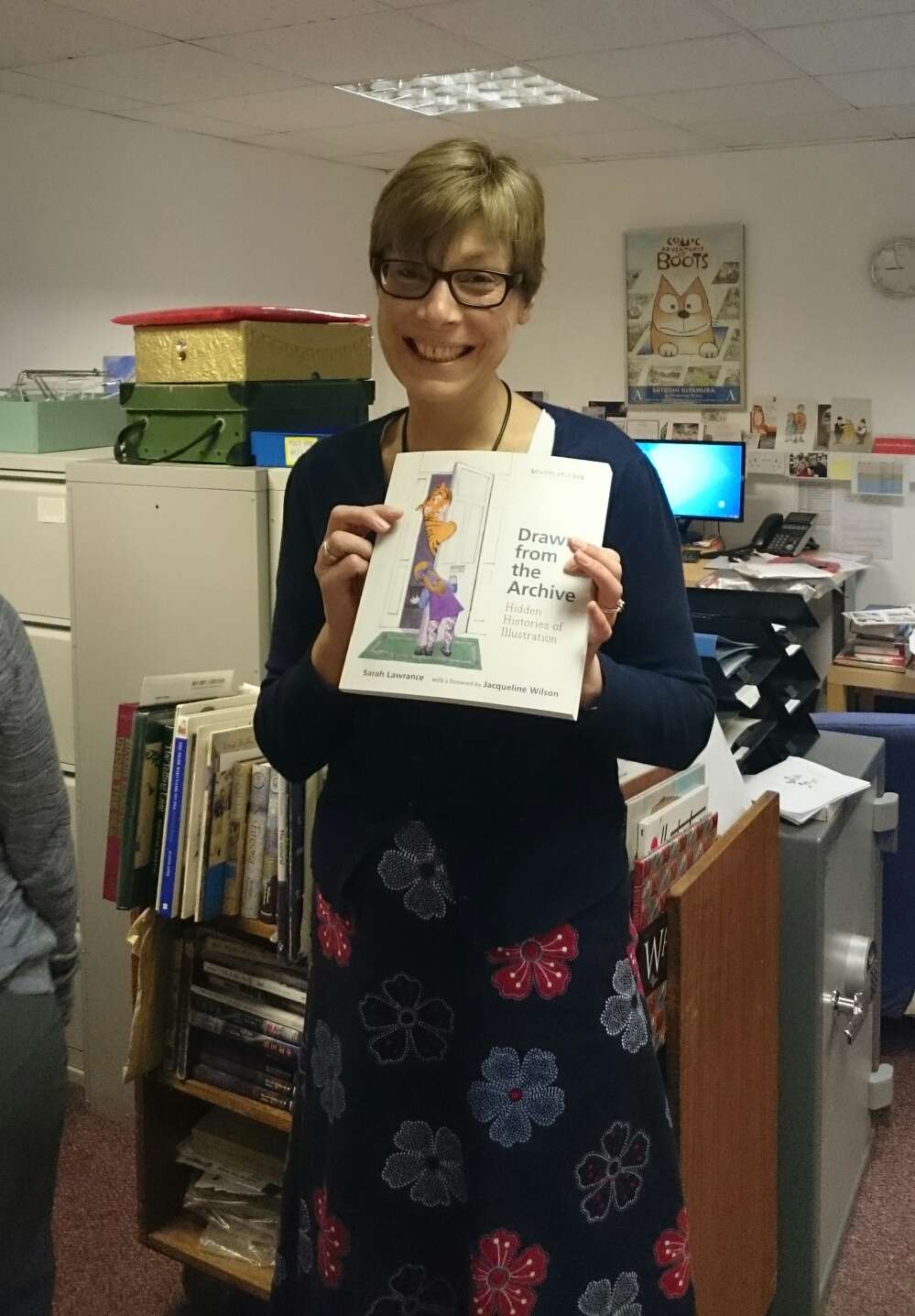
September 2015 - The first book to be written on the Seven Stories Collection arrived in advance copy. Here is the author, Sarah Lawrance (Collections and Exhibitions Director) holding it, possibly just a bit nervous to check the final print! Sarah worked on this book for a long time, pulling together the stories behind many of the collections of illustrations in the archive. Together with her editor, the superb Deirdre McDermott of Walker Books, and help from the team here, it was released to the public in October 2015, and is available to purchase on the Seven Stories website!
September 2015 - Seven Stories and Newcastle University welcomed Karen Sands-O’Connor  as Leverhulme Visiting Fellow for 2015/2016. Karen is Professor of English at Buffalo State College, New York, and specialises in children's literature, twentieth-century British literature, literature about and from the Caribbean, and literary criticism. She is working on a major research project on publishing for a Black British child audience, working extensively with the Seven Stories Collection, and will be giving a series of lectures focusing on this topic.
            ©Damien Wootten for Seven Stories, The National Centre for Children's Books
October 2015 - We announced the donation of the Michael Morpurgo Collection in a special event held at Seven Stories visitor centre, just after the AGM. Michael and his wife Clare Morpurgo spoke in conversation with Sarah Lawrance to an enthusiastic and delighted audience. The archive contains manuscripts, typescripts and other papers covering the entire literary career of Morpurgo to date, and will be on public display from July 2016 at Seven Stories, before going on a national tour. Photograph taken by Damien Wootten for Seven Stories. 
Phew! What a busy 12 months! 

To find out more about all the other awesome archives that are being explored this week, search for the following hashtags all over social media:

#explorearchives
#archiveselfie
#archiveslive
#yearinarchives
#archivesrock
#archiveanimals

And of course, don't forget to follow Seven Stories on Twitter and Instagram using the handle @7stories, or on Facebook by searching for 'Seven Stories, National Centre for Children's Books'.


Seven Stories was able to support the acquisition of the Barbara Firth, Clive King, Paul Stickland, Beverley Naidoo, Michael Morpurgo, Elisabeth Beresford and David Fickling archives through support from a Heritage Lottery Fund ‘Collecting Cultures’ grant. This has been awarded to Seven Stories in recognition of the museum’s national role in telling a comprehensive story of modern British children’s literature. For more information on our HLF Collecting Cultures project see: http://www.sevenstories.org.uk/news/latestnews/hlf.