It is #ExploreArchives week and to help explore#archiveanimals our KTP Associate Dr Jessica Medhurst discusses bears at Seven Stories and bears in children's books.
In February 2017 Seven Stories
will be opening a new exhibition all about bears in children’s books, which
means the exhibitions team is hard at work at the moment reading books about
bears, choosing items from the archive to go in it and speaking to authors and
illustrators about their work on bears.
For my part I’ve been doing a bit
of digging into the history of bears in literature and culture more widely,
including the Aesop’s fable ‘The
Travellers and the Bear’ (moral: be careful who you hit the road with), cartoon
bears (Rupert, Biffo
and Yogi),
Shakespeare’s famous stage direction ‘Exit,
pursued by bear’, and family favourites such as Winnie
the Pooh (1926, Methuen) and Paddington
Bear (Collins, 1958).
 |
| Original artwork by Robert Ingpen of the Hundred Acre Wood, from the well known series Winnie the Pooh written by A.A. Milne. Photograph © Seven Stories, The National Centre for Children's Books |
The association between bears and
childhood seems to be an obvious one, perhaps in part because so many of us had
(or have) teddy bears of our own. But
how did we come to turn this ferocious animal into a cuddly toy that’s our
bedtime protector from bad dreams and the dark?
And what other kinds of bears do we find in children’s books?
Teddy bears began their history
outside of books as an early twentieth-century phenomenon and were developed
simultaneously, in about 1905, in both America (by the Michtom
family, named after Teddy Roosevelt) and Germany (by the Steiff
company who had been making increasingly elaborate
animal-shaped pin cushions for a couple of years). They entered into wider culture quite
quickly: within 2 years the instrumental version of ‘The Teddy
Bear’s Picnic’ was composed (in 1907 – the lyrics were added in
1932) and in 1926 Winnie-the-Pooh was
published, cementing the place of the cuddly bear in children’s books.
Teddy bears are now a common attachment
toy in the UK but what do you do when it’s a bear that needs comforting, rather
than a child? That’s the problem
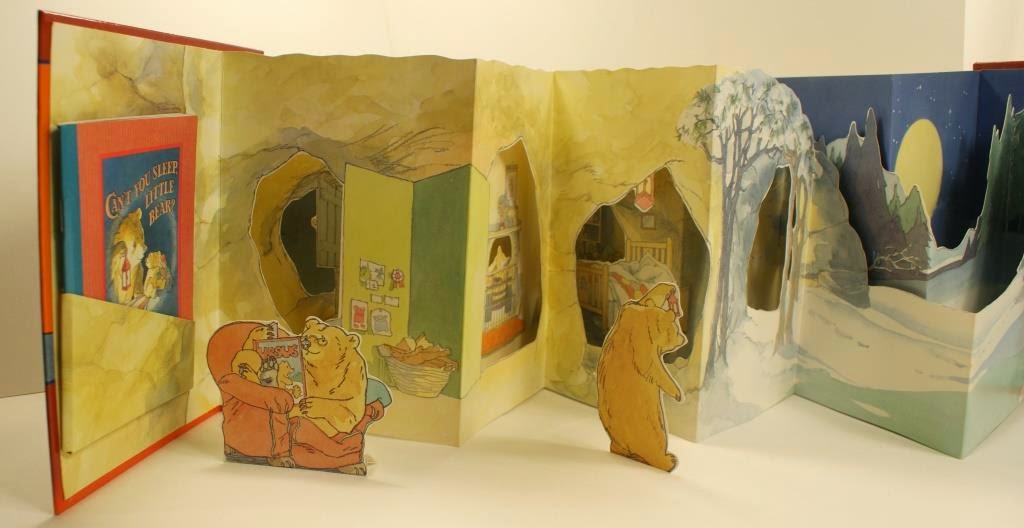
addressed in Martin Waddell and Barbara Firth’s Can’t You Sleep Little Bear? (1988, Walker). In a
bit of a role reversal, Firth’s illustrations of Little Bear’s attachment toys
look rather human, although it takes much more than a couple of toys to get him
to sleep.
 |
| Original artwork by Barbara Firth for 'Can't You Sleep Little Bear' (Walker, 1989), written by Martin Waddell. Photograph © Seven Stories, The National Centre for Children's Books |
The bears in Can’t You Sleep Little Bear? live in a cave but are very
domesticated (they have furniture and Big Bear is trying – desperately – to
finish his book) but not all bears in books are safe and cuddly.
Michael Rosen and Helen
Oxenbury’s We’re Going on a Bear Hunt (1989,
Walker), which is based on an American folk song, doesn’t involve guns or traps
but the bear at the end scares the family enough that they run home and hide in
bed. As you can see from this draft,
the text is quite simple but it’s what’s not
being said that tells us more.
 |
| Michael Rosen's annotated typescript draft of Michael Rosen and Helen Oxenbury’s We’re Going on a Bear Hunt (1989, Walker). Photograph © Seven Stories, The National Centre for Children's Books |
Michael’s
scribbled directions come out in Helen’s illustrations and
also his magnificent performances, like this one.
Of course, sometimes the humans
in the book deserve what’s coming to them, such as in the fairy tale Goldilocks and the Three Bears. I was surprised to learn that neither the
Grimm brothers nor Hans Christian Anderson recorded this story – the earliest known
version is by the Poet Laureate Robert Southey from 1837 (pp318-326 here,
with fabulous fonts for each of the bears), although it’s very likely that it will
have been told – and perhaps even published – before then.
 |
| Ladybird Edition of Goldilocks and the Three Bears (c. 1972) |
Like all fairy tales it’s been retold ever since, with authors changing Southey’s old lady Silver-Hair to a young girl Goldilocks by the end of the nineteenth century. The fairytale has had the Ladybird book treatment more than once, such as the 1972 version above, and Harold Jones illustrated Kathleen Lines’ Jack and the Beanstalk, A Book of Nursery Stories (OUP, 1960), as you can see in the dummy book below. As in Can’t You Sleep Little Bear the bear family here are a bit like hairy humans – in fact they’re perhaps better at being human than the thieving Goldilocks.
 |
Original dummy book artwork by Harold Jones for his 'Jack and The Bean Stalk' (Oxford University Press, 1960) edited by Kathleen Lines. Photograph © Seven Stories, The National Centre for Children's Books |
The relationship between bears
and humans in children’s books is by no means straightforward, something the
exhibition’s curators are getting their (human) teeth into. Sometimes the bears are ferocious, as in Little House in the Big Woods,
sometimes they’re cozy toys, as in Winnie-the-Pooh, and sometimes they’re a mixture of wild
and protector, as is the case with Philip Pullman’s Iorek Brynison in the His Dark Materials books.
All these bears and more will be
explored in the ‘Bears!’ exhibition; in the meantime, we want to know who your favourite book bears
are. Do you agree with this
Top Ten or is Hugless Douglas a family fave?
 |
| A 1922 Edition of Rudyard Kipling's Jungle Book (Macmillan and co) |
What about Baloo, Albert Bear or
John Betjeman’s faithful friend Archibald? You can leave your recommendations in the
comments below.