Showing posts with label exhibition. Show all posts

Tuesday, 22 November 2016

#HairyArchive Bears

It is #ExploreArchives week and to help explore#archiveanimals our KTP Associate Dr Jessica Medhurst discusses bears at Seven Stories and bears in children's books. 

In February 2017 Seven Stories will be opening a new exhibition all about bears in children’s books, which means the exhibitions team is hard at work at the moment reading books about bears, choosing items from the archive to go in it and speaking to authors and illustrators about their work on bears.

For my part I’ve been doing a bit of digging into the history of bears in literature and culture more widely, including the Aesop’s fable ‘The Travellers and the Bear’ (moral: be careful who you hit the road with), cartoon bears (Rupert, Biffo and Yogi), Shakespeare’s famous stage direction ‘Exit, pursued by bear’, and family favourites such as Winnie the Pooh (1926, Methuen) and Paddington Bear (Collins, 1958).

Original artwork by Robert Ingpen of the Hundred Acre Wood, from the well known series Winnie the Pooh written by A.A. Milne.  Photograph © Seven Stories, The National Centre for Children's Books


The association between bears and childhood seems to be an obvious one, perhaps in part because so many of us had (or have) teddy bears of our own.  But how did we come to turn this ferocious animal into a cuddly toy that’s our bedtime protector from bad dreams and the dark?  And what other kinds of bears do we find in children’s books?

Teddy bears began their history outside of books as an early twentieth-century phenomenon and were developed simultaneously, in about 1905, in both America (by the Michtom family, named after Teddy Roosevelt) and Germany (by the Steiff company who had been making increasingly elaborate animal-shaped pin cushions for a couple of years).  They entered into wider culture quite quickly: within 2 years the instrumental version of ‘The Teddy Bear’s Picnic’ was composed (in 1907 – the lyrics were added in 1932) and in 1926 Winnie-the-Pooh was published, cementing the place of the cuddly bear in children’s books.

Teddy bears are now a common attachment toy in the UK but what do you do when it’s a bear that needs comforting, rather than a child?  That’s the problem addressed in Martin Waddell and Barbara Firth’s Can’t You Sleep Little Bear? (1988, Walker).  In a bit of a role reversal, Firth’s illustrations of Little Bear’s attachment toys look rather human, although it takes much more than a couple of toys to get him to sleep.

Original artwork by Barbara Firth for 'Can't You Sleep Little Bear' (Walker, 1989), written by Martin Waddell.  Photograph © Seven Stories, The National Centre for Children's Books

The bears in Can’t You Sleep Little Bear? live in a cave but are very domesticated (they have furniture and Big Bear is trying – desperately – to finish his book) but not all bears in books are safe and cuddly.

Michael Rosen and Helen Oxenbury’s We’re Going on a Bear Hunt (1989, Walker), which is based on an American folk song, doesn’t involve guns or traps but the bear at the end scares the family enough that they run home and hide in bed.  As you can see from this draft, the text is quite simple but it’s what’s not being said that tells us more.  

Michael Rosen's annotated typescript draft of Michael Rosen and Helen Oxenbury’s We’re Going on a Bear Hunt (1989, Walker). Photograph © Seven Stories, The National Centre for Children's Books

Michael’s scribbled directions come out in Helen’s illustrations and also his magnificent performances, like this one.

Of course, sometimes the humans in the book deserve what’s coming to them, such as in the fairy tale Goldilocks and the Three Bears.  I was surprised to learn that neither the Grimm brothers nor Hans Christian Anderson recorded this story – the earliest known version is by the Poet Laureate Robert Southey from 1837 (pp318-326 here, with fabulous fonts for each of the bears), although it’s very likely that it will have been told – and perhaps even published – before then.  

Ladybird Edition of Goldilocks and the Three Bears (c. 1972)

Like all fairy tales it’s been retold ever since, with authors changing Southey’s old lady Silver-Hair to a young girl Goldilocks by the end of the nineteenth century.  The fairytale has had the Ladybird book treatment more than once, such as the 1972 version above, and  Harold Jones illustrated Kathleen Lines’ Jack and the Beanstalk, A Book of Nursery Stories (OUP, 1960), as you can see in the dummy book below. As in Can’t You Sleep Little Bear the bear family here are a bit like hairy humans – in fact they’re perhaps better at being human than the thieving Goldilocks.

Original dummy book artwork by Harold Jones for his 'Jack and The Bean Stalk' (

Oxford University Press, 1960) edited by Kathleen Lines. Photograph © Seven Stories, The National Centre for Children's Books


The relationship between bears and humans in children’s books is by no means straightforward, something the exhibition’s curators are getting their (human) teeth into.  Sometimes the bears are ferocious, as in Little House in the Big Woods, sometimes they’re cozy toys, as in Winnie-the-Pooh, and sometimes they’re a mixture of wild and protector, as is the case with Philip Pullman’s Iorek Brynison in the His Dark Materials books.
 
All these bears and more will be explored in the ‘Bears!’ exhibition; in the meantime, we want to know who your favourite book bears are.  Do you agree with this Top Ten or is Hugless Douglas a family fave? 

A 1922 Edition of  Rudyard Kipling's Jungle Book (Macmillan and co)

What about Baloo, Albert Bear or John Betjeman’s faithful friend Archibald?  You can leave your recommendations in the comments below.

Wednesday, 2 November 2016

500,000 Thank yous

Today HLF are celebrating their 500,000th National Lottery grant.  We'd  like to thank the National Lottery players who have helped to support half a million projects including our current HLF Collecting Cultures project. 

Since our last update a lot has happened at Seven Stories thanks to the HLF funding; we've opened new exhibitions, have been documenting our 2015 arrivals and have made some really exciting acquisitions into the collections.  So, in the spirit of celebration we want to share with you our 2016 Collecting Cultures achievements. 
Acquisitions 
Since January we have received seven acquisitions into the collection. These include 
Wombles artwork 
Artwork from two Wombles illustrators are now represented in our Collection and complement our existing Elisabeth Beresford Collection. 
We now hold a full suite of Oliver Chadwick's original pen and ink artwork for the 1970 title 'The Wandering Wombles'.  What makes this collection so fascinating are the Wombles themselves, they look nothing like the Wombles you may be imagining but seem more bear-like. 

Selection of artwork by Oliver Chadwick for Elisabeth Beresford's book 'The Wondering Wombles.' Photograph © Seven Stories – The National Centre for Children’s Books

The Wombles many people will be familiar with, those based on the design of the Ivor Wood television puppets, can be seen in our second acquisition. These are two pieces of final artwork by Barry Leith for the 1975 reissued edition of 'The Wombles'.  
'The Wombles' books had three illustrators Oliver Chadwick, Barry Leith (who also illustrated 'The Wombles at Work') and Margaret Gordon (who illustrated the other four).  


Selection of artwork by Barry Leith for the 1975 reissue of Elisabeth Beresford's book 'The Wombles.' Photograph © Seven Stories – The National Centre for Children’s Books

Kathleen Lines papers
Back in May we received Kathleen Lines papers which includes material relating to her editorial work, anthologies and talks.  Kathleen Lines was a librarian, critic and anthologist who is well known for her selection of classic fairy tales in Lavender's Blue.   Lines' papers are very well situated in our Collections at Seven Stories and help to support our current holdings. In 2008 we received Lines' book collection and we also hold a full suite of Harold Jones' artwork for Lavender's Blue (some of which you can see in our Rhyme Around the World exhibition).  

Ruth Gervis accrual

To build upon our existing holdings for Ruth Gervis we have acquired a box of original artwork, two notebooks and reviews. Already in our Collection is material associated with the book 'Ballet Shoes', illustrated by Ruth Gervis and written by her sister, Noel Streatfeild. We're very excited to start documenting the accrual!

Wes Magee

Wes Magee has published more than 100 books for young readers – fiction, poetry, plays, picture books, and anthologies - and he is now another great name represented in our Collections. We recently acquired eight boxes of material relating to his work and these are currently being processed by our Conservator before we begin documentation. 

Aidan Chambers 

The biggest acquisition of 2016, and probably in Seven Stories history is that of the Aidan Chambers Collections.  A total of 129 boxes were delivered to our store.  We're very excited about this collection; with its representation of Aidan's work, Thimble Press and Signal it offers a fantastic insight into Children's Literature and will no doubt be a rich resource for researchers.  


Selection of shelving containing the Aidan Chambers collection as it arrived earlier this year.  Photograph © Seven Stories – The National Centre for Children’s Books.


Those of you who are counting may have noticed that not all eight acquisitions have been described here - we have a few exciting surprises up our sleeve so keep your eyes open!

Cataloguing
                   
Michael Morpurgo
The catalogue may not be available online yet but so far we have catalogued material relating to
          • 39 Published titles
          • 10 Picture books
          • 24 different screenplays and adaptations
          • and 277 notebooks                                                                                                                   
Beverley Naidoo

The original delivery and later accrual of Naidoo's collection is now fully repackaged and fully catalogued - it is awaiting a few minor adjustments before you can find it online.


Selection of material from the Beverley Naidoo Collection Photograph © Damien Wooton for Seven Stories – The National Centre for Children’s Books.

Exhibitions

The Michael Morpurgo Collection arrived at Seven Stories in 2015 and by July 2016 we opened the doors to our spectacular Michael Morpurgo: A Lifetime of Stories exhibition which you can see at our Visitor Centre. 


Michael Morpurgo at the opening of his exhibition Michael Morpurgo: A Lifetime of Stories. Photograph ©  Seven Stories – The National Centre for Children’s Books.


Outreach

We don't like our Collections to sit on shelves for too long so some of our Collecting Cultures acquisitions have already been used in educational white glove sessions.  Most notably was Shotton Hall Academy's Beverley Naidoo project in 2015 which worked so well that we're currently planning a similar event using the same material.

Over the year we have shown Wombles artwork, 'Azzi in Between' artwork and Michael Morpurgo and Beverley Naidoo papers to illustration students, budding child writers, academics and researchers. 

Volunteers

Three Seven Stories volunteers hard at work in our store. Photograph © Damien Wooton for Seven Stories – The National Centre for Children’s Books.

At the beginning of 2016 we had five volunteers working on our Collecting Cultures projects - they numbered documents, listed and helped to re-house collections into purpose-made folders. Some of the projects they worked on included the Michael Morpurgo, Beverley Naidoo, Clive King, Gillian Cross and Elisabeth Beresford collections.  Our volunteer Jonathan wrote us a blog post about his experience listing the Clive King papers. 

Currently we have a work placement student from Newcastle University who is helping to sort the Elisabeth Beresford Wombles material as part of her course. 


It has been a busy year for our Collections and Exhibitions team and we look forward to updating you all on our future achievements.  Keep your eyes and ears open for more exciting acquisition announcements!


If you have any questions please email: collections@sevenstories.org.uk or phone: 0191 495 2707 or comment on this blog.

Tuesday, 19 July 2016

All About: (War) Horses


Spoiler Alert: this blog post discusses the end of Michael Morpurgo's War Horse.

Horses have been a mode of transport since at least 2000 BC but the horse that’s the focus of this blog post is much more recent than that: Joey from Michael Morpurgo’s WWI novel War Horse.  The book has become internationally well-known thanks, in part, to a stage production by the National Theatre (featuring spectacular horse-sized puppets) and to the Stephen Spielberg adaptation that came out in 2011. 


Seven Stories' own interpretation of Joey in our Michael Morpurgo: A Lifetime in Stories exhibition. Photograph © Seven Stories The National Centre for Children's Books. 
The Seven Stories exhibition, Michael Morpurgo: A Lifetime in Stories, opened on 2nd July and, of course, it features Morpurgo’s most famous book.  If you visit you’ll find Joey not only as he was first written down (in Morpurgo’s tiny handwriting) but also as he’s been imagined in film, for the stage, and in painting.

Early manuscript draft of Michael Morpurgo's War Horse.  Photograph © Seven Stories The National Centre for Children's Books. 
The novel is narrated by Joey and opens with him being sold at auction:

I was not yet six months old, a gangling, leggy colt who had never been further away than a few feet from his mother.  We parted that day in the terrible hubbub of the auction ring and I was never to see her again. (Page 3)

From here Joey meets Albert, the farmer’s son and they become best friends, until Joey is bought by the British Army and sent to the battlefields of the First World War.  Distraught, Albert joins up and promises to bring him home but it’s not until the end of the war that they’re finally reunited and return home to Devon together.

The Seven Stories archive contains a variety of material about War Horse: there’s the very first manuscript for the book, handwritten on lined paper; the shooting script for the Spielberg film, with its codename Dartmoor written at the top; and letters about the stage production’s transfer to Broadway and the changes the American team had made to the story. 


Various War Horse items from our Morpurgo collection on display at Seven Stories until 2nd July 2017. Photograph © Seven Stories The National Centre for Children's Books. 
But that’s not what this blog post is about.  I want to tell you about a version of War Horse that has an alternate ending – one that doesn’t end quite so happily ever after.

In the late eighties and early nineties Morpurgo collaborated with a producer, Simon Channing Williams, who made his name working with Mike Leigh on films such as Vera Drake and Secrets & Lies.  Channing Williams produced the adaptation of Why the Whales Came, starring Helen Mirren and Paul Scofield and, following this, worked with Morpurgo to get funding for an adaptation of War Horse. 

Papers in the archive show that the funders were initially sceptical of its appeal to children and wanted instead to go for the adult market.  In a report on one of the submitted scripts, Mary Davies, who was a reader for the European Script Fund (ESF), commented:

The writer has seems to have taken heed of comments on the earlier script that it appeared to be aimed at a young rather than an adult audience.  The happy ending and slight sentimentality of the earlier version, together with a greater emphasis on Joey the horse as a character, gave the script this slant.

From this feedback it seems that the ESF wanted a harsher or more realistic script without a happy ending and they encouraged the focus on Joey.
The next version of the script is still recognisable from the book, with an addition of a love story between Emilie and a German soldier (she is somewhat older in this version).  It continues along much the same lines until, that is, the final few pages. 

Just as in the novel, Joey is being sold at auction and, as in the book, the soldiers club together to buy Joey – but they don’t have enough money.  Not to worry, Emilie’s grandpere is also there, with a sack full of silverware to buy back Joey so he can live out his days resting on the farm.  Except the auctioneer won’t accept the silver, only cash.

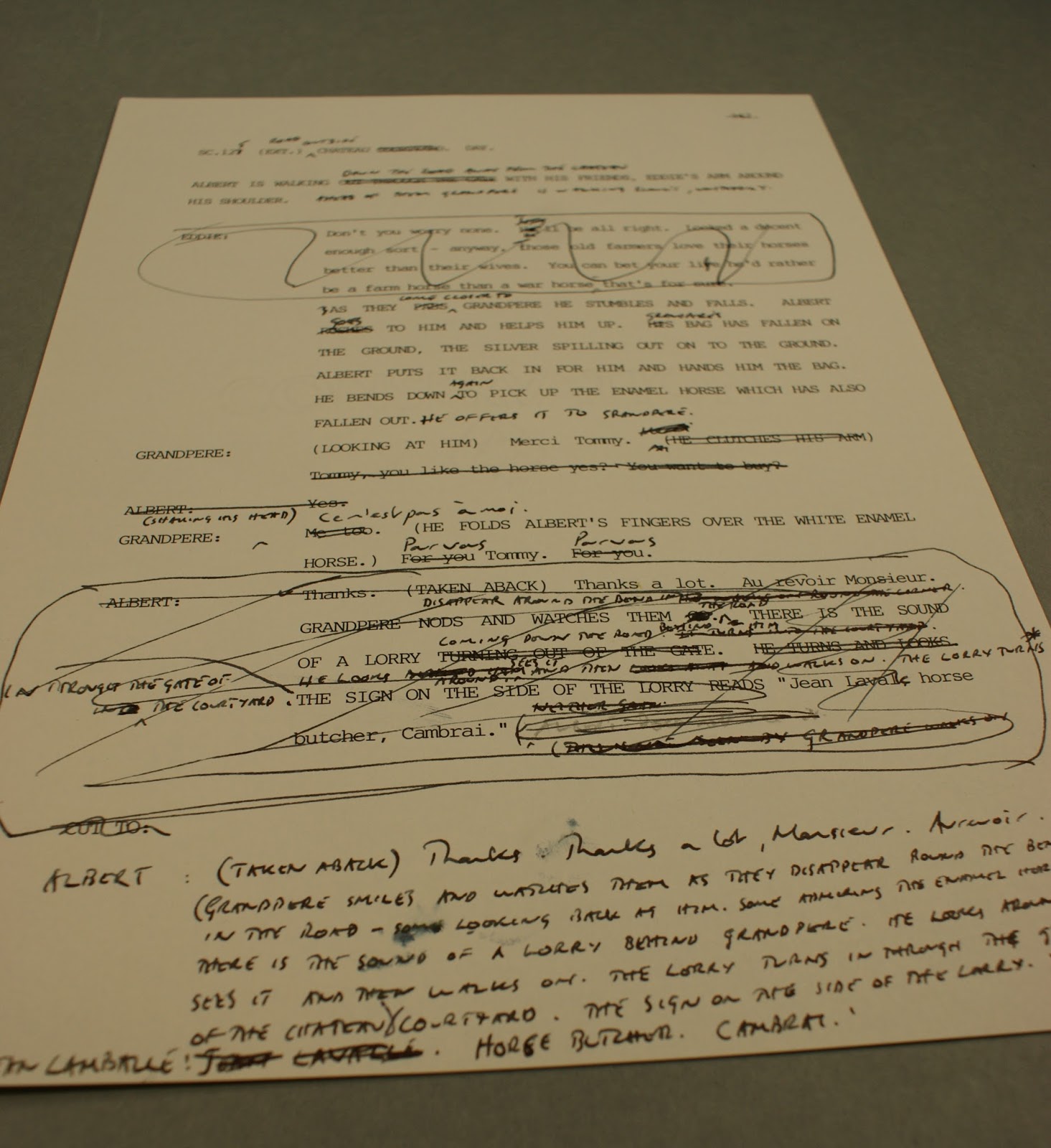
Enter Monsieur Lamballe of Cambrai, who makes his bid, wins Joey and pays in cash.  In the next scene, the third to last in the film, Emilie’s grandpere gives Albert an enamel horse pin to remember Joey by.  Then, as the soldiers leave, a van passes Grandpere.  On the side of it reads ‘Jean Lamballe.  Horse Butcher.  Cambrai’.  Joey has been sold for horse meat. 


Extracts from annotated typescript of War Horse by Simon Channing Williams MMo/06/06/03. Photograph © Seven Stories The National Centre for Children's Books. 
This is a more historically accurate ending (the British Army retained some horses after the end of the war but most that were still fit were sold locally to farmers and slaughterhouses) but it’s a big departure from the rural idyll ending of the novel.

The change raises the question about what’s at stake in Albert and Joey’s glorious return to Devon.  In the novel they’re celebrated and it’s a chance to reflect on the people and horses that died in the war:

And so I came home from the war that Christmas-time with my Albert riding me up into the village, and there to greet us was the Silver Band from Hatherleigh and the rapturous peeling of the church bells.  We were received like conquering heroes, but we both knew that the real heroes had not come home, that they were lying out in France alongside Captain Nicholls, Topthorn, Friedrich, David and little Emilie. (page 141)

The ending cements the comradeship between Albert and Joey: they were received equally, ‘like conquering heroes’, and they shared the knowledge that they weren’t the real heroes. 


But when it’s only Albert that returns the ending is bleaker and he doesn’t feel at home anymore: the script says ‘He seems bewildered by the welcome, detached’.  


Extracts from annotated typescript of War Horse by Simon Channing Williams (MMo/06/06/03). Photograph © Seven Stories The National Centre for Children's Books. 
And a summary of the script submitted to the ESF is even less hopeful: ‘Maisie seems like a stranger to [Albert] and it’s a while before he is able to embrace his mother with any real feeling.’

The homecoming of Joey with Albert at the end of the novel returns things to how they were for everyone else, even if the implication is that Joey and Albert know there’s a difference compared to their lives before the war.  The 1990s script makes the difference much greater. 

Although this film wasn’t eventually financed its inclusion in the Morpurgo archive provides researchers and readers with another version of War Horse that not only helps in learning about the process of adapting a book but also changes the way we think about the novel and raises questions that may not be obvious in the published version.

               - Dr Jessica Medhurst
                 KTP Research Associate

If you want to know more about horses in our collection take a look at All About: Horses.  You can also learn more about the Michael Morpurgo collection here.


If you'd like to find out more about the Seven Stories Collection, then 
email: collections@sevenstories.org.uk or phone: 0191 495 2707 or comment on this blog.


Wednesday, 4 May 2016

All About: Boats

Continuing our monthly transport themed blogs, Seven Stories Exhibition Curator David Wright explores the significance of boats in the work of Edward Ardizzone.

Last week, the Collections and Exhibitions team at Seven Stories, National Centre for Children’s Books was working full steam ahead to ensure that our new exhibition was shipshape and ready to open for bank holiday weekend.

The exhibition uses original artwork from the Seven Stories Collection to celebrate the eightieth anniversary of the publication of Little Tim and the Brave Sea Captain, the first picture book by one of Britain’s greatest illustrators, Edward Ardizzone.

Edward Ardizzone: 80 Years of Little Tim exhibition. 

Little Tim is Ardizzone’s most famous character, starring in a series of eleven picture books, published from 1936 – 1977. Originally created as a character to amuse his son Philip, Tim went on to become one of the great heroes of children’s literature, described by Maurice Sendak, creator of Where the Wild Things Are, as:

“A proper, courageous, if somewhat headstrong seven year-old who has an insatiable wanderlust and lives in a house by the sea…”

Seven Stories Collection © Edward Ardizzone Estate

Ships, the sea and adventures on the waves are at the heart of all of the Little Tim books, with many of Ardizzone’s own childhood experiences informing his stories.

As a boy, the young Ardizzone was engrossed by postcards sent from overseas by his parents, who travelled the world working on government service. He was also fascinated by a ship’s logbook written and illustrated by his Great Grandfather, who had captained a ship that sailed from London to Bombay and back in 1846 – 47.

Growing up at the coast in Ipswich, Ardizzone loved to play by the docks with his cousin Arthur, sneaking aboard the ships to explore, sometimes befriending the crew, sometimes being chased away. Later, Ardizzone lived in Deal, Kent, in a house close enough to the sea for the gentle music of the bands playing aboard passing cruise ships to drift through his bedroom window at night. This house, backing onto a long pebbly beach, is immortalised in his books as the home of Little Tim, and his friends Charlotte and Ginger.

Tim, Charlotte and Ginger outside Tim’s house.  Finished artwork from Tim and Charlotte (Oxford University Press 1951) Seven Stories Collection © Edward Ardizzone Estate

Little Tim himself certainly shares his creator’s enthusiasm for all things nautical. When not sipping grog with his friend Captain McFee or practicing his knots on the beach, Tim can be found spotting "Cunarders" through his telescope, making his plans to run away to sea.

Tim gets his wish in Little Tim and the Brave Sea Captain, sailing out with the old boatman, in a small motor boat memorably named Saucy Sue Walmer. Disaster is never far away in the Little Tim series and before long Tim is narrowly avoiding a one way trip to Davy Jones’ Locker.

Despite the danger of this first adventure, Tim is desperate to go to sea again and never struggles in finding work as a cabin boy. Always eager to help, throughout the series Tim can be found scrubbing decks and peeling potatoes, painting ships and delivering the captain’s dinner; even reading Moby Dick to the crew and writing love letters home for the ship’s cook.

Ardizzone used his childhood experiences to bring the lively atmosphere of ships and the camaraderie of their crew to life on the page. When Little Tim and the Brave Sea Captain was first published in New York, Ardizzone decided to make the journey across the Atlantic in a small, slow cargo boat, rather than a comfy cruise ship, as he felt more at home aboard ordinary working ships.

Finished artwork from Tim in Danger (Oxford University Press 1953) Seven Stories Collection © Edward Ardizzone Estate

Never exhausted by his daily chores, Little Tim always leaves time to avert catastrophe and save the day. A truly fearless hero, Tim is permanently on hand to rescue his friends (and the occasional ship’s cat) from the storms and shipwrecks that are par for the course in Ardizzone’s briny tales.

If reading this blog has helped you find your sea legs, why not visit Seven Stories this summer to see some of Ardizzone’s masterful original illustrations for yourself.


Edward Ardizzone: 80 Years of Little Tim is on show at the Seven Stories visitor centre until 18 September 2016.


If you'd like to find out more about the Seven Stories Collection, then 


email: collections@sevenstories.org.uk or phone: 0191 495 2707 or comment on this blog.

Thursday, 10 September 2015

The Big Prop Shop


This week the wonderful Cathy, our Visitor Services Coordinator talks about the time she spent with us all at collections in preparation for our Rhyme around the World and Painting with Rainbows exhibitions:


My job at Seven Stories is Visitor Services Coordinator which means I spend most of my time working with the Front of House team at the Visitor Centre on Lime Street. But when we closed for refurbishment in May I had nowhere to go! So I was really excited to be asked to come and join the Collections Team whilst the builders took over Seven Stories.

Seven Stories is a museum and like any museum we collect things. These “things” are known as artefacts and the artefacts we collect and look after are original illustrations and manuscripts from British children’s books from the 1930’s to the present day. No wait, we collect more than that. We collect author’s first ideas, notes and squiggles and illustrator’s doodles and scrawls. And we collect books. We collect lots of books. But there’s no point in them hidden away in our archive, we want people to see them. So, that’s where our exhibitions come in. 

The Seven Stories Visitor’s centre has three exhibition spaces where we hang all the beautiful illustrations and display the author’s notes, scribbles and manuscripts for everyone to look at. But not only that, we also have lots of activities and props to bring the pictures and books to life. And that was my job. I had to source and buy all of the props for the Michael Foreman exhibition; Painting with Rainbows and the nursery rhyme exhibition; Rhyme Around the World. This was going to be a shopping experience of a life time.

I worked alongside Alison, our Exhibition Curator and Gill our Senior Curator. Alison gave me a list of things she wanted for the exhibitions plus a budget. The budget was very important.

One of the areas I had to work on was Michael Foreman’s childhood home, or more specifically the living room. Michael grew up during World War 2 in a house that was also the village shop so the space had to look like it was the 1940’s. I’m a bit of a vintage lover and like to dress up in clothes inspired by this period in history, so I was really excited to be given the task of recreating this space. I read his book War Boy, looked closely at all the illustrations and scrutinised the text so I could decide on what needed to be included. I also made an awful lot of notes. 


There were so many things that I wanted to get, but remember that thing called a budget? Well, that meant that I only had a certain amount of money to spend so I had to do my shopping wisely. I also had to think about all the visitors who explore our exhibitions, some of whom are very young, so everything had to be safe to use. My list of ideas was huge, but Alison and Gillian kept me in check and we decided on a Morrison Shelter with a tea set, blankets for the shelter, and an old fashioned radio. When you visit do crawl inside the shelter, you might find some other things in there too. And don’t forget to switch on the radio.

This is Cathy in her Morrison shelter recreated for our Michael Foreman exhibition

Another unusual item I had to find was a tortoise. Michael wrote a fantastic story called The Amazing Tale of Ali Pasha based on the true story of Henry Friston, a 21 year old seaman who fought in the battle of Gallipoli and befriended a tortoise, Ali Pasha. Henry managed to smuggle the tortoise on board his ship and kept him hidden during the journey home. Michael knew Henry’s son who kindly loaned Seven Stories his father’s ditty box and Ali Pasha’s shell!  You can find out all about him in the exhibition.


For the Rhyme Around the World exhibition the biggest items I had to find were a pair of thrones fit for rhyming royalty. It took a long time on Ebay before I found the beautiful pair in regal gold that you’ll find in our exhibition, complete with a snoozing cat.


One of my favourite illustrations on display in Rhyme Around the World, and that I took inspiration from, is by artist Rebecca Cobb. It’s in the area all about food. Take a good look at it. You’ll find all the items that the children are playing with in the illustration, right there in our exhibition, for all our young visitors to play with too! The prop hardest to find was a spotty tea set, but I was determined to include it.


Other props I had to find were dinosaurs, cats and kittens, scruffy dogs, miles of ribbon, astronauts suits, sea creatures, buckets and spades, an arbour, crocheted blankets, a potty, crowns and tiaras, artists smocks, flickering  light bulbs, fluffy bean bags, pretend hay bales and lots and lots of flowers.


Over the following days all these things arrived in the post and we could hardly move for boxes and parcels. Every morning I’d have more things to unwrap; it was like all my birthdays and Christmas’s had come at once.

Then Gillian, Alison and the rest of the collections team had the really hard work of turning a whole year of planning and designing into actual exhibitions in just three weeks, ready for the re-opening of Seven Stories.

Now that I’m back working in the visitor centre, I’ve had so much fun watching all our visitors dress up and play with all the props and activities and become totally immersed in the world of children’s books. 

- Cathy, 
Seven Stories' Visitor Services Coordinator


If you'd like to find out more about the Seven Stories Collection, then 
email: collections@sevenstories.org.uk or phone: 0191 495 2707 or comment on this blog.

Monday, 6 July 2015

Seven Stories on Tour


As part of our touring programme which has seen Seven Stories exhibitions enjoyed by over a million visitors in venues around the country, it is Plymouth City Museum's turn to host the Enid Blyton exhibition. This popular exhibition has travelled to Plymouth following a successful run at the Beaney House of Art and Knowledge,  Canterbury where it was described as  "a blockbuster".

The objects and framed artworks were condition checked by a member of our exhibitions team before being packed in flight cases for transport.


A second condition check took place on arrival at the next venue and it was my turn to travel to Plymouth to do the checks.


Works were thoroughly examined for any change of condition before being carefully stored prior to installation.


I arrived at the museum to find everybody busy painting the walls from their customary white to Noddy's trademark red, yellow and blue. Most of the graphics were in place and more went up during my visit transforming the space into a wonderful sensory experience.


The Magic Faraway Tree was ready to have it's slippery slope added in anticipation of thousands of Blyton lovers sliding down it.


Toyland was taking shape ready for visitors to drive Noddy's car.


Since writing this blog on the train back from Plymouth, the exhibition has opened and runs till the end of August.

Mystery, Magic and Midnight Feasts – the Many Adventures of Enid Blyton  
Plymouth City Museum from Wednesday 17 June – Friday 28 August 2015