
Spoiler
Alert: this blog post discusses the end of Michael Morpurgo's War Horse.
Horses have been a mode of transport since at least 2000 BC
but the horse that’s the focus of this blog post is much more recent than that:
Joey from Michael Morpurgo’s WWI novel War Horse. The book has
become internationally well-known thanks, in part, to a stage production by the National
Theatre (featuring spectacular horse-sized puppets) and to the Stephen Spielberg adaptation
that came out in 2011.
 |
| Seven Stories' own interpretation of Joey in our Michael Morpurgo: A Lifetime in Stories exhibition. Photograph © Seven Stories The National Centre for Children's Books. |
 |
| Early manuscript draft of Michael Morpurgo's War Horse. Photograph © Seven Stories The National Centre for Children's Books. |
The novel is narrated by Joey and opens with him being sold
at auction:
I was not yet six months old, a gangling, leggy colt who had
never been further away than a few feet from his mother. We parted that day in the terrible hubbub of
the auction ring and I was never to see her again. (Page 3)
From here Joey meets Albert, the
farmer’s son and they become best friends, until Joey is bought by the British
Army and sent to the battlefields of the First World War. Distraught, Albert joins up and promises to
bring him home but it’s not until the end of the war that they’re finally
reunited and return home to Devon together.
The Seven Stories archive contains
a variety of material about War Horse:
there’s the very first manuscript for the book, handwritten on lined paper; the
shooting script for the Spielberg film, with its codename Dartmoor written at the top; and letters about the stage
production’s transfer to Broadway and the changes the American team had made to
the story.

 |
| Various War Horse items from our Morpurgo collection on display at Seven Stories until 2nd July 2017. Photograph © Seven Stories The National Centre for Children's Books. |
In the late eighties and early nineties Morpurgo collaborated
with a producer, Simon Channing Williams, who made his name working with Mike
Leigh on films such as Vera Drake and
Secrets & Lies. Channing Williams produced the adaptation of Why the Whales Came,
starring Helen Mirren and Paul Scofield and, following this, worked with
Morpurgo to get funding for an adaptation of War Horse.
Papers in the archive show that the funders were initially
sceptical of its appeal to children and wanted instead to go for the adult
market. In a report on one of the
submitted scripts, Mary Davies, who was a reader for the European Script Fund (ESF),
commented:
The writer has seems to have taken heed of comments on the
earlier script that it appeared to be aimed at a young rather than an adult
audience. The happy ending and slight
sentimentality of the earlier version, together with a greater emphasis on Joey
the horse as a character, gave the script this slant.
From this feedback it seems that the ESF
wanted a harsher or more realistic script without a happy ending and they
encouraged the focus on Joey.
The next version of the script is still recognisable from
the book, with an addition of a love story between Emilie and a German soldier
(she is somewhat older in this version).
It continues along much the same lines until, that is, the final few
pages.
Just as in the novel, Joey is being sold at auction and, as
in the book, the soldiers club together to buy Joey – but they don’t have
enough money. Not to worry, Emilie’s
grandpere is also there, with a sack full of silverware to buy back Joey so he
can live out his days resting on the farm.
Except the auctioneer won’t accept the silver, only cash.
Enter Monsieur Lamballe of Cambrai, who makes his bid, wins
Joey and pays in cash. In the next
scene, the third to last in the film, Emilie’s grandpere gives Albert an enamel
horse pin to remember Joey by. Then, as
the soldiers leave, a van passes Grandpere.
On the side of it reads ‘Jean Lamballe.
Horse Butcher. Cambrai’. Joey has been sold for horse meat.
This is a more historically accurate ending (the British
Army retained some horses after the end of the war but most that were still fit
were sold locally to farmers and slaughterhouses) but it’s a big departure from
the rural idyll ending of the novel.
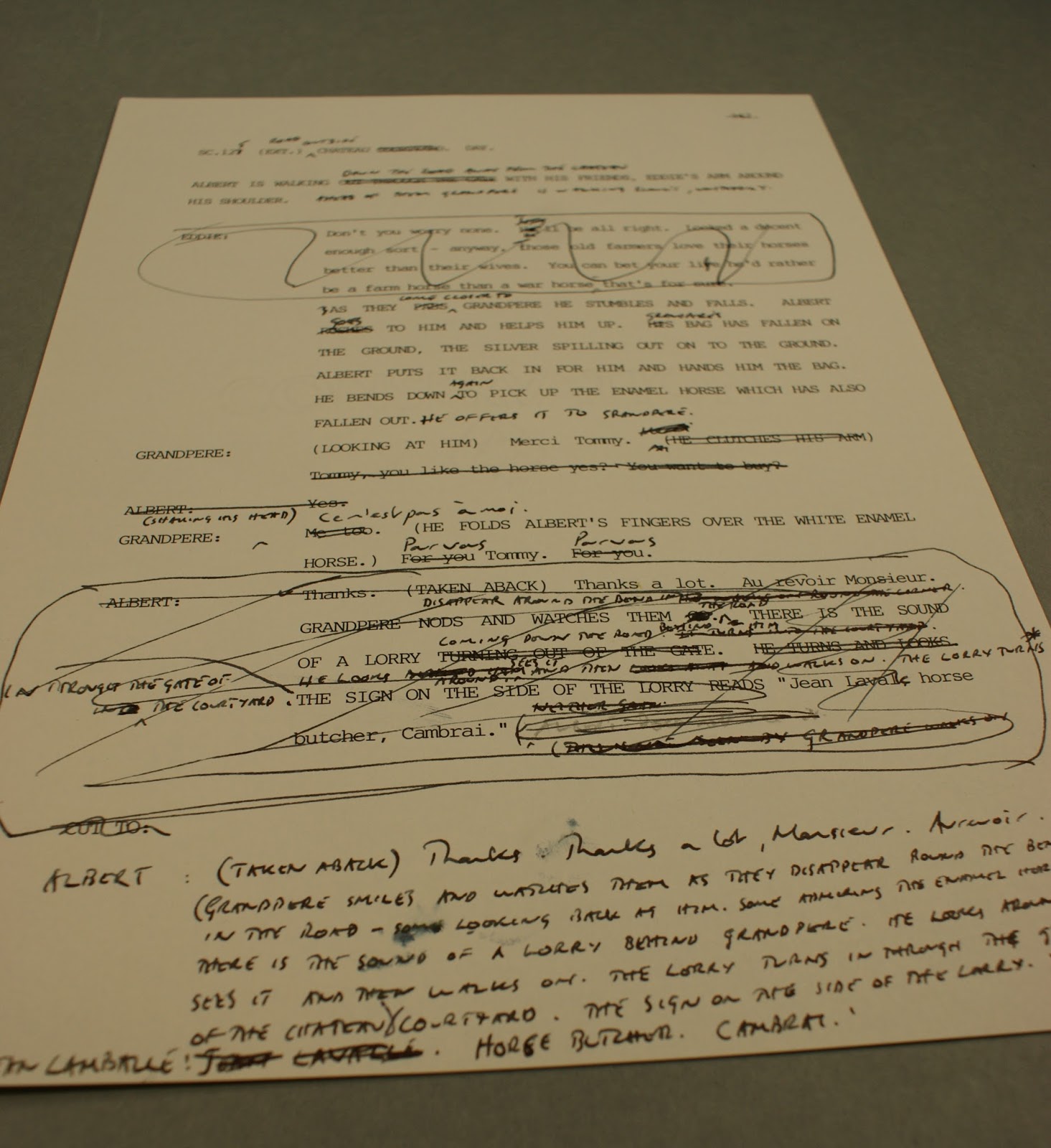 |
| Extracts from annotated typescript of War Horse by Simon Channing Williams MMo/06/06/03. Photograph © Seven Stories The National Centre for Children's Books. |
The change raises the question about what’s at stake in
Albert and Joey’s glorious return to Devon.
In the novel they’re celebrated and it’s a chance to reflect on the
people and horses that died in the war:
And so I came home from the war that Christmas-time with my
Albert riding me up into the village, and there to greet us was the Silver Band
from Hatherleigh and the rapturous peeling of the church bells. We were received like conquering heroes, but
we both knew that the real heroes had not come home, that they were lying out
in France alongside Captain Nicholls, Topthorn, Friedrich, David and little
Emilie. (page 141)
The ending cements the comradeship
between Albert and Joey: they were received equally, ‘like conquering heroes’,
and they shared the knowledge that they weren’t the real heroes.
But when it’s only Albert that returns the ending is bleaker
and he doesn’t feel at home anymore: the script says ‘He seems bewildered by
the welcome, detached’.
And a summary of the script submitted to the
ESF is even less hopeful: ‘Maisie seems like a stranger to [Albert] and it’s a
while before he is able to embrace his mother with any real feeling.’
 |
| Extracts from annotated typescript of War Horse by Simon Channing Williams (MMo/06/06/03). Photograph © Seven Stories The National Centre for Children's Books. |
The homecoming of Joey with Albert at the end of the novel
returns things to how they were for everyone else, even if the implication is
that Joey and Albert know there’s a difference compared to their lives before
the war. The 1990s script makes the
difference much greater.
Although this film wasn’t eventually financed its inclusion
in the Morpurgo archive provides researchers and readers with another version
of War Horse that not only helps in learning
about the process of adapting a book but also changes the way we think about
the novel and raises questions that may not be obvious in the published
version.
- Dr Jessica Medhurst
KTP Research Associate
If you want to know more about horses in our collection take a look at All About: Horses. You can also learn more about the Michael Morpurgo collection here.


If you want to know more about horses in our collection take a look at All About: Horses. You can also learn more about the Michael Morpurgo collection here.
If you'd like to find out more about the Seven Stories Collection, then
email: collections@sevenstories.org.uk or phone: 0191 495 2707 or comment on this blog.


