|
| Our Wombat lives in our Visitors Centre in Ouseburn, Newcastle |
‘I think I’ll go to the Collections today. I’ve been in this Gallery for a few months and I have seen all sorts of things. I’ve been picked up by many children and cuddled, I’ve been drawn and I have had stories written about me, I have wondered around and looked at a lot of pictures and a lot of beautiful words, but where did I come from?’
Wombat loves exploring, so with one of the Seven Stories Story Catchers as his guide (because Wombats don’t know how to use metros) he set off to find out where he came from and what he could learn from the archive that is the heart of Seven Stories, his new home.
‘Why am I a wombat and not a kangaroo?’
Wombat knows that Michael Morpurgo did alot of research to create him - some of it is included in the exhibition and some, like the draft and print outs below, are in the Seven Stories collection.
 |
| In our Michael Morpurgo exhibition we hold draft and research material for 'Wombat goes Walkabout' (Collins, 1995). Photography © Seven Stories – The National Centre for Children’s Books |
Wombat sat on the Story Catchers lap as they trundled along on the metro. She lifted him up to look out of the window and he saw the great expanse of river below. They travelled over the Queen Elizabeth II Bridge from Newcastle to Felling and walked the short little walk from the station to Design Works, where the collection lives. Wombat had seen all of the amazing pieces of artwork in the galleries and the old, coffee stained pages that have been written on by authors with scribbly blotchy pens and knew that the collections would be filled to the ceiling with so many of these.
 |
| You can find out what we have in our store via the online catalogue, highlights page and alphabetical list of people |
To little Wombat the shelves were so big and so long and seem to stretch on forever. He didn’t know where to start! But then his Story Catcher guide suddenly remembered an old friend she really wanted to see again; someone who had been in Seven Stories before she started working there and who had led her around the building many times. So they went to visit the Cat that once lived at Seven Stories.
His name is Browser and the man who drew him is called Satoshi Kitamura.
Meeting the Cat
 |
| Original artwork by Satoshi Kitamura depicting the character Browser the cat. Browser was designed for Seven Stories by Kitamura to appear on signage in Seven Stories' visitor centre, as a familiar mascot to guide visitors through the building. The series includes artwork relating to Kitamura's original commission in 2004; a second commission for new signage in 2008; and a third commission relating to a website redesign in 2010. Photography © Seven Stories – The National Centre for Children’s Books |
‘Hello. I am Wombat and I think a lot and dig a lot and explore a lot. Who are you and what can you do?’
‘Hello. I am Browser the cat.
 |
| Black and white, pen and ink line drawings by Satoshi Kitamura depicting Browser the cat as a storyteller, in various poses. The drawings were all inserted into an envelope, labelled in Kitamura's hand 'storyteller'. SS/SK/01/07 Photography © Seven Stories – The National Centre for Children’s Books |
I can do lots of things. I used to guide children and parents around Seven Stories. I liked tearing tissue paper with my claws to make collage crafts in the creation station and I liked dressing up in the Artist’s Attic under all of the flying books. I liked drawing and telling stories and eating in the café.
But that was when I was young. Now I’m old and I prefer to snooze in my box and read all of the stories on all of the shelves. There are enough in here to read for many lifetimes.’
 |
| Black and white, pen and ink line drawings by Satoshi Kitamura depicting Browser the cat as an illustrator, in various poses. The drawings were all inserted into an envelope, labelled in Kitamura's hand 'illustrator'. SS/SK/01/06 Photography © Seven Stories – The National Centre for Children’s Books |
But that was when I was young. Now I’m old and I prefer to snooze in my box and read all of the stories on all of the shelves. There are enough in here to read for many lifetimes.’
‘That sounds nice.’ Said Wombat, ‘But did you know the Creation Station is now the Studio and the Attic has been transformed into Diagon Alley?’
‘No I didn’t.’ Said Browser thoughtfully, ‘I wondered how much would change without me. I would like to visit again one day.’
‘I’m sure you will. I live there now, but one day I’ll come to live here with you. We can share lots of stories then.’
‘I would like that.’
 |
| In the second comission of artwork there are eight pieces of colour artwork by Satoshi Kitamura featuring Browser the cat, executed in pen and ink and watercolour. This piece shows Browser reading in the winged chair SS/SK/02/02 Photography © Seven Stories – The National Centre for Children’s Books |
Meeting the Bears
Wombat walked and walked, and everywhere he looked he saw something more interesting than the last. Then he heard someone saying
‘We’re going on a bear hunt. We’re going to catch a big one. What a beautiful day! We’re not scared.’
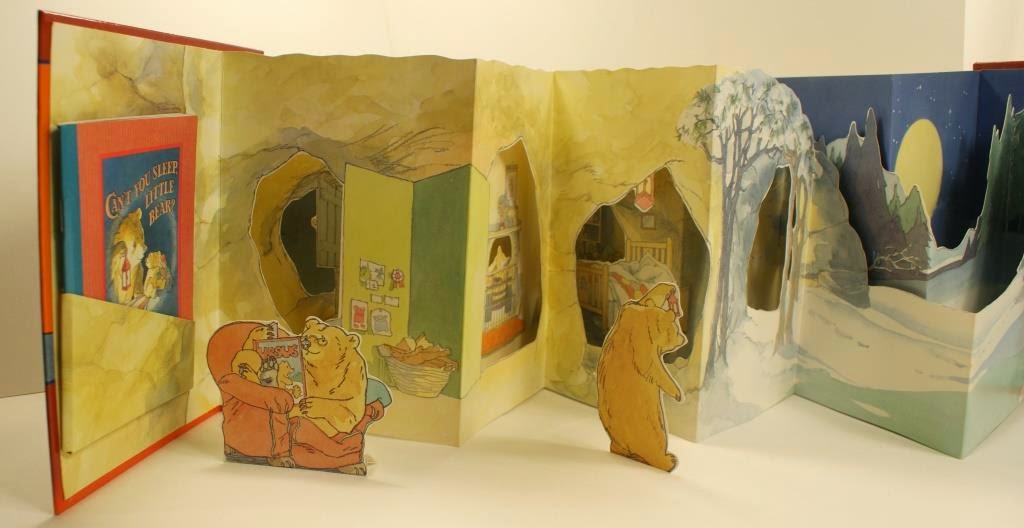
The Exhibition team were hunting for everything they could find about bears! And Wombat soon learned that it was because there will be a bear exhibition arriving at Seven Stories in February. They were all looking in one particular box marked Martin Waddell so wombat nudged his Story Catchers foot and she lifted him up to get a closer look at the box. Inside there were two very smiley bears and Wombat went over to the smallest one to investigate.

We have material in the Collection by author Martin Waddell and illustrator Babara Firth for 'Can't you Sleep Little Bear' (Walker, 1988). Seven Stories recently acquired a full suite of final artwork for this iconic book and develop work by Barbara Firth. Photograph © Seven Stories – The National Centre for Children’s Books
‘Hello. I am Wombat. Who are you and what can you do?’
‘Hello! I’m little bear and I can do a lot of things I think, like bounce around and play, but what I can’t do is sleep because I am too excited! Soon we will be in Seven Stories and we can meet loads of little boys and girls!’
‘Ah.’ Wombat said, ‘I can show you around. I know that place very well.’
Wombat looked at finished artwork from the bears story and typescripts and sketches and preliminary artwork and rough work. It was all very beautiful and Wombat felt that it helped him get to know little bear very well as he could see all the ideas that went into creating him. He waved goodbye to little bear and big bear and together they walked off into the watercolour night to look at a beautiful huge moon. He looked forward to seeing them again.
Meeting the Tiger
Next Wombat went to visit one of his favourite stories. A story that had been around for quite a long time and that his Story Catcher friend had grown up with. So they hunted out the box marked Judith Kerr.
 |
| We hold finished artwork and a small amount of preparatory material relating to 'The Tiger Who Came to Tea', written and illustrated by Judith Kerr and first published in 1968. This image shows final artwork obscured by the original overlay JK/03/01/02 Artwork © Judith Kerr Photograph © Seven Stories – The National Centre for Children’s Books |
Inside was a grinning tiger. There were all sorts of things in this box. Judith Kerr had spent time observing real tigers to draw her sketches so there were lots of tigers that were certainly not grinning. But Wombat was keen to meet the Tiger of his favourite story, so with white gloves on, they carefully took him out of the box.
‘Hello. I am Wombat. Who are you and what can you do?’
‘I am Tiger. I can eat a lot. I used to live in Seven Stories too, but I ate all the sandwiches in the café and all the soup from the kitchen and drank all the sweet drinks until there was nothing for all of the customers to eat or drink. And then I went on tour across the country and met loads of new people. I got to see Judith too, she was the lady who created me. When I finished visiting different Museums and Galleries they thought it best that I come to live here. There are still lots of biscuits and tea here, but at least I’m not eating food made for the visitors.’
‘That sounds like they made a wise decision. They now make white hot chocolates and Seven Stories…’ said Wombat, and his eyes glazed over as he remembered how sweet they were.
 |
| Our Judith Kerr exhibition included a large model tiger ready for tea. The exhibition finished touring earlier in 2016. You can see more items from the Judith Kerr highlight page. Photograph © Seven Stories – The National Centre for Children’s Books |
‘Oh really?’ said the Tiger, trying to imagine them. ‘Hmmm. I might have to visit Seven Stories again some time.’
Meeting the Wolf
‘These are so wonderful, but most people can read these books in shops everywhere. Why are these more special than the ones I can buy in the shop?’
 |
| This is a section of Robert Westall book collection which includes a number of translated editions. Our book collections are often donated alongside collections but we also hold ex-library and standalone collections. |
‘Well’ said the Collections Officer called Paula, ‘These books span hundreds of years. The oldest book in this collection is from 1770. We also house different versions of a lot of children’s books. You can see how the artwork on the covers change as time goes by and styles alter as different art forms become popular. You can also find books signed and collected by authors and publishers, books that were given as gifts from one illustrator to another which reveals friendships and connections across the literature world. You can find books you love in different languages and find out how important British Children’s Literature is to countries around the world. Context connects these books in a very magical way which makes this collection very important'
Then Wombat heard a snarl coming from a box.
‘Oh yes..’ Said Paula quietly, ‘And some books in here you would never find in a book shop.’
Paula pulled the box carefully from the shelf and opened it, lifting sheets of protective paper to reveal a very small, very delicate looking, hand-made book. The cover was made of soft black velvet-y material. There was no title. No writing on the spine. It all looked very ominous.
 |
 |
| Our Catherine Storr collections includes handmade books and dummy books like this one about Clever Polly and the wolf. If you are interested in learning more about Catherine Storr you can explore the The Catherine Storr Experience. CS/02/02 Photograph © Seven Stories – The National Centre for Children’s Books |
‘Hello. Who are you and what can you do…’ Wombat asked, keeping his distance.
‘Well, hello. I am The Hungry Wolf, and I can gobble you up!’ Said the tiny little wolf from the tiny little book. He certainly did look mean and scary, but he was also smaller than Wombat’s paw.
‘He can’t really hurt you.’ said Paula ‘This is what we call a Dummy Book. Writers and Illustrators make these little books to know how the words and the pictures will look on the page when the finished book is put together. Many authors such as Judy Brook, Helen Craig and Katherine Holabird create dummy books and we have lots of them in our collection. You would never find these in a bookshop.’
Wombat was very curious. He looked at the Wolf’s angry little eyes and thought it’s a very good thing he didn’t live at Seven Stories.
‘Thank you for showing me these.’ He said. ‘But I think we should put him away now.’
Time to go Home
Wombat let out a rather large yawn and then found himself being scooped up by his Story Catcher guide. ‘Time to head home I think’ she said. Wombat nodded. He had met a lot of interesting characters on his journey and felt that he had learned a lot. He had a lot to think about now, and a lot to tell the other animals in his gallery when he got home.
‘Yes. Wombats do like to sleep a lot, and I think it is time for me to do just that. But I am looking forward to our next adventure!’
- Charlotte Brumby, Story Catcher (and Wombat).
You can find Wombat in our Michael Morpurgo exhibition