This is the second post written by Paula Pintos. If you haven't read it already her post 'A Twit's story at Seven Stories' was very popular. Paula spent two months with us on an international student placement and did a huge amount of work for us. Here she gives an excellent account of the Book Collections at Seven Stories.
Possibly because my brain was trained to focus on librarian-y ideas, I had never considered the role of books in an archive, let alone a literary archive, before coming to Seven Stories for my work placement. That soon changed, though! On my very first day, Collection Officer Paula Wride introduced me to Seven Stories’ book collections, and I instantly found their role fascinating.
Possibly because my brain was trained to focus on librarian-y ideas, I had never considered the role of books in an archive, let alone a literary archive, before coming to Seven Stories for my work placement. That soon changed, though! On my very first day, Collection Officer Paula Wride introduced me to Seven Stories’ book collections, and I instantly found their role fascinating.
One of the first things I absorbed in my time at Seven Stories is that the whole collection grows strategically, in a Lego-like way, in the sense that acquisitions (mostly) follow a structured plan carefully devised to close gaps in areas of interest. Unlike, for instance, a public library, whose role is to offer a collection that fulfils its patrons’ current needs, changing and diverse as they may be. I realised archives collect items in order to build a coherent body of knowledge that is a legacy in itself. Do we have material in the archive that is linked to this potential purchase or donation? Do we already have the artwork for this author’s work? (This is how I picture things, anyway, it may or may not be an accurate portrayal of reality).
Also,
archives are (mostly) about preserving and sharing unique things, like an
annotated typescript of the first draft for, say, The Gingerbread Man. It is generally not in the nature of books to
be unique though, at least since the invention of the printing press! That is,
I think, why the book collection's role is often to complement the original
artwork and archival material in the collection. They provide a context and
show the final result of the creative process, along with subsequent reprints, revised
editions and even foreign language versions. (That is also why the books are
organised under the name of the donor, instead of some sensible,
straightforward system like - I don’t know - Dewey).
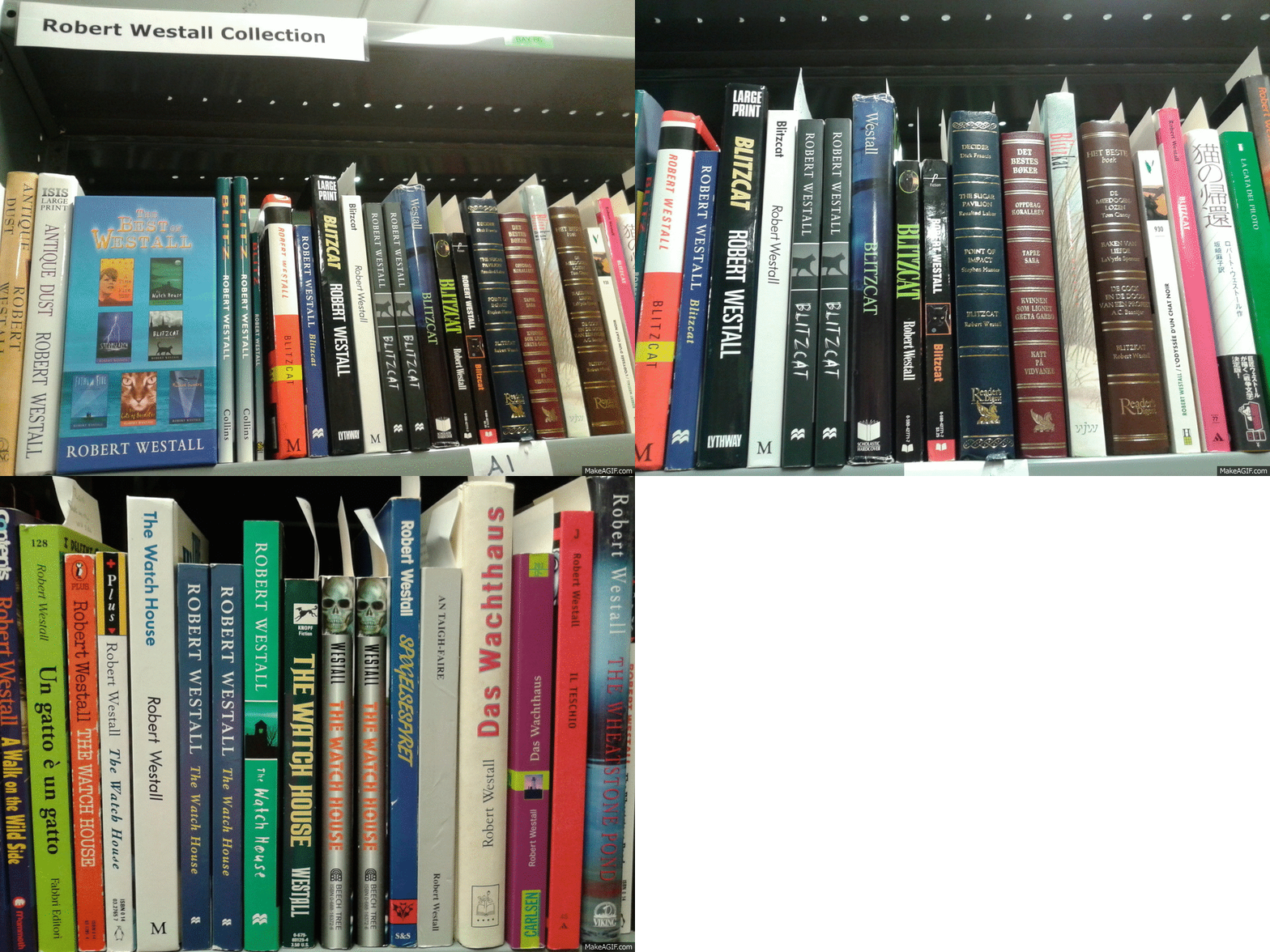 |
| Multiple British and foreign language editions of two of Robert Westall’s titles |
That was possibly not as clear as I thought it would be, actually. Let me give you some examples!
As I mentioned above, one of the roles book collections have in relation to the archive is to complement a parallel body of original archival material (drafts, notes, correspondence, and other exciting things). Kaye Webb’s and Faith Jacques’ collections are good examples of that, as you can read if you browse through the previous blog posts! I think Faith Jacques’ collection is particularly interesting because of the book collection it includes: books that she illustrated for other authors as well as her own titles; books that belonged to her own personal reading library; and most importantly, a huge number of ‘bookmarked’ reference books that she used for researching all the historical background, that would go into the astonishingly accurate and detailed illustrations she was renowned for by authors such as Leon Garfield. Thus, while the archival material provides a picture of Faith Jacques’ creative process as well as her personal and professional life, the book collection offers a glimpse into her own relationship with books as a researcher, an illustrator and a reader.

 Books
illustrated by Faith Jaques and some of the ‘costume’ reference books she used. Books
illustrated by Faith Jaques and some of the ‘costume’ reference books she used. |
Some
of the book collections, however, are not linked to archival material but stand
on their own merit. Sometimes because they consist of a substantial number of
books about a core ‘children’s book’ theme, or else because they open a window
into a particular era, a significant figure or publishing house of/in
Children’s Literature, or because they are unique, out of print or hard to find.
They also often offer really valuable information on the evolution of the
physical book from design, through printing techniques and marketing
strategies.
Possibly the strongest collections of this particular kind are Pat Garret’s and Thimble Press. The former includes ever-growing collections of alphabet books (585 and still growing!), as well as counting and number books from 1930 to 2010. The Thimble Press Collections, donated by Aidan and Nancy Chambers, include four different core topics for any children’s books collection: traditional tales (1300), pop-up books (72), children’s literature related reference books (270) and multiple editions of ‘Alice’ (25!)
Paula wrote a blog all about Thimble Press Traditional Tales Collection, so I suggest you read that first, because I have only been working with Thimble Press Children’s Literature Reference Books. In fact, I have been working with several reference book collections, and it has been fascinating. Seven Stories’ donors are often involved with children’s books in a professional way e.g. librarians and storytellers, publishers, editors, agents and reviewers, each of whom has a set of reference books. So, there is a strong body of reference material covering children’s literature through the centuries from all sorts of angles, including ideology and diversity in children’s books, literary criticism, literacy promotion and education, and biographies of significant figures in the genre.
Possibly the strongest collections of this particular kind are Pat Garret’s and Thimble Press. The former includes ever-growing collections of alphabet books (585 and still growing!), as well as counting and number books from 1930 to 2010. The Thimble Press Collections, donated by Aidan and Nancy Chambers, include four different core topics for any children’s books collection: traditional tales (1300), pop-up books (72), children’s literature related reference books (270) and multiple editions of ‘Alice’ (25!)
Paula wrote a blog all about Thimble Press Traditional Tales Collection, so I suggest you read that first, because I have only been working with Thimble Press Children’s Literature Reference Books. In fact, I have been working with several reference book collections, and it has been fascinating. Seven Stories’ donors are often involved with children’s books in a professional way e.g. librarians and storytellers, publishers, editors, agents and reviewers, each of whom has a set of reference books. So, there is a strong body of reference material covering children’s literature through the centuries from all sorts of angles, including ideology and diversity in children’s books, literary criticism, literacy promotion and education, and biographies of significant figures in the genre.
 |
| Thimble Press Children’s Literature Reference books. |
As you can imagine, while browsing through the book collections, questions and research ideas often leap at you from the shelves. They are less shy in person than manuscripts, hiding away in their minty coloured boxes. Still, the one book collection that I was shown on my very first day and, being the language nerd I am, am a bit sad to leave only half-explored, is Colin Ray’s Collection of International Children’s Books. This collection was originally built in the 1970s by Colin Ray (husband of Sheila Ray) and lecturer at the Department of Librarianship of Birmingham Polytechnic (later the University of Central England), in order to collect a sample of the foreign books that were being published around the world, to be used for reference by students of Librarianship and external researchers. It is comprised of more than 3,000 books and journals in various foreign languages including French, Spanish, Italian, Russian and Japanese, but also Afrikaans, Catalan, Czech, Danish, Dutch, Finnish, Hebrew, Hungarian, Persian, Malay, Polish and Swedish.

 |
The
Colin Ray Collection of International Children’s Books and some of the Spanish
titles.
|
This
book collection is a bit of a rarity in that it is not attached to an archive
and it is not about a particular core topic or a relevant figure, but it offers
a fascinating snapshot of what was published, both originally and in
translation, all around the world in a particular period. It is quite overwhelming,
I could only help to identify some languages (not as easy as it sounds with
about 50 of them!) and provide translations into English of book titles that
were not in the amazing original ‘old-school’ card catalogue.
 |
Colin
Ray’s card catalogue for the International Children’s Books arranged by
‘Author’, Country of publication’, ‘Language’ plus a volume of ‘British Books
in Translation’.
|
I am
not immune to its vintage charm, I must say, but what I enjoyed the most is
seeing how the Spanish and Catalan books are quite representative of the time, including
familiar names such as illustrator Luis
de Horna and author Ana María Matute, and finding a few typed translations of
some of the books texts, seemingly for informative purposes.
But moving away from the Spanish-language books, it is easy to notice some names again and again, with Christine Nöstlinger and Enid Blyton being particularly ubiquitous, and there is a stunning variety of illustration techniques and book designs. Even without being able to compare the contents of that chaotic Babelesque army of children’s books, nosing through the stacks highlights the cultural and social ingredients that go into defining what makes an edition appropriate or appealing for children. I think my 22 year-old self would have regarded this collection as Gringotts, minus the gnomes, so I really hope it sparks at least a handful of research projects on comparative literature and translation! Regardless of the languages you speak, there is bound to be something for you. And, you know, there’s always Enid!
But moving away from the Spanish-language books, it is easy to notice some names again and again, with Christine Nöstlinger and Enid Blyton being particularly ubiquitous, and there is a stunning variety of illustration techniques and book designs. Even without being able to compare the contents of that chaotic Babelesque army of children’s books, nosing through the stacks highlights the cultural and social ingredients that go into defining what makes an edition appropriate or appealing for children. I think my 22 year-old self would have regarded this collection as Gringotts, minus the gnomes, so I really hope it sparks at least a handful of research projects on comparative literature and translation! Regardless of the languages you speak, there is bound to be something for you. And, you know, there’s always Enid!
- Paula Pintos
If you'd like to find out more about the Seven Stories Collection, then
email: collections@sevenstories.org.uk or phone: 0191 495 2707 or comment on this blog.