Showing posts with label The National Archives. Show all posts

Monday, 16 November 2015

14 things you need to know about Seven Stories' Collection

This week is Explore Your Archive Week and archives across the UK will be taking part to #explorearchives and talk about the different collections we all hold.


1. We're a museum and an archive

We collect all sorts of material relating to children's books. Our collection includes drafts, correspondence, illustrations, dummy books and everything that goes into making a children's book. We also have objects - the odd cuddly toy, typewriter and model boat.  We have shell wombles too(!)

2. Seven Stories Collection is made up of over 140 archive collections. 

photograph by Damien Wooton
We started collecting in the mid-1990s and since then our Collection has grown at a phenomenal rate. We now hold over 1800 boxes of archives (housed across 300 metres of shelving). Last year we were awarded a Heritage Lottery Fund’s Collecting Cultures grant to expand our Collection further.


3. We hold original material by over 250 artists and authors.  


That’s roughly 135 authors, 123 illustrators, 5 critics, 4 editors and 2 playwrights. As we continue to acquire and catalogue new collections these numbers continue to grow. Have a look at the list of people represented in our collections (the list is constantly growing).

4. Our archive features work by many significant and household names 
Familiar names in our Collection include Enid Blyton, Philip Pullman, Robert Westall, Judith Kerr, Edward Ardizzone and Kaye Webb.

5. Our newest collection is Michael Morpurgo's

Last month we announced the arrival of Michael Morpurgo's collection.  Earlier this year, our Collections Director, Sarah, and Archivist, Kris, went on a trip to Michael's house in Devon to collect boxes and boxes of his work. 

6. Our first major acquisition arrived in 1997

Kaye Webb's collection consists of 55 archive boxes and 11 oversize boxes.  This collection is very well used and items have been used in many of our exhibitions.  Kaye Webb is a hugely important figure in British children's literature; in 1961 Webb became editor of Puffin Books and in 1967 she created the Puffin Club.

7. Our library is HUGE

photograph by Damien Wooton
Another way in which we can help to tell the story of Children’s books is through our incredible library. We hold around 35,000 books and as our archive collection grows so does the book collection.  We have early, rare, signed and first edition children's books.  We even have books annotated by the authors. 

8. We're interested in the whole process

From the very first notes to the fan mail we like to document the entire process of the creation of children's books.

9. We're the home of British children's literature

There are quite a few institutions around the world that collect children's literature archives but our collection is the most substantial archive of 20th Century British children's literature anywhere.

10. Our Collection is unique

We are the only institution in the world with a collecting policy dedicated to modern and contemporary British children's literature.

11. The first book about our Collections was published this year


Written by our Collection Director, Sarah Lawrence, Drawn from the Archive was published earlier this year. The book gives a behind-the-scenes look at sketches, storyboards, drafts and redrafts from some of the illustrators represented in our collections including Edward Ardizzone, Judith Kerr, Nick Sharratt and Polly Dunbar. 


12.  We don't like our collections to collect dust

We like to use them. Our expert team includes curators, librarian, archivist, researchers and touring coordinator.  We use the Seven Stories collection to create many of our exhibitions, to tour them, to provide research access, to blog, and to work with our other departments to create fantastic learning programmes.

13. We keep a Visitor's book


We welcome many authors and illustrators to our Collections so we keep a very interesting Visitor's book.  Our latest visitor was Jim Kay!

14.  We're taking over this week's social media

Join us on Twitter, and Instagram using the handle @7stories and on Facebook by searching for 'Seven Stories, National Centre for Children's Books' to #explorearchives with us. 


Friday, 13 November 2015

David Fickling Collection continued

You may have read our recent blog posts by our volunteer, Grace, about foraging for archival treasure in the David Fickling Collection.  I thought it would be a nice idea to continue the story.   

Stuck to the wall above my desk is a postcard of David Fickling. I have no idea where it came from but it was there when I arrived at Seven Stories in February.  It shows David Fickling pointing at us readers - ‘Readers: your DFB needs you’. I think this is definite incentive to keep on cataloging: the DFB collection needs me, and our volunteers too. 


David Fickling is a big name in Children’s literature, he is an editor and his name has lent itself as an imprint for both Scholastic and Random House. But, in 2014 David Fickling Books became an independent publishing house.  David seems to be a magnet for talent, he and his team have an eye for spotting amazing books and authors. 

Many of our collections at Seven Stories are from authors and illustrators which is fantastic but this collection shows another side to the story.  It helps to complete the picture, offering us a different insight into how those pencil scribbles, research materials and early drafts develop into neat more complete stories, and how an editor contributes to the creation of the final book that will fill the shelves of bookshops, homes and libraries. David Fickling’s collection represents a large number of author’s work including proof and draft manuscripts, often with editor’s comments.  It’s a goldmine of information and presents a great cross section of the industry in representing approximately 75 different writers.  As the collection unfolds we’re hoping to find cross over material with some of our other collections. However, we still have a lot of work to do in managing all of this information. I haven't even opened the boxes of correspondence that Grace discussed in her last post.


There are currently forty two archive boxes in the David Fickling Collection and as I work through each box the number is steadily increasing.  It is vast, and one of our largest collections at Seven Stories. The collection arrived earlier in the year and since then has undergone serval stages of archival processing by two of our wonderful volunteers.  

Firstly, Grace listed the materials and created a spreadsheet of content so that Kris (our Archivist) and I (the Collections and Exhibitions Assistant) had a better idea of what we had.  Listing a collection as it arrives makes it easier not only to locate material, but to see patterns of how materials are organised, what themes occur and what types of documents make up the bulk of the collection.  This information makes it easier to start thinking about how the final catalogue will be structured.

Then Jen came along as a student placement from Newcastle University's International Centre for Cultural and Heritage.  She used Grace’s original list to repackage everything. This is a very important stage, the original files and boxes need to be replaced with acid free materials, all corrosive metals are replaced with brass paperclips and the original file labels are recorded.  

Jen lending a hand and sorting the David Fickling Collection
Whilst repackaging Jen also reorganised.  She organised all of the files alphabetically by author, and arranged work by each author chronologically. This was a huge task and Jen spent much of her time at Seven Stories surrounded by files and boxes.  She also made the next step in processing much easier.  Jen had created a structure! 

All I have to do now is work my way through the lovely neat repackaged boxes and add everything to CALM.  For those of you not familiar with our archive-y terminology CALM (Collections Management for Archives, Libraries and Museums) is a massive database where we record everything that happens to our collections and every exhibition loan that comes through our door.  It’s also what we use to catalogue our collections.  

When we start to catalogue it’s really important that we keep people in mind.  It’s not just us archive-y folk and our volunteers that will use this catalogue but you -the researchers, the academics, and the enthusiasts - and our Seven Stories teams, our curators and our learning and participation team. There are a lot of uses for a collection like David Fickling’s and we need to have an idea of what they are, and what language and structures we need to use to make all of the important information easy to find.  At Seven Stories nothing sits on a shelf for too long. We believe that all of this work created and gathered by incredibly creative people should be shared with other creative people but this has to start with a comprehensive catalogue.

So, at the moment I am twenty-five boxes in and working hard.  It’s great fun to catalogue a collection like David Fickling’s because there is so much variation between files and though I know what is coming in a very practical sense (thanks to Grace’s listings and Jen’s labelling), there are still fun surprises. 


Original artwork by Paddy Mounter and book proofs for Tony Mitton's Riddledy Piggledy
When the catalogue is finished it’ll be made available online. However, if there are any interested researchers out there please do get in touch.


If you’re late to the exploration of the David Fickling collection check out the other diary entries written by our volunteer Grace.

Next week is The National Archives Explore your Archive Week.  So come explore our archives and join in the #exploreachives conversation.  Join us on Twitter, and Instagram using the handle @7stories and on Facebook by searching for 'Seven Stories, National Centre for Children's Books'.

If you'd like to find out more about the Seven Stories Collection, then 
email: collections@sevenstories.org.uk or leave a comment.


Seven Stories was able to support the acquisition from David Fickling through support from a Heritage Lottery Fund ‘Collecting Cultures’ grant, which has been awarded to Seven Stories in recognition of the museum’s national role in telling a comprehensive story of modern British children’s literature. For more information on our HLF Collecting Cultures project see: http://www.sevenstories.org.uk/news/latestnews/hlf.


Thursday, 12 November 2015

Foraging through Fickling’s Archive Part 3

If you’re late to the exploration check out the other diary entries written by our volunteer Grace .  This is Grace’s final forage into the Fickling collection. 

Next week is The National Archives Explore your Archive Week.  So come explore our archives and join in the #exploreachives conversation.  Join us on Twitter, and Instagram using the handle @7stories and on Facebook by searching for 'Seven Stories, National Centre for Children's Books'.

Part 3

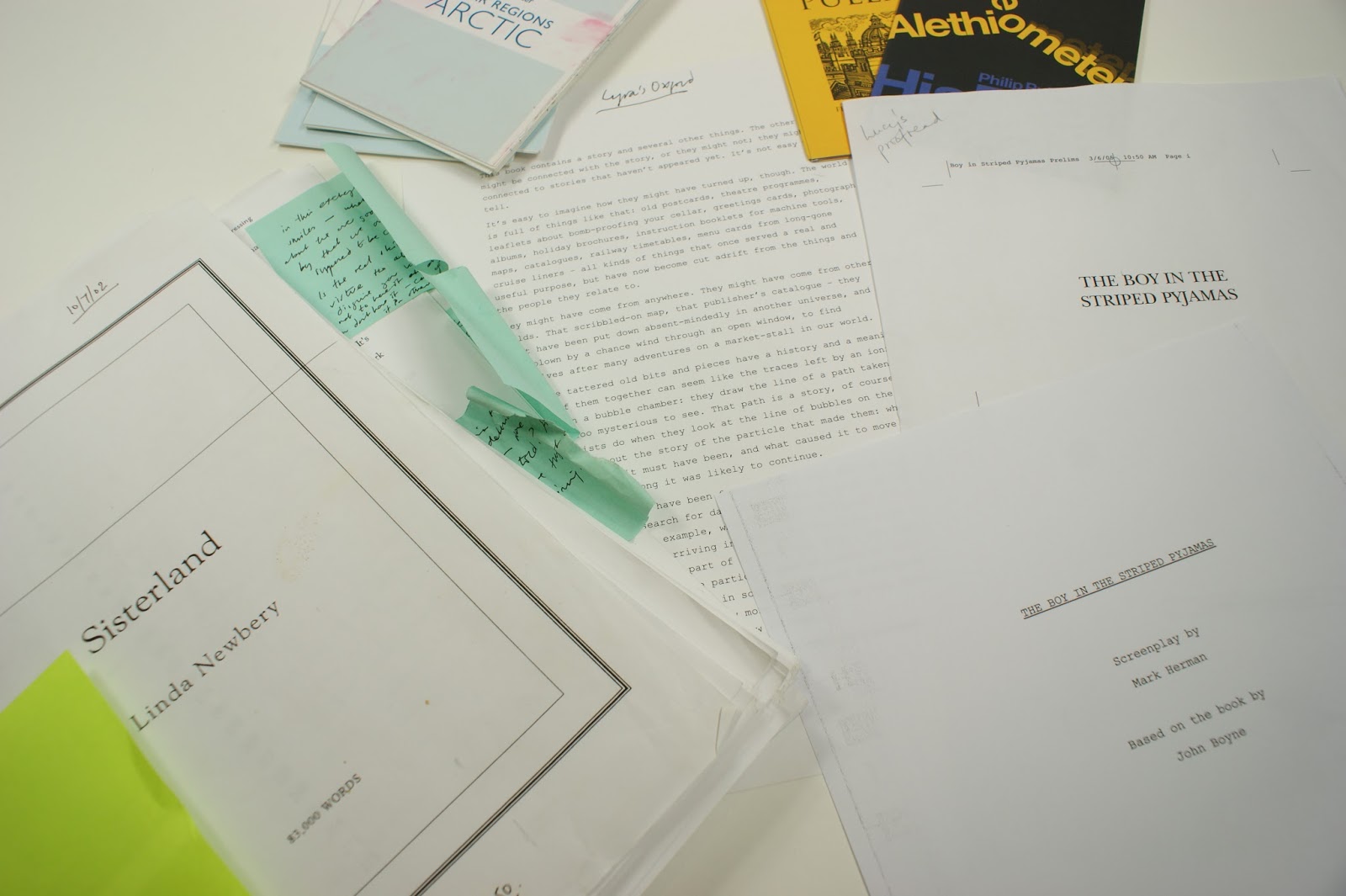
I managed to sort through the final few boxes today - they contained a massive array of little surprises. One box contained cover ideas, mock-ups and all the little extra bits of promotional material to go with several books such as Philip Pullman’s Lyra’s Oxford and Mark Haddon’s The Curious Incident of the Dog in the Night Time. In amongst these little gems were personal letters of Fickling’s that will have to be weeded out before the cataloguing process. 


The archive team have to ensure that all personal data is removed before making the archive available to the public. My main role in sorting through these boxes has been to gain an understanding, for the archivist, about what is actually there. The boxes were entirely unsorted and had not been looked at in some time, so it is no wonder there was so much interesting stuff. I have to say, although it is fantastic that Fickling donated so much material to Seven Stories, I can’t imagine, if I ever became famous enough, that I would be able to just hand over all my work! When looking I can clearly see the hours of work dedicated to the drafts, the time and effort dedicated to the editorial notes, the many letters between all the parties and I just feel like the archive contains a huge part of Fickling and his team’s life.  

- Grace Owens


Seven Stories was able to support the acquisition of David Fickling's archive through support from a Heritage Lottery Fund ‘Collecting Cultures’ grant. This has been awarded to Seven Stories in recognition of the museum’s national role in telling a comprehensive story of modern British children’s literature. For more information on our HLF Collecting Cultures project see: http://www.sevenstories.org.uk/news/latestnews/hlf.


Wednesday, 11 November 2015

Foraging through Fickling’s Archive Part 2

Our volunteer Grace continues her exploration of our David Fickling Collection. If you haven’t seen it yet, take a look at her first blog here. 

Next week is The National Archives Explore your Archive Week.  So come explore our archives and join in the #exploreachives conversation.  Join us on Twitter, and Instagram using the handle @7stories and on Facebook by searching for 'Seven Stories, National Centre for Children's Books'.


Part 2

Delving deeper into the boxes this week I came across a pile of papers which I personally thought were a bit boring – some of Fickling’s financial documents. Nothing major just a few bits of correspondence between illustrator and publisher with some figures nestled in there. I was a bit dismissive, these were not as exciting as the original material with lovely scribbles all over it, so I just sorted it into a box and labelled it. However later I discussed this with my tutor, just an off-the-cuff comment, and she illuminated how valuable this information can be. Apparently when it comes to actual facts and figures about who was paid what, how many books were published at the time and anything else of that nature, they are really hard to get hold of. As a researcher you need this kind of information to back up your claims, or to shed light on a particular book or author. Not so boring!

Letters, notebook and floppy discs from David Fickling's correspondence files
The day continued as before, I have probably enjoyed the rifling through letters, comments by editors, ideas by authors and illustrators a bit too much. I feel very nosy! I found some of the John Boyne The Boy in the Striped Pyjamas drafts and ideas for screenplay. I think it is really interesting to see the agent promoting John Boyne as an unknown author to the publishers – seeing how the dialogue works between the agent and publisher, how they advertise their client.  I found it quite funny to read the agent’s positivity about Boyne’s distressing story! This story was marketed at children and yet contains ideas and themes that are considered by many as controversial. However, it is still undeniably a highly successful book and now a film too. All of this is in post-it notes, letters and emails between all the parties, are all part of the story behind the story. 

- Grace Owens


Seven Stories was able to support the acquisition of David Fickling's archive through support from a Heritage Lottery Fund ‘Collecting Cultures’ grant. This has been awarded to Seven Stories in recognition of the museum’s national role in telling a comprehensive story of modern British children’s literature. For more information on our HLF Collecting Cultures project see: http://www.sevenstories.org.uk/news/latestnews/hlf.


Tuesday, 10 November 2015

Foraging through Fickling’s Archive Part 1


This has been an extraordinarily busy year for our collections team with the arrival of so many new collections. We are very pleased that among the new arrivals is the David Fickling collection. 

Over the next few days we'll be posting the archival adventures of our fantastic volunteer Grace.  She was one of the first to get to know David Fickling's collection.  Grace is something of a children's literature expert after completing her MLitt in Children's Literature so it seemed fitting that she should work on a collection that represents such a wide range of children's book titles. Her insight and perspective into our collections has been invaluable and we are very thankful for the work that Grace has done for us.  We wish her the best of luck in her new job, spreading the love of children’s books as a teacher.  

Part 1

Today I was delving deep into the higgledy-piggledy piles of David Fickling’s archive, which had just arrived in the collection department, essentially looking for treasure. David Fickling, for those who don’t know, is a children’s editor and publisher. He has worked for a wide range of publishers including Oxford University Press and Scholastic, subsequently setting up David Fickling Books as an imprint under Random House, before finally becoming an independent publisher. He’s published authors such as Linda Newbery, John Boyne and Philip Pullman – big names, so you can see why I was intrigued by the pile of papers before me.


To be honest though, I was equally intrigued by the process the pieces in the archive had to go through before they arrived mounted and framed perfectly preserved on Seven Stories’ exhibition walls. They had arrived in the past few days in plastic storage boxes, and we knew there would be some valuable stuff in there, but I was the lucky person who was allowed to explore. I literally had to find out what was in there, and sort, the boxes so that the team knew what they were dealing with. Someone once mentioned to me that often archives have a backlog of work that is measured in years and after seeing this one collection I can see why. The boxes held drafts and drafts of work hoping to be published. For example, Varjak Paw The Outlaw by SF Said had over 8 drafts, all slightly different, many with yellow sticky notes all over with edits, all of which will have to be stored and preserved carefully. The sorting out was just the start.

I am very interested, as a researcher of children’s literature, in how the author and the editor work together to be published. I want to know what children are allowed to read, what is deemed acceptable, who is more adventurous - the author or the editor? Consequently, the yellow sticky notes fascinate me!

Many of the typescript drafts have post-it note comments from editors.  This is a typescript of John Dickinson's A Cup of the World (David Fickling Books, 2004). The post-its will all be removed and flattened in melinex sleeves for preservation. 

Anyway what did I find…? I found, in amongst one of the preliminary drafts for Tony Mitton’s Wayland and a short story of Jamila Gavin’s, several documents relating to the film The Golden Compass. Aha – pure gold!

- Grace Owens.

Next week is The National Archives Explore your Archive Week.  So come explore our archives and join in the #exploreachives conversation.  Join us on Twitter, and Instagram using the handle @7stories and on Facebook by searching for 'Seven Stories, National Centre for Children's Books'.


Seven Stories was able to support the acquisition of David Fickling's archive through support from a Heritage Lottery Fund ‘Collecting Cultures’ grant. This has been awarded to Seven Stories in recognition of the museum’s national role in telling a comprehensive story of modern British children’s literature. For more information on our HLF Collecting Cultures project see: http://www.sevenstories.org.uk/news/latestnews/hlf.