Showing posts with label children's book adaptations. Show all posts

Friday, 24 October 2014

Guest Post: Brian Selznick gives a behind the scenes look at 'The Invention of Hugo Cabret'

Seven Stories current exhibition, Moving Stories, children's books from page to screen, has been on show since April 2014, and features some of the most well loved and innovative adaptations to grace our screens.

One of our absolute favourites is the Martin Scorsese adaptation of the beautiful book The Invention of Hugo Cabret!, written and illustrated by Brian Selznick. This area of the exhibition has been captivating visitors to the building for months, and the stunning display of costume and behind the scenes photos from the film has been a real highlight.


On the blog today, Brian has very kindly shared some new pictures of the creation of Hugo exclusively with the readers of the Seven Stories Collection blog. All the images and comments below are straight from Brian.

This is a view of the inside of my flat files, where I keep most of the Hugo drawings and dummies. This is dummy with a rough draft of the drawing of Isabelle. You can see how small they are by comparing them to the size of my hand in the photo. They are about 1/4 size of the book.
Image © Brian Selznick
This is the dummy with a sketch of Hugo from the beginning of the book.
Image © Brian Selznick
This is an actual drawing done by the real eighteenth century automaton that I researched for Hugo. The automaton can be found at the Franklin Institute, and when I first discovered him, he was no longer on display, as he'd broken many years earlier. While writing Hugo I met a mechanical genius named Andy Baron who helped me get all the clock and machine descriptions correct. I introduced Andy to the curators at the museum, and now the automaton is fixed and on display again.
Image © Brian Selznick
To find out more about the original automaton, named 'Maillardet's Automaton' click here 

And to see a film of Brian and Andy demonstrating the automaton actually drawing, click here. 
This is a rough sketch of Hugo winding the clocks. You can see notes I've written to Andy Baron asking if they machinery is correct, along with several other notes to my editor.
Image © Brian Selznick
Here is a sketch cut from the end of early drafts of Hugo, along with an early cover design. You can see that the title wasn't always The Invention of Hugo Cabret!
Image © Brian Selznick
Very few final pieces of art are cut from the finished book. Usually I remove drawings while they are still in the rough draft stage. But here is a finished drawing that didn't make it to the final story. Originally, when Hugo was walking across the graveyard to Melies's house, he was going to pass this gravestone with his own name on it. I hoped the reader might think for a moment that Hugo was a ghost, which would add to the mystery, and only later would we find out that Hugo's father had had the same name as him, and this Hugo Cabret was the dad's grave. But for obvious reasons I thought this might get a little confusing, so I cut it.
Image © Brian Selznick

To find out more about Brian Selznick, visit these websites www.theinventionofhugocabret.com and www.wonderstruckthebook.com.

For more information about the Moving Stories, Children's Books from Page to Screen exhibition, click here. The exhibition runs until April 2015.

Moving Stories was curated in partnership with the National Media Museum, to find out more about them, visit this link.

Wednesday, 28 May 2014

Moving Stories in the archive: 'The Machine Gunners' and the BBC

In this special blog post to coincide with our current exhibition Moving Stories: Children's Books from Page to Screen, we look at another children's book featured in our collection that has been adapted for the screen, Robert Westall's The Machine Gunners.

First published in 1975, The Machine Gunners was Robert Westall’s very first novel. The story follows a group of north east school children during the Second World War who manage to take the machine gun from a crashed German aircraft. Originally written for Westall’s son, Christopher (who later died in a tragic motorcycle accident), the book draws heavily upon Westall's own childhood on the north east coast (the book is set in fictional 'Garmouth', largely based on Tynemouth where Westall spent the war as a boy). Upon its release, The Machine Gunners was critically acclaimed and brought Westall the first of his two Carnegie Awards. The novel is still a much-loved classic and in 2007 made the list of top ten all time Carnegie winners.


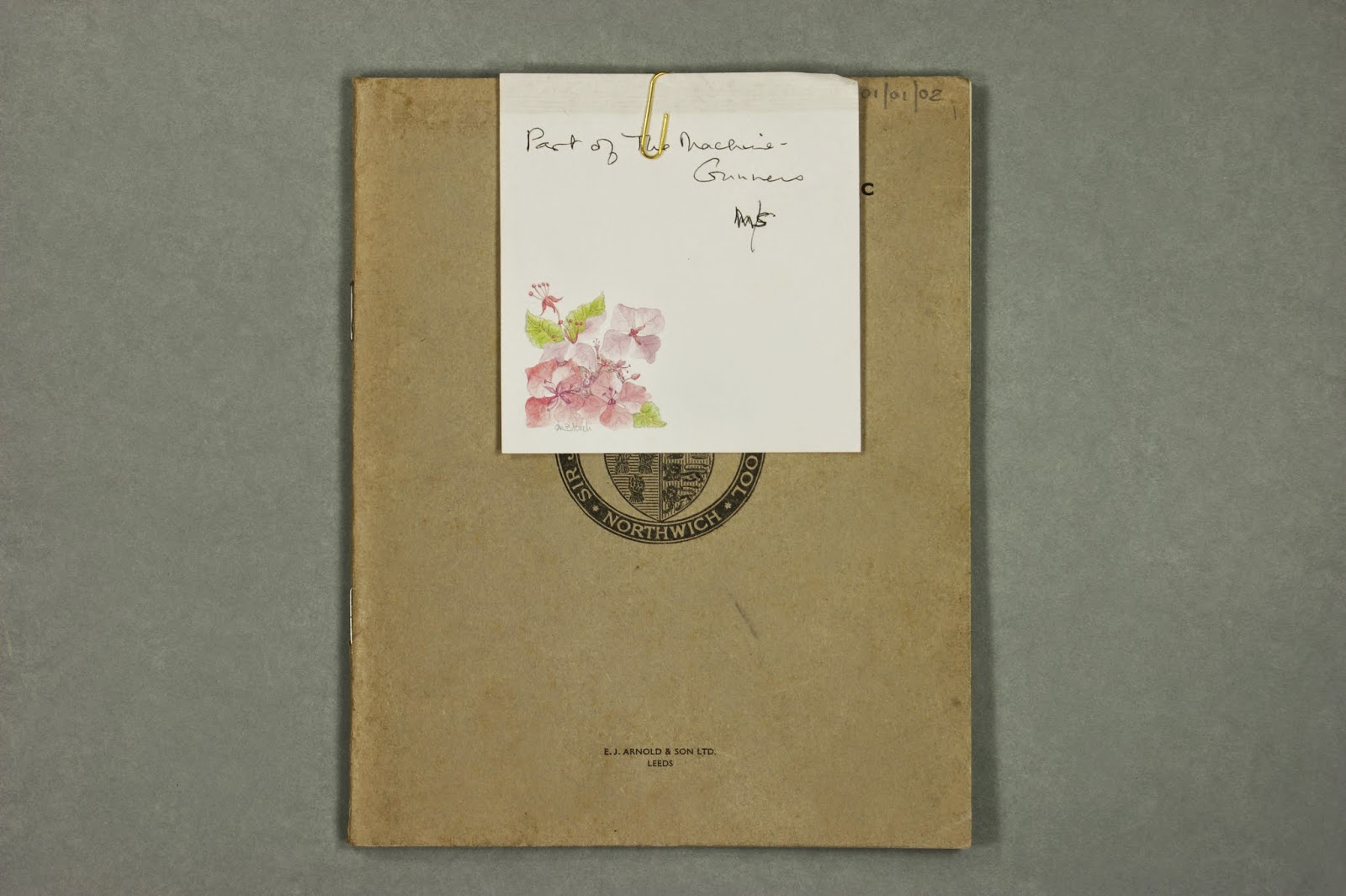
One of the notebooks in which Robert Westall wrote his manuscript for The Machine Gunners,
from the collection here at Seven Stories


In 1981, six years after the book's publication the production rights were bought by the BBC. Television drama made for children and young people was becoming increasingly popular at this time (Grange Hill had only just made its first appearance three years earlier in 1978) and television companies were eager for stories that had potential for serialisation. The much-loved and critically acclaimed, The Machine Gunners, presented an ideal opportunity for the BBC and they set out to secure the rights for a six part drama.


Letters from the BBC to Robert Westall about The Machine Gunners,
from the Robert Westall collection here at Seven Stories


The first episode aired on 23 February 1983. The script was written by another well-known writer originally from the north east, William Corlett - who, as well as being a script writer and playwright, produced a number of successful novels for children and adults. The series director was Colin Cant, a specialist in children's drama who, as well as serving for many years on Grange Hill, went on to direct other children's book adaptations including Moondial (by Helen Cresswell) and The Children of Green Knowe (by Lucy M. Boston).

The series was well received by audiences and is even now fondly remembered by many. Of the adaptation Robert Westall himself wrote:

"I quite approve of the TV serial made from 'The Machine Gunners'.   The script writer was William Corlett, who also writes children's novels.   He loved the book very much – perhaps too much, for he could not bear to leave many incidents out, and at times (as in the Mrs. Spalding incident with her knickers), things got a little rushed and blurred.   The fault lies with the BBC producers, who did not allow more than six episodes.   It takes about ten episodes to do justice even to a children's book, and they just don't seem to have the nerve to allow this many episodes."

('About 'The Machine Gunners'', http://www.robertwestall.com/the_machine_gunners_by_robert_westall.html)


Another of the notebooks in which Robert Westall wrote his manuscript for The Machine Gunners,
from the collection here at Seven Stories

In 2002, The Machine Gunners was again adapted by the BBC but this time for radio. The story has also appeared on stage - in 2011 a stage version was performed at Polka Theatre in London, commissioned by the Imperial War Museum.


The Robert Westall collection is available to consult by appointment at Seven Stories Collections Department. If you'd like to find out more about this collection or others that we hold you can
email: collections@sevenstories.org.uk or phone: 01914952707.

Material from the Seven Stories archive is currently on display at  an exhibition looking at the work of Robert Westall at the Friends of Weaver Hall Museum in Northwich, Cheshire: http://www.fowhm.org.uk/events/exhibition-robert-westall-a-writer-and-his-world/ 

If you'd like to find out more about other children's books adapted for the screen then why not visit our exhibition Moving Stories: Children's Books from Page to Screen at the Seven Stories visitor centre, Newcastle upon Tyne, until April 2015