Showing posts with label volunteer. Show all posts

Wednesday, 2 November 2016

500,000 Thank yous

Today HLF are celebrating their 500,000th National Lottery grant.  We'd  like to thank the National Lottery players who have helped to support half a million projects including our current HLF Collecting Cultures project. 

Since our last update a lot has happened at Seven Stories thanks to the HLF funding; we've opened new exhibitions, have been documenting our 2015 arrivals and have made some really exciting acquisitions into the collections.  So, in the spirit of celebration we want to share with you our 2016 Collecting Cultures achievements. 
Acquisitions 
Since January we have received seven acquisitions into the collection. These include 
Wombles artwork 
Artwork from two Wombles illustrators are now represented in our Collection and complement our existing Elisabeth Beresford Collection. 
We now hold a full suite of Oliver Chadwick's original pen and ink artwork for the 1970 title 'The Wandering Wombles'.  What makes this collection so fascinating are the Wombles themselves, they look nothing like the Wombles you may be imagining but seem more bear-like. 

Selection of artwork by Oliver Chadwick for Elisabeth Beresford's book 'The Wondering Wombles.' Photograph © Seven Stories – The National Centre for Children’s Books

The Wombles many people will be familiar with, those based on the design of the Ivor Wood television puppets, can be seen in our second acquisition. These are two pieces of final artwork by Barry Leith for the 1975 reissued edition of 'The Wombles'.  
'The Wombles' books had three illustrators Oliver Chadwick, Barry Leith (who also illustrated 'The Wombles at Work') and Margaret Gordon (who illustrated the other four).  


Selection of artwork by Barry Leith for the 1975 reissue of Elisabeth Beresford's book 'The Wombles.' Photograph © Seven Stories – The National Centre for Children’s Books

Kathleen Lines papers
Back in May we received Kathleen Lines papers which includes material relating to her editorial work, anthologies and talks.  Kathleen Lines was a librarian, critic and anthologist who is well known for her selection of classic fairy tales in Lavender's Blue.   Lines' papers are very well situated in our Collections at Seven Stories and help to support our current holdings. In 2008 we received Lines' book collection and we also hold a full suite of Harold Jones' artwork for Lavender's Blue (some of which you can see in our Rhyme Around the World exhibition).  

Ruth Gervis accrual

To build upon our existing holdings for Ruth Gervis we have acquired a box of original artwork, two notebooks and reviews. Already in our Collection is material associated with the book 'Ballet Shoes', illustrated by Ruth Gervis and written by her sister, Noel Streatfeild. We're very excited to start documenting the accrual!

Wes Magee

Wes Magee has published more than 100 books for young readers – fiction, poetry, plays, picture books, and anthologies - and he is now another great name represented in our Collections. We recently acquired eight boxes of material relating to his work and these are currently being processed by our Conservator before we begin documentation. 

Aidan Chambers 

The biggest acquisition of 2016, and probably in Seven Stories history is that of the Aidan Chambers Collections.  A total of 129 boxes were delivered to our store.  We're very excited about this collection; with its representation of Aidan's work, Thimble Press and Signal it offers a fantastic insight into Children's Literature and will no doubt be a rich resource for researchers.  


Selection of shelving containing the Aidan Chambers collection as it arrived earlier this year.  Photograph © Seven Stories – The National Centre for Children’s Books.


Those of you who are counting may have noticed that not all eight acquisitions have been described here - we have a few exciting surprises up our sleeve so keep your eyes open!

Cataloguing
                   
Michael Morpurgo
The catalogue may not be available online yet but so far we have catalogued material relating to
          • 39 Published titles
          • 10 Picture books
          • 24 different screenplays and adaptations
          • and 277 notebooks                                                                                                                   
Beverley Naidoo

The original delivery and later accrual of Naidoo's collection is now fully repackaged and fully catalogued - it is awaiting a few minor adjustments before you can find it online.


Selection of material from the Beverley Naidoo Collection Photograph © Damien Wooton for Seven Stories – The National Centre for Children’s Books.

Exhibitions

The Michael Morpurgo Collection arrived at Seven Stories in 2015 and by July 2016 we opened the doors to our spectacular Michael Morpurgo: A Lifetime of Stories exhibition which you can see at our Visitor Centre


Michael Morpurgo at the opening of his exhibition Michael Morpurgo: A Lifetime of Stories. Photograph ©  Seven Stories – The National Centre for Children’s Books.


Outreach

We don't like our Collections to sit on shelves for too long so some of our Collecting Cultures acquisitions have already been used in educational white glove sessions.  Most notably was Shotton Hall Academy's Beverley Naidoo project in 2015 which worked so well that we're currently planning a similar event using the same material.

Over the year we have shown Wombles artwork, 'Azzi in Between' artwork and Michael Morpurgo and Beverley Naidoo papers to illustration students, budding child writers, academics and researchers. 

Volunteers

Three Seven Stories volunteers hard at work in our store. Photograph © Damien Wooton for Seven Stories – The National Centre for Children’s Books.

At the beginning of 2016 we had five volunteers working on our Collecting Cultures projects - they numbered documents, listed and helped to re-house collections into purpose-made folders. Some of the projects they worked on included the Michael Morpurgo, Beverley Naidoo, Clive King, Gillian Cross and Elisabeth Beresford collections.  Our volunteer Jonathan wrote us a blog post about his experience listing the Clive King papers

Currently we have a work placement student from Newcastle University who is helping to sort the Elisabeth Beresford Wombles material as part of her course. 


It has been a busy year for our Collections and Exhibitions team and we look forward to updating you all on our future achievements.  Keep your eyes and ears open for more exciting acquisition announcements!


If you have any questions please email: collections@sevenstories.org.uk or phone: 0191 495 2707 or comment on this blog.

Thursday, 18 August 2016

The Clive King Collection

As part of our HLF Collecting Cultures project we recruited a team of  volunteers to help us list, repackage and number our new acquisitions.  One of these new and very exciting acquisitions which we haven't yet mentioned on the blog is our Clive King Collection.  King's collection came to us in 2015 and our hard working volunteer Jonathan Oscher has been creating detailed box lists of what we have. Here is  Jonathan's insight and overview of the collection so far: 

Clive King, author of the immortal Stig of the Dump, has left a collection of manuscripts, letters and cuttings to Seven Stories.  To classify and list the contents of all these boxes has been a long, though very absorbing, task with each box providing a new historical insights.  In fact the sheer volume of correspondence means that the archive provides a value over and above that of simply being a record of Clive King’s long literary career – impressive thought that is. 

First Edition of Clive King's Stig of the Dump with illustration by Edward Ardizzone. Photography © Seven Stories - The National Centre for Children's Books
It allows the reader or researcher a fascinating glimpse into the ebbs and flows of the literary world in the sixties, seventies and eighties.   Hence there are letters from legendary figures in or around the industry such as Lawrence Pollinger, Biddy Baxter and Kaye Webb.  There are the royalty and advance figures.  Even the procession of old letterheads and typefaces give a good history lesson.

 Selection of letters from Editors in the Clive King Collection. Photography © Seven Stories - The National Centre for Children's Books


One thing that becomes abundantly clear from a long reading of the contents of the archive is just how incredibly demanding publishers are (and seemingly have always been) with regard to the contents – particularly the factual contents – of children’s books.  In 1960 the American publishers Harper & Bros actually rejected Stig of the Dump because of the final chapter set on Midsummer’s night in which Barney and his sister Lou are transported back to Stig’s own time. Harper & Bros, clearly uncomfortable with the direct reference to time travel stated, in a letter, that here the story ‘grew weak, confused and unclear’.  That same chapter, however, is now an integral part of the book’s charm and appeal.

On the same topic, Kaye Webb – the legendary publishing brain behind the Puffin children’s label – writes to Clive King in 1965:

I really don’t think, Clive, that you, as a creative author, quite appreciate the amount of fussing over detail which has to be done with a child’s book.  ...  For instance an absolutely crackingly good book called THE CHILDREN was rejected out of hand in Australia because the author put a lyre bird in the wrong part of Australia and all the people who recommend children’s books ... took it off their lists because of this.

In December 1974, by the same token, Clive King received a letter from Patrick Hardy of Kestrel Books with no fewer than twenty suggestions for change in the book he had submitted for publication, Me and My Millions.   Point two of the twenty suggestions reads a little bizarrely : ‘I am a little unhappy about the transvestite element in the angels.’

Selection of Clive King's notebooks. Photography © Seven Stories - The National Centre for Children's Books
What makes the Clive King collection such a fascinating insight into the travails of being a children’s author is its warts-and-all quality, the feeling that the author has not carefully selected for the archive only the correspondence that is pleasing and flattering to himself.   This cannot help but add historical interest to the collection.  We become acquainted with the disappointments of authorship as well as the triumphs.

- Jonathan Oscher,
Seven Stories volunteer

Look out for further snippets of the Clive King Collection in later blog posts. 


If you'd like to find out more about the Seven Stories Collection, then 
email: collections@sevenstories.org.uk or phone: 0191 495 2707 or comment on this blog.

Seven Stories was able to support the acquisition of the Clive King collection through support from a Heritage Lottery Fund ‘Collecting Cultures’ grant. This has been awarded to Seven Stories in recognition of the museum’s national role in telling a comprehensive story of modern British children’s literature. For more information on our HLF Collecting Cultures project see:  http://www.sevenstories.org.uk/news/latestnews/hlf.


Friday, 8 January 2016

"Books have reference numbers too"

This is the second post written by Paula Pintos.  If you haven't read it already her post 'A Twit's story at Seven Stories' was very popular.  Paula spent two months with us on an international student placement and did a huge amount of work for us. Here she gives an excellent account of the Book Collections at Seven Stories. 

Possibly because my brain was trained to focus on librarian-y ideas, I had never considered the role of books in an archive, let alone a literary archive, before coming to Seven Stories for my work placement. That soon changed, though! On my very first day, Collection Officer Paula Wride introduced me to Seven Stories’ book collections, and I instantly found their role fascinating.

One of the first things I absorbed in my time at Seven Stories is that the whole collection grows strategically, in a Lego-like way, in the sense that acquisitions (mostly) follow a structured plan carefully devised to close gaps in areas of interest. Unlike, for instance, a public library, whose role is to offer a collection that fulfils its patrons’ current needs, changing and diverse as they may be. I realised archives collect items in order to build a coherent body of knowledge that is a legacy in itself. Do we have material in the archive that is linked to this potential purchase or donation? Do we already have the artwork for this author’s work? (This is how I picture things, anyway, it may or may not be an accurate portrayal of reality).

Also, archives are (mostly) about preserving and sharing unique things, like an annotated typescript of the first draft for, say, The Gingerbread Man. It is generally not in the nature of books to be unique though, at least since the invention of the printing press! That is, I think, why the book collection's role is often to complement the original artwork and archival material in the collection. They provide a context and show the final result of the creative process, along with subsequent reprints, revised editions and even foreign language versions. (That is also why the books are organised under the name of the donor, instead of some sensible, straightforward system like - I don’t know - Dewey).
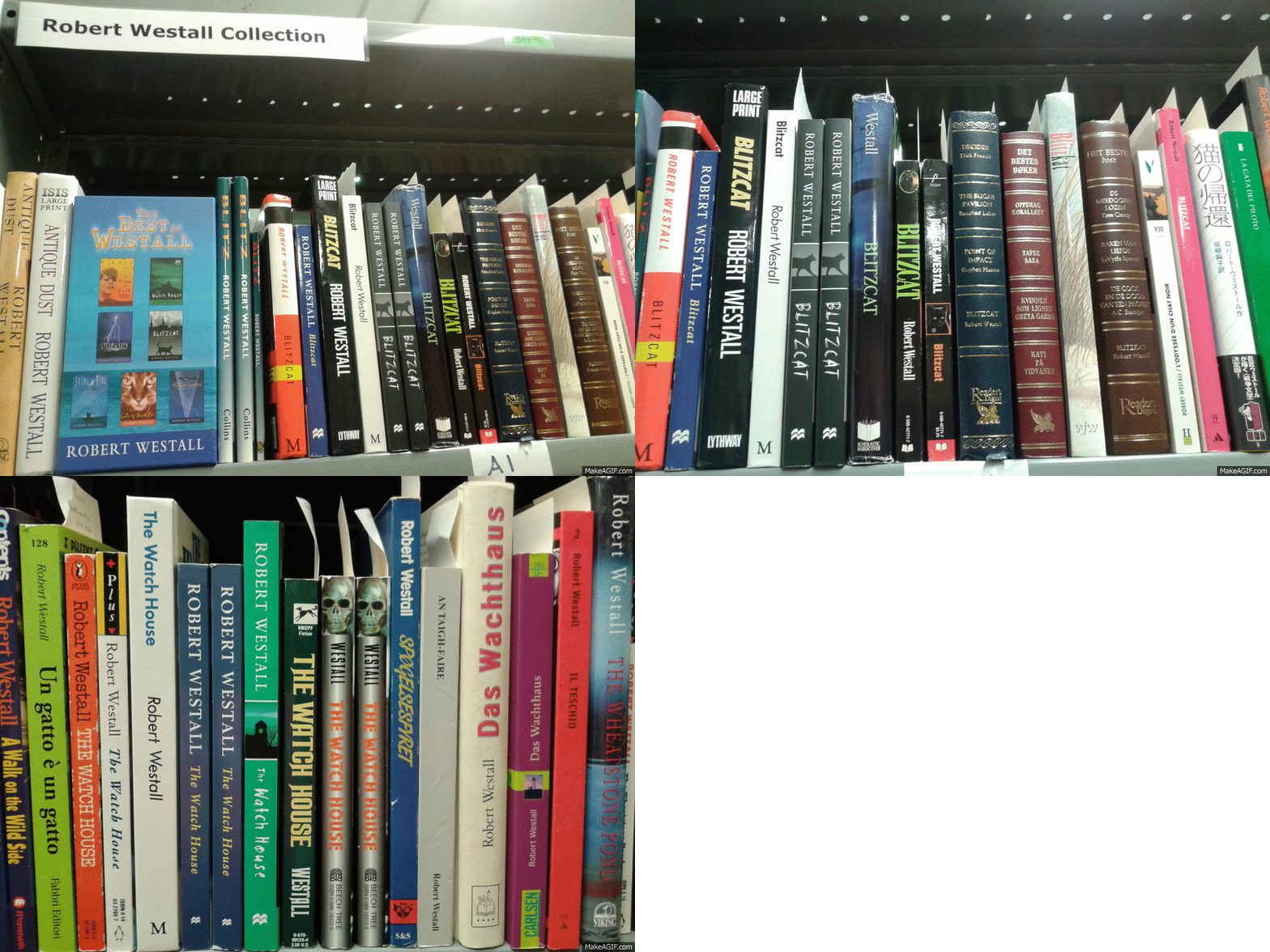
Multiple British and foreign language editions of two of Robert Westall’s titles
It’s important to respect the origin and the links between items, so that researchers are able to follow the crumb trails. The best way to express it that I could think of was to steal for the title the fifth law of library science written by Ranganathan, a librarian with an ability to express abstract ideas quite poetically. Libraries and archives are both growing organisms in their own particular way, and Seven Stories’ book collections are part of an archive, rather than a traditional library.

That was possibly not as clear as I thought it would be, actually. Let me give you some examples!

As I mentioned above, one of the roles book collections have in relation to the archive is to complement a parallel body of original archival material (drafts, notes, correspondence, and other exciting things). Kaye Webb’s and Faith Jacques’ collections are good examples of that, as you can read if you browse through the previous blog posts! I think Faith Jacques’ collection is particularly interesting because of the book collection it includes: books that she illustrated for other authors as well as her own titles; books that belonged to her own personal reading library; and most importantly, a huge number of ‘bookmarked’ reference books that she used for researching all the historical background, that would go into the astonishingly accurate and detailed illustrations she was renowned for by authors such as Leon Garfield. Thus, while the archival material provides a picture of Faith Jacques’ creative process as well as her personal and professional life, the book collection offers a glimpse into her own relationship with books as a researcher, an illustrator and a reader.


Books illustrated by Faith Jaques and some of the ‘costume’ reference books she used.
Some of the book collections, however, are not linked to archival material but stand on their own merit. Sometimes because they consist of a substantial number of books about a core ‘children’s book’ theme, or else because they open a window into a particular era, a significant figure or publishing house of/in Children’s Literature, or because they are unique, out of print or hard to find. They also often offer really valuable information on the evolution of the physical book from design, through printing techniques and marketing strategies. 

Possibly the strongest collections of this particular kind are Pat Garret’s and Thimble Press. The former includes ever-growing collections of alphabet books (585 and still growing!), as well as counting and number books from 1930 to 2010.  The Thimble Press Collections, donated by Aidan and Nancy Chambers, include four different core topics for any children’s books collection: traditional tales (1300), pop-up books (72), children’s literature related reference books (270) and multiple editions of ‘Alice’ (25!) 

Paula wrote a blog all about Thimble Press Traditional Tales Collection, so I suggest you read that first, because I have only been working with Thimble Press Children’s Literature Reference Books. In fact, I have been working with several reference book collections, and it has been fascinating. Seven Stories’ donors are often involved with children’s books in a professional way e.g. librarians and storytellers, publishers, editors, agents and reviewers, each of whom has a set of reference books.  So, there is a strong body of reference material covering children’s literature through the centuries from all sorts of angles, including ideology and diversity in children’s books, literary criticism, literacy promotion and education, and biographies of significant figures in the genre. 
Thimble Press Children’s Literature Reference books.
The Thimble Press Reference Books Collections includes 383 books mainly published between the 1940s and 2010. It covers many areas, but it is particularly strong in early children’s literature, biographies of authors and illustrators (such as C.S. Lewis and Edward Ardizzone), and booklists/annual book guides, including both bibliographies of award-winning books and recommended books, from influential librarians and critics such as Elaine Moss and Naomi Lewis. Since the collection covers such a long period, we can also note research topics changing and becoming more contemporary. For instance, the 70s seem to have brought a new wave of literary criticism centered on social matters, and so Aidan and Nancy Chambers also collected books on how children’s books are affected by class, gender, diversity or the construction of the concept of childhood.

As you can imagine, while browsing through the book collections, questions and research ideas often leap at you from the shelves. They are less shy in person than manuscripts, hiding away in their minty coloured boxes. Still, the one book collection that I was shown on my very first day and, being the language nerd I am, am a bit sad to leave only half-explored, is Colin Ray’s Collection of International Children’s Books. This collection was originally built in the 1970s by Colin Ray (husband of Sheila Ray) and lecturer at the Department of Librarianship of Birmingham Polytechnic (later the University of Central England), in order to collect a sample of the foreign books that were being published around the world, to be used for reference by students of Librarianship and external researchers. It is comprised of more than 3,000 books and journals in various foreign languages including French, Spanish, Italian, Russian and Japanese, but also Afrikaans, Catalan, Czech, Danish, Dutch, Finnish, Hebrew, Hungarian, Persian, Malay, Polish and Swedish. 

The Colin Ray Collection of International Children’s Books and some of the Spanish titles.
This book collection is a bit of a rarity in that it is not attached to an archive and it is not about a particular core topic or a relevant figure, but it offers a fascinating snapshot of what was published, both originally and in translation, all around the world in a particular period. It is quite overwhelming, I could only help to identify some languages (not as easy as it sounds with about 50 of them!) and provide translations into English of book titles that were not in the amazing original ‘old-school’ card catalogue.

Colin Ray’s card catalogue for the International Children’s Books arranged by ‘Author’, Country of publication’, ‘Language’ plus a volume of ‘British Books in Translation’.
I am not immune to its vintage charm, I must say, but what I enjoyed the most is seeing how the Spanish and Catalan books are quite representative of the time, including  familiar names such as illustrator Luis de Horna and author Ana María Matute, and finding a few typed translations of some of the books texts, seemingly for informative purposes.

But moving away from the Spanish-language books, it is easy to notice  some names again and again, with Christine Nöstlinger and Enid Blyton being particularly ubiquitous, and there is a stunning variety of illustration techniques and book designs. Even without being able to compare the contents of that chaotic Babelesque army of children’s books, nosing through the stacks highlights the cultural and social ingredients that go into defining what makes an edition appropriate or appealing for children. I think my 22 year-old self would have regarded this collection as Gringotts, minus the gnomes, so I really hope it sparks at least a handful of research projects on comparative literature and translation! Regardless of the languages you speak, there is bound to be something for you. And, you know, there’s always Enid! 

- Paula Pintos 

If you'd like to find out more about the Seven Stories Collection, then 
email: collections@sevenstories.org.uk or phone: 0191 495 2707 or comment on this blog.

Friday, 13 November 2015

David Fickling Collection continued

You may have read our recent blog posts by our volunteer, Grace, about foraging for archival treasure in the David Fickling Collection.  I thought it would be a nice idea to continue the story.   

Stuck to the wall above my desk is a postcard of David Fickling. I have no idea where it came from but it was there when I arrived at Seven Stories in February.  It shows David Fickling pointing at us readers - ‘Readers: your DFB needs you’. I think this is definite incentive to keep on cataloging: the DFB collection needs me, and our volunteers too. 


David Fickling is a big name in Children’s literature, he is an editor and his name has lent itself as an imprint for both Scholastic and Random House. But, in 2014 David Fickling Books became an independent publishing house.  David seems to be a magnet for talent, he and his team have an eye for spotting amazing books and authors. 

Many of our collections at Seven Stories are from authors and illustrators which is fantastic but this collection shows another side to the story.  It helps to complete the picture, offering us a different insight into how those pencil scribbles, research materials and early drafts develop into neat more complete stories, and how an editor contributes to the creation of the final book that will fill the shelves of bookshops, homes and libraries. David Fickling’s collection represents a large number of author’s work including proof and draft manuscripts, often with editor’s comments.  It’s a goldmine of information and presents a great cross section of the industry in representing approximately 75 different writers.  As the collection unfolds we’re hoping to find cross over material with some of our other collections. However, we still have a lot of work to do in managing all of this information. I haven't even opened the boxes of correspondence that Grace discussed in her last post.


There are currently forty two archive boxes in the David Fickling Collection and as I work through each box the number is steadily increasing.  It is vast, and one of our largest collections at Seven Stories. The collection arrived earlier in the year and since then has undergone serval stages of archival processing by two of our wonderful volunteers.  

Firstly, Grace listed the materials and created a spreadsheet of content so that Kris (our Archivist) and I (the Collections and Exhibitions Assistant) had a better idea of what we had.  Listing a collection as it arrives makes it easier not only to locate material, but to see patterns of how materials are organised, what themes occur and what types of documents make up the bulk of the collection.  This information makes it easier to start thinking about how the final catalogue will be structured.

Then Jen came along as a student placement from Newcastle University's International Centre for Cultural and Heritage.  She used Grace’s original list to repackage everything. This is a very important stage, the original files and boxes need to be replaced with acid free materials, all corrosive metals are replaced with brass paperclips and the original file labels are recorded.  

Jen lending a hand and sorting the David Fickling Collection
Whilst repackaging Jen also reorganised.  She organised all of the files alphabetically by author, and arranged work by each author chronologically. This was a huge task and Jen spent much of her time at Seven Stories surrounded by files and boxes.  She also made the next step in processing much easier.  Jen had created a structure! 

All I have to do now is work my way through the lovely neat repackaged boxes and add everything to CALM.  For those of you not familiar with our archive-y terminology CALM (Collections Management for Archives, Libraries and Museums) is a massive database where we record everything that happens to our collections and every exhibition loan that comes through our door.  It’s also what we use to catalogue our collections.  

When we start to catalogue it’s really important that we keep people in mind.  It’s not just us archive-y folk and our volunteers that will use this catalogue but you -the researchers, the academics, and the enthusiasts - and our Seven Stories teams, our curators and our learning and participation team. There are a lot of uses for a collection like David Fickling’s and we need to have an idea of what they are, and what language and structures we need to use to make all of the important information easy to find.  At Seven Stories nothing sits on a shelf for too long. We believe that all of this work created and gathered by incredibly creative people should be shared with other creative people but this has to start with a comprehensive catalogue.

So, at the moment I am twenty-five boxes in and working hard.  It’s great fun to catalogue a collection like David Fickling’s because there is so much variation between files and though I know what is coming in a very practical sense (thanks to Grace’s listings and Jen’s labelling), there are still fun surprises. 


Original artwork by Paddy Mounter and book proofs for Tony Mitton's Riddledy Piggledy
When the catalogue is finished it’ll be made available online. However, if there are any interested researchers out there please do get in touch.


If you’re late to the exploration of the David Fickling collection check out the other diary entries written by our volunteer Grace.

Next week is The National Archives Explore your Archive Week.  So come explore our archives and join in the #exploreachives conversation.  Join us on Twitterand Instagram using the handle @7stories and on Facebook by searching for 'Seven Stories, National Centre for Children's Books'.

If you'd like to find out more about the Seven Stories Collection, then 
email: collections@sevenstories.org.uk or leave a comment.


Seven Stories was able to support the acquisition from David Fickling through support from a Heritage Lottery Fund ‘Collecting Cultures’ grant, which has been awarded to Seven Stories in recognition of the museum’s national role in telling a comprehensive story of modern British children’s literature. For more information on our HLF Collecting Cultures project see: http://www.sevenstories.org.uk/news/latestnews/hlf.


Thursday, 12 November 2015

Foraging through Fickling’s Archive Part 3

If you’re late to the exploration check out the other diary entries written by our volunteer Grace .  This is Grace’s final forage into the Fickling collection. 

Next week is The National Archives Explore your Archive Week.  So come explore our archives and join in the #exploreachives conversation.  Join us on Twitterand Instagram using the handle @7stories and on Facebook by searching for 'Seven Stories, National Centre for Children's Books'.

Part 3

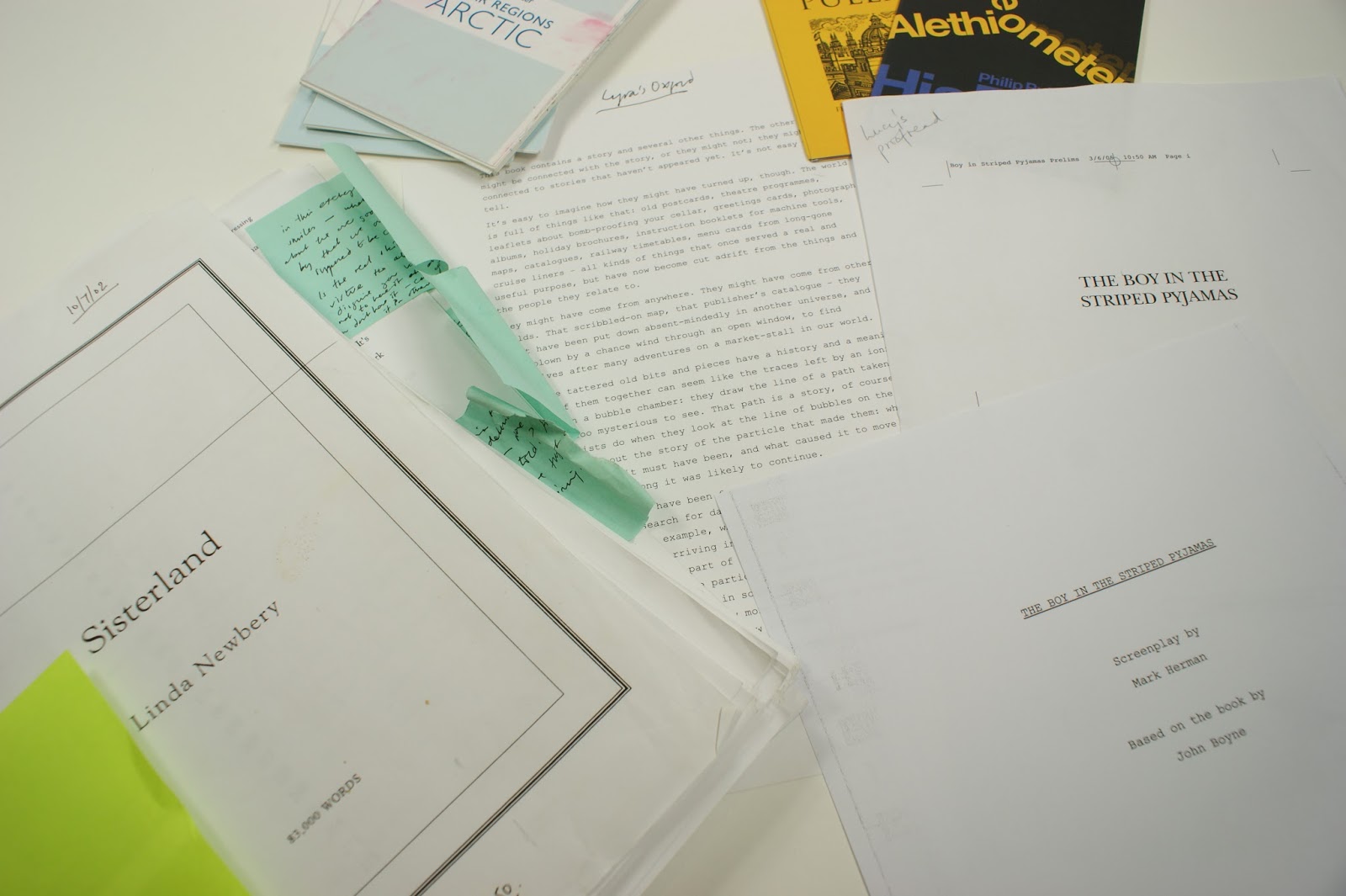
I managed to sort through the final few boxes today - they contained a massive array of little surprises. One box contained cover ideas, mock-ups and all the little extra bits of promotional material to go with several books such as Philip Pullman’s Lyra’s Oxford and Mark Haddon’s The Curious Incident of the Dog in the Night Time. In amongst these little gems were personal letters of Fickling’s that will have to be weeded out before the cataloguing process. 


The archive team have to ensure that all personal data is removed before making the archive available to the public. My main role in sorting through these boxes has been to gain an understanding, for the archivist, about what is actually there. The boxes were entirely unsorted and had not been looked at in some time, so it is no wonder there was so much interesting stuff. I have to say, although it is fantastic that Fickling donated so much material to Seven Stories, I can’t imagine, if I ever became famous enough, that I would be able to just hand over all my work! When looking I can clearly see the hours of work dedicated to the drafts, the time and effort dedicated to the editorial notes, the many letters between all the parties and I just feel like the archive contains a huge part of Fickling and his team’s life.  

- Grace Owens


Seven Stories was able to support the acquisition of David Fickling's archive through support from a Heritage Lottery Fund ‘Collecting Cultures’ grant. This has been awarded to Seven Stories in recognition of the museum’s national role in telling a comprehensive story of modern British children’s literature. For more information on our HLF Collecting Cultures project see: http://www.sevenstories.org.uk/news/latestnews/hlf.


Wednesday, 11 November 2015

Foraging through Fickling’s Archive Part 2

Our volunteer Grace continues her exploration of our David Fickling Collection. If you haven’t seen it yet, take a look at her first blog here

Next week is The National Archives Explore your Archive Week.  So come explore our archives and join in the #exploreachives conversation.  Join us on Twitterand Instagram using the handle @7stories and on Facebook by searching for 'Seven Stories, National Centre for Children's Books'.


Part 2

Delving deeper into the boxes this week I came across a pile of papers which I personally thought were a bit boring – some of Fickling’s financial documents. Nothing major just a few bits of correspondence between illustrator and publisher with some figures nestled in there. I was a bit dismissive, these were not as exciting as the original material with lovely scribbles all over it, so I just sorted it into a box and labelled it. However later I discussed this with my tutor, just an off-the-cuff comment, and she illuminated how valuable this information can be. Apparently when it comes to actual facts and figures about who was paid what, how many books were published at the time and anything else of that nature, they are really hard to get hold of. As a researcher you need this kind of information to back up your claims, or to shed light on a particular book or author. Not so boring!

Letters, notebook and floppy discs from David Fickling's correspondence files
The day continued as before, I have probably enjoyed the rifling through letters, comments by editors, ideas by authors and illustrators a bit too much. I feel very nosy! I found some of the John Boyne The Boy in the Striped Pyjamas drafts and ideas for screenplay. I think it is really interesting to see the agent promoting John Boyne as an unknown author to the publishers – seeing how the dialogue works between the agent and publisher, how they advertise their client.  I found it quite funny to read the agent’s positivity about Boyne’s distressing story! This story was marketed at children and yet contains ideas and themes that are considered by many as controversial. However, it is still undeniably a highly successful book and now a film too. All of this is in post-it notes, letters and emails between all the parties, are all part of the story behind the story. 

- Grace Owens


Seven Stories was able to support the acquisition of David Fickling's archive through support from a Heritage Lottery Fund ‘Collecting Cultures’ grant. This has been awarded to Seven Stories in recognition of the museum’s national role in telling a comprehensive story of modern British children’s literature. For more information on our HLF Collecting Cultures project see: http://www.sevenstories.org.uk/news/latestnews/hlf.


Tuesday, 10 November 2015

Foraging through Fickling’s Archive Part 1


This has been an extraordinarily busy year for our collections team with the arrival of so many new collections. We are very pleased that among the new arrivals is the David Fickling collection. 

Over the next few days we'll be posting the archival adventures of our fantastic volunteer Grace.  She was one of the first to get to know David Fickling's collection.  Grace is something of a children's literature expert after completing her MLitt in Children's Literature so it seemed fitting that she should work on a collection that represents such a wide range of children's book titles. Her insight and perspective into our collections has been invaluable and we are very thankful for the work that Grace has done for us.  We wish her the best of luck in her new job, spreading the love of children’s books as a teacher.  

Part 1

Today I was delving deep into the higgledy-piggledy piles of David Fickling’s archive, which had just arrived in the collection department, essentially looking for treasure. David Fickling, for those who don’t know, is a children’s editor and publisher. He has worked for a wide range of publishers including Oxford University Press and Scholastic, subsequently setting up David Fickling Books as an imprint under Random House, before finally becoming an independent publisher. He’s published authors such as Linda Newbery, John Boyne and Philip Pullman – big names, so you can see why I was intrigued by the pile of papers before me.


To be honest though, I was equally intrigued by the process the pieces in the archive had to go through before they arrived mounted and framed perfectly preserved on Seven Stories’ exhibition walls. They had arrived in the past few days in plastic storage boxes, and we knew there would be some valuable stuff in there, but I was the lucky person who was allowed to explore. I literally had to find out what was in there, and sort, the boxes so that the team knew what they were dealing with. Someone once mentioned to me that often archives have a backlog of work that is measured in years and after seeing this one collection I can see why. The boxes held drafts and drafts of work hoping to be published. For example, Varjak Paw The Outlaw by SF Said had over 8 drafts, all slightly different, many with yellow sticky notes all over with edits, all of which will have to be stored and preserved carefully. The sorting out was just the start.

I am very interested, as a researcher of children’s literature, in how the author and the editor work together to be published. I want to know what children are allowed to read, what is deemed acceptable, who is more adventurous - the author or the editor? Consequently, the yellow sticky notes fascinate me!

Many of the typescript drafts have post-it note comments from editors.  This is a typescript of John Dickinson's A Cup of the World (David Fickling Books, 2004). The post-its will all be removed and flattened in melinex sleeves for preservation. 

Anyway what did I find…? I found, in amongst one of the preliminary drafts for Tony Mitton’s Wayland and a short story of Jamila Gavin’s, several documents relating to the film The Golden Compass. Aha – pure gold!

- Grace Owens.

Next week is The National Archives Explore your Archive Week.  So come explore our archives and join in the #exploreachives conversation.  Join us on Twitterand Instagram using the handle @7stories and on Facebook by searching for 'Seven Stories, National Centre for Children's Books'.


Seven Stories was able to support the acquisition of David Fickling's archive through support from a Heritage Lottery Fund ‘Collecting Cultures’ grant. This has been awarded to Seven Stories in recognition of the museum’s national role in telling a comprehensive story of modern British children’s literature. For more information on our HLF Collecting Cultures project see: http://www.sevenstories.org.uk/news/latestnews/hlf.