Showing posts with label illustrators. Show all posts

Wednesday, 26 November 2014

Charles Keeping's illustrations for 'The God Beneath the Sea' and 'The Golden Shadow'

Earlier this month we were delighted to receive into the Seven Stories Collection a fine set of signed Charles Keeping prints. These prints reproduce a selection of wonderfully dark illustrations made by Keeping for Leon Garfield and Edward Blishen's books, The God Beneath the Sea and The Golden Shadow. The prints were donated to Seven Stories by former school teacher and long-time supporter of Seven Stories, Nick Brown. Here Nick talks about how he came across the prints and the impact the work of Charles Keeping has had on him:

When I was training as a teacher in the early 70s, I came across The God Beneath the Sea by Leon Garfield and Edward Blishen. This retelling of some of the Greek myths was radically different from the ones we usually used on teaching practice by authors such as Roger Lancelyn Green, Barbara Leone Picard or even Andre Lang. I found the stories compelling and used some of them in my teaching.

Detail of Hades Chariot from The God Beneath the Sea. Image © Charles Keeping estate


Whilst the book itself received a mixed critical reception, this was not the case with the illustrations which were almost universally praised and, I suspect, contributed to it being awarded the Carnegie Medal in 1970. In addition, Keeping received a Kate Greenaway Commendation- an award that is no longer given. Interestingly, though, the U.S. edition does not feature Keeping's illustrations and I wonder if they were thought too "strong" for American sensibilities.


Copies of the books


But it isn't  the stories that have stayed with me, it's Charles Keeping's amazing illustrations that have resonated over the years. I was stunned by Keeping's illustrations so much so that when a portfolio of his illustrations for both The God Beneath the Sea and The Golden Shadow became available, I snapped it up. And they have remained with me ever since. I would take them out every so often and admire their power and violent beauty. I've enjoyed these prints for so many years that it seemed fitting to donate them to Seven Stories to add to their archive, where they could be viewed alongside the original Leon Garfield manuscripts.


Pages from Leon Garfield's notebooks for The Golden Shadow here at Seven Stories


On my visit to the Seven Stories Collection I was able to look through Leon Garfield's notebook that contain partial drafts of both novels. At this stage of writing, not surprisingly, there is no indication about illustrating them. It would be really interesting to find out when/how Keeping became a part of the process and how much freedom he had in deciding what to illustrate. But that is for another time.


Detail of punishment of Prometheus from The God Beneath the Sea. Image © Charles Keeping estate


It has to be remembered that whilst both books were promoted as suitable for older children,  one wonders if the illustrations are! Today, we see resonances of Keeping's work in that of Dave McKean (Coraline), Chris Riddell (The Graveyard Book) and Jim Kay (A Monster Calls). Keeping is crucial to our understanding of the development of post war children's book illustration and the illustrations for God Beneath the Sea and The Golden Shadow are an important part of this process.


Leon Garfield's notebooks for The Golden Shadow here at Seven Stories


Both books are lavishly illustrated. As in  most of Keeping's illustrative work, the illustrations are in black and white. They appear as half page and full page but also across a double page in a powerfully dynamic way. The illustrations don't simply accompany the text they propel us through the story. This  can be seen in his illustration of Hades' chariot in The God Beneath the Sea. And for a gruesome rendition of the punishment of Prometheus, we need go no further. Keeping's illustration of the dead Nemean lion is rather ambiguous.  After staring at it for a while it becomes less lionlike and more human. Or do I need an optician's appointment?


Dead Nemean lion from The Golden Shadow. Image © Charles Keeping estate


By Nick Brown

The Charles Keeping prints and the Leon Garfield collection are available to view by appointment at the Seven Stories Collections Department. To find out more about the Seven Stories Collection click here. To make an appointment to visit the Collection or to find out more about the collections featured in this post or other collections that we hold then click here to contact us.

Tuesday, 18 November 2014

Harold Jones's 'Lavender's Blue' comes to Seven Stories

To celebrate the recent arrival of Harold Jones's original illustrations for the classic volume of nursery rhymes, Lavender's Blue (1954), here is a special blog post all about the life and work of Harold Jones.


A chest painted by Harold Jones in his South London home


Harold Jones


Harold Jones (1904-1992) was a painter, wood engraver and printmaker, widely known as one of the twentieth century’s most significant and original illustrators of books for children. He began his career in the 1930s as a freelance illustrator and cover illustrator adding his distinctive style to many children’s books, including M. E. Atkinson’s Lockett series. Jones’s first picture book was a collaboration with the renowned children’s poet, Walter de la Mare which resulted in This Year, Next Year (1937). From then, until his death, Jones’s output was prolific and his idiosyncratic style remains instantly recognisable. His most notable and critically acclaimed work was, and remains, Lavender’s Blue (1954).


Artwork for This Year Next Year (1937), illustrated by Harold Jones, written by Walter De La Mare (Seven Stories Collection)

Ever since his early career Jones has won acclaim for his unique, seemingly simplistic, though haunting illustrations. His lithographs for This Year, Next Year marked him out as a fresh talent; the book itself received wide critical acclaim and was included in the First Editions Club’s annual exhibition of “the fifty books of the year”. Children’s book critic for The Times, Brian Alderson describes Jones as “the most original illustrator of the period” adding of Jones’s style:

‘On the surface… there seems to be only a rather stylised, rather wooden, rather traditional pictorialism. But within the hatched, pastel-shaded frames of his pictures there lurks a silent, eerie world – glimpsed or hinted at under the dark arches of the Serpentine bridge, in the eyes of a pensive dog, or behind a half opened door.’  (1)

Harold Jones had a broad range of artistic training before embarking on a career as an illustrator. He began with evening classes at Goldsmith’s College before moving on to Camberwell School of Arts and Crafts, where he studied under Albert Rutherston. He later studied at Royal College under Rutherston’s brother, William Rothenstein, and Arthur Rackham’s teacher, Edward Sullivan. Following his training Jones went on to teach. In 1930 he took a job as an art master at Bermondsey Central School for Boys. However, he quit the job in 1934 as it provided little outlet for his creativity. After leaving Bermondsey, Jones pursued work as a freelance illustrator whilst continuing to work as an art teacher. Between 1937 and 1940 he worked as a visiting lecturer at both the Ruskin School of Drawing in Oxford and the Chelsea School of Art. He also enjoyed a steady income from his work as a freelance illustrator; among other commissions, he illustrated the last three books written by H. G. Wells.


Some of the books illustrated by Harold Jones


During the Second World War, Jones worked for the Royal Engineers as a lithographic draughtsman. He ‘spent his days in a disused Pimlico garage drawing maps for the Supreme headquarters of the Allied Expeditionary Force. He used to recall how he had “the great fortune to draw the D-Day maps. We knew about everything months before the generals.”’ (2)

In 1945 Jones resumed teaching, taking up a post at Sunningdale School of Ballet, and continued to take commissions as an illustrator. The publication of Lavender’s Blue in 1954, and its wide and substantial critical acclaim, cemented his place as one of the foremost illustrators in Britain. In the proceeding decades he illustrated numerous picture books by various authors – generally favouring traditional, biblical and folkloric tales over more modern stories. In 1961 Jones gained further recognition when he was hired to illustrate the first children’s book published by the major British publishing house, Gollanzc: a new edition of Charles Kingsley’s The Water Babies. Throughout his career he also wrote and illustrated a number of his own stories including The Visit to the Farm (1939) and Enchanted Night (1947).


Harold Jones's studio at his South London home


Though foremost an illustrator, throughout his life Jones also continued to pursue an interest in fine art, producing a number of paintings. Both his art and his illustration have had significant appeal far beyond the world of children’s books, and the decorative and artistic merits of Jones’s work have been widely acclaimed:

‘His drawings function at a high level both spatially and decoratively, and at their best possess a quality of stillness and timelessness reminiscent of Italian quattrocento painting.’ (3)

While still a student, he sold his first picture in a Royal College of Art student exhibition to the influential art patron, Lady Ottoline Morrell. His work has been exhibited at venues including the Tate Gallery and the Royal Academy. Tate owns Jones’s early work ‘The black door’ which it purchased in 1940 and work by Jones featured in The Modern British Paintings, Drawings and Sculpture (Chamot, Farr and Butlin, 1964).


About Lavender's Blue


Copy of Lavender's Blue (Oxford: Oxford University Press, 1954) compiled by Kathleen Lines and illustrated by Harold Jones


Upon its release, Lavender’s Blue won substantial critical acclaim and its publication can be seen as something of a landmark in the history of children’s illustration. It received an honourable mention by the Hans Christian Andersen Award (this award remains the highest international recognition given to an author or illustrator of children’s books) and Jones was given a ‘special commendation’ by the British Library Association at the awarding of that year’s prestigious Carnegie Award. Though members of the Carnegie selection committee had for some time planned to introduce a separate illustration award, at this time there was still no major award honouring illustrators. However, it was decided that, due to the quality and originality of Jones’s illustrations, Lavender’s Blue deserved a high commendation and it is generally regarded that, had events ‘moved more quickly, [Jones] would have been the first recipient of the Kate Greenaway Medal’ – the illustration companion to the Carnegie award, introduced in 1956 (4). Since its establishment, the Kate Greenaway Medal (the first winner of which was Edward Ardizzone in 1956) has remained by far the most coveted award for illustration in Britain. On its release in the United States Lavender’s Blue was also met with strong critical praise. It received the American Library Association Award, and was included on the list of winners of the Lewis Carroll Shelf Award (5).


Artwork by Harold Jones for Lavender's Blue (1954)


First published by Oxford University Press in 1954, Lavender’s Blue is by far the most noted and celebrated of Harold Jones works. The book’s illustrations epitomise the seemingly bright and innocent, though slightly eerie style that sets Jones work apart. Each picture offers a world to explore full of rich depth and detail. As The Times Literary Supplement said of Jones at the time:

‘Among artists who specialise in books for children, Harold Jones is pre-eminent. Since Jean de Brunhoff’s incomparable Babar series, no artist has understood more successfully than he that a picture has little meaning for a child if he cannot step inside it.’ (6)

Lavender’s Blue was compiled by the noted librarian, critic and editor, Kathleen Lines who brought to the project her considerable knowledge and expertise on children’s literature. Lines had previously won acclaim for her critical survey of children's books, Four to Fifteen (1950) (also illustrated by Jones). Through her series of Fairytale Picture Books produced throughout the 1960s and 1970s, Lines would later go on to work with some of the leading children’s illustrators including Edward Ardizzone. The Times Literary Supplement noted of Kathleen Lines’s compilation of Lavender’s Blue that: ‘…as could be expected of someone so knowledgeable in the field of children’s books, [Kathleen Lines] has done her part with great thoroughness. No traditional favourite seems to be missing and sticklers can be sure, too, of finding the traditional verses.’ (7)


The Kathleen Lines book collection here at Seven Stories includes many of the books Lines used to research rhymes for Lavender's Blue


Throughout its 60 years, Lavender’s Blue has remained with Oxford University Press and enjoys the distinction of never once having been out of print. Rather uniquely, although the printing quality has varied, Jones’s original design of the book has never been substantially altered. In 2004, a special 50th anniversary edition was published which saw the book and its illustrations restored to their original quality.

Lavender’s Blue is still regarded as a classic by many children’s authors and illustrators working today. Former Children’s Laureate and author, Jacqueline Wilson, lists the book in her top ten all time children’s books. Of the illustrations, she has said: “[Harold Jones] uses a wonderful delicate colour palette of blue, sage green, lilac and apricot to create his own quirkily detailed dream-like world. You could pore over the pages every day for a year and still find fresh delights.” (8) The well renowned illustrator and author, Ian Beck, regularly cites Harold Jones as one of his foremost influences. He describes Jones illustrations as: “…never fail[ing] to delight. Even when tackling a simple line drawing of a water pump something delectable emerges. He would be my choice of desert island illustrator, even above Ardizzone.” (9)


The fantastic collection of artwork for Lavender's Blue came to Seven Stories in August to join our already significant collection of Jones's original illustrations. The purchase was made possible thanks to grants from ArtFund (http://www.artfund.org/) and the Arts Council England/Victoria and Albert Museum Purchase Grant Fund (www.vam.ac.uk/purchasegrantfund).
Harold Jones's Lavender's Blue illustrations will soon be available to view by appointment at the Seven Stories Collections Department. The work will also be featuring in future exhibitions at the Seven Stories Visitor Centre. If you'd like to know more about the Harold Jones Archive or work by other illustrators in the Seven Stories Collection then contact us.


Notes and references from the text:

1) Alderson, B., ‘Some notes on children’s book illustration 1915-1985’, in Horne, A. (ed), The Dictionary of 20th Century British Book Illustrators (Suffolk: Antique Collectors’ Club, 1994)

2) Harold Jones’s obituary, The Daily Telegraph (London, England), 13th June 1992

3) Peppin, B. (ed) and Micklethwaite, L. (ed), Dictionary of British Book Illustrators: twentieth century, (London: John Murray Publishers, Ltd., 1984)

4) Barker, Keith, In the Realms of Gold: the story of the Carnegie Medal, (London: Julia MacRae Books, 1986)

5) The Lewis Carroll Shelf Award (1958-1979) was an annual American literary award granted by the University of Wisconsin–Madison School of Education to books deemed to "belong on the same shelf" as Alice's Adventures in Wonderland and Through the Looking-Glass

6) Serraillier, Ian, ‘Pen, Brush and Pencil’, Times Literary Supplement, (London, England), 19th November, 1954

7) Dowding, K. M., ‘Rhymes and jingles’, Times Literary Supplement, (London, England), 19th November, 1954

8) Wilson, Jacqueline, ‘The great books giveaway’, The Guardian, (London: England), 4th March, 2011

9) ‘Harold Jones’ on Ian Beck’s blog – http://ianbeckblog.wordpress.com/2011/03/27/harold-jones-2/ (accessed 4th June 2014)

Friday, 7 November 2014

Edward Ardizzone artwork donation at the CILIP Youth Libraries Group conference

On 17th and 18th October I was delighted to attend the CILIP Youth Libraries Group, National Conference in Durham.  It was wonderful to meet so many enthusiastic Local Authority and School Librarians, who despite current financial challenges, are excited about children’s books and eager to enthuse their users about books and reading.  Over the two days, we were treated to a great line-up of speakers from the children's literature world including: authors such as Elizabeth Laird, Jackie Morris, and David Almond (all of whom are represented in Seven Stories’ archive collection); Prue Goodwin (lecturer and author of books about children’s literature); and Wendy Cooling (former head of the Children’s Book Foundation now known as ‘Book Trust’).


The magnificent Conference Gala Dinner was attended by a whole host of librarians, local dignitaries, publisher representatives, authors and illustrators.  Impassioned speeches about the importance of libraries were given by both Carnegie Medal 2014 winner author Kevin Brooks, and author Mal Peet (a former Carnegie medal winner).  During the proceedings I was presented, on behalf of Seven Stories, with a delightful piece of signed original artwork by Edward Ardizzone.  Apparently, in 1957, it was decided to have a special bookplate designed for items in the Library Association Youth Libraries Section (now known as CILIP Youth Libraries Group) collection.  Edward Ardizzone agreed to design the bookplate, and a fee of 10 guineas was accepted.


This is a lovely addition to our existing Ardizzone holdings which include artwork for two of his titles 'Tim in Danger', ’Tim and Charlotte' and his artwork for Graham Greene's, 'The Little Train'.

Tea and lunch breaks throughout the conference were sponsored by different Publishers during which delegates were treated to an amazing array of ‘book themed’ cupcakes!  One batch that particularly took my eye, were those provided by Macmillan Children's Books in celebration of eight titles in a new Classics edition, which include two titles by Ursula Moray Williams which are represented in our archive collection - Gobbolino the Witch’s Cat and Adventures of the Little Wooden Horse.


One of the conference Workshop sessions was led by Seven Stories, and centred on our recently announced book list, ‘Diverse Voices – 50 of the Best Children’s Books celebrating cultural diversity in the UK’.   Here are Debbie Beeks (Learning & Participation Manager) and Jake Hope (Freelance Children's Book Consultant) leading the workshop.


To find out more about ‘Diverse Voices’ and to see the list of 50 titles follow this link:


I thoroughly enjoyed my time at the conference and even came back to work with 48 Proof copies of books (due to be published in 2015) for our Staff Library as well!


By Paula Wride - Seven Stories Collections Officer


To find out more about the Seven Stories Collection click here. To contact us click here.

Wednesday, 3 September 2014

Classic children's illustrations find a new home at Seven Stories

Last month saw the arrival at Seven Stories of two sets of classic children's illustrations which have been given a new home in the national collection. 

Thanks to a hugely generous response to a recent appeal we have managed to acquire five of Susan Einzig's wonderful original illustrations for Phillippa Pearce's Tom's Midnight Garden (read more about the appeal here: http://www.sevenstories.org.uk/news/latestnews/save-tom). In addition to this fantastic acquisition we were also delighted to acquire Harold Jones's original (and near complete) artwork for the classic book of nursery rhymes Lavender's Blue. The purchase of this artwork was made possible thanks to grants from ArtFund (http://www.artfund.org/) and the Victoria and Albert Museum/Arts Council England Purchase Grant Fund (http://www.vam.ac.uk/purchasegrantfund).

Late last month, Lindsey (Seven Stories conservator) and I had a trip to London to collect both of our new acquisitions and bring them back to the national collection up in Newcastle.

Our first visit was to the Piers Feetham gallery in Fulham to pick up the Susan Einzig artwork. 


The artwork has recently been on display here and is still freshly mounted.


Next we made the short trip to Putney (where illustrator Harold Jones used to live) to pick up the artwork for Lavender's Blue. There was much more of this artwork (over 160 pieces altogether!) so careful repackaging was required before we could take the artwork away.


This is Lindsey carefully deframing some of the artwork
This is the artwork being transferred to its new acid free, archival packaging

For any fans of Harold Jones we were also introduced to the original 'Bunby' (the character from A Happy Christmas, There and Back Again, and other of Jones's books):


'Bunby'

We rounded our day of classic children's illustration off with a quick stop off to see our friends at the fantastic House of Illustration where we saw (but unfortunately couldn't take!) some wonderful Quentin Blake illustrations.


On our way to the House of Illustration

To celebrate the arrival of Lavender's Blue at Seven Stories there'll be a feature length blog post coming up all about the life and work of Harold Jones. There'll also be a special post looking at Susan Einzig and Tom's Midnight Garden. So keep an eye out for these. The artwork for Lavender's Blue will be featuring in a new Seven Stories exhibition on nursery rhymes next summer.

If you want to find out more about either of these collections or about any other of our illustration collections then
email: collections@sevenstories.org.uk, phone: 01914952707 or visit: http://www.sevenstories.org.uk/collection.


Thursday, 31 July 2014

Interview with Angelina Ballerina Illustrator, Helen Craig

The third and final part in our Angelina Ballerina series, linked to the 'Twist and Tails - the Story of Angelina Ballerina' exhibition is this interview with Helen Craig.

Helen Craig showing Kris McKie, Seven Stories Archivist works from her Angelina Ballerina archive.
This interview was part of the Seven Stories Picturebooks in Progress project, which you can find out about elsewhere on this blog. It was conducted by Martin Salisbury, Professor of Illustration and Course Leader of the MA in Children's Book Illustration at Anglia Ruskin University. It details Helen's creative process, where the idea for the character's came from, and show's Helen discussing in her own words the journey of Angelina Ballerina.


If you would like to visit the exhibition, it will be on display from Saturday 19th July until April 2015 at Seven Stories, National Centre for Children's Books. Click here to find out details about visiting the Centre.

If you'd like to find out more about the Helen Craig archive or would like to arrange a research visit to the Seven Stories Collection then
email: collections@sevenstories.org.uk, phone: 01914952707 or visit: http://www.sevenstories.org.uk/collection.

Interested in other posts about Storylab Gallery at Seven Stories? Click here or here.

Angelina Ballerina books are now published by Puffin Books and are available for sale from the Seven Stories Bookshop.

To find out more about Martin Salisbury, and the Illustration course at Anglia Rusking, click here.

Wednesday, 2 July 2014

All about pop-up books! (2 of 2)

In this post our guest blogger on pop-up books, Lena Kleine Bornhorst, looks through the Seven Stories Collection and picks out examples of pop-ups featuring some very well known children's characters:


Winnie the Pooh, Noddy, Peter Rabbit, Paddington Bear and The Tiger who Came to Tea are all well-known children’s book characters who have featured in pop-up books. Popular figures or famous stories have often been published in pop-up editions – with varying results!  Pop-up books can be used to raise the popularity of a book or character. They can be used as a merchandising product (like soft toys or board games) and they’re a clever way for publishers to reuse already existent material.

The reuse of established characters in pop-up books is not a new concept: as we saw in the last post, one of the key partnerships in the history of pop-up books was that between US publisher Blue Ribbon and the Walt Disney Company in the 1930s. Pop-up books are a convenient medium to bring film characters or themes into a book version. The movement in the pages and the dynamics can fill the gap between a film and an ordinary book: like a film in a book format.


However, pop-up books with well-known characters shouldn't only be seen as merchandising products. The results are very often quite exciting and it’s interesting how diverse the pop-up editions can be. We can take a look at an example from the Seven Stories Collection: three Thomas the Tank Engine pop-up books produced in the 1990s.

Thomas’s Party Pop-up (Heinemann, 1999) tells in five double-pages a short story about Thomas Birthday Party. The paper engineering is kept very simple and the technique of the pop-ups is always the same. The back of the book is located at the top. Each double-page contains a 90 degree pop-up-element which unfolds when you held the book in a 90 degree angle.

Thomas's Big Railway Pop-up Book (Heinemann, 1992) features seven double-page spreads about seven adventures had by Thomas and his friends throughout a week.  In contrast to Thomas’s Party Pop-up, this book includes different and complex paper engineering. All the included pop-up elements are 180 degree pop-ups, which work when the book is completely open. The reader is encouraged to turn the book in different directions to see all of the pop-up elements and there are many interactive pull-tabs. Two of the interactive elements feature string, which is used to demonstrate rope – the text says: “On Wednesday James runs away. Edward and an Inspector chase him and stop him with a rope.” The other string is integrated in a pull-tab, which makes it possible to lift the Tank Engine after an accident.

Spread from Thomas's Big Railway Pop-up Book (Heinemann, 1992)


Thomas’s Amazing Pop-Up Train Set Book (Heinemann, 1995) contains only four double pages, but the format has a bigger size than the other two books. This book contains detailed 180 degree pop-ups and there are many interactive elements – in particular, a detachable paper engineered Tank Engine, which can use for a free play with the book.  The book is the base for the play as it contains railway lines, over which the Tank Engine can find the way (via a house and over a bridge) through the book. The story is told on little story-stops on every page: Thomas has to deliver a parcel in time, but is too late so he follows further story-stops which bring him back through the book till he catches a paper engineered helicopter which brings the parcel safe to his owner. The story and the interactive part with the detachable Tank Engine are cleverly combined and show another aspect of how pop-up elements can be used.


Spread from Thomas’s Amazing Pop-Up Train Set Book (Heinemann, 1995)

The Thomas the Tank Engine examples show how different paper engineering can look and how different the functions of pop-up books can be. If pop-up books are cleverly made, they can make a story more alive and intensive. Interactive elements let the reader be part of the story and join in.

Other examples of innovative pop-ups featuring well-known characters include the Winnie-the-Pooh Pop-up Theatre Book (Methuen, 1992), for which the paper engineering was done by Helen Balmer and Jose R. Seminario.  The book contains five double pages and every right side is covered by a big flap which can be lifted with a small ribbon. The enfolded paper engineering shows a scene of the story. With the included character puppets these scenes can be used for a free theatre play and pull-flaps bring movement to the scene.


Spread from Winnie-the-Pooh Pop-up Theatre Book (Methuen, 1992)

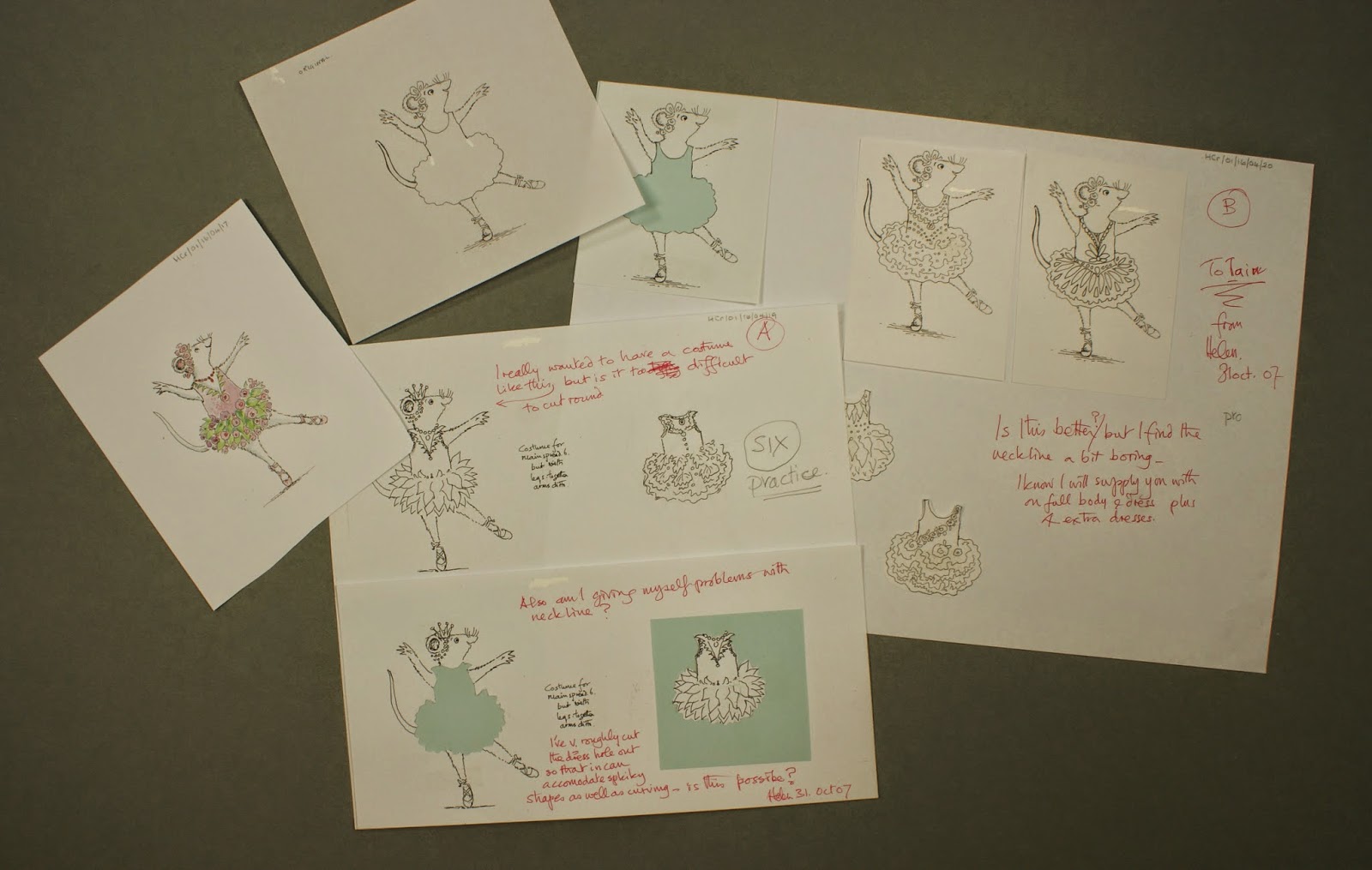
The amount of work required to make a pop-up book can be seen in the archive at Seven Stories. For example, Angelina Ballerina illustrator, Helen Craig’s collection includes extensive material from two Angelina pop-up books. This material shows the entire process of the development of a pop-up-book, in this case Angelina Ballerina’s Pop-up and Play Musical Theatre (Penguin, 2008) and Angelina Ballerina’s Pop-up Dancing School (Puffin, 2007). Looking at this archive, we can see that the production of a pop-up-book is very different to that of a normal book.

Dummy book of Angelina Ballerina’s Pop-up and Play Musical Theatre (Penguin, 2008) ©  Helen Craig and Katharine Holabird

Dummy book of Angelina Ballerina’s Pop-up and Play Musical Theatre (Penguin, 2008) ©  Helen Craig


The Angelina Ballerina material shows how important and precise the arrangements between the illustrator and the paper engineer must be. Helen Craig’s collection includes paper engineering dummies of different stages, original illustrations, work plans about necessary illustration parts, letters, emails and many designs and construction sheets with handwritten comments by Helen and paper engineers Ian Smith and Maggie Bateson. In their correspondence they talk about things such as the right sizes of the illustrations, so that they fit perfectly on a particular flap. In one email exchange they speak about the size of miniature coat hangers so that the press-out clothes hold perfectly on the small clothes rail!


Preliminary drawings for Angelina Ballerina’s Pop-up Dancing School (Puffin, 2007) ©  Helen Craig


The dummies seem to be a very important resource for this process. They make it understandable for the illustrator which areas can be seen at the end and which illustrations or added decorations are needed, so that at the end a wonderful pop-up book can be published.


Part of early dummy book of Angelina Ballerina’s Pop-up Dancing School (Puffin, 2007) 

Part of later dummy book of Angelina Ballerina’s Pop-up Dancing School (Puffin, 2007) 


The creation of pop-up books and bringing well-known characters into this new format demands a lot of creativity and knowledge. A successful pop-up-book that can offer something interesting and different to a traditional book is much more than a simple reuse of existing characters and illustrations. It can be an exciting new artwork. Pop-up books provide multifarious opportunities to create something special and new with already well-known characters and stories.


If you'd like to find out more about the Seven Stories Collection, the Helen Craig archive, or the pop-up (and other!) books we hold, then 
email: collections@sevenstories.org.uk or phone: 01914952707.

Tuesday, 17 June 2014

Yasmeen Ismail winner of Best Book Illustrator at the V&A Illustration Awards!

Congratulations to Yasmeen Ismail who, earlier this month, won the V&A Book Illustration Award for her debut picture book, Time for Bed, Fred! (2013). You can read all about the judges’ response to Yasmeen’s illustrations (and find out a bit more about her technique) here: http://www.vam.ac.uk/b/villa-2014/book-illustrations.

The annual V&A Illustration Awards celebrate the best illustration published over the last year. First established in 1972, the awards have rocketed in popularity in recent years: this year saw over 800 entrants over all four categories. Though not exclusively for children’s picture books, the Book Illustration award regularly showcases work by many highly regarded illustrators for children. This year’s list featured artwork by over 120 artists, including a number of noted children’s illustrators such as Levi Pinfold, Oliver Jeffers, Jackie Morris, Chris Riddell, Catherine Rayner, and Jane Ray.


Preliminary artwork for Time for Bed, Fred! in the Seven Stories Collection


At the end of last year, Yasmeen kindly donated artwork – including a selection of preliminary and finished work for Time for Bed, Fred! – to the Seven Stories Collection. The material gives a real insight into Yasmeen’s process and her original sketches and illustrations are simply a delight to look at. You can find out more about artwork that Yasmeen donated to the Seven Stories Collection here: http://sevenstoriescollection.blogspot.co.uk/2014/01/yasmeen-ismail-at-seven-stories-archive.html.

Yasmeen’s illustrations for Time for Bed, Fred!, along with artwork by the other four Illustration Award winners will be on display at the National Art Library Landing Gallery (part of the Victoria and Albert Museum) Kensington, West London until 2nd July.

To find out more about Seven Stories illustration collections or to arrange a research visit to the Seven Stories Collections Department, please email: collections@sevenstories.org.uk or phone: 0191 495 2707.

Tuesday, 10 June 2014

All about pop-up books! (1 of 2)

In the first of our series on pop-up books, our guest blogger Lena Kleine Bornhorst, browses through the Seven Stories book collection and looks at some of the milestones in the history of moveable books:

On the bookshelves in the Seven Stories Collection Department you can find lots of copies of a very special kind of book: pop-up books. These books – full of surprises and wonderful 3D elements – are worth having a closer look at. Pop-up books have a very long tradition and had their beginning in the area of ‘toy books’ – also called ‘movable books’. All of them have special interactive functions or attributes, which make them different to a traditional book. The first known toy books date from the thirteen century. Rotating discs were included for example in mathematics books, where they were used for changing a maths formula when the disc was turned.

The years 1880 – 1910 were seen as the first enormous height of toy books. One of the big names in the field at this time was the British publisher and printer, Ernest Nister, who used different interactive elements in his books. The Seven Stories Collection holds reproductions of some of his titles. For example, his book Revolving Pictures, which was originally published in 1892. When you revolve the tabs around the illustration in this book, you can see a hidden picture appear.


Detail from Ernest Nister's Revolving Pictures (1892)


A significant person at this time, and an important figure in the development of paper-engineering books, was the German illustrator Lothar Meggendorfer. He used many different techniques in clever ways and published numerous books – for example Internationaler Circus (International Circus) in 1887. Meggendorfer's books were translated into many languages. His German Publisher house J.F. Schreiber Verlag exists today under the name Esslinger Verlag (http://www.esslinger-verlag.de/) and many of his great books have been reprinted. The Seven Stories Collection includes a copy of his title Das Puppenhaus (The doll’s house). Meggendorfer’s wide and lasting influence on the pop-up industry is demonstrated by the fact that the American Movable Book Society (http://www.movablebooksociety.org/) named their prize for outstanding paper engineering after him.


Cover of Lothar Meggendorfer's Das Puppenhaus (1889)


Internal spread from Lothar Meggendorfer's Das Puppenhaus (1889)


The first book with the definition ‘pop-up’ on the cover was already published in 1912. Very often, though, the beginnings of the term ‘pop-up’ is associated with Jack the Giant Killer, which was published by the New York publishing house Blue Ribbon in 1932. It became a big success and Blue Ribbon published other pop-up fairy tales which developed as a big seller.

The Blue Ribbon pop-up books were based on a British example. In 1929 publisher, S. Louis Giraud in his publisher house Strand Publications in London, produced the first book of his successful series Bookano Stories. The books contained five coloured double pages with 3D-elements, which Giraud called “pictures that spring up in model form”. The books were printed in a large run and became a big success. At the Seven Stories Collection you can find a copy of a later volume of the Bookano Stories from 1947.


Front cover of S. Louis Giraud's Bookano Stories no. 16 (1947)


Paper engineered Tower Bridge from S. Louis Giraud's Bookano Stories no. 16 (1947)


Blue Ribbon worked closely with Walt Disney to create pop-up books of Disney characters beginning in 1933 with four Micky Mouse pop-up books. A lot of Walt Disney-Pop-ups followed and the licenses were sold all over the world. There have been numerous Disney themed pop-up-books over the years.  At Seven Stories you can find for example a copy of Pocahontas – Meeko’s Busy Day from 1996 or The Aristocats from 1971 – made by (but not credited to) the internationally regarded pop-up artist VojtÄ›ch KubaÅ¡ta.

Internal spread from The Aristocats (1971)


KubaÅ¡ta’s characteristic style is obvious throughout this book: the spine of the book is at the top rather than the left, the paper engineering-elements emerge at the left and right side of the book when you open the pages, and the pull-tabs are cleverly integrated. These characteristics can all be seen in The Aristocats as well as in his many other books. KubaÅ¡ta produced over 70 titles and his particular style makes him another important person in the history of paper engineering.

In the middle of the 60s began the so-called second golden age of pop-up books.  In 1974 the American Waldo Hunt, set up the pop-up production company Intervisual Communications. Hunt produced also the pop-up book Haunted House by the British author and illustrator Jan PieÅ„kowski (paper engineering for this book was created by Tor Lokvig). In 1979 this became the first pop-up-book to win the Kate Greenaway Award – a very remarkable honour for a pop-up-book. A signed copy of this special book is available at the Seven Stories Collection Department.


The cover of Jan Pienkowski's Haunted House (1979)

Internal spread from Jan Pienkowski's Haunted House (1979)


Waldo Hunt also worked with some other great known paper engineers, like David Pelham, David A. Carter, and Robert Sabuda. Many of their books can be found in the Seven Stories Collection.

Beyond the well-known paper-engineers, many successful illustrators and authors, such as Anthony Browne and Maurice Sendak, have worked with paper engineers to make wonderful pop-up books. Animal Fair (2002) by Anthony Browne is available at the Seven Stories Collection Department and here you can see a short film about a conversation about Maurice Sendaks Mommy? http://vimeo.com/32596506, published 2006.


There have been a lot more exciting and creative pop-up-books over the last years and some very innovative paper engineers like Robert Crowther, Ron van der Meer (who specialises in pop-ups for adults), and the paper engineer Matthew Reinhardt.  But why not come along and explore all the wonderful books here yourself?


If you'd like to find out more about the Seven Stories Collection, the pop-up books we hold, or our extensive library of children's books and related literature, then 
email: collections@sevenstories.org.uk or phone: 01914952707.