Showing posts with label Angelina Ballerina. Show all posts

Sunday, 28 June 2015

Hartlepool Festival of Illustration

Seven Stories have been happy to be involved in a brand new event around illustration in the North East - the Hartlepool Festival of Illustration.

Working with the festival organisers, we loaned several pieces of artwork from the Seven Stories Collection to an exhibition held at Hartlepool Art Gallery. Artwork from the below has all been on display alongside additional loaned works from Chris Riddell, Sara Ogilvie and John McCrea, amongst others. 

  • Edward Ardizzone
  • Shirley Hughes
  • Polly Dunbar
  • Sarah Garland
  • Angela Barrett
  • Helen Craig
  • John Burningham

As part of the festival, we have also been out on a whirlwind tour of the local area, working with an amazing 730 participants over 10 days. The sessions took place in nine primary schools, one college of further education and in Hartlepool Art Gallery itself. Lynn hosted a spectacular 29 illustration workshops over this time - and is now on a well deserved holiday! This is what she has to say about the experience:

Having completed a two week residency in Hartlepool schools, I feel very privileged to have been involved with such an exciting outreach programme, using original materials from the Seven Stories Collection to help inspire the next generation of illustrators and designers.

Knowing that the exhibition would include materials to illustrate the creative processes in the making of a picture book, I was very keen to develop a primary workshop using illustrator Sarah Garland’s sketchbooks, and Polly Dunbar’s sketches and finished artwork for My Dad’s a Birdman, written by David Almond.

Based in a new school each day, I arrived each morning with 90 sketchbooks, HB pencils, graphite sticks and a gross of felt tip pens. Needless to say these were put to great use, the children hugely excited to have their own sketchbook and pencils, all kindly provided by Cleveland College of Art and Design. The workshops were planned to last between 75-90 minutes. Most followed a similar format with variations depending on the age and maturity of the pupils. 

Of courser it  wouldn’t be a Seven Stories workshop if it there wasn't any book chat! We talked about the children’s favourite storybooks, the authors and illustrators they knew and liked. We browsed picture books selection to look at style. Children talked about why they liked the illustrations and considered where authors and illustrators get their ideas from.

I wanted the children to experience quick sketching, and told them:

“We are going to look, talk, listen, draw, draw, draw again, draw some more, more talking, more drawing, more looking, talking, listening and if there is sufficient time, even more drawing!”

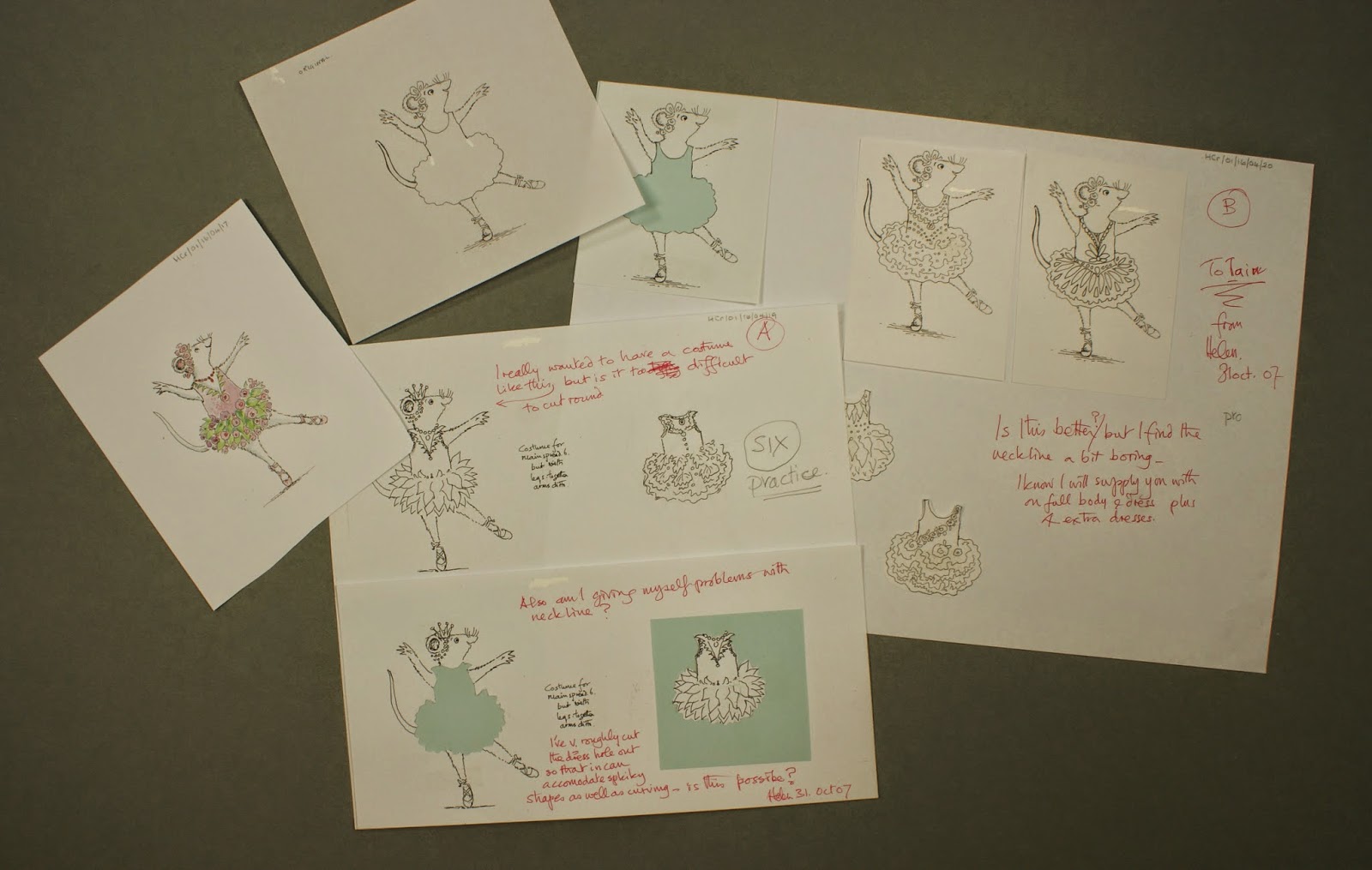
We looked at some facsimiles of artwork in the exhibition. They saw how illustrators use sketchbooks, sometimes drawing multiple images on one page. Sarah Garland’s quick sketches of families in the swimming pool show how little information is needed in a sketch for it to work as a preparatory drawing. They noticed how Polly Dunbar uses just a dot for an eye or a line for the mouth in her Birdman sketches. They considered how an illustrator develops a character from an initial sketch. From the slumped posture in the sketch of Lizzie’s dad, they started to understood how an illustrator can portray a character’s emotions in the pose or facial expression. We looked at Angela Barratt’s graphite sketch and finished drawing for The Snow Queen, and Helen Craig’s artwork for Angelina Ballerina.

An illustration workshop needs drawing time! We started drawing birds.

“How many different birds can you draw in a minute?”

We drew more, changing the size of beaks and wings to see how that affected the drawing. We handled feathers and a selection of soft toy birds. Talking about their achievements at the end of the sessions, many highlighted using graphite sticks to draw their real and imagined feathers as a favourite part. Graphite can be used for clean sharp lines or blended and smudged to create featheriness. It was a new medium for most of the young artists.

Examples of the students work
Next: drawing a human. I wanted the children to try drawing a simple human character, with not too much detail, as we would use our experience of drawing feathers and birds to transform our character. There was a real buzz throughout the entire workshops. I read extracts from My Dad's a Birdman or retold parts while the children were busy drawing.

Throughout the workshops children proudly showed back their work to each other and talked about their achievements. Every child participated. No one once said that they "couldn’t" or "didn’t" know how to draw a bird, feather or human. They were working as illustrators.

Next step storyboarding. We compared different approaches to storyboarding. I had included some additional storyboard facsimiles from the original Picture Book in Progress exhibition, held at Seven Stories visitor centre in 2014. The groups compared these with John Burningham’s storyboard which features in the Festival  exhibition. Children pointed out that some of the frames have very little detail, yet the sketches of animals are drawn in greater detail.

We were able to see how Sarah Garland’s storyboard for Doing Christmas was roughly sketched on lined A4 paper, how Judith Kerr used very faint drawings in her storyboards for Mog the Forgetful Cat and The Tiger Who Came to Tea. In contrast, Helen Cooper’s storyboard for Little Monster Did It includes everything she wants on the page including minute text. I heard  “wow” almost every time someone looked closely at this one. There is no right or wrong way in developing a storyboard - illustrators use them as they need.

Everyone had created a new character so the next stage was to think of what happened to them.  Everyone had a go at storyboarding 3 frames to show the participation: Frame 1 getting ready to start. Frame 2 character mid flight, to show the shape they make in the air.
Frame 3 Success? Failure? Cheers or splash?

In the extended workshops children then worked for some time developing one of their storyboard frames into an actual illustration. In her finished artwork, Polly Dunbar portrays   dad and Lizzie tumbling through the air wearing their beaks and feathers. Many of the participants worked on their own version of this scene.

On the second last day of the residency I led the illustration workshops in the Art Gallery surrounded by world class illustration.  I adapted the session for working with the older B Tech Students from East Durham College to include David Almond’s initial character notes for his Birdman, asking them to try to think along these lines when developing their own characters. They considered appearance, their character’s fears and desires. Would they have a special object? Several students annotated their drawings, finding this a useful way to develop ideas.

In addition to exploring the creative process through the original materials from the exhibition, the students were able to compare how different illustrators respond to the same subject, and compared Ralph Steadman’s illustration from Treasure Island with Chris Mould’s interpretation of the same scene.

On display, next to our workspace were several illustrations from Chris Riddell’s Ottoline books.  Chris had been named as the ninth Children’s Laureate days earlier. In his five point plan he includes the joy of sketchbooks and celebration of reading for pleasure. I talked about this with the groups and how Chris had been one of the key speakers at the festival launch.

We were doing just what he was suggesting, doodling with our birds and feathers and enjoying drawing in a beautiful sketchbook.

The  feedback has been  very positive with children reflecting on  what they had learnt or enjoyed,  including finding out how much works goes into the making of a picturebook. I had a thoroughly enjoyable time. When asked to reflect on something they had learnt as a result of the workshops, one 8 year old boy wrote:

“ I learnt I could draw!”

Lynn Telford

The Picture Book in Progress Illustration workshops were part of the Hartlepool Festival of Illustration, a partnership between Cleveland College of Art and Design, Hartlepool Borough Council and Seven Stories.
  

Monday, 1 December 2014

All About: Christmas Animals

Now it's the first of December, we can officially start celebrating Christmas here in the Seven Stories Collection. To start off our celebrations, we have a series of Christmas animals to show you, all taken from the material held in our store. This is the start of a new series, next year, on the first of each month we will be bringing you a post on a different feature animal! Leave a comment below with your favourite and we will see what we can do...


Original artwork by Helen Craig for Angelina Ice Skates, story by Katharine Holabird (Puffin, 1993)

Angelina uses her beautiful ballet skills to dance across the ice instead of a stage.

Illustration © Helen Craig
Original artwork by Helen Craig for Angelina's Christmas, story by Katharine Holabird (Puffin, 1985)

This is a heart warming story of Angelina bringing some Christmas cheer to Mr Bell, who has retired from being the village post man. To see more artwork from this book, and many other Angelina Ballerina titles, visit 'Twists and Tails - the Story of Angelina Ballerina' at the Seven Stories Visitor Centre until April 2015.

                                                                                             Illustration © Helen Craig
Original artwork for Tim Mouse and Father Christmas by Judy Brook (World’s Work Press, 1971)
Tim Mouse and children find a little old man with a long white beard lying in the snow.  They know nothing about Christmas, but the old man soon tells them all about Christmas Day, who he was, and how he got lost.  Tim, with the help of his wife, his children and his friends, comes to the rescue and makes sure that no one is disappointed on Christmas Day.
Illustration © Judy Brook's Estate
Original artwork for Tim Mouse and Father Christmas by Judy Brook (World's Work Press, 1971)                                                                                   Illustration © Judy Brook's Estate
Original artwork for Mog’s Christmas by Judith Kerr (William Collins Sons & Co. Ltd., 1976) 

Christmas come to Mog’s household and Mog finds it a little unsettling. There are lots of new people and a walking tree!
                                                     Illustration ©Kerr-Kneale Productions Limited
Original artwork for Mog’s Christmas by Judith Kerr (William Collins Sons & Co. Ltd., 1976) 
                                                           Illustration ©Kerr-Kneale Productions Limited

Original artwork for The Good Little Christmas Tree by Ursula Moray Williams (George G. Harrap, 1943)
Two parents bring home a Christmas tree for their children for Christmas day, but they cannot afford to decorate it with candles and sparkle. When they go to sleep, the Christmas tree goes on a journey to find decorations to delight the children on Christmas morning. He loses many of his needles, and only Santa Claus can help. 
                                                         Illustration © Ursula Moray Williams Estate
Original artwork for The Good Little Christmas Tree by Ursula Moray Williams (George G. Harrap, 1943)How many different animals can you spot in these pictures?
                                                                  Illustration © Ursula Moray Williams Estate

To find out more about any of the items shown in this post, visit the Seven Stories Catalogue. You can also call on 0191 495 2707 or email at collections@sevenstories.org.uk.

Tuesday, 30 September 2014

Ballet Stories with Katharine Holabird and Pam Knights

This weekend Seven Stories have been hosting several events with the Angelina Ballerina author Katharine Holabird. Katharine has been going in to schools, and hosting public events in our visitor centre, with lots of Angelina fans, especially many budding ballerinas.

One of the public events held in the Artists Attic this weekend.
On Monday evening we had a particularly special event, an audience with both Katharine Holabird, and Pam Knights, retired lecturer in English and American Literature at Durham University, and ballet book lover! 

Pam had spent time working with the Seven Stories archive to uncover the story it tells about children's books on ballet, and gave a fascinating and funny talk about the treasures she found. Starting with the Ballet Shoes books by Noel Streatfeild and illustrated by Ruth Gervis, and touching on the Lorna Hill's Sadlers Wells series, right up to the present day phenomenon that is Angelina Ballerina.


An example Pam used in her talk on ballet stories. This is an unpublished illustration created for Ballet Shoes, which Pam used to compare with other, published, portrayals of Posy in the book. Created in around 1936, this is one of the older artworks in the Seven Stories collection.
Katharine then gave a fascinating talk on her inspiration and drive to write the Angelina series. She gave additional insight in to her early love of ballet, and how the books were inspired not just by seeing her children enjoy it, but her childhood creative play, and visiting the ballet in Chicago with her grandmother.


Katharine Holabird speaking at the event.
The event was chaired by Sarah Lawrance, Collection Director, who took questions from the audience. Pam and Katharine answered questions on the roles of boys in ballet, and the importance of showing the hard work and determination it takes to be a dancer, but also that the stories must still be fun!

Katharine, Pam and Sarah in conversation.
Accompanying the event, we took a display of archival material that Pam had explored, including some of Helen Craig's beautiful artwork for their latest book Angelina's Big City Ballet, which has left us all desperate to visit New York (aka the Big Cheese).

Lindsey Gibson, Seven Stories conservator, discussing the archive with guests at the event.
Twists and Tails, the Story of Angelina Ballerina is on display at the Seven Stories visitor centre until April 2015.

If you want to find out more about this collection, or about any other of our archives then 
email: collections@sevenstories.org.uk
phone: 01914952707 
visit: http://www.sevenstories.org.uk/collection 

Thursday, 31 July 2014

Interview with Angelina Ballerina Illustrator, Helen Craig

The third and final part in our Angelina Ballerina series, linked to the 'Twist and Tails - the Story of Angelina Ballerina' exhibition is this interview with Helen Craig.

Helen Craig showing Kris McKie, Seven Stories Archivist works from her Angelina Ballerina archive.
This interview was part of the Seven Stories Picturebooks in Progress project, which you can find out about elsewhere on this blog. It was conducted by Martin Salisbury, Professor of Illustration and Course Leader of the MA in Children's Book Illustration at Anglia Ruskin University. It details Helen's creative process, where the idea for the character's came from, and show's Helen discussing in her own words the journey of Angelina Ballerina.


If you would like to visit the exhibition, it will be on display from Saturday 19th July until April 2015 at Seven Stories, National Centre for Children's Books. Click here to find out details about visiting the Centre.

If you'd like to find out more about the Helen Craig archive or would like to arrange a research visit to the Seven Stories Collection then
email: collections@sevenstories.org.uk, phone: 01914952707 or visit: http://www.sevenstories.org.uk/collection.

Interested in other posts about Storylab Gallery at Seven Stories? Click here or here.

Angelina Ballerina books are now published by Puffin Books and are available for sale from the Seven Stories Bookshop.

To find out more about Martin Salisbury, and the Illustration course at Anglia Rusking, click here.

Thursday, 24 July 2014

Installing Angelina


Welcome to the Storylab Gallery and the exhibition 'Twists and Tails - The Story of Angelina Ballerina'.  My name is Sarah McGlynn, and I'm the new Exhibitions Assistant, newest member of the Collections Team. I was excited to get started on the installation of this exhibition, we had been working on it since before I arrived in May and now the date had arrived. 


For three days last week most of the Collections Team were involved in the hanging of this exhibition.  On Monday, after dismantling and packing the Picturebook in Progress exhibition we then prepared the gallery by filling in holes and repainting the walls so that the space looked brand new again. Hanging exhibitions is best done methodically and the team worked closely according to our schedules, we did invite some extra helpers but they remained firmly seated on the sofa.


I spent Tuesday customising a large mirror and transforming it into what would hopefully become the centrepiece of  every little mouse's experience of visiting the exhibition.  Due to the delicate nature of the artwork, we have to keep light levels at 50 LUX; this meant that the photopoint, which has recently become a prerequisite for exhibitions, had to be placed well away from any original artworks.  We decided to have the mirror as a central part of this area so that visitors could dress up, see themselves in the mirror and then have their photo taken in front of the Angelina wall graphics. 


The original artwork and correspondence from Helen Craig and Katherine Holabird had been framed and was ready to be mirror plated before installation could take place.  Whilst mirror plating, we were able to take the measurements of the frames and prepare to make the calculations required for hanging. The exhibition had been carefully curated in advance and the layout went according to plan, using some double hanging, there would be exactly the right amount of wallspace for the works chosen. 


At the same time as we were hanging the artworks, Lindsey, the Seven Stories conservator, was carefully placing objects in the display cases on mounts specifically made from archival mount board. 


Simultaneously the graphics both large and small were being sited and fixed to the walls.  The original artwork is very beautiful, tiny and detailed so we used large graphics to complement the artwork and give Angelina a presence in the room from a distance.


With the addition of pink labels crediting the artwork, a sprinkling of pink stars, generous piles of Angelina picture books and drawing activities, a plain room had been transformed into a delightful space filled with gems of information and a truly wonderful place to spend time.


If you would like to visit the exhibition, it will be on display from Saturday 19th July until April 2015 at Seven Stories, National Centre for Children's Books. Click here to find out details about visiting the Centre.

If you'd like to find out more about the Helen Craig archive or would like to arrange a research visit to the Seven Stories Collection then
email: collections@sevenstories.org.uk, phone: 01914952707 or visit: http://www.sevenstories.org.uk/collection.

Interested in other posts about Storylab Gallery at Seven Stories? Click here or here.

Angelina Ballerina books are now published by Puffin Books and are available for sale from the Seven Stories Bookshop.


Thursday, 17 July 2014

The making of 'Twists and Tails - The Story of Angelina Ballerina'

When Helen Craig and Katharine Holabird donated their archives of work for the Angelina Ballerina series, the exhibition team wanted to put the material on display as quickly as possible. Not only does the archive represent one of the most popular children's series of the past thirty years, but the level of detail available from both sides of the page is wonderful.

Kris (Seven Stories Archivist) and I (Alison, Curator) identified three main themes visible in the archive and stories.

How to make an Angelina book

The first was 'How to make an Angelina book'. One of the most crucial parts of the archive, and Seven Stories mission, is to make visible the process of creating a book. This material gives us the chance to show the long development that goes in to creating each book; showing the involvement of not just author and illustrator, but editor too. 


Section of draft for Angelina and the Princess, written by Katharine Holabird with comments from Helen Craig, c.1983
Kris and I worked through all the books represented in the collection, and chose Angelina and the Princess as the most visual example of this process. The second book in the series, published in 1984, it was written while the concepts behind Angelina and the world of Mouseland were still being developed. There is also a complete run of preparatory work, in which alterations to the story are clearly visible. What we found most intriguing was the evolution of the original story from Angelina performing for 'The Duchess of Mouseberry', to performing for the Princess. The material on display allows the viewer to track the changes made through the whole process. 

To represent the illustration side, we chose to focus on one particular scene from the book - the double page spread of Angelina performing for the Princess. For this there were many rough illustrations created by Helen Craig, complete with notes to herself about composition. It is an interesting exercise to decipher which elements have changed between each draft, and work out which came first.


Early rough for final double page spread by Helen Craig, for Angelina and the Princess, written by Katharine Holabird (Aurum Press, 1984)
Colour rough for final double page spread by Helen Craig, for Angelina and the Princess, written by Katharine Holabird (Aurum Press, 1984)

Angelina's Journey

The second theme most apparent in the archive is that of Angelina's journey, both within the books, but also from initial picture book to global star.

The archive holds the very first illustrations and manuscript created by Helen and Katharine. Although different to the final version, these show the very beginnings of Angelina, and are on display alongside each other. Showing Angelina's journey within the books led us to choosing some of our favourite Angelina moments, including when she is preparing to go to her first ballet lesson, performs for royalty, and when she meets her new baby sister for the first time. We also have on show an illustration from the (as yet unpublished) latest book in the series Angelina's Big City Ballet, of Angelina and her family arriving in the Big Cheese (aka New York).


Small section of the first draft, which later became Angelina Ballerina. Katharine Holabird, 1982.
The set of stand up illustrations Helen Craig sent to Katharine Holabird, as her idea's for 'Primrose', c. 1982
We also follow Angelina's journey to international fame. The archive contains material from Katharine and Helen's initial and ongoing discussions with HiT entertainment, who hold the licence for the Angelina Ballerina brand. This correspondence often shows the frustrations of allowing other people to work on a character the creators care deeply about. There is also an opportunity to display material from the many different spin-off's, such as the English National Ballet adaptation, much of the merchandise produced over 30 years, and examples of the two television animations.


A sample of some of the Angelina Ballerina merchandise, these were created in 2002 for HIT Entertainment

Mouseland

Probably the most fun we had was choosing content for this section. The world Angelina inhabits is called 'Mouseland', and comes set with certain rules. It was wonderful to explore this within the illustrations and Helen's rough work, uncovering hitherto unseen floorplans of Angelina's home, and choosing pieces which help to show the detailed world the mice inhabit.


Small section of 'Angelina's House', by Helen Craig, 1982

Cross section of a house in Mouseland, with Angelina peering through the window. Final illustration by Helen Craig, for Angelina's Christmas, written by Katharine Holabird (Aurum Press, 1985)
If you would like to visit the exhibition, it will be on display from Saturday 19th July 2014 until April 2015, at Seven Stories, National Centre for Children's Books. Click here to find out more details about visiting the centre.

If you would like to book a visit to research the archives within our collection store, click here for further details.

Interested in other posts about the Storylab Gallery at Seven Stories? Click here or here.

Angelina Ballerina is now published by Puffin Books, and are available for sale from the Seven Stories bookshop, one of the largest independent children's bookshops in the UK.

Wednesday, 2 July 2014

All about pop-up books! (2 of 2)

In this post our guest blogger on pop-up books, Lena Kleine Bornhorst, looks through the Seven Stories Collection and picks out examples of pop-ups featuring some very well known children's characters:


Winnie the Pooh, Noddy, Peter Rabbit, Paddington Bear and The Tiger who Came to Tea are all well-known children’s book characters who have featured in pop-up books. Popular figures or famous stories have often been published in pop-up editions – with varying results!  Pop-up books can be used to raise the popularity of a book or character. They can be used as a merchandising product (like soft toys or board games) and they’re a clever way for publishers to reuse already existent material.

The reuse of established characters in pop-up books is not a new concept: as we saw in the last post, one of the key partnerships in the history of pop-up books was that between US publisher Blue Ribbon and the Walt Disney Company in the 1930s. Pop-up books are a convenient medium to bring film characters or themes into a book version. The movement in the pages and the dynamics can fill the gap between a film and an ordinary book: like a film in a book format.


However, pop-up books with well-known characters shouldn't only be seen as merchandising products. The results are very often quite exciting and it’s interesting how diverse the pop-up editions can be. We can take a look at an example from the Seven Stories Collection: three Thomas the Tank Engine pop-up books produced in the 1990s.

Thomas’s Party Pop-up (Heinemann, 1999) tells in five double-pages a short story about Thomas Birthday Party. The paper engineering is kept very simple and the technique of the pop-ups is always the same. The back of the book is located at the top. Each double-page contains a 90 degree pop-up-element which unfolds when you held the book in a 90 degree angle.

Thomas's Big Railway Pop-up Book (Heinemann, 1992) features seven double-page spreads about seven adventures had by Thomas and his friends throughout a week.  In contrast to Thomas’s Party Pop-up, this book includes different and complex paper engineering. All the included pop-up elements are 180 degree pop-ups, which work when the book is completely open. The reader is encouraged to turn the book in different directions to see all of the pop-up elements and there are many interactive pull-tabs. Two of the interactive elements feature string, which is used to demonstrate rope – the text says: “On Wednesday James runs away. Edward and an Inspector chase him and stop him with a rope.” The other string is integrated in a pull-tab, which makes it possible to lift the Tank Engine after an accident.

Spread from Thomas's Big Railway Pop-up Book (Heinemann, 1992)


Thomas’s Amazing Pop-Up Train Set Book (Heinemann, 1995) contains only four double pages, but the format has a bigger size than the other two books. This book contains detailed 180 degree pop-ups and there are many interactive elements – in particular, a detachable paper engineered Tank Engine, which can use for a free play with the book.  The book is the base for the play as it contains railway lines, over which the Tank Engine can find the way (via a house and over a bridge) through the book. The story is told on little story-stops on every page: Thomas has to deliver a parcel in time, but is too late so he follows further story-stops which bring him back through the book till he catches a paper engineered helicopter which brings the parcel safe to his owner. The story and the interactive part with the detachable Tank Engine are cleverly combined and show another aspect of how pop-up elements can be used.


Spread from Thomas’s Amazing Pop-Up Train Set Book (Heinemann, 1995)

The Thomas the Tank Engine examples show how different paper engineering can look and how different the functions of pop-up books can be. If pop-up books are cleverly made, they can make a story more alive and intensive. Interactive elements let the reader be part of the story and join in.

Other examples of innovative pop-ups featuring well-known characters include the Winnie-the-Pooh Pop-up Theatre Book (Methuen, 1992), for which the paper engineering was done by Helen Balmer and Jose R. Seminario.  The book contains five double pages and every right side is covered by a big flap which can be lifted with a small ribbon. The enfolded paper engineering shows a scene of the story. With the included character puppets these scenes can be used for a free theatre play and pull-flaps bring movement to the scene.


Spread from Winnie-the-Pooh Pop-up Theatre Book (Methuen, 1992)

The amount of work required to make a pop-up book can be seen in the archive at Seven Stories. For example, Angelina Ballerina illustrator, Helen Craig’s collection includes extensive material from two Angelina pop-up books. This material shows the entire process of the development of a pop-up-book, in this case Angelina Ballerina’s Pop-up and Play Musical Theatre (Penguin, 2008) and Angelina Ballerina’s Pop-up Dancing School (Puffin, 2007). Looking at this archive, we can see that the production of a pop-up-book is very different to that of a normal book.

Dummy book of Angelina Ballerina’s Pop-up and Play Musical Theatre (Penguin, 2008) ©  Helen Craig and Katharine Holabird

Dummy book of Angelina Ballerina’s Pop-up and Play Musical Theatre (Penguin, 2008) ©  Helen Craig


The Angelina Ballerina material shows how important and precise the arrangements between the illustrator and the paper engineer must be. Helen Craig’s collection includes paper engineering dummies of different stages, original illustrations, work plans about necessary illustration parts, letters, emails and many designs and construction sheets with handwritten comments by Helen and paper engineers Ian Smith and Maggie Bateson. In their correspondence they talk about things such as the right sizes of the illustrations, so that they fit perfectly on a particular flap. In one email exchange they speak about the size of miniature coat hangers so that the press-out clothes hold perfectly on the small clothes rail!


Preliminary drawings for Angelina Ballerina’s Pop-up Dancing School (Puffin, 2007) ©  Helen Craig


The dummies seem to be a very important resource for this process. They make it understandable for the illustrator which areas can be seen at the end and which illustrations or added decorations are needed, so that at the end a wonderful pop-up book can be published.


Part of early dummy book of Angelina Ballerina’s Pop-up Dancing School (Puffin, 2007) 

Part of later dummy book of Angelina Ballerina’s Pop-up Dancing School (Puffin, 2007) 


The creation of pop-up books and bringing well-known characters into this new format demands a lot of creativity and knowledge. A successful pop-up-book that can offer something interesting and different to a traditional book is much more than a simple reuse of existing characters and illustrations. It can be an exciting new artwork. Pop-up books provide multifarious opportunities to create something special and new with already well-known characters and stories.


If you'd like to find out more about the Seven Stories Collection, the Helen Craig archive, or the pop-up (and other!) books we hold, then 
email: collections@sevenstories.org.uk or phone: 01914952707.

Thursday, 13 March 2014

Helen Craig's studio

At the end of February we visited author and illustrator Helen Craig at her home in Cambridge. Most of you will know Helen as the illustrator of the world famous Angelina Ballerina books (written by Katharine Holabird). We were visiting Helen to pick up artwork for the two latest books in the series: Angelina's Cinderella (published last year) and Angelina's Big City Ballet (which is due to be released in November this year).

It was in the early 1980s that Katharine Holabird first came up with the idea of a story (based on her two daughters) about a ballet loving little girl called Primrose. When Katharine showed the story to her friend and collaborator Helen Craig, Helen drew Primrose as a white mouse. The character's name was later changed to Angelina, due to the fact - as Helen points out - that there was already a little mouse called Primrose in Jill Barklem's popular Brambly Hedge series of books. Angelina's debut story book Angelina Ballerina was published in 1983. The little dancing mouse has since appeared in over 20 books, two animated series, and even on stage with the English National Ballet.


We are delighted that Helen has chosen Seven Stories as the home for her Angelina artwork - over the last few months Helen has donated the artwork for every one of the Angelina titles she has illustrated. Helen's collection includes everything from intricately detailed storyboards and dummy books, right through to her wonderful finished artwork. Seven Stories already holds Katharine Holabird's archive, which she very kindly donated to us in 2012. Katharine's fantastic collection includes, amongst a variety of other things, her drafts for the books, a selection of Angelina merchandise, and papers relating to the Angelina animations. The two collections side by side make for a truly wonderful resource for researchers and Angelina fans alike!


Helen looking through some of her rough artwork


On our visit to Cambridge, Helen was kind enough to show us around her studio. As you might expect in Helen's studio, Angelina pops up everywhere you turn. Helen showed us the very first Angelina doll she made by hand back in 1986 after the publication of the fifth book in the series.


This is Helen holding the very first Angelina doll she made by hand in 1986

Helen also talked us through her creative process and the materials she uses in her work. Most striking was her three layered box of watercolour pencils.


Helen's very neat pencil box

If you'd like to know more about the Helen Craig and Katharine Holabird collections you can email collections@sevenstories.org.uk. Both collections are available to view at the Seven Stories Collections department in Felling, Gateshead (Helen's collection will be searchable on our online catalogue soon). Some of Helen's artwork is currently on display in our Picturebook in Progress exhibition at the Seven Stories visitor centre in Newcastle upon Tyne. Angelina Ballerina will be featuring in other Seven Stories exhibitions and events soon!