
Within our collections at Seven Stories, the National Centre for Children's books, we have collections that you might expect to find - Philip Pullman, Diana Wynne Jones, Judith Kerr, David Fickling, Michael Morpurgo - but we also have some unexpected but equally brilliant collections. Pearl Binder wasn't primarily a children's book illustrator; she was known as a writer, artist and television personality, as well as being a sculptor and stained glass artist with an interest in fashion. She is a fascinating character and we're lucky enough to have material which relates to her role as children's book illustrator.
Binder was born in Salford but moved to London after the first world war to study at the Central School of Art and Design. She settled in East London in the 1920's and the area features prominently in her work; Pearl illustrated Thomas Burke's The Real East End (Constable, 1932) and was an advocate of the Pearly Kings
and Queens.
Included in her achievements are her Pearly mug for Wedgewood, her work with Amal Gosh and City Literary Institute's stained glass evening class to design and make armorial windows for the house of Lords, and her involvement in the early days television broadcasting (British Museum: bibliographical details). According to Project Gutenberg she may have been the first heavily pregnant woman to appear on television . And, of course, because this is a Children's Literature blog another achievement to celebrate is Binder's Puffin Picture Book Misha Learns English (Puffin, 1942).
Included in her achievements are her Pearly mug for Wedgewood, her work with Amal Gosh and City Literary Institute's stained glass evening class to design and make armorial windows for the house of Lords, and her involvement in the early days television broadcasting (British Museum: bibliographical details). According to Project Gutenberg she may have been the first heavily pregnant woman to appear on television . And, of course, because this is a Children's Literature blog another achievement to celebrate is Binder's Puffin Picture Book Misha Learns English (Puffin, 1942).
Though our collection of her material is small (all of two items!) it is still worth a blog post. The first item is her dummy book for Chi Ming and the Tiger Kitten (Dobson books, 1964) written by Binder's daughter Josephine Marquand.
 |
| Dummy book dedication and title page by Pearl Binder for Chi Ming and the Tiger Kitten (Dobson books, 1964). Photograph © Seven Stories The National Centre for Children's Books. |
Chi Ming and the Tiger Kitten is the first in a series of collaborations between Binder and Marquand about the little boy Chi Ming who lives on Hong Kong Island. Interestingly, Binder was an adventurous traveller, with a particular interest in visiting and writing about China (Spitalfields Life). Whilst illustrating Chi Ming and the Tiger Kitten Pearl was living with her daughter Josephine Marquand in Hong Kong.
Chi Ming and the Tiger Kitten is a story with many nuances, and a subtly educational feel. In 1964 Hong Kong was under British sovereignty so, Chi Ming and the Tiger Kitten provides an insight into the Chinese culture of a region under British administration. The book is beautifully detailed and tells the story of a small boy, Chi Ming, and his family who are fruit sellers.
Ladder Street was
not really a ladder but a flight of grey stone steps running between two rows
of crumbling houses on the island of Hong Kong. At the top of the steps
grew a very old Tree of Heaven, which burst into scarlet blossom every summer
(Chi Ming and the Tiger Kitten, dummy book).
Ladder street is set
on a real street in Sheung
Wan and the Tree of Heaven has a long history in Chinese
culture - for medicine and as a metaphor (a father figure as a fully developed
tree and a spoiled child a stump).
 |
| Ladder Street in the typhoon. Dummy book by Pearl Binder for Chi Ming and the Tiger Kitten (Dobson books, 1964). Photograph © Seven Stories The National Centre for Children's Books. |
 |
| Dummy book. by Pearl Binder for Chi Ming and the Tiger Kitten (Dobson books, 1964). Photograph © Seven Stories The National Centre for Children's Books. |
In the story the families of the
street are so poor that they sleep under their stalls, and during a typhoon Chi
Ming's family suffer the destruction of their canvas awning. They also
experience something that could only be lucky according to Chi Ming's uncle The
Great-Uncle Ma. It is the year of the Tiger and what should fall on Chi
Ming's shoulder but a tiger kitten with five stripes? Five being a lucky number in Chinese culture, and associated with the five elements.
Once the storm is
over the family discover that the kitten belongs to the son of a very rich
family. Ma encourages Chi Ming to give the kitten back to the son despite Chi Ming's attachment to the kitten. As a reward for returning the kitten Chi Ming is asked what he would like. Nothing could replace the kitten so he asks for a replacement canvas
for his family's stall.
Though initially jealous of the tiger kitten's attachment to Chi Ming - a kitten that seems to favour the kind by sitting on their shoulder and purring - the young rich boy offers Chi Ming another gift out of kindness. Perhaps the Tree of Heaven overlooking this story is a metaphor; we have both the guiding and steady figure of wisdom, The Great Uncle Ma, who encourages Chi Ming to do the right thing, and the
spoiled child who learns to be kind and giving.
This second gift is 'an enormous paper lantern in the shape of a white carp, with pink
scales and red fins, a scarlet tail and curling yellow whiskers' which
enables Chi Ming to lead the Ladder Street children in the Moon Festival lantern parade. (Pearl Binder's dummy book for Chi Ming and the Tiger Kitten)
The moon festival is the second
largest festival in the Chinese lunar calendar. The festival celebrates
three fundamental concepts: gathering, thanksgiving and praying. These three concepts also guide the plot of Chi Ming and the Tiger Kitten. Chi Ming's family and neighbours gather together in
the aftermath of the storm, they are thankful for their luck and fortune in
finding the kitten which enables them to fix the damage done by the storm and,
at the very beginning of the story, Chi Ming visits the Temple to pray to Kuan
Yin, the goddess of Mercy, to keep his family safe.
 |
| The Moon Festival double page spread. Dummy book by Pearl Binder for Chi Ming and the Tiger Kitten (Dobson books, 1964). Photograph © Seven Stories The National Centre for Children's Books. |
 |
| Details of the Moon Festival; Chi Ming, the Great-Uncle Ma and the carp lantern. Dummy book by Pearl Binder for Chi Ming and the Tiger Kitten (Dobson books, 1964). Photograph © Seven Stories The National Centre for Children's Books. |
As you can see the illustrations in the dummy book are rough but stunning. If you look closer there is so much texture and detail to her work. Binder has used a variety of techniques on separate pieces of paper and brings these together as a dummy book. There has been careful attention to word placement with individual words being cut and pasted into place. In places the text has also been annotated and ammended.
There are a variety of pen sketches and full colour spreads. The coloured double page spreads are particularly stunning. They're so vibrant - with washes that sometimes overcome Binder's ink sketches. These are usually mixed media - strong washes, with ink drawings and details picked out strongly in contrasting pastels (particularly in the typhoon and Moon Festival images above).
Binder is able to perfectly capture different atmospheres of the story - as you can see in the Temple, the typhoon, the bustling street and parade which are photographed.
There are a variety of pen sketches and full colour spreads. The coloured double page spreads are particularly stunning. They're so vibrant - with washes that sometimes overcome Binder's ink sketches. These are usually mixed media - strong washes, with ink drawings and details picked out strongly in contrasting pastels (particularly in the typhoon and Moon Festival images above).
Binder is able to perfectly capture different atmospheres of the story - as you can see in the Temple, the typhoon, the bustling street and parade which are photographed.
 |
| At the Temple. Dummy book by Pearl Binder for Chi Ming and the Tiger Kitten (Dobson books, 1964). Photograph © Seven Stories The National Centre for Children's Books. |
I find the street
scenes particularly interesting because the very lack of detail and the
bright, yet limited colour palette, somehow seems to add to a sense of
busy-ness.
 |
| Street scene before the storm. Dummy book by Pearl Binder for Chi Ming and the Tiger Kitten (Dobson books, 1964). Photograph © Seven Stories The National Centre for Children's Books. |
Unfortunately we don't have a copy
of Chi Ming and the Tiger Kitten in our book collection to
compare. In fact the only one of Binder's books we do have is unrelated to her illustration work and shows a completely different side to her
career; Pearl Binder as author, with an interest in both culture and fashion. Illustrator Faith Jaques had a huge reference library for her illustration work, often for historical illustration, and Binder's Muffs and Morals (George G. Harrap & Co, 1958) is one of the many books about historical fashion that Jaques collected. Binder also illustrated this title with line drawings which are characteristic of her style.
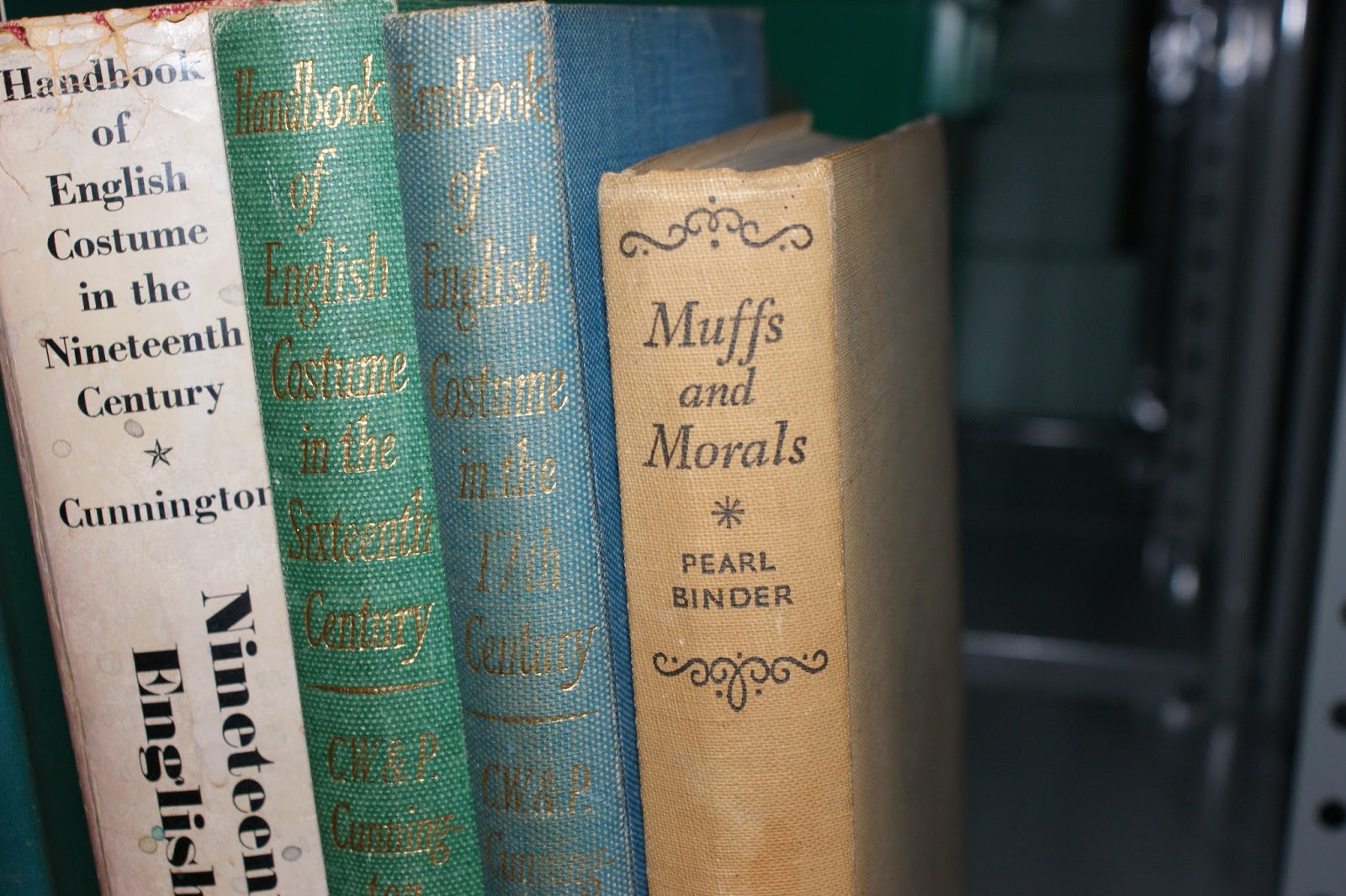 |
| Pearl Binder's Muffs and Morals (George G. Harrap & Co, 1958) as part of our Faith Jaques book collection © Seven Stories The National Centre for Children's Books. |
Back to Pearl Binder as children's illustrator - the second book I want to show you
also begins far away from both Binder's life in East London and China. In 1963 she illustrated
K. Goell's Pocahontas (Florence printed).
 |
Front cover of illustration proofs by Pearl Binder for K. Goell's Pocahontas (Florence printed, 1963) Photograph © Seven Stories The National Centre for Children's Books.
|
 |
| Back cover of illustration proofs by Pearl Binder for K. Goell's Pocahontas (Florence printed, 1963) Photograph © Seven Stories The National Centre for Children's Books. |
This is a printed proof for the book's illustration and is wordless. You don't need the words to interpret Pearl's depiction of Pocahontas. It showcases the same bold colour palette yet seems very different from Chi Ming and the Tiger Kitten.
 |
| Wedding celebration double page spread from illustration proofs by Pearl Binder for K. Goell's Pocahontas (Florence printed, 1963) Photograph © Seven Stories The National Centre for Children's Books. |
As
well as illustrating this version of the story Binder also designed a musical
based on the historical figure of Pocahontas for Joan Littlewood at the Theatre
Royal Statford East (Tyne and Wear Archives and Museums).
If you're interested in Pearl
Binder Spitalfields Life gives a fantastic in depth account of her work and her attachment to
the East End of London. As part of a series of blog posts about 'Everyman
prints' Tyne and Wear Archives and Museums explore
more of her life and work. Design for Today have also written an interesting blog post which includes the cover image for Puffin Picture Book Misha Learns English.
If you'd like to find out more about
the Seven Stories Collection, then
email: collections@sevenstories.org.uk
or phone: 0191 495 2707 or comment on this blog.


