Showing posts with label Moving Stories. Show all posts

Monday, 1 February 2016

All About: Castles

If I were going to spend a weekend in the magical world of Ingary I’d want to travel in comfort.  It’s quite far from here so I’d have to think carefully of how I’d make my way. I’d definitely travel by CASTLE.  This week we’re going to dip into our Diana Wynne Jones collection and look at that most inventive and smoke-belching mode of transport: a castle, Howl’s Moving Castle, to be specific.  


[Howl’s castle] suddenly appeared on the hills above Market Chipping, blowing clouds of black smoke from its four tall thin turrets…what made it all the scarier was that the castle did not stay in the same place…You could see it moving sometimes, with smoke pouring from its turrets in dirty gray gusts (Extract from Jones' Howl's Moving Castle, p.2, Methuen, 1986).

Inside this Castle that clunks and smokes through the wastes is a rugby-obsessed Welsh wizard called Howl, his fiery fire-spirit Calcifer and the unsuspecting companion in these adventures, the hat-maker’s apprentice, Sophie. 

This is a story about growing up. Sophie is transformed into an old woman by the powerful Witch of the Waste and leaves the hat shop to find work as a cleaner for the notorious wizard Howl.  The castle is where Sophie learns not only about Howl's unwillingness to clean but about her own magical abilities.  It may sound cliché but the Castle opened up a journey of discovery for Sophie.  In her home of Market Chipping she was a cooperative and compliant young girl who later emerges from the castle as a strong, confident old lady (old until the curse is lifted but still confident).  Diana Wynne Jones believed that all children should be encouraged to discover their own individuality, rather than being expected to follow the rules (Seven Stories Moving Stories text panel). Sophie certainly discovers her individuality on the journey and doesn't quite follow the rules. Howl was rumored to be terrifying - probably somebody a young girl should try to avoid and escape not seek employment from.

[Howl] was known to amuse himself by collecting young girls and sucking the souls from them.  Or some people said he ate their hearts.  He was an utterly cold-blooded and heartless wizard and no young girl was safe from him' (Extract from Jones' Howl's Moving Castle, p.3, Methuen, 1986).

Sophie was not exactly a young girl, thanks to the Witch's curse, but her physical transformation from young to old mirrors a transformation of character.  She grows into a person who is no longer resigned to her fate in a hat shop but who controls her own destiny.  

Howl's Moving Castle area of the Moving Stories exhibition which came to a close in 2015. Photography by Damien Wooten © Seven Stories – The National Centre for Children’s Books
It doesn’t exactly seem to be environmentally friendly, but Howl’s Castle allows him to move between worlds. It is his home and his transport. The castle has taken many forms with the Studio Ghibli re-imagining becoming somewhat iconic. Studio Ghibli adapted Howl’s Moving Castle for the screen in 2004. The co-founder of the studio, director Hayao Miyazaki's personal views on environmentalism, pacifism and feminism have a strong influence upon his work. So, a wheezing castle and Sophie's personal journey seem an ideal choice for the Studio however, Miyazaki's adaptation shows significant differences to the book. Prior to the release of the film,  Miyazaki visited Jones at her home to watch the film with her.  About the Japanese director she said "I don't think I've ever met anyone before who thinks like I do. It was wonderful. He saw my books from the inside out."

Diana Wynne Jones is represented in many of our book collections; you can almost always count on finding her name in former public library collections. We have two different versions of Howl's Moving Castle and this cover from the Indonesian edition shows a very different portrayal to the wooden-faced castle of Studio Ghibli. I can understand how a Castle running through the hills like it has spontaneously uprooted and grown legs would have been very frightening to those in the Ingary town of Market Chipping. 

Indonesian edition of Howl's Moving Castle.  Reference: DWJ/06/01/18 © Seven Stories – The National Centre for Children’s Books

The second version features my favourite book cover of all time: it's Howl, with his precious blonde mane and his electric guitar.  For me, this cover embodies some of the humour of Jones’ writing even though Howl isn’t quite as I had imagined and Calcifer is nothing short of terrifying (I have to admit to my fandom of Hayao Miyazaki's much more lovable fire spirit). An online search for Howl's Moving Castle book covers reveals so many different editions each with wonderful artwork - if you own a different copy, I would love to see it!  You can leave a picture in the comment section, or tweet us at @7Stories

Howl's Moving Castle Reference: STSLS/01/451 © Seven Stories – The National Centre for Children’s Books
Jones is widely recognised among scholars, writers and fans of science fiction and fantasy as a truly ground-breaking writer so it's not surprising that her collection is one of our most popular among researchers. In 2014 Seven Stories and Newcastle University hosted a memorial conference for Jones, as a celebration of her work and an evaluation of her contribution to children’s literature, fantasy and science fiction. 

Archival material in our collection includes stories written by Jones as a child; draft material for 49 published works; material relating to numerous unpublished works; correspondence and fan-mail.  

Only a small proportion of material relates to Howl’s Moving Castle with two files containing typescript drafts.  One of which is a setting draft, marked up with typesetting instructions for the printer.  The annotations on this draft mostly refer to formatting amendments for the printers, however some do refer to language use for American editions of the book. 

Setting copy transcript.  Reference: DWJ/02/01/01/02 © Seven Stories – The National Centre for Children’s Books

The  second typescript came to us in a brown envelope with a scrawled label reading  'Howl minus by Miriam'.  This draft is what Howl's Moving Castle could have looked like if Diana's editor Miriam had had her way. The draft was sent to Laura Cecil, Diana’s agent, who gave the following explanation when the collection was donated:

This was a joke version of an edited HOWL sent to Laura Cecil by an exasperated Diana Wynne Jones, showing in a reductio ad absurdum version what would happen if she followed Miriam Hodgson’s editorial comments to the letter.  Neither Miriam nor anyone else at Methuen knew about this version.  It was part of Diana’s way of letting off steam when she was having to fight her corner with publishers.  Later on she and Miriam had a very good relationship, but it took some time for her to understand Diana’s work.


Howl minus by Miriam draft.  Reference: DWJ/02/01/01/01© Seven Stories – The National Centre for Children’s Books
The version is incomplete and the majority of red-ink annotations are suggestions for rephrasing and sentence deletions. As an example here is a change made in chapter thirteen 'In which Sophie blackens Howl's name' 


and another from the end of Chapter 10 'In which Calcifer promises Sophie a hint'


These changes aren't huge or structural, they don't change the story but their frequency would change the flow of the book.  So, this typescript is Jones' reaction to edits that she thought would flatten and oversimplify her language.  Judging from her strong presence in our book collections, numerous translated editions and a Japanese film adaptation, Jones' book has clearly had great success without these particular amendments. 

I may not be able to guarantee that a castle is an efficient mode of transport (with all the billowing smoke and terrified reactions it may not be worth it).  What I can guarantee is that Howl's Moving Castle is an excellent read and our collections shed some light on the stages of its creation, and Diana's popularity as an author.


If you'd like to find out more about the Seven Stories Collection, then 

email: collections@sevenstories.org.uk or phone: 0191 495 2707 or comment on this blog.


Friday, 24 October 2014

Guest Post: Brian Selznick gives a behind the scenes look at 'The Invention of Hugo Cabret'

Seven Stories current exhibition, Moving Stories, children's books from page to screen, has been on show since April 2014, and features some of the most well loved and innovative adaptations to grace our screens.

One of our absolute favourites is the Martin Scorsese adaptation of the beautiful book The Invention of Hugo Cabret!, written and illustrated by Brian Selznick. This area of the exhibition has been captivating visitors to the building for months, and the stunning display of costume and behind the scenes photos from the film has been a real highlight.


On the blog today, Brian has very kindly shared some new pictures of the creation of Hugo exclusively with the readers of the Seven Stories Collection blog. All the images and comments below are straight from Brian.

This is a view of the inside of my flat files, where I keep most of the Hugo drawings and dummies. This is dummy with a rough draft of the drawing of Isabelle. You can see how small they are by comparing them to the size of my hand in the photo. They are about 1/4 size of the book.
Image © Brian Selznick
This is the dummy with a sketch of Hugo from the beginning of the book.
Image © Brian Selznick
This is an actual drawing done by the real eighteenth century automaton that I researched for Hugo. The automaton can be found at the Franklin Institute, and when I first discovered him, he was no longer on display, as he'd broken many years earlier. While writing Hugo I met a mechanical genius named Andy Baron who helped me get all the clock and machine descriptions correct. I introduced Andy to the curators at the museum, and now the automaton is fixed and on display again.
Image © Brian Selznick
To find out more about the original automaton, named 'Maillardet's Automaton' click here 

And to see a film of Brian and Andy demonstrating the automaton actually drawing, click here. 
This is a rough sketch of Hugo winding the clocks. You can see notes I've written to Andy Baron asking if they machinery is correct, along with several other notes to my editor.
Image © Brian Selznick
Here is a sketch cut from the end of early drafts of Hugo, along with an early cover design. You can see that the title wasn't always The Invention of Hugo Cabret!
Image © Brian Selznick
Very few final pieces of art are cut from the finished book. Usually I remove drawings while they are still in the rough draft stage. But here is a finished drawing that didn't make it to the final story. Originally, when Hugo was walking across the graveyard to Melies's house, he was going to pass this gravestone with his own name on it. I hoped the reader might think for a moment that Hugo was a ghost, which would add to the mystery, and only later would we find out that Hugo's father had had the same name as him, and this Hugo Cabret was the dad's grave. But for obvious reasons I thought this might get a little confusing, so I cut it.
Image © Brian Selznick

To find out more about Brian Selznick, visit these websites www.theinventionofhugocabret.com and www.wonderstruckthebook.com.

For more information about the Moving Stories, Children's Books from Page to Screen exhibition, click here. The exhibition runs until April 2015.

Moving Stories was curated in partnership with the National Media Museum, to find out more about them, visit this link.

Wednesday, 28 May 2014

Moving Stories in the archive: 'The Machine Gunners' and the BBC

In this special blog post to coincide with our current exhibition Moving Stories: Children's Books from Page to Screen, we look at another children's book featured in our collection that has been adapted for the screen, Robert Westall's The Machine Gunners.

First published in 1975, The Machine Gunners was Robert Westall’s very first novel. The story follows a group of north east school children during the Second World War who manage to take the machine gun from a crashed German aircraft. Originally written for Westall’s son, Christopher (who later died in a tragic motorcycle accident), the book draws heavily upon Westall's own childhood on the north east coast (the book is set in fictional 'Garmouth', largely based on Tynemouth where Westall spent the war as a boy). Upon its release, The Machine Gunners was critically acclaimed and brought Westall the first of his two Carnegie Awards. The novel is still a much-loved classic and in 2007 made the list of top ten all time Carnegie winners.


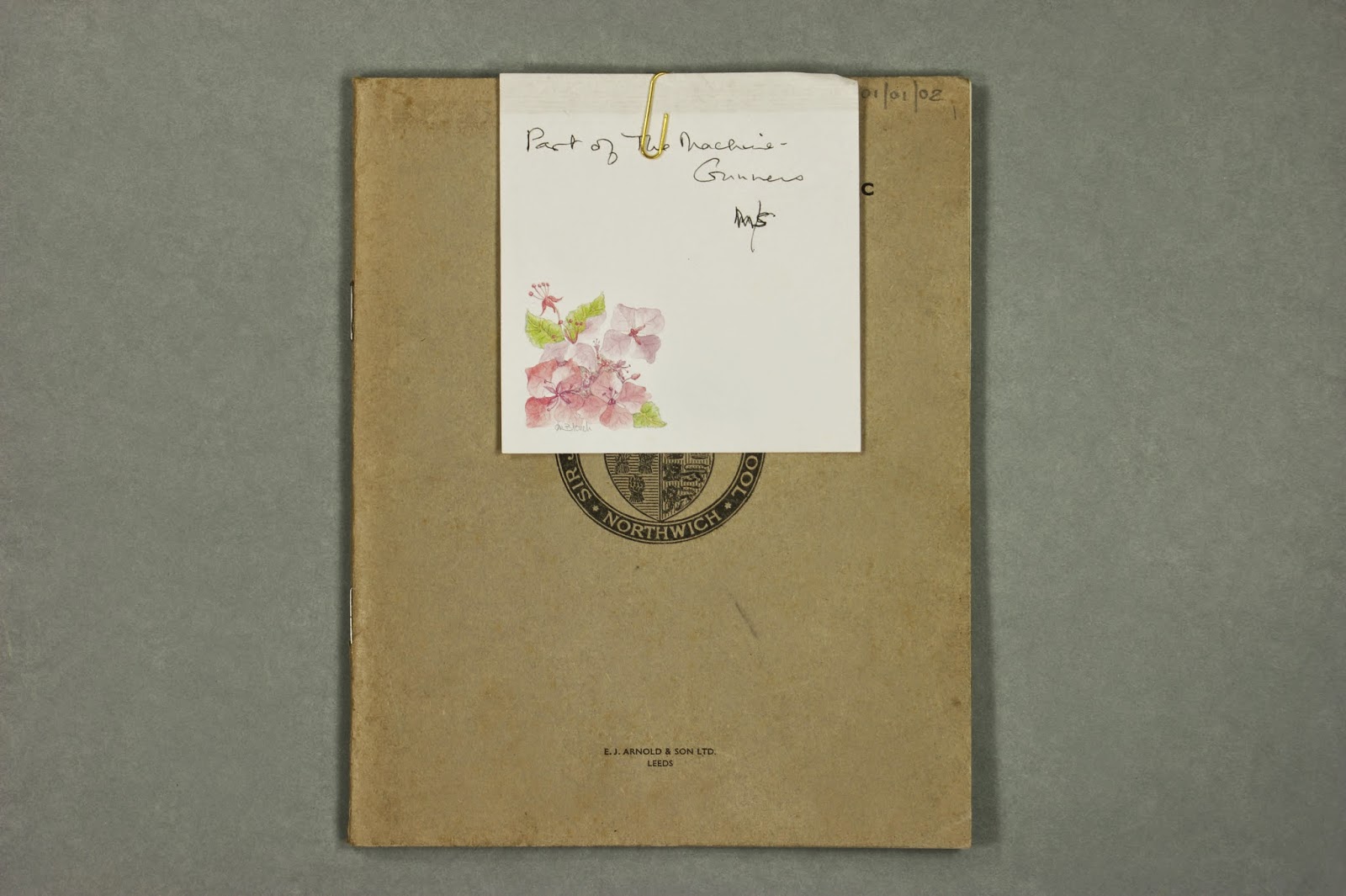
One of the notebooks in which Robert Westall wrote his manuscript for The Machine Gunners,
from the collection here at Seven Stories


In 1981, six years after the book's publication the production rights were bought by the BBC. Television drama made for children and young people was becoming increasingly popular at this time (Grange Hill had only just made its first appearance three years earlier in 1978) and television companies were eager for stories that had potential for serialisation. The much-loved and critically acclaimed, The Machine Gunners, presented an ideal opportunity for the BBC and they set out to secure the rights for a six part drama.


Letters from the BBC to Robert Westall about The Machine Gunners,
from the Robert Westall collection here at Seven Stories


The first episode aired on 23 February 1983. The script was written by another well-known writer originally from the north east, William Corlett - who, as well as being a script writer and playwright, produced a number of successful novels for children and adults. The series director was Colin Cant, a specialist in children's drama who, as well as serving for many years on Grange Hill, went on to direct other children's book adaptations including Moondial (by Helen Cresswell) and The Children of Green Knowe (by Lucy M. Boston).

The series was well received by audiences and is even now fondly remembered by many. Of the adaptation Robert Westall himself wrote:

"I quite approve of the TV serial made from 'The Machine Gunners'.   The script writer was William Corlett, who also writes children's novels.   He loved the book very much – perhaps too much, for he could not bear to leave many incidents out, and at times (as in the Mrs. Spalding incident with her knickers), things got a little rushed and blurred.   The fault lies with the BBC producers, who did not allow more than six episodes.   It takes about ten episodes to do justice even to a children's book, and they just don't seem to have the nerve to allow this many episodes."

('About 'The Machine Gunners'', http://www.robertwestall.com/the_machine_gunners_by_robert_westall.html)


Another of the notebooks in which Robert Westall wrote his manuscript for The Machine Gunners,
from the collection here at Seven Stories

In 2002, The Machine Gunners was again adapted by the BBC but this time for radio. The story has also appeared on stage - in 2011 a stage version was performed at Polka Theatre in London, commissioned by the Imperial War Museum.


The Robert Westall collection is available to consult by appointment at Seven Stories Collections Department. If you'd like to find out more about this collection or others that we hold you can
email: collections@sevenstories.org.uk or phone: 01914952707.

Material from the Seven Stories archive is currently on display at  an exhibition looking at the work of Robert Westall at the Friends of Weaver Hall Museum in Northwich, Cheshire: http://www.fowhm.org.uk/events/exhibition-robert-westall-a-writer-and-his-world/ 

If you'd like to find out more about other children's books adapted for the screen then why not visit our exhibition Moving Stories: Children's Books from Page to Screen at the Seven Stories visitor centre, Newcastle upon Tyne, until April 2015


Friday, 21 February 2014

Moving Stories Introduction Evening

The next exhibition opening at Seven Stories is Moving Stories, Children's Books from Page to Screen Saturday 5th April. This is an exhibition curated in partnership with the National Media Museum in Bradford, and was on display there during Summer 2013. It will be displayed over BOTH galleries at Seven Stories!

The exhibition aims to show all the fantastic ways that stories can be adapted, be it in a book or on film. The exhibition is divided in to 5 themes; Fairy Tales, Journey of Adventure, World of Fantasy, Overcoming the Monster and Friends and Family.

To find out more about the exhibition, click here or here!

Last night was the introduction event, to show the plans for the exhibition off to all staff and volunteers involved with Seven Stories. We had a fantastic turnout, with a few photos below. Gill (Senior Curator), Beth (Learning Co-ordinator) and I (Alison, Curator) presented all the different elements of the exhibition, our new methods of interpretation and a brand new drama experience for all visitors - watch this blog to find out more about the exhibition content.

The audience broke in to groups to explore different areas of the exhibition, before feeding back their favourite parts of the exhibition and the books involved.
Some of our fantastic textile illustrations from the Judith Kerr Exhibition, exploring the Sensory Explorer Bags being rolled out for the new exhibition.

Alison (Curator)