Showing posts with label picturebook. Show all posts

Tuesday, 17 June 2014

Yasmeen Ismail winner of Best Book Illustrator at the V&A Illustration Awards!

Congratulations to Yasmeen Ismail who, earlier this month, won the V&A Book Illustration Award for her debut picture book, Time for Bed, Fred! (2013). You can read all about the judges’ response to Yasmeen’s illustrations (and find out a bit more about her technique) here: http://www.vam.ac.uk/b/villa-2014/book-illustrations.

The annual V&A Illustration Awards celebrate the best illustration published over the last year. First established in 1972, the awards have rocketed in popularity in recent years: this year saw over 800 entrants over all four categories. Though not exclusively for children’s picture books, the Book Illustration award regularly showcases work by many highly regarded illustrators for children. This year’s list featured artwork by over 120 artists, including a number of noted children’s illustrators such as Levi Pinfold, Oliver Jeffers, Jackie Morris, Chris Riddell, Catherine Rayner, and Jane Ray.


Preliminary artwork for Time for Bed, Fred! in the Seven Stories Collection


At the end of last year, Yasmeen kindly donated artwork – including a selection of preliminary and finished work for Time for Bed, Fred! – to the Seven Stories Collection. The material gives a real insight into Yasmeen’s process and her original sketches and illustrations are simply a delight to look at. You can find out more about artwork that Yasmeen donated to the Seven Stories Collection here: http://sevenstoriescollection.blogspot.co.uk/2014/01/yasmeen-ismail-at-seven-stories-archive.html.

Yasmeen’s illustrations for Time for Bed, Fred!, along with artwork by the other four Illustration Award winners will be on display at the National Art Library Landing Gallery (part of the Victoria and Albert Museum) Kensington, West London until 2nd July.

To find out more about Seven Stories illustration collections or to arrange a research visit to the Seven Stories Collections Department, please email: collections@sevenstories.org.uk or phone: 0191 495 2707.

Monday, 16 June 2014

Looking at radical children's literature, no. 2: 'The Magic of Coal'

Our second post on radical children’s literature looks at the Puffin picturebook, The Magic of Coal (1945). The first books ever produced under the Puffin imprint, the Puffin picture book series began at the beginning of the Second World War with War on Land (immediately followed by War at Sea and War in the Air). The series was devised by Noel Carrington – then editor of Country Life – who approached the founder of Penguin books, Allen Lane, with the idea in 1939.  An educational and mostly non-fiction series, the Puffin picture books were largely inspired by Soviet mass-produced educational books for children. This Soviet inspiration is clearly apparent in The Magic of Coal – the 49th book in the Puffin series. Here Newcastle University English students, Lucy Campbell Woodward and Clara Heathcock look at the Soviet inspiration behind The Magic of Coal and the book’s Socialist message.


Cover from The Magic of Coal (© Penguin Books)


The Magic of Coal as a ‘production book’ (Clara Heathcock):

"Following the 1917 Bolshevik revolution, soviet Russia identified the field of children’s literature as a highly charged political milieu in which the potential lay to educate the populace about communist ideology. The production book genre developed as an attempt to do just this.

Production books detailed the production process of economically essential resources such as coal or steel. Emphasis was placed on the difference between the capitalist and communist machinery used to create these resources; where capitalist machinery was shown to feed greed and overproduction, communist machinery provided a helping hand in creating a prosperous future everyone could enjoy. Thus production books clearly directed the child reader’s attention to a wider political narrative beyond the specificities of the text.

Production books were aesthetically modernist, combining ideas from abstract painting with typography to create a visual language strikingly different from what had gone before. Pictures held a machine-like appearance, using straight lines and elementary forms. By championing newness, it was conveyed to the child reader that they had the potential to be aesthetically innovative. Rather than simply encouraging them to learn to copy what was already seen as beautiful, aesthetic modernism puts more at stake for the child; if whatever they create has the potential to be considered beautiful, there is more incentive for them to attempt to create. Similarly, if a transformed communist society is shown to be a plausible alternative to today’s society, there is a greater incentive for the child to become an activist to help bring this society about. 

The Magic of Coal was published in Great Britain in 1945 and contains all of the features of a production book here discussed. Reference is made to, ‘our gas works’ and ‘our community, implying collective ownership, and all images are aesthetically modernist. Thus it is an example of the attempts of a popular front of left-wing publishers to bring the production book genre and its associated radicalism to Britain in the interwar period."


Internal spread from The Magic of Coal (© Penguin Books)


The Magic of Coal and Socialist ideology (Lucy Campbell-Woodward):

"The Magic of Coal introduces readers to the admirably technical and industrious world of coal mining. Taking the child on a journey, it tells not only of the production of coal but also elevates the miner as an important and  respectable member of society. In doing so, the text and its illustrations point towards a political goal.

The text focusses on the production process rather than around any one character. Each role within the mine is shown through illustrations and accompanying text, implying that there is something for everybody. Every individual has a skill set to offer in the production of coal and is a valuable cog in the machinery of the mine. A sense of a community at work is created and when combined with impressionist illustrations of tiny black figures and miners whose faces are blurred or have their backs to the reader, this sense of community solidifies into the socialist theory of collectivism.

The text informs the reader that the miners can attend the ‘pitbaths’ before or after work, challenging class boundaries as it suggests that before he enters the mine, a working-class man looks like, and therefore is like, any other man going about any other business. The text also tells us of the miner’s life outside of work, mentioning societies, theatre visits and higher education, indicating that the miners are not only important members of coal-fueled, modern society, but also respectable citizens with good standards of living and a thirst for culture.

The Magic of Coal presents the world of the working-class man as being not only respectable but also desirable. It implies that coal mining is important to a progressive society, thus the miners are as important as the ‘treasure’ they dig up. For many middle-class children this would have been a radically different literary theme in itself, however its advocation of  left-wing ideology further bolsters The Magic of Coal’s radical message."


Internal spread from The Magic of Coal (© Penguin Books)


Seven Stories Collections Department has a large collection of original Puffin picturebooks (including The Magic of Coal) as well as other Puffin-related material such as the Kaye Webb archive. If you'd like to find out more about these collections or others that we hold you can
email: collections@sevenstories.org.uk or phone: 01914952707.

Monday, 2 June 2014

Looking at radical children's literature, no. 1: Olive Dehn's 'Come In'

Earlier this year a group of undergraduate students studying at Newcastle University's English department visited Seven Stories to find inspiration for a project looking at radical children's literature. The students looked at a range of material from the collection including: material from the archive of the anarchist poet and children's writer, Olive Dehn; items from the collection of the prolific left-wing children's writer, Geoffrey Trease; and some of the very earliest Puffin picturebooks, inspired by Soviet educational books for children. We'll be posting extracts from some of the studies over the next two weeks.

The first of our posts looks at Come In (1946) written by Olive Dehn and illustrated by Kathleen Gell. Very obviously based on Dehn's own experiences (the name of the family in the book is even Markham - Dehn's own married name), Come In is the story of a day in the life of a suburban housewife. In its depiction of the dull and monotonous routine of the housewife (in contrast to her husband's exciting work as an actor), the book shares an explicitly feminist message and pokes fun at traditional family 'roles'. Here Newcastle students Isabel Ashton and Olivia Bland look at how the book challenges the traditional role of the housewife and the idea of the nuclear family.


Come In and the idea of the nuclear family (Isabel Ashton):

"Come In exposes the serious hard work that life as a housewife entails.  Dehn is urging her child readers to appreciate the difficulties that their own mothers face in daily life.  Come In lends a voice to women in society who were expected to fulfil their duties of domesticity and motherhood gladly and without complaint. Written and illustrated by two women, the book focuses on the home as a principally female domain, and Mr Markham is notably absent for most of the story.  His job as an actor is depicted as self-indulgent and frivolous in comparison to the stress of Mrs Markham’s day. Her endless list of menial tasks and the illustrations of her black and white outfit, complete with apron, infer that there is little differentiation between being a housewife and being a maid.  Dehn is creating an authentic representation of family roles by rebelling against the idealisation of the mother figure.

Come In criticises the “nuclear family” as an imposed ideal on society. Following the devastating effect of World War 2 on so many households, the institution of the family was promoted as more significant than ever. However, the Markhams undermine this romanticized image of the “nuclear family”, and Mrs Markham’s fallibility relieves the pressure that women were under to create a perfect home life.  Dehn’s radicalism is evident as she is unafraid to articulate ideas that other, more conventional writers would not. Come In reveals what really goes on behind closed doors in the apparently conformist family home."


Internal spread from Come In (illustrations © Kathleen Gell estate)


'The housewife speaks out’ (Olivia Bland):

"At the start of the book, after complaining about how dull her life is, Mrs Markham (the mother) is asked by her husband to write an account of her day, so that he ‘could read exactly how dull it was’; this she undertakes without objection. Throughout the day the reader bears witness to the unending list of chores and challenges that Mrs Markham undertakes. She is the cook, cleaner and nanny, and appropriately is illustrated to be wearing an apron, and the black and white of a maid’s outfit. The whole text is punctuated by illustrations of, and references to, clocks, drawn by an artist who is requested to portray the day’s events. These show how regulated Mrs Markham’s day is, implying a machine-like routine, though without the expected order of a mechanised environment. Kathleen Gell’s modernist images serve to complement Dehn’s words and add to the radical theme running through the book.


Final page from Come In (illustration © Kathleen Gell estate)


Whilst implying to the child reader that a deeper appreciation for their mother’s work is necessary, there is also a slightly satirical tone, which perhaps only the adult reader would detect. References such as: ‘it’s time somebody began to think about getting dinner ready’, seem to be a wink to the mother reader, as if to say, ‘I wonder who that might be?’ Being that this text was written and illustrated by two women, Dehn and Gell, this outlook is to be expected, thus making it all the more radical.

Dehn challenges the expectation that being a 1940s housewife was a happy and rewarding role, and encourages her readers, whether children or adults, to see that this job alone does not allow for a life of sufficient fulfilment. Although people were conscious that life in the typical suburban home was not necessarily as perfect as it seemed, Dehn’s perspective would have been considered controversial, as, unlike other writers for children, she expresses its realities, thus making this a particularly radical text."

Inscription by Olive Dehn in the cover of the copy of Come In at Seven Stories Collections Department


Olive Dehn's original manuscript of Come In at the Seven Stories archive


The Olive Dehn collection is available to consult by appointment at Seven Stories Collections Department. If you'd like to find out more about this collection or others that we hold you can
email: collections@sevenstories.org.uk or phone: 01914952707.

Tuesday, 29 April 2014

Picturebook in Progress at Edinburgh College of Art

Last November a group of illustration students from Edinburgh College of Art visited the Seven Stories collections department and visitor centre as part of the Picturebook in Progress project.

The students viewed a range of archive material relating to how homes and families are represented in picturebooks, including work by Sarah Garland, Shirley Hughes and Kim Lewis, amongst others.

After returning to University, the students set to work on a brief to take a secondary character from one of the books they studied and illustrate a new home for them to inhabit. The project culminated in an exhibition of the new work that ran from 4 – 21 April at the College of Art.

There were some fantastically creative responses to the collection on display, including some surprising reinterpretations of classic picturebooks.

Yasmine Pirouz reworked Jan Ormerod’s Sunshine into a contemporary comic book, told from the point of view of a toy.


Laura Darling took a character from David Almond’s My Dad’s a Birdman and developed a new subplot in which he struggles to find a new job after the culmination of the book. In the ambiguous ending to her story, the character seems to be in the verge of a new life in the theatre.


After viewing artwork by Angela Barrett for The Snow Queen, Wenjin Lu took a minor character and imagined how their story might unfold.


Judith Kerr’s classic picturebook The Tiger Who Came To Tea has been interpreted in many ways. Maria Stoian’s version presents the tiger as a metaphor for depression, visiting the character of the mother unannounced.


As well as the illustrators featured here, other students took inspiration from work by Leila Berg, Helen Craig and Faith Jaques.

To see further examples of how the Seven Stories Collection has inspired illustration students, visit the Picturebook in Progress exhibition, on show at the Seven Stories visitor centre until June.

Wednesday, 2 April 2014

Gillian McClure Visits Seven Stories

Last week saw a visit to the Seven Stories Collections Department from author / illustrator Gillian McClure.

Gillian McClure at the Seven Stories Collections Department

Over the years Gillian has donated finished and preliminary artwork for many of her titles to the Seven Stories Collection, giving a comprehensive insight into her creative process, from first ideas through to finished artwork.
Her archive also displays a wonderful mastery of different media, including watercolour, acrylic and coloured glazes.

Gillian was visiting to be interviewed as part of the Picturebook in Progress project, with her insights to be used as part of a digital learning resource currently in development for aspiring illustrators.

One of the main topics of discussion was Gillian’s illustrations for Tog the Ribber, a uniquely scary and innovative picturebook written by her father Paul Coltman.

While discussing the origins of the book, Gillian surprised us all by revealing her early artwork for the first draft of the book which stands in complete contrast to the version which hit the shelves in 1985.


Artwork from the first draft of Tog the Ribber

The black and white crosshatching and colour wash give the first draft a completely different texture to the published artwork, while Gillian went onto explain that the final version’s wonderful depth came from constant experimentation with masking fluid and acrylic paint.

Most interestingly of all, the first draft lacks the outright nightmarish quality of the final artwork, Gillian herself admitting that she felt too protective towards the main character in this early version. A combination of allowing the skeletal character of Tog more prominence in the story and the introduction of page borders dividing safety and peril give the finished book a genuinely haunting quality.

Artwork from the first draft of Tog the Ribber

Final artwork for Tog the Ribber

Gillian has kindly donated the artwork for the first draft of Tog the Ribber to the Seven Stories Collection where it will sit alongside the final artwork, providing a deeper insight into an endlessly interesting book.

Learn more about Gillian McClure by visiting her website http://www.gillianmcclure.com and blog http://gillianmcclure.blogspot.co.uk


To book a visit to Seven Stories Collection department or learn more about the forthcoming Picturebook in Progress Digital Learning Resource, please contact collections@sevenstories.org.uk

Limited Copies of Tog the Ribber signed by Gillian McClure are available to buy in the Seven Stories Bookshop. Please email bookshop@sevenstories.org.uk or call 0191 261 2000 to order.

Friday, 21 March 2014

Finding Your Voice in Children's Books

Our last post offered a brief overview of the fantastic depth in the collections of Helen Craig and Katharine Holabird held at Seven Stories. One of the interesting aspects displayed by these collections is the attention to detail that goes in to creating a series of books as successful as the Angelina Ballerina titles. Particularly noteworthy is the level of research and planning that goes into the books, as evidenced by the stacks of drafts and rough versions of stories and illustrations, created by both Helen and Katharine.

More than anything else, the collections highlight what an absorbing experience it can be to write and illustrate children’s books. The level of work and dedication required to succeed in the world of children’s books is keenly felt by Michelle Robinson, author of picturebooks such as How to Wash a Wooly Mammoth and the forthcoming There’s a Lion in my Cornflakes.


We spoke to her about her experiences finding her way into the industry and developing her own distinct style. In her own words…


“Agents and publishers are always seeking original voices - ones that grab us from the first word and hold us beyond the last. Forget interesting marketing angles, bestselling trends and clever manuscripts - a fresh voice is the only thing that will give you a chance of publication.

So how do you find that voice? Where does it come from? When you do find it, why won’t it leave you alone, even when you’re in the shower? And why must it insist on asking questions instead of providing answers?

I found my voice through hard slog. Like a child learning to ride a bike, I started off writing with the stabilisers on. I read a lot, absorbed a lot and wrote my early stories in the style of other authors. I didn’t mean to, I just hadn’t found my own way into it yet. But I was getting there.

The more I practiced, the better I became. I gained confidence, loosened up, experimented, gathered pace and was soon freewheeling in my own style. I could push the metaphor further and say I fell off a few times (and still do, regularly), but it’s getting rather tired. So, forget bicycles and picture yourself in Devon.

The birds are singing, you’re drifting in a digital-free haven and there’s nothing to do but write. Because if practicing is how I found my voice, a writing course is where. The course came at just the right time. I needed to be challenged. I had to work harder. I relished the chance to show off. I was ready to go, I just needed a captive audience: my tutors. Thanks to them I secured an agent and the first of many book deals. I’d found my voice - and I had an awful lot to say.”


The Seven Stories collection is a unique resource for aspiring writers and illustrators.

For information about research opportunities, please contact collections@sevenstories.org.uk

Michelle Robinson’s next book There’s a Lion in my Cornflakes is due out in July, published by Bloomsbury.

Thursday, 13 March 2014

Helen Craig's studio

At the end of February we visited author and illustrator Helen Craig at her home in Cambridge. Most of you will know Helen as the illustrator of the world famous Angelina Ballerina books (written by Katharine Holabird). We were visiting Helen to pick up artwork for the two latest books in the series: Angelina's Cinderella (published last year) and Angelina's Big City Ballet (which is due to be released in November this year).

It was in the early 1980s that Katharine Holabird first came up with the idea of a story (based on her two daughters) about a ballet loving little girl called Primrose. When Katharine showed the story to her friend and collaborator Helen Craig, Helen drew Primrose as a white mouse. The character's name was later changed to Angelina, due to the fact - as Helen points out - that there was already a little mouse called Primrose in Jill Barklem's popular Brambly Hedge series of books. Angelina's debut story book Angelina Ballerina was published in 1983. The little dancing mouse has since appeared in over 20 books, two animated series, and even on stage with the English National Ballet.


We are delighted that Helen has chosen Seven Stories as the home for her Angelina artwork - over the last few months Helen has donated the artwork for every one of the Angelina titles she has illustrated. Helen's collection includes everything from intricately detailed storyboards and dummy books, right through to her wonderful finished artwork. Seven Stories already holds Katharine Holabird's archive, which she very kindly donated to us in 2012. Katharine's fantastic collection includes, amongst a variety of other things, her drafts for the books, a selection of Angelina merchandise, and papers relating to the Angelina animations. The two collections side by side make for a truly wonderful resource for researchers and Angelina fans alike!


Helen looking through some of her rough artwork


On our visit to Cambridge, Helen was kind enough to show us around her studio. As you might expect in Helen's studio, Angelina pops up everywhere you turn. Helen showed us the very first Angelina doll she made by hand back in 1986 after the publication of the fifth book in the series.


This is Helen holding the very first Angelina doll she made by hand in 1986

Helen also talked us through her creative process and the materials she uses in her work. Most striking was her three layered box of watercolour pencils.


Helen's very neat pencil box

If you'd like to know more about the Helen Craig and Katharine Holabird collections you can email collections@sevenstories.org.uk. Both collections are available to view at the Seven Stories Collections department in Felling, Gateshead (Helen's collection will be searchable on our online catalogue soon). Some of Helen's artwork is currently on display in our Picturebook in Progress exhibition at the Seven Stories visitor centre in Newcastle upon Tyne. Angelina Ballerina will be featuring in other Seven Stories exhibitions and events soon!

Wednesday, 19 February 2014

David Almond and Polly Dunbar talk about My Dad's a Birdman

One of the most interesting aspects of making an illustrated book is the collaboration between the various creative forces.

The Seven Stories Collection includes numerous archives showing the interplay between author and illustrator. An excellent example of this can be found in the material relating to the book My Dad’s a Birdman, by David Almond and Polly Dunbar.


My Dad's a Birdman © Walker Books

In the summer of 2008, author David Almond donated his original manuscript and notes for the book to Seven Stories. Later that year illustrator Polly Dunbar donated all of her work from the book, from initial character sketches through to the finished artwork.

The material gives a unique insight into the creative mind of the author, as well as an interesting take on how an illustrator responds to a text and brings their own interpretation to it.

Last week, Seven Stories was pleased to host an event in conjunction with Newcastle University that marked the first time David and Polly have ever spoken together about the process of creating the book.


Polly and David at the event

As well as busting some myths about what it is like to collaborate on a book (the two never met until after the book was released), they both spoke of their desire to make a book with such strong and adult themes accessible to a young audience. Here's a preview clip of the talk:


A fascinating insight for aspiring authors and illustrators alike, the talk will be available to view at the Seven Stories collection, where the original material from the book is also open to public access. The full video will also soon be available via the Newcastle University, Children's Literature Unit website.


David Wright (Learning Co-ordinator: Picturebook in Progress Project)

Tuesday, 28 January 2014

Picturebook in Progress

Last weekend, the first exhibition in the newly renovated Storylab gallery opened at the Seven Stories visitor centre. The Picturebook in Progress exhibition is one of the outcomes of a collaborative project between the Collections and Learning and Participation teams which has been running since July 2013.

The project has the aim of using the Seven Stories collection to inspire and empower the picturebook illustrators of the future by working closely with students from illustration courses across Britain.
Over the course of the project, students from Anglia Ruskin University, Cambridge, Edinburgh College of Art, Sunderland University, as well as sixth form students from St. Cuthbert’s Catholic High School, Newcastle have been introduced to the Seven Stories collection and allowed to explore its rich illustration holdings.


Students from St Cuthbert's Catholic High School in the Seven Stories archive


Each group has investigated material relating to the creative process of illustrators, seeing how plots and characters develop and how these ideas become the finished books we see on the shelves. Using correspondence between authors, illustrators and publishers from the Seven Stories Collection, the students have also seen how ideas can be shaped by the pressures of the professional world of illustration, a vital understanding to have for anyone serious about pursuing a career in children’s books.


Illustration and Design Students from Sunderland University, investigating Seven Stories artwork collections


The exhibition allows visitors to Seven Stories to go on the same journey as the participating students, following a picturebook from from the very first ideas, be they rough scribbles or short notes, through every stage of development until reaching the fantastic finished artwork submitted to publishers.
As well as showcasing many of the collection items that the students viewed, the exhibition also features five artworks created by students from Sunderland and St. Cuthbert’s in response to their visit to the archive.


The Picturebook in Progress exhibition is open until April 2014.

(David Wright, Learning Co-ordinator: Picturebook in Progress project)

Monday, 27 January 2014

Judy Brook's boat

Last week this wonderful item arrived at Seven Stories Collections department - the latest acquisition for our archive.


Judy Brook's boat in the archive


This wooden boat belonged to author and illustrator, Judy Brook. Judy began illustrating in the 1950s and in the 1960s began illustrating the TV Land comic strip 'Brock and Bruin'. She went on to write and illustrate a variety of children's books, many of which feature animals. Judy is probably best known for writing and illustrating the Tim Mouse series of books. 


Unpacking the boat


The boat has been donated to the Seven Stories Collection by Judy Brook's brother, James Brook, to add to our already extensive archive of Judy Brook artwork. James told us that Judy came across the boat in a junk shop whilst looking for inspiration for her fourth Tim Mouse book - Tim Mouse goes down the stream. In this book Tim and his friend Mr Brown set out to rescue their friend Willy Frog from a gang of fierce river rats.

After finding the boat Judy scrapped her previous ideas and chose the little wooden boat as the model for the rat gang's vessel. 


Early rough artwork featuring a very different boat


In the finished illustration every porthole and handrail has been faithfully reproduced. The model boat provides a great insight into the detailed research often needed to make picturebooks.


Finished artwork from Tim Mouse goes down the stream


Our BRAND NEW Storylab Gallery: Behind the Scenes

Seven Stories, as we all know, has seven floors! The sixth floor has been undergoing refurbishment for the past three weeks, and has now opened its doors to the public.

The floor now boasts a small dedicated gallery space - designed to host small scale exhibitions for 3-4 months - as well as the 'Storylab Studio', which is a new room to accommodate larger groups for all different kinds of booked workshops and training sessions. 

Here are a few images of the transformation of the room to the calming gallery space we now have. This new gallery will allow us to display our Collection - especially newly acquired archives - much more quickly, and also allow for external exhibitions to be brought in.

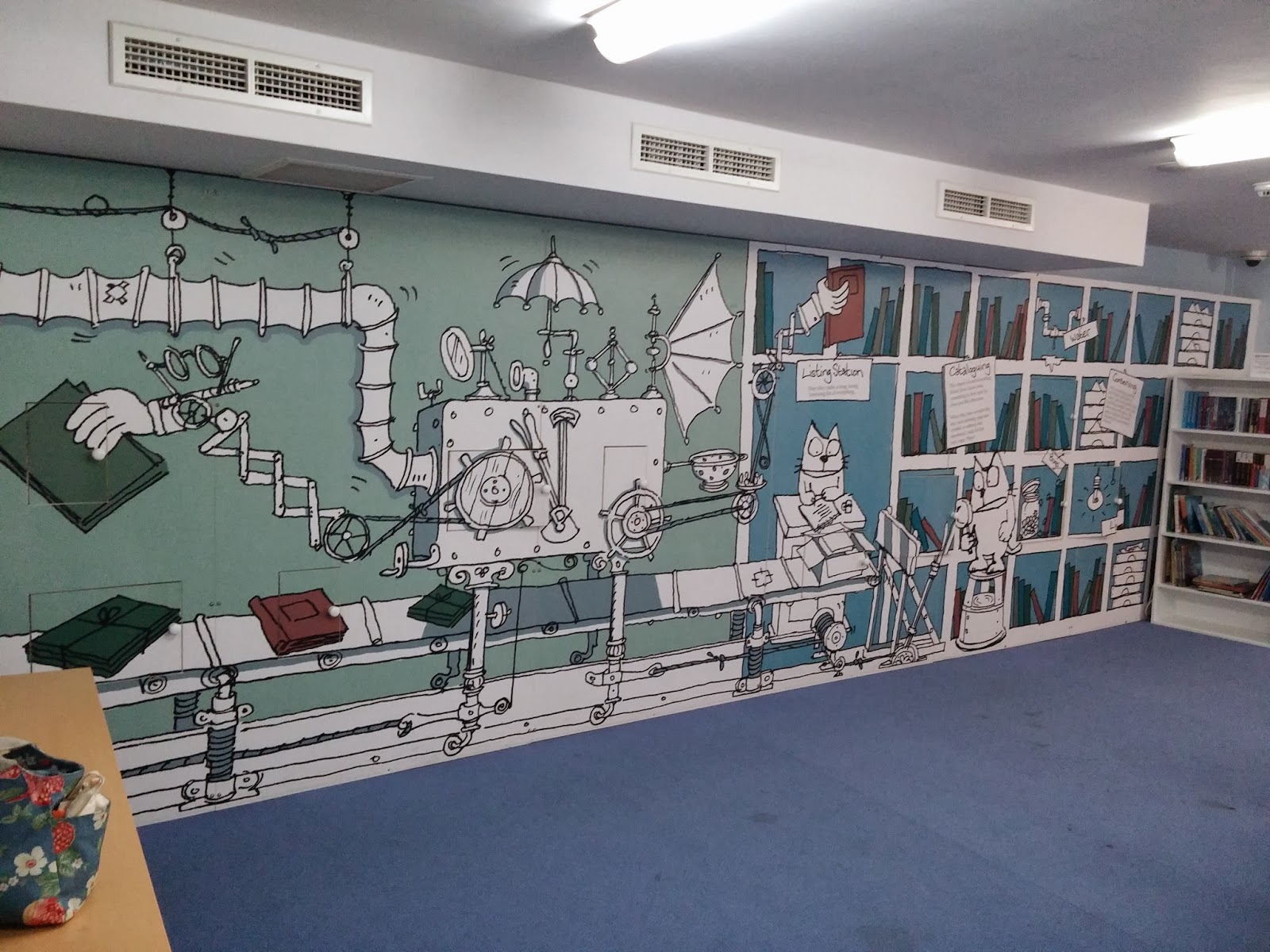
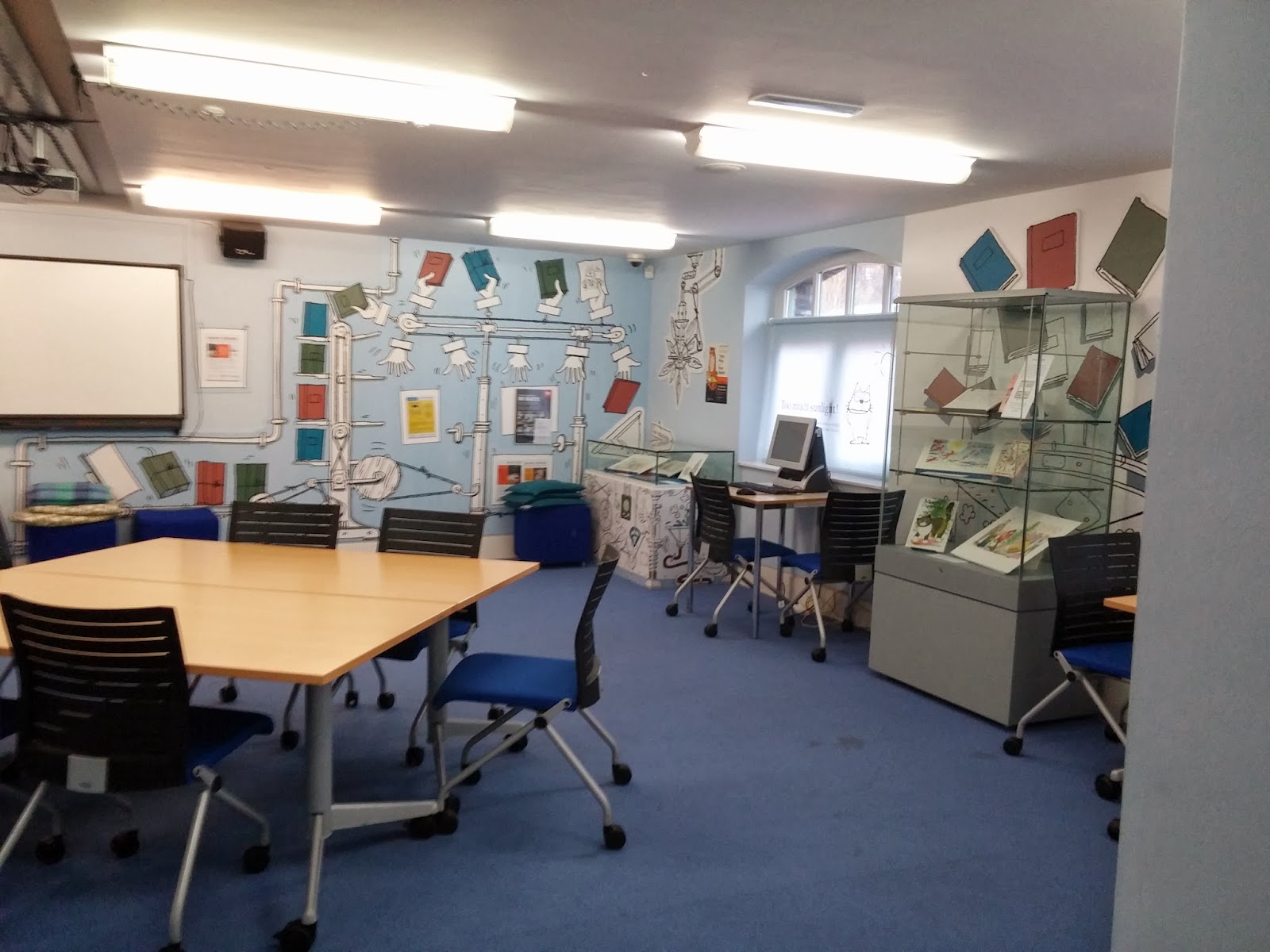
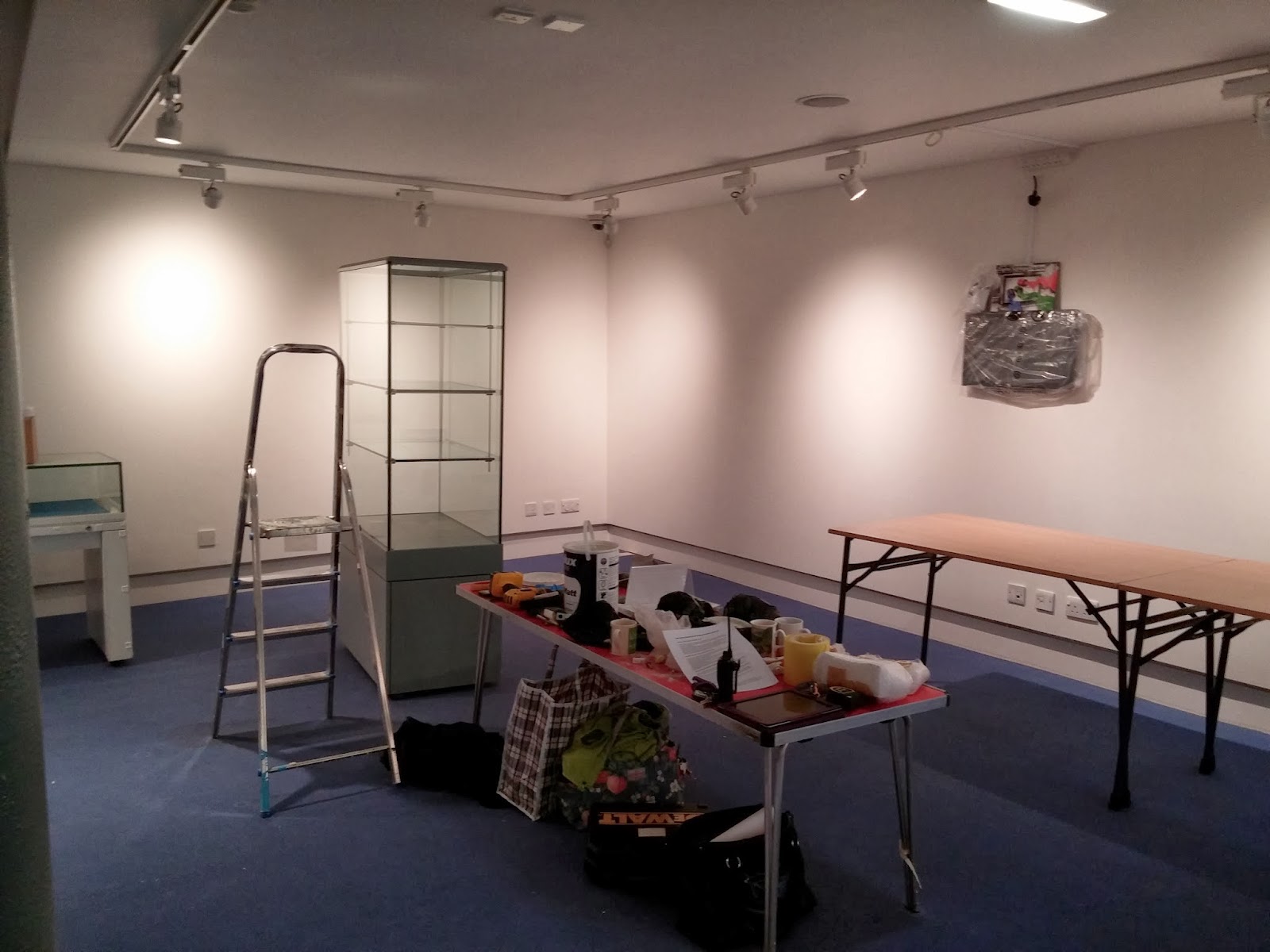
During the transformation the lighting tracks were altered to gallery style lighting, and the windows were blocked to protect the delicate artworks from harmful light levels. We also removed the original graphics, and added two new walls. We kept the two display cases that have been in here for some time, to continue to display 3D items.

Storylab BEFORE 
Storylab BEFORE

Storylab mid-transformation 
Storylab mid-transformation
Gallery FINISHED
Gallery FINISHED

Gallery FINISHED

Gallery FINISHED

Gallery FINISHED 
Gallery FINISHED
The current display is 'Picturebooks in Progress', which uses our Collection to show how a picturebook is created - from early ideas to final artwork.

This exhibition is one of the outcomes of a large scale learning project, funded by the Arts Council. For the past year, members of our Learning Team have been working with higher education and further education students around the country, using the Seven Stories Collection as inspiration for their illustration work. The material that was used to inspire them is now on display, alongside a film of the project. Find out more about the project in an upcoming blog post!

Find out more about the gallery here.

Alison (the Curator)