Showing posts with label Robert Ingpen. Show all posts

Thursday, 1 October 2015

All About: Lions

This month our feature animal is the majestic lion. An ever popular animal in children's literature, especially for younger readers who may enjoy 'roaring' along with the pictures! This month again we will take a look at an illustration, archival item and a book to explore three very different elements of our collection.


Illustration by Robert Ingpen for 'The Lion and the Unicorn', Over the Hills and Far Away, collected by Elizabeth Hammill (Francis Lincoln, 2014)
Our first example this month is this beautiful work from the Australian illustrator Robert Ingpen. Currently on display in our Rhyme Around the World exhibition (click here to find out more and how to visit), this artwork is executed in graphite pencil, acrylic paint and pastel. It is just one of the many different contributions from 77 different illustrators, collected together by co-founder of Seven Stories, Elizabeth Hammill. 

Elizabeth chose nursery rhymes from around the English speaking world, and presented them together in one volume, with fantastic, newly commissioned illustrations. This particular artwork was one of two submitted by Ingpen, and is the one that was used in the final book. The other work, for 'Humpy Dumpty' unfortunately didn't fit within the book's structure, as there was a limit of maximum one double spread per illustrator. If you look very closely, you can also see that Ingpen has included Hammill's name in the illustration - 'Hammill's Breads and Cakes'.

The illustration is for the very well known English rhyme 'The Lion and the Unicorn'.


The lion and the unicorn
Were fighting for the crown;
The lion beat the unicorn
All round about the town.

Some gave them white bread,
And some gave them brown;
Some gave them plum cake
And drummed them out of town.

The first written record of the rhyme is in 1709, shortly after the Act of Union between the English and Scottish parliaments and the formation of 'Great Britain'. It is possible that the rhyme refers to fights between the lion (England) and the unicorn (Scotland) - the royal coat of arms having been amalgamated earlier in the seventeenth century to show both beasts after the crowning of the Scottish King James I as King of England.

To buy a copy of this book, with all proceeds going towards supporting Seven Stories, National Centre for Children's Books, click here.

Typescript for The Prince Who Walked with Lions by Elizabeth Laird, (Macmillan, 2012)
This month's example of archival material is taken from Elizabeth Laird's The Prince Who Walked with Lions. The story takes place in a location Laird has often returned to in her work, Abyssinia - modern day Ethiopia, having lived, worked and travelled there extensively. It is based on the true story of the young prince Alamayu, whose father has been murdered by the British Army. Set in 1868, during the Abyssinia Campaign, Alamayu is taken by the British back to England, and sent to boarding school there. 

The section shown in the image above is taken from the printed typescript, the archive also holds an earlier hand written manuscript, written predominantly on the back of printed correspondence, research and typescripts for other books. In the pictured section, close to the end of the book, Alamayu has a very moving meeting with a caged lion, part of a travelling 'menagerie' that has come by his school, and he feels a strong connection to this symbol of his home.


'His smell took hold in my nostrils. I breathed in deeply that rich, long-forgotten mustiness of lion.'
Extract from The Prince Who Walked with Lions

The Elizabeth Laird Collection, donated by the author in 2012, consists of draft material and correspondence relating to 25 of her published novels for children, including the Carnegie nominated Secret Friends, Jake's Tower, The Garbage King and Crusade. There are also re-tellings of traditional stories and anthologies edited by Laird, material relating to the British Council project collecting traditional stories in Ethiopia and a small quantity of personal papers. 

To find out more about Laird's work in Ethiopia, or to explore The Ethiopian Story Collecting Project set up by the Ethiopian Ministry of Education and the British Council, click here and here.


This month’s featured books are copies of Disney’s The Lion King in a variety of editions, which were all published by Ladybird Books to tie-in with the American animated musical film produced by Walt Disney Feature Animation, and released by Walt Disney Pictures on June 15, 1994.


The Lion King is the story of Simba, a young lion who is to succeed his father, Mufasa, as king.  However, after Simba's uncle Scar murders Mufasa, Simba is manipulated into thinking he was responsible and flees into exile in shame and despair. Throughout his childhood, Simba is given some valuable perspective by his friends, and his shaman, Rafiki, and once he’s grown-up he returns to challenge Scar to end his tyranny.

The film has led to many derived works, including a Broadway adaptation, a sequel The Lion King II: Simba's Pride (in 1998) and of course, a whole host of film tie-in books, as above! These illustrate the brilliance of Ladybird books in producing multiple formats of the same title, aimed at a variety of audiences in terms of reading ability (length of text, quantity of illustrations, and level of activity) and at a range of affordable prices for different pockets. There is a film tie-in book for everyone!

These six books are from our Ladybird Books Collection. This collection was donated to Seven Stories after the publisher Pearson decided to fully merge Ladybird into its Penguin Books subsidiary, and the Ladybird offices and printing factory in Loughborough were closed. This happened in 1998, and much of the company's archive of historic artwork was also transferred to public collections at the same time.

Our Ladybird collection consists of over 2,000 books and includes more than 1,500 books in the traditional Ladybird format, more than 200 ‘Disney’ related books, and about 250 items in a variety of other formats including: bath, cloth and board books; activity, sticker, and colouring books; cassette tape and book packs; and even friezes.

If you'd like to find out more about the Seven Stories Collection, then 
email: collections@sevenstories.org.uk or phone: 0191 495 2707 or comment on this blog.

Thursday, 1 January 2015

All About: Bears

For our very first post of 2015, we are going to talk about the brilliant bears belonging to our bounteous collection. Each of these animal posts will show you a piece of illustration, manuscript or written archive, and a printed book from our large library of children's books.

Original artwork by Robert Ingpen of the Hundred Acre Wood, from the well known series Winnie the Pooh written by A.A. Milne.
Image © Robert Ingpen
Our very first bear is possibly the most famous bear in children's books - Winnie the Pooh. This illustration was created specifically for Seven Stories, displaying lots of the different elements of the Hundred Acre Wood. Pooh is shown in many different scenes around the wood, and all the other famous characters can also be seen - see if you can spot Eeyore, Piglet, Rabbit and Christopher Robin.

It was originally displayed in the From Toad Hall to Pooh Corner exhibition, shown from 2008-9 at Seven Stories in Newcastle. The exhibition featured some absolutely beautiful artwork from Ingpen's 2007 edition of Winnie the Pooh, amongst many other artwork for this series, and other treasures from Wind in the Willows.

The other exciting work held in our collection from this Australian illustrator is artwork created for the Francis Lincoln publication Over the Hills and Far Away, which was released in the UK in October 2014. This book showcases many illustrators, including Ingpen, who created artwork for the rhyme 'The Lion and the Unicorn'. We also hold a beautiful unpublished illustration for 'Humpty Dumpty', which will be on display in the upcoming exhibition Rhyme Around the World (opening July 2015).


Annotated typescript draft of We're Going on a Bear Hunt, by Michael Rosen, c. 1989.
This month's typescript contribution comes from the prodigious Michael Rosen, very well known to all young children from 1989 onwards - We're Going on a Bear Hunt. This is one of the most well known of children's tales, and has been chanted by many a parent, teacher and child for 25 years. Originally a traditional folk tale, Rosen says this is "just one other way" of telling the story. 

In these images you can see a typed version of the story, with plenty of Rosen's hand written scribbles and directions for how it should be performed. It has been heavily edited with tippex - a more definite method of obscuring the original text to uncover than the more traditional crossing out, we wonder what those alternatives could have been!

This typescript comes from the Michael Rosen Collection, which contains 19 different files of material for books for children, including the breathtaking Michael Rosen's Sad Book, another bear story The Bear in the Cave, amongst many others. Also present is a small amount of material from his books for adults, including This is Not My Nose, and some unpublished material. The archive was very kindly donated to Seven Stories by Rosen in the year our visitor centre opened to the public, 2005.

This material is currently on display in Berwick, until Sunday 18th January 2015, click here to find out more.

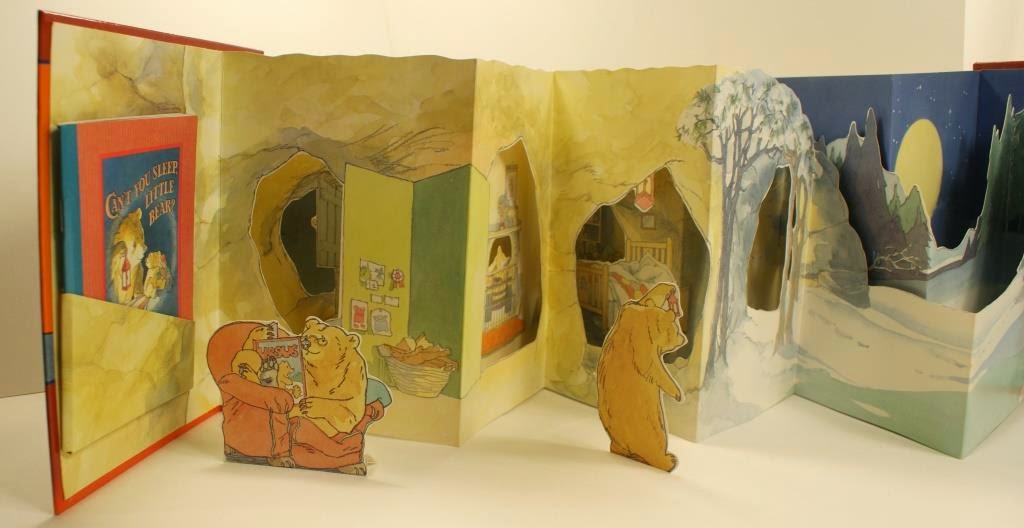
Can't You Sleep, Little Bear? by Martin Waddell, illustrated by Barbara Firth (Walker Books, this edition 1995)
One of the most recent acquisitions to the collection, this beautiful little pop-up version of Can't You Sleep Little Bear, is a lovely wintery example of a duo of bears in winter. Little bear just can't get to sleep, as he is scared of the dark, and it is up to Big Bear to help (even if he really wants to finish his very interesting book!).

This is an example of one of a huge variety of books in our specially purchased collection, which is developed by our Collections Officer to make sure we have copies of all of the books for which we hold any original material. This can often be quite a difficult task, as we really like to have good first edition copies. They are useful for many reasons, particularly when researchers are using the archive, and also for the archivist to correctly organise and identify everything when it first arrives!

We hold the archive of Martin Waddell, which is quite large and covers many of his picture books (over 50 of them!), as well as notebooks and diaries, and Waddell's work for various reading schemes published by a variety of illustrators. It is an interesting and varied collection, with plenty of detail to explore. The material relating to Can't You Sleep Little Bear runs to quite a lot, there is a draft typescript of the text, correspondence between Waddell and Firth, proofs of the illustrations and letters from the publisher, Walker. The file also contains drafts of two unpublished 'Little Bear' stories!

Just in case you were wondering - "Big Bear is the big bear, and Little Bear is the little bear."


If you'd like to find out more about the Seven Stories Collection, then 
email: collections@sevenstories.org.uk or phone: 0191 495 2707 or comment on this blog.