Showing posts with label Michael Morpurgo. Show all posts

Friday, 25 November 2016

Wombat goes walk about to the Seven Stories Collection

For #archiveanimals Wombat decided to take a break from the Michael Morpurgo exhibition: 


Our Wombat lives in our Visitors Centre in Ouseburn, Newcastle
One day Wombat woke up and thought, 


‘I think I’ll go to the Collections today. I’ve been in this Gallery for a few months and I have seen all sorts of things. I’ve been picked up by many children and cuddled, I’ve been drawn and I have had stories written about me, I have wondered around and looked at a lot of pictures and a lot of beautiful words, but where did I come from?’ 

Wombat loves exploring, so with one of the Seven Stories Story Catchers as his guide (because Wombats don’t know how to use metros) he set off to find out where he came from and what he could learn from the archive that is the heart of Seven Stories, his new home.


‘Why am I a wombat and not a kangaroo?’


Wombat knows that Michael Morpurgo did alot of research to create him - some of it is included in the exhibition and some, like the draft and print outs below, are in the Seven Stories collection.  

In our Michael Morpurgo exhibition we hold draft and research material for 'Wombat goes Walkabout' (Collins, 1995). Photography © Seven Stories – The National Centre for Children’s Books

But wombat wanted to meet the other animals of Seven Stories – who are they and what can they do?

Wombat sat on the Story Catchers lap as they trundled along on the metro. She lifted him up to look out of the window and he saw the great expanse of river below. They travelled over the Queen Elizabeth II Bridge from Newcastle to Felling and walked the short little walk from the station to Design Works, where the collection lives. Wombat had seen all of the amazing pieces of artwork in the galleries and the old, coffee stained pages that have been written on by authors with scribbly blotchy pens and knew that the collections would be filled to the ceiling with so many of these. 


You can find out what we have in our store via the online catalogue, highlights page and alphabetical list of people 

However, he did not expect to see so many books too; thousands and thousands and thousands of books given to the collection by authors and publishers and illustrators over many years.

To little Wombat the shelves were so big and so long and seem to stretch on forever. He didn’t know where to start! But then his Story Catcher guide suddenly remembered an old friend she really wanted to see again; someone who had been in Seven Stories before she started working there and who had led her around the building many times. So they went to visit the Cat that once lived at Seven Stories. 

His name is Browser and the man who drew him is called Satoshi Kitamura.


Meeting the Cat


Original artwork by Satoshi Kitamura depicting the character Browser the cat.  Browser was designed for Seven Stories by Kitamura to appear on signage in Seven Stories' visitor centre, as a familiar mascot to guide visitors through the building.  The series includes artwork relating to Kitamura's original commission in 2004; a second commission for new signage in 2008; and a third commission relating to a website redesign in 2010. Photography © Seven Stories – The National Centre for Children’s Books


‘Hello. I am Wombat and I think a lot and dig a lot and explore a lot. Who are you and what can you do?’

‘Hello. I am Browser the cat. 

Black and white, pen and ink line drawings by Satoshi Kitamura depicting Browser the cat as a storyteller, in various poses.  The drawings were all inserted into an envelope, labelled in Kitamura's hand 'storyteller'.   SS/SK/01/07 Photography © Seven Stories – The National Centre for Children’s Books

I can do lots of things. I used to guide children and parents around Seven Stories. I liked tearing tissue paper with my claws to make collage crafts in the creation station and I liked dressing up in the Artist’s Attic under all of the flying books. I liked drawing and telling stories and eating in the café. 


Black and white, pen and ink line drawings by Satoshi Kitamura depicting Browser the cat as an illustrator, in various poses.  The drawings were all inserted into an envelope, labelled in Kitamura's hand 'illustrator'. SS/SK/01/06 Photography © Seven Stories – The National Centre for Children’s Books

But that was when I was young. Now I’m old and I prefer to snooze in my box and read all of the stories on all of the shelves. There are enough in here to read for many lifetimes.’

‘That sounds nice.’ Said Wombat, ‘But did you know the Creation Station is now the Studio and the Attic has been transformed into Diagon Alley?’

‘No I didn’t.’ Said Browser thoughtfully, ‘I wondered how much would change without me. I would like to visit again one day.’

‘I’m sure you will. I live there now, but one day I’ll come to live here with you. We can share lots of stories then.’

‘I would like that.’

In the second comission of artwork there are eight pieces of colour artwork by Satoshi Kitamura featuring Browser the cat, executed in pen and ink and watercolour.  This piece shows Browser reading in the winged chair SS/SK/02/02 Photography © Seven Stories – The National Centre for Children’s Books

Meeting the Bears

Wombat walked and walked, and everywhere he looked he saw something more interesting than the last. Then he heard someone saying 

‘We’re going on a bear hunt. We’re going to catch a big one. What a beautiful day! We’re not scared.’ 

The Exhibition team were hunting for everything they could find about bears! And Wombat soon learned that it was because there will be a bear exhibition arriving at Seven Stories in February. They were all looking in one particular box marked Martin Waddell so wombat nudged his Story Catchers foot and she lifted him up to get a closer look at the box. Inside there were two very smiley bears and Wombat went over to the smallest one to investigate.


We have material in the Collection by author Martin Waddell and illustrator Babara Firth for 'Can't you Sleep Little Bear' (Walker, 1988). Seven Stories recently acquired a full suite of final artwork for this iconic book and develop work by Barbara Firth.  Photograph © Seven Stories – The National Centre for Children’s Books


Hello. I am Wombat. Who are you and what can you do?’
‘Hello! I’m little bear and I can do a lot of things I think, like bounce around and play, but what I can’t do is sleep because I am too excited! Soon we will be in Seven Stories and we can meet loads of little boys and girls!’
‘Ah.’ Wombat said, ‘I can show you around. I know that place very well.’

Wombat looked at finished artwork from the bears story and typescripts and sketches and preliminary artwork and rough work. It was all very beautiful and Wombat felt that it helped him get to know little bear very well as he could see all the ideas that went into creating him. He waved goodbye to little bear and big bear and together they walked off into the watercolour night to look at a beautiful huge moon. He looked forward to seeing them again.


Meeting the Tiger

Next Wombat went to visit one of his favourite stories. A story that had been around for quite a long time and that his Story Catcher friend had grown up with. So they hunted out the box marked Judith Kerr.


We hold finished artwork and a small amount of preparatory material relating to 'The Tiger Who Came to Tea', written and illustrated by Judith Kerr and first published in 1968. This image shows final artwork obscured by the original overlay JK/03/01/02  Artwork © Judith Kerr Photograph © Seven Stories – The National Centre for Children’s Books

Inside was a grinning tiger. There were all sorts of things in this box. Judith Kerr had spent time observing real tigers to draw her sketches so there were lots of tigers that were certainly not grinning. But Wombat was keen to meet the Tiger of his favourite story, so with white gloves on, they carefully took him out of the box.


‘Hello. I am Wombat. Who are you and what can you do?’


‘I am Tiger. I can eat a lot. I used to live in Seven Stories too, but I ate all the sandwiches in the café and all the soup from the kitchen and drank all the sweet drinks until there was nothing for all of the customers to eat or drink. And then I went on tour across the country and met loads of new people.  I got to see Judith too, she was the lady who created me. When I finished visiting different Museums and Galleries they thought it best that I come to live here. There are still lots of biscuits and tea here, but at least I’m not eating food made for the visitors.’
‘That sounds like they made a wise decision. They now make white hot chocolates and Seven Stories…’ said Wombat, and his eyes glazed over as he remembered how sweet they were.


Our Judith Kerr exhibition included a large model tiger ready for tea. The exhibition finished touring earlier in 2016. You can see more items from the Judith Kerr highlight pagePhotograph © Seven Stories – The National Centre for Children’s Books

‘Oh really?’ said the Tiger, trying to imagine them. ‘Hmmm. I might have to visit Seven Stories again some time.’

Meeting the Wolf

Then wombat thought about all of the books on all of the shelves in the collections. 
‘These are so wonderful, but most people can read these books in shops everywhere. Why are these more special than the ones I can buy in the shop?’


This is a section of Robert Westall book collection which includes a number of translated editions.  Our book collections are often donated alongside collections but we also hold ex-library and standalone collections.

‘Well’
 said the Collections Officer called Paula, ‘These books span hundreds of years. The oldest book in this collection is from 1770. We also house different versions of a lot of children’s books. You can see how the artwork on the covers change as time goes by and styles alter as different art forms become popular. You can also find books signed and collected by authors and publishers, books that were given as gifts from one illustrator to another which reveals friendships and connections across the literature world. You can find books you love in different languages and find out how important British Children’s Literature is to countries around the world. Context connects these books in a very magical way which makes this collection very important'

Then Wombat heard a snarl coming from a box.


‘Oh yes..’ Said Paula quietly, ‘And some books in here you would never find in a book shop.’

Paula pulled the box carefully from the shelf and opened it, lifting sheets of protective paper to reveal a very small, very delicate looking, hand-made book. The cover was made of soft black velvet-y material. There was no title. No writing on the spine. It all looked very ominous.


They heard another muffled growl coming from within the pages. So together they opened the book and looked inside. It was a story about Polly and the hungry wolf by Catherine Storr, but the pages were all written in pen and Wombat could see where illustrations had been rubbed out and drawn over. After a few pages, they happened upon the Wolf.


Our Catherine Storr collections includes handmade books and dummy books like this one about Clever Polly and the wolf. If you are interested in learning more about Catherine Storr you can explore the The Catherine Storr Experience.  CS/02/02 Photograph © Seven Stories – The National Centre for Children’s Books

‘Hello. Who are you and what can you do…’
Wombat asked, keeping his distance.

‘Well, hello. I am The Hungry Wolf, and I can gobble you up!’ Said the tiny little wolf from the tiny little book. He certainly did look mean and scary, but he was also smaller than Wombat’s paw.
‘He can’t really hurt you.’ said Paula ‘This is what we call a Dummy Book. Writers and Illustrators make these little books to know how the words and the pictures will look on the page when the finished book is put together. Many authors such as Judy Brook, Helen Craig and Katherine Holabird create dummy books and we have lots of them in our collection. You would never find these in a bookshop.’

Wombat was very curious. He looked at the Wolf’s angry little eyes and thought it’s a very good thing he didn’t live at Seven Stories. 
‘Thank you for showing me these.’ He said. ‘But I think we should put him away now.’


Time to go Home

Wombat let out a rather large yawn and then found himself being scooped up by his Story Catcher guide. ‘Time to head home I think’ she said. Wombat nodded. He had met a lot of interesting characters on his journey and felt that he had learned a lot. He had a lot to think about now, and a lot to tell the other animals in his gallery when he got home.


Yes. Wombats do like to sleep a lot, and I think it is time for me to do just that. But I am looking forward to our next adventure!’

- Charlotte Brumby, Story Catcher (and Wombat). 

You can find Wombat in our Michael Morpurgo exhibition

Tuesday, 19 July 2016

All About: (War) Horses


Spoiler Alert: this blog post discusses the end of Michael Morpurgo's War Horse.

Horses have been a mode of transport since at least 2000 BC but the horse that’s the focus of this blog post is much more recent than that: Joey from Michael Morpurgo’s WWI novel War Horse.  The book has become internationally well-known thanks, in part, to a stage production by the National Theatre (featuring spectacular horse-sized puppets) and to the Stephen Spielberg adaptation that came out in 2011. 


Seven Stories' own interpretation of Joey in our Michael Morpurgo: A Lifetime in Stories exhibition. Photograph © Seven Stories The National Centre for Children's Books. 
The Seven Stories exhibition, Michael Morpurgo: A Lifetime in Stories, opened on 2nd July and, of course, it features Morpurgo’s most famous book.  If you visit you’ll find Joey not only as he was first written down (in Morpurgo’s tiny handwriting) but also as he’s been imagined in film, for the stage, and in painting.

Early manuscript draft of Michael Morpurgo's War Horse.  Photograph © Seven Stories The National Centre for Children's Books. 
The novel is narrated by Joey and opens with him being sold at auction:

I was not yet six months old, a gangling, leggy colt who had never been further away than a few feet from his mother.  We parted that day in the terrible hubbub of the auction ring and I was never to see her again. (Page 3)

From here Joey meets Albert, the farmer’s son and they become best friends, until Joey is bought by the British Army and sent to the battlefields of the First World War.  Distraught, Albert joins up and promises to bring him home but it’s not until the end of the war that they’re finally reunited and return home to Devon together.

The Seven Stories archive contains a variety of material about War Horse: there’s the very first manuscript for the book, handwritten on lined paper; the shooting script for the Spielberg film, with its codename Dartmoor written at the top; and letters about the stage production’s transfer to Broadway and the changes the American team had made to the story. 


Various War Horse items from our Morpurgo collection on display at Seven Stories until 2nd July 2017. Photograph © Seven Stories The National Centre for Children's Books. 
But that’s not what this blog post is about.  I want to tell you about a version of War Horse that has an alternate ending – one that doesn’t end quite so happily ever after.

In the late eighties and early nineties Morpurgo collaborated with a producer, Simon Channing Williams, who made his name working with Mike Leigh on films such as Vera Drake and Secrets & Lies.  Channing Williams produced the adaptation of Why the Whales Came, starring Helen Mirren and Paul Scofield and, following this, worked with Morpurgo to get funding for an adaptation of War Horse

Papers in the archive show that the funders were initially sceptical of its appeal to children and wanted instead to go for the adult market.  In a report on one of the submitted scripts, Mary Davies, who was a reader for the European Script Fund (ESF), commented:

The writer has seems to have taken heed of comments on the earlier script that it appeared to be aimed at a young rather than an adult audience.  The happy ending and slight sentimentality of the earlier version, together with a greater emphasis on Joey the horse as a character, gave the script this slant.

From this feedback it seems that the ESF wanted a harsher or more realistic script without a happy ending and they encouraged the focus on Joey.
The next version of the script is still recognisable from the book, with an addition of a love story between Emilie and a German soldier (she is somewhat older in this version).  It continues along much the same lines until, that is, the final few pages. 

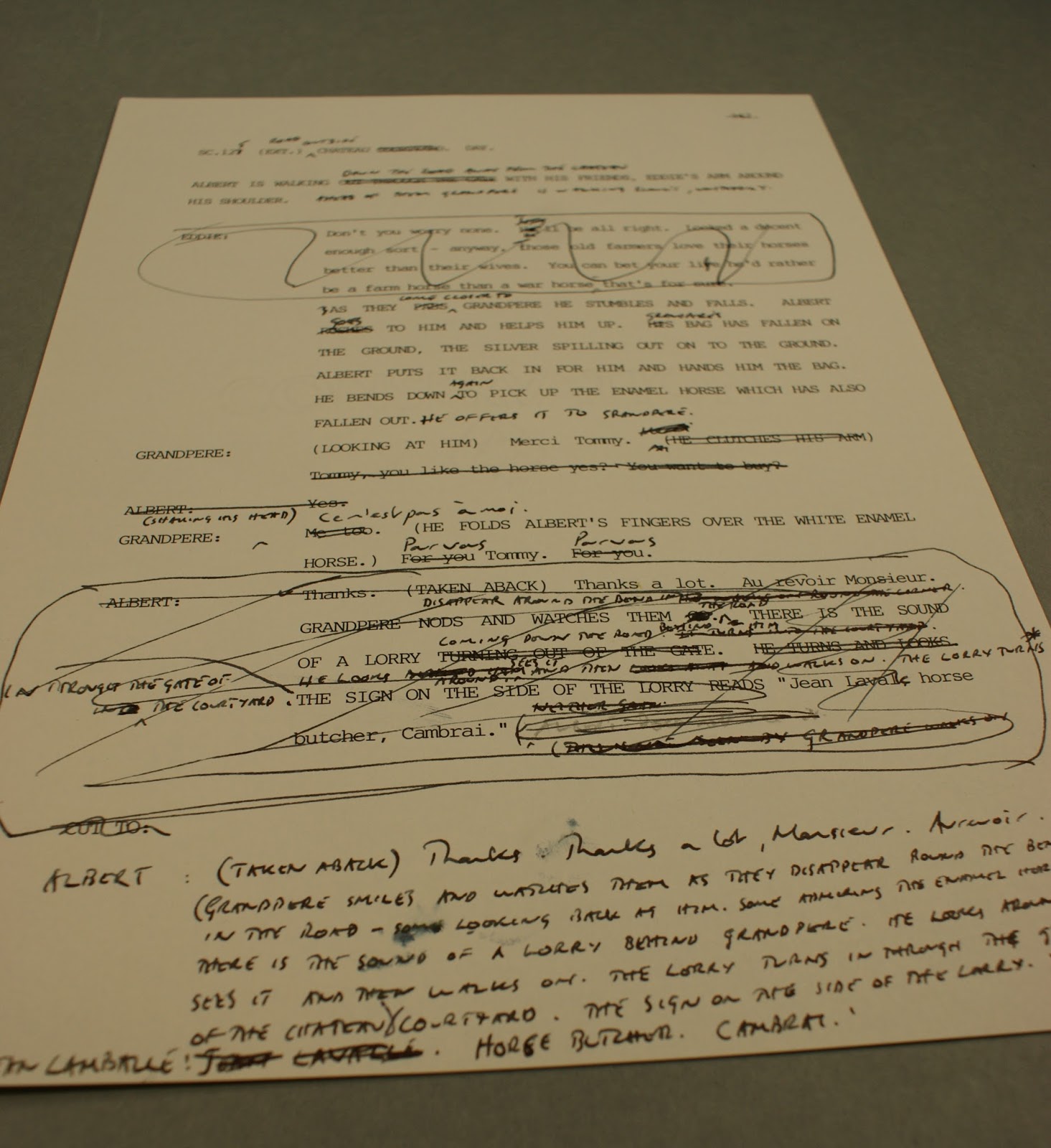
Just as in the novel, Joey is being sold at auction and, as in the book, the soldiers club together to buy Joey – but they don’t have enough money.  Not to worry, Emilie’s grandpere is also there, with a sack full of silverware to buy back Joey so he can live out his days resting on the farm.  Except the auctioneer won’t accept the silver, only cash.

Enter Monsieur Lamballe of Cambrai, who makes his bid, wins Joey and pays in cash.  In the next scene, the third to last in the film, Emilie’s grandpere gives Albert an enamel horse pin to remember Joey by.  Then, as the soldiers leave, a van passes Grandpere.  On the side of it reads ‘Jean Lamballe.  Horse Butcher.  Cambrai’.  Joey has been sold for horse meat. 


Extracts from annotated typescript of War Horse by Simon Channing Williams MMo/06/06/03. Photograph © Seven Stories The National Centre for Children's Books. 
This is a more historically accurate ending (the British Army retained some horses after the end of the war but most that were still fit were sold locally to farmers and slaughterhouses) but it’s a big departure from the rural idyll ending of the novel.

The change raises the question about what’s at stake in Albert and Joey’s glorious return to Devon.  In the novel they’re celebrated and it’s a chance to reflect on the people and horses that died in the war:

And so I came home from the war that Christmas-time with my Albert riding me up into the village, and there to greet us was the Silver Band from Hatherleigh and the rapturous peeling of the church bells.  We were received like conquering heroes, but we both knew that the real heroes had not come home, that they were lying out in France alongside Captain Nicholls, Topthorn, Friedrich, David and little Emilie. (page 141)

The ending cements the comradeship between Albert and Joey: they were received equally, ‘like conquering heroes’, and they shared the knowledge that they weren’t the real heroes. 


But when it’s only Albert that returns the ending is bleaker and he doesn’t feel at home anymore: the script says ‘He seems bewildered by the welcome, detached’.  


Extracts from annotated typescript of War Horse by Simon Channing Williams (MMo/06/06/03). Photograph © Seven Stories The National Centre for Children's Books. 
And a summary of the script submitted to the ESF is even less hopeful: ‘Maisie seems like a stranger to [Albert] and it’s a while before he is able to embrace his mother with any real feeling.’

The homecoming of Joey with Albert at the end of the novel returns things to how they were for everyone else, even if the implication is that Joey and Albert know there’s a difference compared to their lives before the war.  The 1990s script makes the difference much greater. 

Although this film wasn’t eventually financed its inclusion in the Morpurgo archive provides researchers and readers with another version of War Horse that not only helps in learning about the process of adapting a book but also changes the way we think about the novel and raises questions that may not be obvious in the published version.

               - Dr Jessica Medhurst
                 KTP Research Associate

If you want to know more about horses in our collection take a look at All About: Horses.  You can also learn more about the Michael Morpurgo collection here.


If you'd like to find out more about the Seven Stories Collection, then 
email: collections@sevenstories.org.uk or phone: 0191 495 2707 or comment on this blog.


Tuesday, 15 March 2016

King Arthur

In this blog post, former school teacher and long-time supporter of Seven Stories, Nick Brown, talks about his love of Arthurian legends and many of his favourite Camelot-based children’s books.

There are few books from my childhood that I treasure but, of these, the one that means the most to me is the Puffin edition of King Arthur and his Knights of the Round Table. This edition will be well known to older reader. It was “newly re-told out of the old romances” by Roger Lancelyn Green and wonderfully illustrated by Lottie Reiniger with a beautiful stained glass window of a cover.


Not only was it the beauty of the book and the captivating tales, it was the wonderful names of the protagonists that were so different from any other stories I’d come across. Arthur, Merlin, Guinevere and Launcelot seemed so mysterious. Also, Green’s introduction invited the young reader to become part of a heritage of storytelling that began with Thomas Malory and continued through to the present day.

Since then, I have ‘progressed’ through reading Malory’s Le Morte D’Arthur;  I have read various medieval romances such as Simon Armitage’s wonderful translation of Sir Gawain and the Green Knight, and I have watched numerous TV programmes and films, including John Boorman’s 1981 film, Excaliburthat have either investigated the ‘historical’ Arthur, retold the tales or used the characters for new adventures.

Arthurian romances have long proved to be popular both for adult and child readers. Children’s editions began to appear from the 1860s and continue to appear up to the present day. Seven Stories’ book collection contains a wonderful range of these stories and I want to mention just a few of them.

The first book I came across on my recent research visit to Seven Stories Collections Department was Rosemary Sutcliffe’s The Lantern Bearers. Set in the time when the Roman legions began to leave Britain, Sutcliffe introduces us to the ‘historic’ Arthur through the characters of Ambrosius and Artos who lead the resistance to the invading Saxons.


Sutcliffe was to continue her interest in all things Arthur with her Arthurian cycle, which deals with the quest for the Holy Grail. In this series of books, as in many retellings, Merlin is both powerful and mysterious. Sometimes, one feels that he is the more important character who uses the other protagonists as his pawns. I’m sure that I’m not the first to think that!

Conversely, in T H White’s The Sword in the Stone, Merlin is not seen as manipulative, but more as a king trainer. The young Arthur, or should we say ‘Wart’, learns, not only about the world of men but also of nature when he is transformed into various animals or fish. Only then is he ready to pull the sword from the stone and set in motion the tumultuous events of his reign.


But it’s not all deadly seriousness in the world of Arthur. Ladybird produced many Arthurian stories, many unrelated to the world of Malory and full of fanciful illustrations not particularly historically accurate, either to the sixth century or the high Middle Ages. Rosemary Manning goes further with the more light hearted exploration of the world of Camelot with her Dragon Quest sequence. These books feature an ancient dragon who knew Arthur and who tells wonderful tales to a girl from modern times.


 For those looking for very much grittier Arthur, Philip Reeve’s 2008 Carnegie Medal winning Here Lies Arthur is the one to read. As with Rosemary Sutcliffe’s novels, Reeves’ book is set in the fifth or sixth century. However, Reeves didn’t set out to write an historical novel. Rather, Reeves himself explains that: “in writing it I did not set out to portray ‘the real King Arthur,’ only to add my own little thimbleful to the sea of stories which surrounds him.” And what a thimble! We have a bard called Myrddin who creates an image of Arthur that will help unite the Britons in their resistance to the Saxons. The story is full of violence: Arthur is no pious hero. Reeves’ also explains that his interest in Arthur began when he watched Boorman’s “brilliant, beautiful and barking mad” film, Excalibur, on 5 July 1981.


 Susan Cooper’s, The Dark is Rising, sequence is a classic piece of British children’s fantasy. Although not strictly Arthurian, Cooper blends in British myths and legends in the protagonist Will’s quest to find a number of magical objects, one much like the grail. At the centre of these novels is Merriman the wizard who is, of course, our old friend Merlin. If you haven't read these books do give them a go (in this blogger’s opinion, the books are far superior to the film of recent times that does Cooper few favours).


 Finally, if you’re a fan of the Arthurian legends and of illustration then Seven Stories Michael Foreman exhibition, Painting with Rainbows, contains two of Foreman’s wonderful original illustrations for Michael Morpurgo’s Arthur, High King of Britain. In Morpurgo’s version, set in modern times, a Cornish boy is rescued from drowning by Arthur Pendragon, who now lives in a cave waiting to be summoned to save Britain in its direst need. Arthur appears to suffer from insomnia and is only too glad to tell the boy of his adventures, although his dog, Bercelet has heard the stories many times before! As many readers will know, Michael Morpurgo has donated his archive to Seven Stories and I’m looking forward to exploring Morpurgo’s original notes and drafts of this particular story.


The appeal of Arthurian legends will long continue to endure in popular culture; no doubt, numerous books, films and TV programmes are yet to be made about him. Who knows when the next Arthurian children’s book comes along but I don’t think we’ll have too long to wait.


If you'd like to find out more about the Seven Stories Collection, then email: collections@sevenstories.org.uk or phone: 0191 495 2707 or comment on this blog.

Thursday, 22 October 2015

The Michael Morpurgo Archive

This month, Seven Stories is celebrating the donation of Michael Morpurgo’s archive and the announcement of the forthcoming Morpurgo retrospective exhibition, which will open on 1st July 2016.  To help inform the exhibition the  museum has teamed up with Newcastle University to appoint a Research Associate, funded through the Knowledge Transfer Partnership scheme– the first appointment of its kind in the field of literature.  In this blog, the KTP Research Associate, Dr Jessica Medhurst, introduces the Morpurgo collection and gives a sneak preview of her research.

I was delighted to join Seven Stories the National Centre for Children’s Books in September, not least because the KTP Research Associate post offers me the chance to work on an as yet unseen collection: Michael Morpurgo’s papers, which were donated in May of this year.


Later typescript draft of War Horse annotated by Michael Morpurgo with a first edition copy of the book

My research is exploring Morpurgo’s published and unpublished works, including a large pile of orange notebooks in which many of his famous novels were first drafted, as well as early adaptations of War Horse and material from his early life.  I’ll be considering the ways in which his works fits in with, and sometimes goes against, traditions in children’s literature and I’m interested in thinking closely about what kinds of childhood we can read in Morpurgo’s work, particularly in relation to the places and spaces he constructs such as the Scilly Isles, Devon and further afield in novels like Kensuke’s Kingdom and Alone on a Wide, Wide Sea.  I’m also hoping to do some work on the human-animal relationship that characterises many of his books, such as The Butterfly Lion, Why the Whales Came and The Dancing Bear.  This will be no small job: Morpurgo has written more than 130 books and we’ve got some unpublished material in the collection too so there is plenty of reading to be done.


Morpurgo's early handwritten drafts in notebooks

Intriguingly, Morpurgo doesn’t think of himself as a writer but rather as a storyteller.  In Singing for Mrs Pettigrew he writes of his need to ‘allow the story time to find its own voice to weave itself, to dream itself out of my head’ (p26) and in her recent authorised biography of him, Maggie Fergusson writes that ‘[h]e began as a classroom storyteller, and he has remained much more confident about the spoken than the written word’ (p315).  Ideas of storytelling also crop up in lots of his books: you might have read about Tomas and the librarian in I Believe in Unicorns, or the story Paulo Levi tells the journalist in The Mozart Question, or even the stories told about The Birdman in Why the Whales Came, which turn out not to be the whole truth. 

Many of the manuscripts donated as part of the collection also produce ideas of how stories are told, including the difficulties that even established authors like Morpurgo have: among the many orange notebooks is one for Kensuke’s Kingdom, the beginning of which is rewritten four times, with each attempt at beginning it slightly different and slightly longer than the last.  The first handwritten version has the lead character called Paul rather than Michael, puts his birthday as 6th February 1988 rather than 28th July 1988 and introduces a newspaper cutting headlined ‘Tragedy strikes round the world yachting family’, constructing a part of the story that happens in Paul/Michael’s absence, which is not present in the published version.


The first draft page for the beginning of Kensuke's Kingdom
Morpurgo re-drafted the beginning of Kensuke's Kingdom many times

Having this KTP funding means that I can spend time researching into this archive to inform the curation of the exhibition, led by Gill Rennie (Senior Curator), as well as to attract more adult audiences to the galleries, including researchers.  The collection often gets visits from students and academics who are interested in the manuscripts held at Seven Stories and we hope to be welcoming even more people to explore the gems held in the archive as well as in the children’s book collection; if you’re thinking of visiting you can find out more here.  I’ll be sharing some of my findings on the blog over the next nine months as the exhibition develops; if you’ve got any questions for me you can leave them in the comments section below.


Seven Stories was able to support the acquisition of David Fickling's archive through support from a Heritage Lottery Fund ‘Collecting Cultures’ grant. This has been awarded to Seven Stories in recognition of the museum’s national role in telling a comprehensive story of modern British children’s literature. For more information on our HLF Collecting Cultures project see: http://www.sevenstories.org.uk/news/latestnews/hlf.


For More information on our KTP project with Newcastle University see here: http://www.ncl.ac.uk/press/news/2015/10/sevenstoriesktp/