Showing posts with label pop-up books. Show all posts

Thursday, 10 July 2014

The Wonderful World of Kate Petty

In April, Newcastle University Museums Studies students Sarah Seeley and Maria Gkelmpoura joined the Seven Stories Collections team on placement. As part of her time with us Sarah has been exploring the archive of the editor, writer and publisher Kate Petty (donated to Seven Stories in 2012). Here Sarah talks about Kate's work and the range of interesting items she has found:

In 2012, a collection of work by the author and publisher Kate Petty was kindly donated to Seven Stories by Kate’s daughter, Rachel.  Kate Petty, who sadly died from cancer in 2007, wrote and published hundreds of children’s books on a huge range of topics.  The collection here at Seven Stories contains a wealth of material including notebooks, drafts, preliminary art and layouts, dummy books and correspondence, giving an enlightening and extensive insight into how she worked and developed her ideas.

Kate Petty began her career as an editor of adult books for Jonathan Cape and Phaidon. She carried out various editing, copyediting and proofreading jobs for other publishers, working on titles such as Rites of Passage by P.D. James and The Restaurant at the End of the Universe by Douglas Adams.  Her own writing career of children’s books began with a series of non-fiction titles for 5-8 year olds on subjects such as animals, transport and planets.  From this, she went on to write various non-fiction books specialising in the 5-8 age range.


Selection of books from Kate Petty's early writing career


Kate is perhaps best known for her pop-up books.  While working at Random House Publishers, she had the idea of writing a grammar book for children.  Kate had always loved grammar as a child and together with illustrator Jennie Maizels and paper engineer Damian Johnston set about creating a book “as much fun as the wackiest of today’s ABCs” to fill a gap she felt was present in children’s education.  The Great Grammar Book, published in 1996, was an astounding success, providing a fun and interesting introduction to what is considered a dull and complicated subject, and it enjoyed many weeks on the Times Bestseller List.


The Great Grammar Book (Bodley Head, 1996) with Spanish co-edition


Kate and Jennie developed a strong friendship and together went on to produce a series of wonderfully detailed pop-up books full of intricate paper engineering and facts, ranging from music and science to the environment.  Jennie’s preparatory work for many of the books can be found throughout the collection, as well as mock-ups of paper engineering mechanisms and dummy books.  One book for which Seven Stories has some of her original rough artwork is The Global Garden.


Artwork and notes from Global Garden (Eden Children's Books, 2005)


The Global Garden was published through the Eden Project for which Kate was the editor of the Children’s Publishing List, and won the Royal Society’s Aventis Prize for Science Books, Junior Prize 2006.  In the collection here at Seven Stories we find a wonderful range of material, from the initial proposal with Transworld Publishers all the way through to the finished, published book.  Kate’s notebook and numerous drafts alongside her rough layout sketches, Jennie’s artwork, and plans and draft work by the paper engineer for Global Garden, Corina Fletcher, provide an amazing look into how pop-up books are made.


Preparatory handmade dummy book for Global Garden alongside the published book


Aside from non-fiction, Kate also wrote what she called “soft non-fiction”, children’s books that were informative but used fictional characters, which created an engaging way for children to learn about and identify with topics such as road safety and bullying.  She also wrote a small amount of fiction, most notably her teen novels Girls Like You, a series of eight books following the well-known struggles of eight different girls navigating life between childhood and becoming a teenager over a summer holiday.  This series was compiled into two volumes by Dolphin/Orion Publishers: Summer Heat and Summer Cool.

In Seven Stories’ book collection can be found two of these books which are particularly interesting.  Also donated by Kate’s family, Holly and Alex are full of post-it notes on which are scribbled Kate’s own notes and edits she wanted made to the books.  Some of the edits can be found in the compiled versions of the novels and are possibly the only evidence we have of these changes.  Among Kate’s handwriting we find that of another person’s, possibly her editor, and in a folder containing material for another of Kate’s teenage books, Makeover, we find letters written by teenage girls reviewing the book pre-publication.  Here, and indeed with her non-fiction also, it is clear that Kate took great care with the research and realism of her work.


Kate's copy of Holly (Orion Children's, 2000) with post-it notes


Kate had a great talent for writing in such a way that was educational but never patronising or judgemental.  The popularity of her books is evidenced by the fan mail she received from readers and teachers alike, and she is a sadly missed voice in the genre of children’s non-fiction.


Sarah Seeley (postgraduate student in Museum Studies at Newcastle University, International Centre for Cultural and Heritage Studies)


If you'd like to find out more about the Kate Petty archive, the Seven Stories Collection, or the pop-up (and other!) books we hold, then 
email: collections@sevenstories.org.uk or phone: 01914952707.

Wednesday, 2 July 2014

All about pop-up books! (2 of 2)

In this post our guest blogger on pop-up books, Lena Kleine Bornhorst, looks through the Seven Stories Collection and picks out examples of pop-ups featuring some very well known children's characters:


Winnie the Pooh, Noddy, Peter Rabbit, Paddington Bear and The Tiger who Came to Tea are all well-known children’s book characters who have featured in pop-up books. Popular figures or famous stories have often been published in pop-up editions – with varying results!  Pop-up books can be used to raise the popularity of a book or character. They can be used as a merchandising product (like soft toys or board games) and they’re a clever way for publishers to reuse already existent material.

The reuse of established characters in pop-up books is not a new concept: as we saw in the last post, one of the key partnerships in the history of pop-up books was that between US publisher Blue Ribbon and the Walt Disney Company in the 1930s. Pop-up books are a convenient medium to bring film characters or themes into a book version. The movement in the pages and the dynamics can fill the gap between a film and an ordinary book: like a film in a book format.


However, pop-up books with well-known characters shouldn't only be seen as merchandising products. The results are very often quite exciting and it’s interesting how diverse the pop-up editions can be. We can take a look at an example from the Seven Stories Collection: three Thomas the Tank Engine pop-up books produced in the 1990s.

Thomas’s Party Pop-up (Heinemann, 1999) tells in five double-pages a short story about Thomas Birthday Party. The paper engineering is kept very simple and the technique of the pop-ups is always the same. The back of the book is located at the top. Each double-page contains a 90 degree pop-up-element which unfolds when you held the book in a 90 degree angle.

Thomas's Big Railway Pop-up Book (Heinemann, 1992) features seven double-page spreads about seven adventures had by Thomas and his friends throughout a week.  In contrast to Thomas’s Party Pop-up, this book includes different and complex paper engineering. All the included pop-up elements are 180 degree pop-ups, which work when the book is completely open. The reader is encouraged to turn the book in different directions to see all of the pop-up elements and there are many interactive pull-tabs. Two of the interactive elements feature string, which is used to demonstrate rope – the text says: “On Wednesday James runs away. Edward and an Inspector chase him and stop him with a rope.” The other string is integrated in a pull-tab, which makes it possible to lift the Tank Engine after an accident.

Spread from Thomas's Big Railway Pop-up Book (Heinemann, 1992)


Thomas’s Amazing Pop-Up Train Set Book (Heinemann, 1995) contains only four double pages, but the format has a bigger size than the other two books. This book contains detailed 180 degree pop-ups and there are many interactive elements – in particular, a detachable paper engineered Tank Engine, which can use for a free play with the book.  The book is the base for the play as it contains railway lines, over which the Tank Engine can find the way (via a house and over a bridge) through the book. The story is told on little story-stops on every page: Thomas has to deliver a parcel in time, but is too late so he follows further story-stops which bring him back through the book till he catches a paper engineered helicopter which brings the parcel safe to his owner. The story and the interactive part with the detachable Tank Engine are cleverly combined and show another aspect of how pop-up elements can be used.


Spread from Thomas’s Amazing Pop-Up Train Set Book (Heinemann, 1995)

The Thomas the Tank Engine examples show how different paper engineering can look and how different the functions of pop-up books can be. If pop-up books are cleverly made, they can make a story more alive and intensive. Interactive elements let the reader be part of the story and join in.

Other examples of innovative pop-ups featuring well-known characters include the Winnie-the-Pooh Pop-up Theatre Book (Methuen, 1992), for which the paper engineering was done by Helen Balmer and Jose R. Seminario.  The book contains five double pages and every right side is covered by a big flap which can be lifted with a small ribbon. The enfolded paper engineering shows a scene of the story. With the included character puppets these scenes can be used for a free theatre play and pull-flaps bring movement to the scene.


Spread from Winnie-the-Pooh Pop-up Theatre Book (Methuen, 1992)

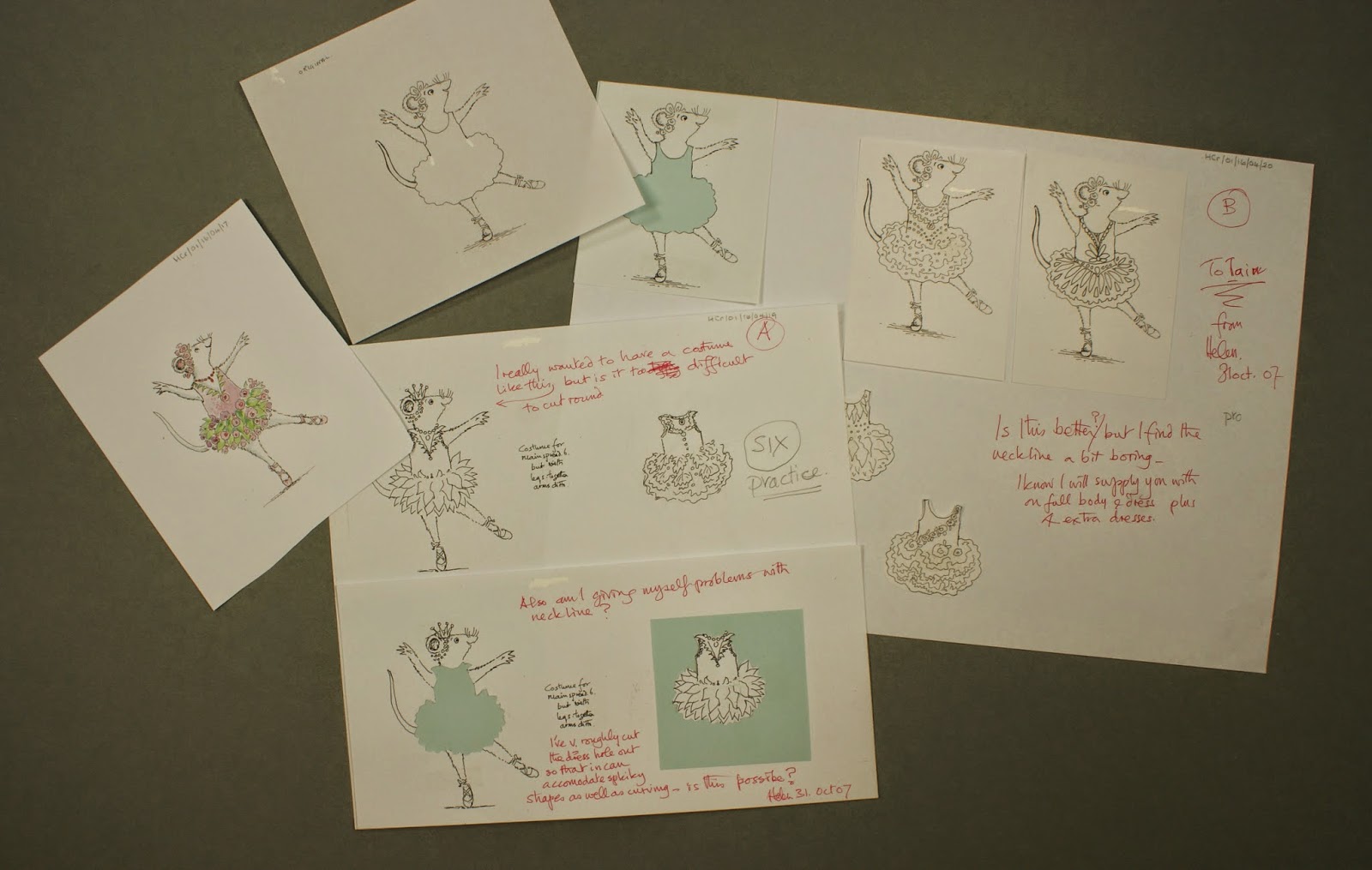
The amount of work required to make a pop-up book can be seen in the archive at Seven Stories. For example, Angelina Ballerina illustrator, Helen Craig’s collection includes extensive material from two Angelina pop-up books. This material shows the entire process of the development of a pop-up-book, in this case Angelina Ballerina’s Pop-up and Play Musical Theatre (Penguin, 2008) and Angelina Ballerina’s Pop-up Dancing School (Puffin, 2007). Looking at this archive, we can see that the production of a pop-up-book is very different to that of a normal book.

Dummy book of Angelina Ballerina’s Pop-up and Play Musical Theatre (Penguin, 2008) ©  Helen Craig and Katharine Holabird

Dummy book of Angelina Ballerina’s Pop-up and Play Musical Theatre (Penguin, 2008) ©  Helen Craig


The Angelina Ballerina material shows how important and precise the arrangements between the illustrator and the paper engineer must be. Helen Craig’s collection includes paper engineering dummies of different stages, original illustrations, work plans about necessary illustration parts, letters, emails and many designs and construction sheets with handwritten comments by Helen and paper engineers Ian Smith and Maggie Bateson. In their correspondence they talk about things such as the right sizes of the illustrations, so that they fit perfectly on a particular flap. In one email exchange they speak about the size of miniature coat hangers so that the press-out clothes hold perfectly on the small clothes rail!


Preliminary drawings for Angelina Ballerina’s Pop-up Dancing School (Puffin, 2007) ©  Helen Craig


The dummies seem to be a very important resource for this process. They make it understandable for the illustrator which areas can be seen at the end and which illustrations or added decorations are needed, so that at the end a wonderful pop-up book can be published.


Part of early dummy book of Angelina Ballerina’s Pop-up Dancing School (Puffin, 2007) 

Part of later dummy book of Angelina Ballerina’s Pop-up Dancing School (Puffin, 2007) 


The creation of pop-up books and bringing well-known characters into this new format demands a lot of creativity and knowledge. A successful pop-up-book that can offer something interesting and different to a traditional book is much more than a simple reuse of existing characters and illustrations. It can be an exciting new artwork. Pop-up books provide multifarious opportunities to create something special and new with already well-known characters and stories.


If you'd like to find out more about the Seven Stories Collection, the Helen Craig archive, or the pop-up (and other!) books we hold, then 
email: collections@sevenstories.org.uk or phone: 01914952707.

Tuesday, 10 June 2014

All about pop-up books! (1 of 2)

In the first of our series on pop-up books, our guest blogger Lena Kleine Bornhorst, browses through the Seven Stories book collection and looks at some of the milestones in the history of moveable books:

On the bookshelves in the Seven Stories Collection Department you can find lots of copies of a very special kind of book: pop-up books. These books – full of surprises and wonderful 3D elements – are worth having a closer look at. Pop-up books have a very long tradition and had their beginning in the area of ‘toy books’ – also called ‘movable books’. All of them have special interactive functions or attributes, which make them different to a traditional book. The first known toy books date from the thirteen century. Rotating discs were included for example in mathematics books, where they were used for changing a maths formula when the disc was turned.

The years 1880 – 1910 were seen as the first enormous height of toy books. One of the big names in the field at this time was the British publisher and printer, Ernest Nister, who used different interactive elements in his books. The Seven Stories Collection holds reproductions of some of his titles. For example, his book Revolving Pictures, which was originally published in 1892. When you revolve the tabs around the illustration in this book, you can see a hidden picture appear.


Detail from Ernest Nister's Revolving Pictures (1892)


A significant person at this time, and an important figure in the development of paper-engineering books, was the German illustrator Lothar Meggendorfer. He used many different techniques in clever ways and published numerous books – for example Internationaler Circus (International Circus) in 1887. Meggendorfer's books were translated into many languages. His German Publisher house J.F. Schreiber Verlag exists today under the name Esslinger Verlag (http://www.esslinger-verlag.de/) and many of his great books have been reprinted. The Seven Stories Collection includes a copy of his title Das Puppenhaus (The doll’s house). Meggendorfer’s wide and lasting influence on the pop-up industry is demonstrated by the fact that the American Movable Book Society (http://www.movablebooksociety.org/) named their prize for outstanding paper engineering after him.


Cover of Lothar Meggendorfer's Das Puppenhaus (1889)


Internal spread from Lothar Meggendorfer's Das Puppenhaus (1889)


The first book with the definition ‘pop-up’ on the cover was already published in 1912. Very often, though, the beginnings of the term ‘pop-up’ is associated with Jack the Giant Killer, which was published by the New York publishing house Blue Ribbon in 1932. It became a big success and Blue Ribbon published other pop-up fairy tales which developed as a big seller.

The Blue Ribbon pop-up books were based on a British example. In 1929 publisher, S. Louis Giraud in his publisher house Strand Publications in London, produced the first book of his successful series Bookano Stories. The books contained five coloured double pages with 3D-elements, which Giraud called “pictures that spring up in model form”. The books were printed in a large run and became a big success. At the Seven Stories Collection you can find a copy of a later volume of the Bookano Stories from 1947.


Front cover of S. Louis Giraud's Bookano Stories no. 16 (1947)


Paper engineered Tower Bridge from S. Louis Giraud's Bookano Stories no. 16 (1947)


Blue Ribbon worked closely with Walt Disney to create pop-up books of Disney characters beginning in 1933 with four Micky Mouse pop-up books. A lot of Walt Disney-Pop-ups followed and the licenses were sold all over the world. There have been numerous Disney themed pop-up-books over the years.  At Seven Stories you can find for example a copy of Pocahontas – Meeko’s Busy Day from 1996 or The Aristocats from 1971 – made by (but not credited to) the internationally regarded pop-up artist VojtÄ›ch KubaÅ¡ta.

Internal spread from The Aristocats (1971)


KubaÅ¡ta’s characteristic style is obvious throughout this book: the spine of the book is at the top rather than the left, the paper engineering-elements emerge at the left and right side of the book when you open the pages, and the pull-tabs are cleverly integrated. These characteristics can all be seen in The Aristocats as well as in his many other books. KubaÅ¡ta produced over 70 titles and his particular style makes him another important person in the history of paper engineering.

In the middle of the 60s began the so-called second golden age of pop-up books.  In 1974 the American Waldo Hunt, set up the pop-up production company Intervisual Communications. Hunt produced also the pop-up book Haunted House by the British author and illustrator Jan PieÅ„kowski (paper engineering for this book was created by Tor Lokvig). In 1979 this became the first pop-up-book to win the Kate Greenaway Award – a very remarkable honour for a pop-up-book. A signed copy of this special book is available at the Seven Stories Collection Department.


The cover of Jan Pienkowski's Haunted House (1979)

Internal spread from Jan Pienkowski's Haunted House (1979)


Waldo Hunt also worked with some other great known paper engineers, like David Pelham, David A. Carter, and Robert Sabuda. Many of their books can be found in the Seven Stories Collection.

Beyond the well-known paper-engineers, many successful illustrators and authors, such as Anthony Browne and Maurice Sendak, have worked with paper engineers to make wonderful pop-up books. Animal Fair (2002) by Anthony Browne is available at the Seven Stories Collection Department and here you can see a short film about a conversation about Maurice Sendaks Mommy? http://vimeo.com/32596506, published 2006.


There have been a lot more exciting and creative pop-up-books over the last years and some very innovative paper engineers like Robert Crowther, Ron van der Meer (who specialises in pop-ups for adults), and the paper engineer Matthew Reinhardt.  But why not come along and explore all the wonderful books here yourself?


If you'd like to find out more about the Seven Stories Collection, the pop-up books we hold, or our extensive library of children's books and related literature, then 
email: collections@sevenstories.org.uk or phone: 01914952707.