Showing posts with label transport. Show all posts

Thursday, 22 December 2016

All About: Sleighs

Our final transport blog for the year is all about a Christmassy collection which includes artwork of people travelling by sleigh (despite the current lack of snow here in Newcastle). 

We're focusing on the ‘Johnstone Memorial Collection’ archive and book collection at Seven Stories. This extensive collection of publications, prints, original artwork and over 200 books by the illustrator twins Janet and Anne Grahame Johnstone, was brought together by Betty and Anthony Reid, admirers and personal friends of the illustrators.  The collection includes quite a few Christmas cards and other seasonal items so it seems like an appropriate time to share them!

The twins, Janet and Anne Grahame Johnstone , were born 1st June 1928 in London. They were educated at Heathfield School, Ascot, during the Second World War and then at St Martin's School of Art, London.  Working together in the early 1950's the twins became established artists and illustrators, receiving regular commissions for picture books from Award Publications and Deans. During the 1950's and 1960's the Johnstone twins also contributed work to several weekly comic publications, including 'Robin', 'Parent' and 'Seven', providing illustrations for characters such as Andy Pandy and The Flower-pot Men, which went on to be popularised on children's television. From about 1968 onward, the Johnstones were also commissioned to design greetings cards for various publishers, including most notably Royle of London and Valentines of Dundee. They produced just over 200 of these, including about 80 colour postcards.

 (left) The New Sleigh and (right) The Litte Blue Sleigh cards by the Johnstone Sisters printed by Royle Publications Ltd. (JAJ/02/05/14 and JAJ/02/05/19) Photograph © Seven Stories, The National Centre for Children's Books

While the twins generally worked on their paintings together, Janet had a preference for drawing birds and animals, particularly horses, and produced many specially commissioned animal portraits whilst Anne concentrated on figures and period costume.


Home with the Tree card by Anne Johnstone, printed by Royle Publications Ltd. (JAJ/02/10/16) Photograph © Seven Stories, The National Centre for Children's Books

Quite a few cards in this collection (including the one below) were created using the Dufex process.  Dufex printing was a process developed by F.J. Warren in the early 20th century, and involves printing images onto aluminium foil-lined paper or cardboard, using UV formulated transparent inks, which allow the reflective shine to be retained.  Engraving techniques are then used to add a range of light reflective textures to the foil. 
 'Winter Sleigh Ride' Dufex postcard by Anne Johnstone, printed by F.J. Warren Ltd.  (JAJ/02/06/20) Photograph © Seven Stories, The National Centre for Children's Books

Moving away from the sleigh cards, to provide further seasonal flavour and more context about the many books the twins produced, here are some of the ‘Christmas’ books from their collection:


(Top left) Your Pantomime Book (The Heirloom Library Ltd.,[1952])
(Top right) My Christmas book of stories and carols illustrated by Anne Grahame Johnstone (Award Publications, 1993)
(Middle) Postcard book of Christmas scenes (Grange Books in association with Royle Publications Ltd., 1992)
(Bottom left) Santa Claus is coming to town (Dean & Son Ltd.,1980)

(Bottom right) The night before Christmas (Dean & Son Ltd.,1980) Photograph © Seven Stories, The National Centre for Children's Books

And some Christmassy Pop-up books:
                                                         

 More carols pop-up book with illustrations by Janet & Anne Grahame Johnstone (Dean & Son Ltd., 1974) Photograph © Seven Stories, The National Centre for Children's Books

Christmas Carols pop-up book with illustrations by Janet & Anne Grahame Johnstone (Dean & Son Ltd., 1972) Photograph © Seven Stories, The National Centre for Children's Books

Perhaps the most notable of the twins’ book illustrations include those they produced for Dodie Smith’s  'The Hundred and One Dalmatians' (of course another seasonal favourite) and its sequels, 'The Starlight Barking' and 'The Midnight Kittens', (all published by Heinemann, in 1956, 1967 and 1978 respectively).

The collection constitutes an unbroken sequence of the twins' work, whether as original artwork or published material, from about 1951 to 1999.  If you’d like to find out more, this collection also includes the typescript of an unpublished book 'Gems in Unfathom'd Caves'  by Betty and Anthony Reid, which gives a brief overview of their relationship with the twins and an in-depth critique of their work.  This typescript also gives a detailed history of how the collection was developed over the years, and where material came from.


Wishing all our Blog readers a very Happy Christmas from all the Seven Stories, Collection Team.  May all of you who are travelling over the festive season (though probably not by sleigh, except for Santa of course), have safe journeys!

- Paula Wride, Collections Officer

Thursday, 24 November 2016

All About: #autoarchives

We've held onto this month's All About Transport blog post to bring you a selection of the Collection and Exhibition Team's favorite modes of transport for #autoarchives.  It is #ExploreArchives week afterall.  Don't forget to let us know your favorite mode of transport in children's books. 

Original artwork by Helen Craig for 'Angelina's Birthday'. HCr/01/04/04 Artwork © Helen Craig. Photography © Seven Stories – The National Centre for Children’s Books

I love the red bike that Angelina gets for her birthday, the excitement of getting a shiny new bike is phenomenal, Helen Craig conveys that so well through her beautiful illustrations.  We gave our daughter a bike basket just like Angelina’s when she was 7 and decorated our garden in much the same way that Angelina did with streamers and balloons.
Sarah McGlynn – Touring Coordinator

Section about materials in the Ladybird Book 'How to Make: Flying Models Photography © Seven Stories – The National Centre for Children’s Books

Spotting the difference between Ladybird books has become a habit of mine. There are just so many editions, so many similar titles and just so many books.  I had started to count editions of Ladybirds about motorcars to make this point.  I counted ten and then got distracted by a huge pile of ‘Tootles the Taxi’, before I finally realised how arbitrary such a count would be because I couldn’t decide when to draw the line.  Then I decided I wanted to write about Hovercrafts in Ladybird books before stumbling on this gem: ‘How to Make: Flying Models’. Ladybird have written about everything.  This book teaches us not only how to make the PERFECT paper aeroplane but how to make planes from wood – really committed crafting.  What this little task has made me realise is that people survived without the internet because they had Ladybird books.  The internet?  Please ask me about the Ladybird title ‘How to Internet Shop’ for #autoarchives
Danielle McAloon – Collections and 
Exhibition Assistant

Original artwork with annotations, by Barabara Jones for Timothy Tramcar, c. 1950. These illustrations show the campaign in favour of the trams, and a bus leaving poor Timothy in his wake. Photography © Seven Stories – The National Centre for Children’s Books


I love the artwork by Barbara Jones for Timothy Tramcar. It was actually one of the first ever artworks I saw when starting work at Seven Stories, and it stuck with me ever since. The artwork in places is quite psychedelic, and I was really excited to get to work in a place that uncovered such intriguing books! Recently I researched it further for a blog post, and the history of it I still find quite fascinating, particularly the illustrator’s involvement in documenting the dramatic changes in post war life around the UK, and how this feeds in to the story.
Alison Fisher – Exhibition Curator

Draft material by Elisabeth Beresford for her series of Wombles Titles. Photography © Seven Stories – The National Centre for Children’s Books. 

The Wombles are the perfect urban citizen. They keep to themselves, clean up rubbish, and have a strong sense of community. I love the fact that they form their lives around recycled material and objects, and are always having creative, if far-fetched, inventive ideas. In a story draft called ‘The Conservation Car’, the author Elisabeth Beresford describes how the Wombles come across a giant magnet and want to put it to use. It happens that fuel prices are too high for them to drive their car (a hotchpotch of castaway human objects) – so they attach the magnet to the front of it and get pulled along by an unwitting lorry. I’m sure they were the furriest hitchers the driver has ever had.
Charlie Shovlar – Career Development 
Module work placement student


Photographs from translated editions of 'The Little Train' illustrated by Edward Ardizzone. Editions include Japanese, Spanish and Afrikaans.  Photography © Seven Stories – The National Centre for Children’s Books.


I’m fascinated by the foreign editions of The Little Train book, illustrated by Edward Ardizzone in the 1973 which we’ve recently acquired.  Excuse the pun but there’s an intriguing story attached to the publication of The Little Train, which was written by Graham Greene and originally illustrated by Dorothy Craigie in 1946.  Seven Stories holds the original illustrations by both Craigie and Ardizzone and it is really interesting to see how they each chose to illustrate the same story, in their own different styles and media.  What I love about the foreign editions of the books is that not only has the text of the main story been translated as one would expect, but Ardizzone’s hand written text which is overlaid within his illustrations has also been translated e.g. in the labels on the map of the Little Train’s journey and in text written within speech bubbles.  Sometimes this has caused a practical problem for the translator / publisher so that in the Japanese, Spanish, Afrikaans, Norwegian, and Swedish editions of the book, you can clearly see where Ardizzone’s original text has been overwritten and hasn’t quite been disguised!  I also love comparing the text in all the different languages to see how the translator has coped with some of the more unusual words.  It’s particularly fun looking at the black ‘Stop – Boomp – Woosh…. Bump – Clang – Whee - Bang’ page and the very last ‘Puff, puff, puff’ page of the book.
Paula Wride – Collection Officer

Thursday, 1 September 2016

All About: Walking

This month's mode of transport isn't technically a mode of transport but it does get people to where they need to be. Walking is a very prominent feature in Beverley Naidoo's Journey to Jo’burg, a story that delivers a subtle and powerful message about apartheid South Africa. 

The story is about two children, Naledi and Tiro, who are frightened that their sick baby sister, Dineo, might die.  They need their Mma’s help to get Dineo to a hospital but Mma works and lives far away in Johannesburg.  To get there Naledi and Tiro begin a 300 kilometre journey. Of course, the children don't walk the entire distance but, the journey is long and one where they begin to realise the impact and injustice of apartheid law.

 Notes by Beverley Naidoo for Journey to Jo'burg which outlines the exact journey Tiro and Naledi take to find their mother. In the first edition of Journey to Joburg (Longman, 1985) there is a map of the journey.  According to Google maps it would take over 60 hours on foot!  BN/01/01/01/27 Photograph © Seven Stories – The National Centre for Children’s Books. 

In a country with a history of Pass Laws – which required black South Africans to carry passes to regulate and control movement – this action of walking to Johannesburg is very significant. Out of an innocent desire to find their Mma the children embark on a journey that is politically dangerous. The book encourages child readers to discover for themselves the wrongs and injustice of apartheid. Naidoo doesn't explain the issues of South Africa but portrays them in a way that encourages us to ask questions. Why does Mma live far away from her children? Why can't they just take Dineo to hospital?  Why do the children avoid the police in Johannesburg, aren't police there to help?  Why can't Mma help them straight away?  These questions alone make the differences between Tiro, Naledi and Naidoo's young British readers striking. These two young innocent children, who just want their Mma, become political beings. It then seems unsurprising that Journey to Jo'burg was banned in South Africa until 1991: 


Thousands of children were reading the book around the world but the apartheid government refused to let South African children read it until 1991, the year after Nelson Mandela was released from jail. Today, it’s not just a story from the past.  It’s a universal story where two children, faced with great injustice, do something very brave as they try to save their little sister (quote from Beverley Naidoo, http://www.beverleynaidoo.com/)


This is the notice sent to Beverley's sister-in-law from the Doeane en Aksyns Customs and Excise to inform of the seizure of prohibited material.  Journey to Jo'burg was considered an  'undesirable' import and was seized when Naidoo sent copies of the book to South Africa. BN/01/01/08/03  Photograph © Seven Stories – The National Centre for Children’s Books. 

You may remember that we received Beverley Naidoo's collection early last year and almost as soon as it was unpacked and listed we took some of the Journey to Jo’burg files to a school in County Durham – you can read about the resulting event here. 


Beverley Naidoo and local school children for a Journey to Jo'burg event. 

This summer we took a much smaller selection of Journey to Jo'burg material to our Team Creative summer school attendees; this time we only used a selection of Naidoo's research and her drafts. It was a great reminder of how moving the story can be with one of Team Creative explaining to us that the session left him feeling sad and angry that people aren't treated equally. 

Research material from Journey to Jo’burg includes newspaper clippings, notes on plot and language, British children's perceptions of South Africa and correspondence.  This material demonstrates just how meticulous Naidoo is in getting her stories and their message just right. 

Newspaper articles from Beverley's collection with a copy of Journey to Jo'burg which includes two real newspaper articles at the beginning of the story. BN/01/01/08/03  Photograph © Seven Stories – The National Centre for Children’s Books. 

The file of research is like a snippet from time; it shows us what Naidoo, and indeed what the rest of Britain, were reading in the papers and what people were writing and thinking about South Africa at the time. Printed at the beginning of the book are two newspaper articles which draw Naidoo's fiction into reality. These newspaper reports are very similar to the story of Tiro and Naledi - they are the seed of truth from which her fiction grows. Her fictional characters almost share the same space as these real newspaper stories. It presents a very interesting interweaving of real vs. unreal which has its roots in all of this research material. Journey to Jo'burg is a good story but most of all it is informative. Regarding her own experiences Naidoo has written:


"...I became very angry at all the injustice around me - and how I was part of it. I had been brought up with blinkers. Later, when I began to write, I wanted to write stories that would challenge narrow ways of seeing." (http://www.beverleynaidoo.com/faqs.htm)


Children's perceptions of South Africa. Photography © Seven Stories – The National Centre for Children’s Books

The associations from school children, a small selection of which you can see in the above photograph, are a very interesting way to look at perceptions of South Africa. Many paint a picture of South Africa as a sunny place with awesome animals but, many also refer to racism and/or to a division of people.  What Naidoo did with Journey to Jo'burg was to make the reality of apartheid South Africa accessible to a younger audience, and it is sadly a story with persevering relevance.  

The first draft of Journey to Jo'burg which is untitled and heavily annotated (BN/01/01/02). Photography by Damien Wooten © Seven Stories – The National Centre for Children’s Books


There are eight full drafts of Journey to Jo'burg in our collection.  Most of these drafts include extensive annotation, changes and significant developments which give us insight into how Naidoo works as an author.  We may say it a lot on this blog, but everybody has a different approach to writing and Beverley Naidoo's collection is so rich with development work - there are post it notes, letters from her many proof readers and lots and lots of draft material. 

The draft material also gives us an interesting insight into Beverley's intentions and some of the choices she made whilst drafting.  In the image below the post it note reads:

'Essential that in the extract the strength of the black characters is revealed otherwise one just exposes pain' (BN/01/01/02/04/01)

You can also see one of the first titles for Journey to Jo'burg.

A subsequent draft of Journey to Jo'burg (then titled HELP! A South African Story)  however, this is a full draft of the story, the earlier draft is in bullet-point form.  This draft is also annotated.  Photography by Damien Wooten © Seven Stories – The National Centre for Children’s Books

Naidoo's fictional books are built on a foundations of experience and research.  In addition to the research files that complement each of her typescript novels we also have material for her non-fiction work.  Her first published work 'Censoring Reality' analysed the image of South Africa being presented to school children in the 1980s. Naidoo found misleading portrayals of South Africa, racist perceptions and a very limited, one sided view of a country under apartheid law. The files we hold for 'Censoring Reality' demonstrate Niadoo's active stance against biased literature for children, working towards an informed portrayal of world issues and equality. These principles form the basis of Beverley's fictional writing. 

Naidoo's later study, 'Through Whose Eyes', aimed to address racist issues and perceptions in books for young people through dramatic workshops. Naidoo's interest in education is a thread that can be easily followed through her collection.  We have files of material relating to educational workshops and educational resources.  Through letters, resources and school feedback we can see how Journey to Jo'burg (and many of Naidoo's other books) was used from its publication in 1985 to today.  It shows priorities in teaching and how issues of racism, diversity and multiculturalism have been addressed over almost four decades. 

There are also boxes and boxes of fan mail. 

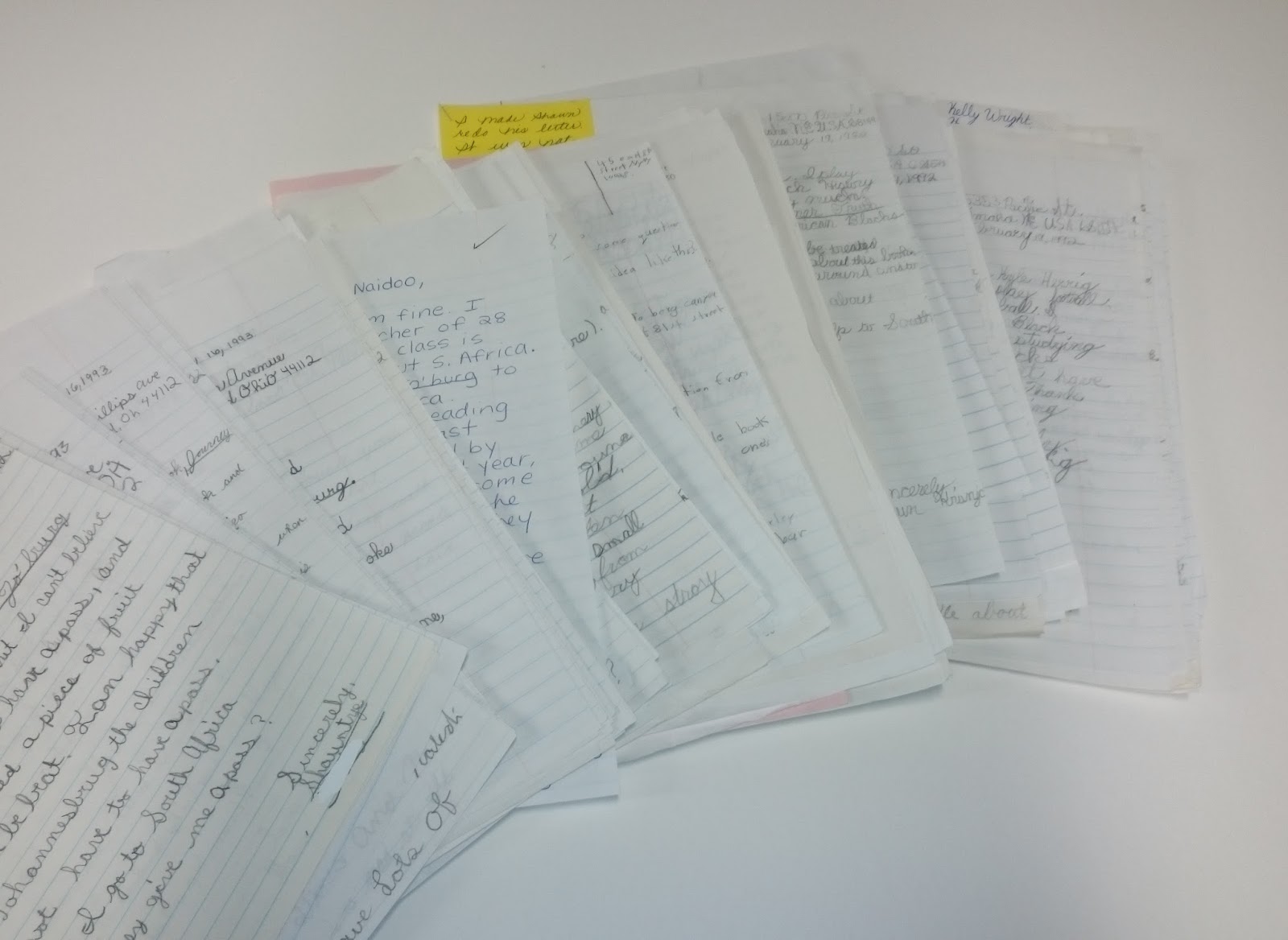
Letters from American children to Beverley about Journey to Jo'burg (BN/12/02/01/03) © Seven Stories – The National Centre for Children’s Books 

Fan mail is something that we would sometimes consider sampling (keeping only a representative selection of material), particularly when there is so much of it but Naidoo's fanmail, as well as being lovely to look at, is particularly interesting in terms of looking at social opinion and reaction to her work over the span of her career. Letters are sent from schools, individuals, children and adults from all over the world.  According to Naidoo the 'Most exciting for me is when I feel my writing has really touched a nerve' (http://www.beverleynaidoo.com/faqs.htm).

In some cases its clear where Naidoo's fiction has changed and challenged opinion. 

From the first notes to the last batch of fan letters it has been a long journey for Naledi and Tiro.  It has been a political journey, a one of social history and opinion, and hopefully a step towards a more equal world.  


Our many editions of Journey to Jo'burg including translated versions© Seven Stories – The National Centre for Children’s Books

Journey to Jo’burg is only one novel in a list of many.  Naidoo's collection covers a large proportion of her career and includes her PhD thesis, novels, short stories, picture books, professional and personal correspondence.  There is a vast amount of information with a great potential for research and learning projects - if you have any questions about the collection  
email: collections@sevenstories.org.uk or phone: 0191 495 2707 or comment on this blog.

Seven Stories was able to support the acquisition of the Beverley Naidoo collection through support from a Heritage Lottery Fund ‘Collecting Cultures’ grant. This has been awarded to Seven Stories in recognition of the museum’s national role in telling a comprehensive story of modern British children’s literature. For more information on our HLF Collecting Cultures project see:  http://www.sevenstories.org.uk/news/latestnews/hlf.


Monday, 1 August 2016

All About: Air Balloons

From Beatrix Potter to Disney the world loves adventurous anthropomorphic 
characters but, the greatest air balloon harvest mouse rescue is surely Judy Brook's Tim Mouse.  


Tim Mouse with model baskets and Tim Mouse himself.  Photograph © Seven Stories – The National Centre for Children’s Books
It's harvest time and the harvest mice face imminent danger; the farmer is cutting corn and there are too many dogs and cats for the mice to make a safe escape from the field.  Its okay though, Tim Mouse and the other country-side animals are quite resourceful. Tim blows up a big red balloon, hops in a basket attached to the bottom and with the help of Robin, he saves the day in the air balloon.  Bravery, recycling and airborne adventure - what more could one ask of a mouse?

It's a simple adventure story but the process of creating a book like Tim Mouse is, of course, not simple at all. 


Judy Brook's original artwork with the book Tim Mouse. Photograph © Seven Stories – The National Centre for Children’s Books

Tim Mouse is the first in a series of Tim Mouse's adventures written and illustrated by Judy Brook. At Seven Stories we have a significant Judy Brook collection which includes drafts, dummy books and final artwork. This range of material is great for demonstrating the development of story and characters from draft to printed book.  

In the image below you can see successive spreads from rough pencil sketches to the final artwork with the same spread from the book.  These three images only represent a small proportion of the Tim Mouse material - we have another two dummy books, sketches and alternative artwork as well as a full spread of final artwork. 

Ideas don't come fully formed and perfect and this collection shows that the creation of a children's book is a process.  Its sometimes easy to forget that such hard work goes into children's books and what may start as a few scribbled lines on a piece of paper can become a beloved story. Here at Seven Stories we find that idea encouraging and we like to encourage everyone to keep on drawing and writing - who knows who you might create! 


Unbound dummy book (JB/01/05/01/02), final art (JB/01/05/05) and Tim Mouse book. Photograph © Seven Stories – The National Centre for Children’s Books

This creative process isn't necessarily linear and it's most definitely not the same for everyone.  Brook's is just one of many illustrators' collections that we hold and shows just one approach to creating a children's book. 

Below you can see some of the images that didn't make it into the final artwork of Tim Mouse.  Another important lesson we can take from this collection is that you don't have to keep everything you create, its okay to make mistakes and to change your mind.  These drawings also show a development from her first rough sketches with notes (in the GIF above), to more detailed graphite drawings that focus on character. 

Photograph © Seven Stories – The National Centre for Children’s Books

Photograph © Seven Stories – The National Centre for Children’s Books
As well as archival material we have models of characters. This means that we have an archive box full of tiny mice - something I'm sure not many archives can claim. 


Its like a little mouse nest © Seven Stories – The National Centre for Children’s Book.
The mice are quite fragile with very long fine tails, they're hand painted and made from gypsum and wood. The models are a little bit of a mystery to us, it is unclear why they were created or whether they date from the creation of the books.

There are also three air balloon baskets with minute details from sandbags, ropes, to real metal anchors. One even includes Tim Mouse watching over the side. 


Tim Mouse in his balloon. Photograph © Seven Stories – The National Centre for Children’s Book.
Like the whole Judy Brook collection these models are intricately and carefully worked.  What I adore most about this collection is the delicacy of Brook's drawings, so the next picture has nothing to do with air balloons, its just a tiny tiny cow cut-out paper clipped to a final spread. 


A tiny cow from a final illustration, its not attached to the main work so has been paper-clipped in place. © Seven Stories – The National Centre for Children’s Books

The mice aren't the only models in the Judy Brook collection, we also have a wooden boat. 

If you'd like to find out more about the Seven Stories Collection, then 
email: collections@sevenstories.org.uk or phone: 0191 495 2707 or comment on this blog.


Tuesday, 19 July 2016

All About: (War) Horses


Spoiler Alert: this blog post discusses the end of Michael Morpurgo's War Horse.

Horses have been a mode of transport since at least 2000 BC but the horse that’s the focus of this blog post is much more recent than that: Joey from Michael Morpurgo’s WWI novel War Horse.  The book has become internationally well-known thanks, in part, to a stage production by the National Theatre (featuring spectacular horse-sized puppets) and to the Stephen Spielberg adaptation that came out in 2011. 


Seven Stories' own interpretation of Joey in our Michael Morpurgo: A Lifetime in Stories exhibition. Photograph © Seven Stories The National Centre for Children's Books. 
The Seven Stories exhibition, Michael Morpurgo: A Lifetime in Stories, opened on 2nd July and, of course, it features Morpurgo’s most famous book.  If you visit you’ll find Joey not only as he was first written down (in Morpurgo’s tiny handwriting) but also as he’s been imagined in film, for the stage, and in painting.

Early manuscript draft of Michael Morpurgo's War Horse.  Photograph © Seven Stories The National Centre for Children's Books. 
The novel is narrated by Joey and opens with him being sold at auction:

I was not yet six months old, a gangling, leggy colt who had never been further away than a few feet from his mother.  We parted that day in the terrible hubbub of the auction ring and I was never to see her again. (Page 3)

From here Joey meets Albert, the farmer’s son and they become best friends, until Joey is bought by the British Army and sent to the battlefields of the First World War.  Distraught, Albert joins up and promises to bring him home but it’s not until the end of the war that they’re finally reunited and return home to Devon together.

The Seven Stories archive contains a variety of material about War Horse: there’s the very first manuscript for the book, handwritten on lined paper; the shooting script for the Spielberg film, with its codename Dartmoor written at the top; and letters about the stage production’s transfer to Broadway and the changes the American team had made to the story. 


Various War Horse items from our Morpurgo collection on display at Seven Stories until 2nd July 2017. Photograph © Seven Stories The National Centre for Children's Books. 
But that’s not what this blog post is about.  I want to tell you about a version of War Horse that has an alternate ending – one that doesn’t end quite so happily ever after.

In the late eighties and early nineties Morpurgo collaborated with a producer, Simon Channing Williams, who made his name working with Mike Leigh on films such as Vera Drake and Secrets & Lies.  Channing Williams produced the adaptation of Why the Whales Came, starring Helen Mirren and Paul Scofield and, following this, worked with Morpurgo to get funding for an adaptation of War Horse. 

Papers in the archive show that the funders were initially sceptical of its appeal to children and wanted instead to go for the adult market.  In a report on one of the submitted scripts, Mary Davies, who was a reader for the European Script Fund (ESF), commented:

The writer has seems to have taken heed of comments on the earlier script that it appeared to be aimed at a young rather than an adult audience.  The happy ending and slight sentimentality of the earlier version, together with a greater emphasis on Joey the horse as a character, gave the script this slant.

From this feedback it seems that the ESF wanted a harsher or more realistic script without a happy ending and they encouraged the focus on Joey.
The next version of the script is still recognisable from the book, with an addition of a love story between Emilie and a German soldier (she is somewhat older in this version).  It continues along much the same lines until, that is, the final few pages. 

Just as in the novel, Joey is being sold at auction and, as in the book, the soldiers club together to buy Joey – but they don’t have enough money.  Not to worry, Emilie’s grandpere is also there, with a sack full of silverware to buy back Joey so he can live out his days resting on the farm.  Except the auctioneer won’t accept the silver, only cash.

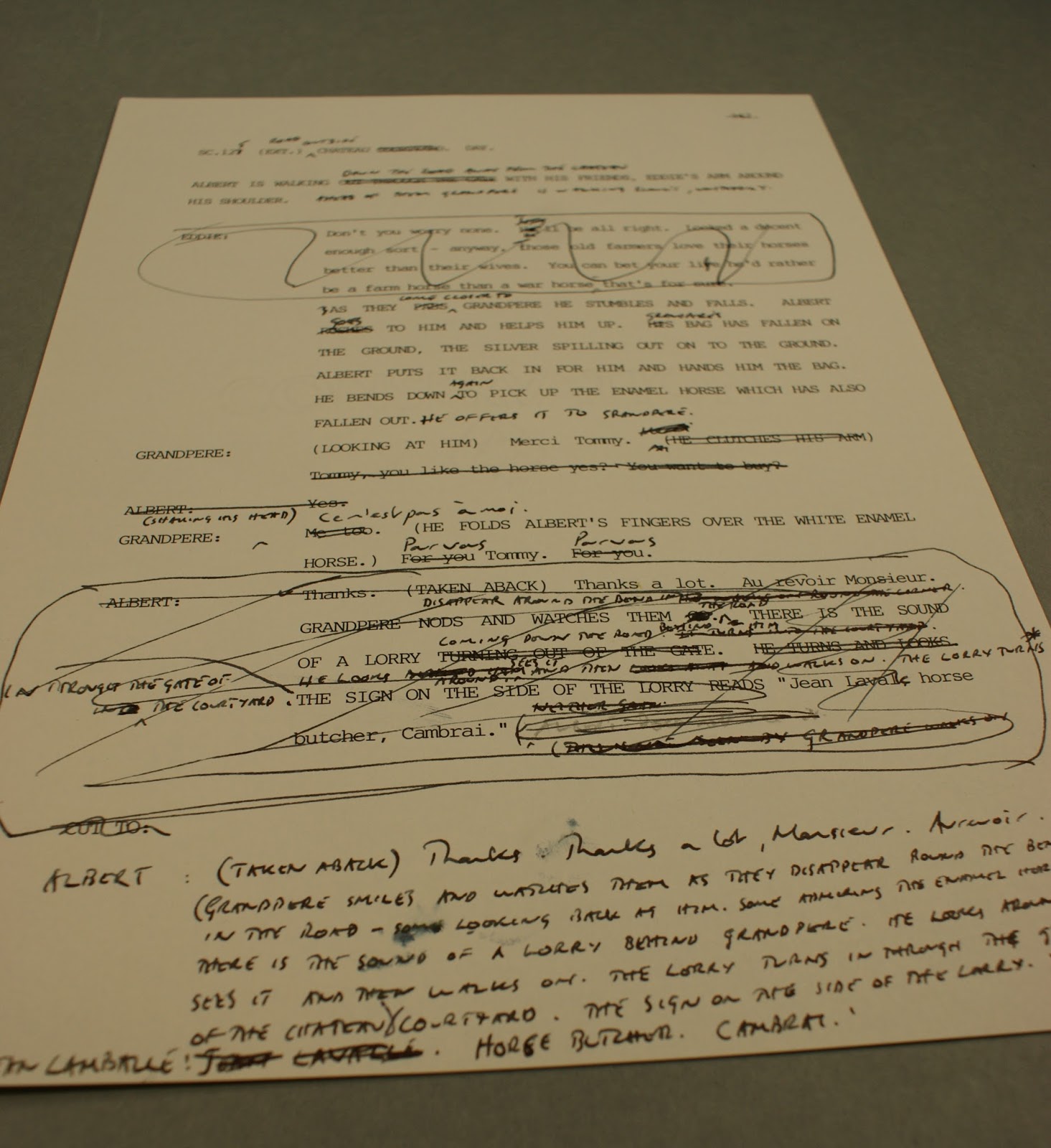
Enter Monsieur Lamballe of Cambrai, who makes his bid, wins Joey and pays in cash.  In the next scene, the third to last in the film, Emilie’s grandpere gives Albert an enamel horse pin to remember Joey by.  Then, as the soldiers leave, a van passes Grandpere.  On the side of it reads ‘Jean Lamballe.  Horse Butcher.  Cambrai’.  Joey has been sold for horse meat. 


Extracts from annotated typescript of War Horse by Simon Channing Williams MMo/06/06/03. Photograph © Seven Stories The National Centre for Children's Books. 
This is a more historically accurate ending (the British Army retained some horses after the end of the war but most that were still fit were sold locally to farmers and slaughterhouses) but it’s a big departure from the rural idyll ending of the novel.

The change raises the question about what’s at stake in Albert and Joey’s glorious return to Devon.  In the novel they’re celebrated and it’s a chance to reflect on the people and horses that died in the war:

And so I came home from the war that Christmas-time with my Albert riding me up into the village, and there to greet us was the Silver Band from Hatherleigh and the rapturous peeling of the church bells.  We were received like conquering heroes, but we both knew that the real heroes had not come home, that they were lying out in France alongside Captain Nicholls, Topthorn, Friedrich, David and little Emilie. (page 141)

The ending cements the comradeship between Albert and Joey: they were received equally, ‘like conquering heroes’, and they shared the knowledge that they weren’t the real heroes. 


But when it’s only Albert that returns the ending is bleaker and he doesn’t feel at home anymore: the script says ‘He seems bewildered by the welcome, detached’.  


Extracts from annotated typescript of War Horse by Simon Channing Williams (MMo/06/06/03). Photograph © Seven Stories The National Centre for Children's Books. 
And a summary of the script submitted to the ESF is even less hopeful: ‘Maisie seems like a stranger to [Albert] and it’s a while before he is able to embrace his mother with any real feeling.’

The homecoming of Joey with Albert at the end of the novel returns things to how they were for everyone else, even if the implication is that Joey and Albert know there’s a difference compared to their lives before the war.  The 1990s script makes the difference much greater. 

Although this film wasn’t eventually financed its inclusion in the Morpurgo archive provides researchers and readers with another version of War Horse that not only helps in learning about the process of adapting a book but also changes the way we think about the novel and raises questions that may not be obvious in the published version.

               - Dr Jessica Medhurst
                 KTP Research Associate

If you want to know more about horses in our collection take a look at All About: Horses.  You can also learn more about the Michael Morpurgo collection here.


If you'd like to find out more about the Seven Stories Collection, then 
email: collections@sevenstories.org.uk or phone: 0191 495 2707 or comment on this blog.