Showing posts with label Katharine Holabird. Show all posts

Tuesday, 30 September 2014

Ballet Stories with Katharine Holabird and Pam Knights

This weekend Seven Stories have been hosting several events with the Angelina Ballerina author Katharine Holabird. Katharine has been going in to schools, and hosting public events in our visitor centre, with lots of Angelina fans, especially many budding ballerinas.

One of the public events held in the Artists Attic this weekend.
On Monday evening we had a particularly special event, an audience with both Katharine Holabird, and Pam Knights, retired lecturer in English and American Literature at Durham University, and ballet book lover! 

Pam had spent time working with the Seven Stories archive to uncover the story it tells about children's books on ballet, and gave a fascinating and funny talk about the treasures she found. Starting with the Ballet Shoes books by Noel Streatfeild and illustrated by Ruth Gervis, and touching on the Lorna Hill's Sadlers Wells series, right up to the present day phenomenon that is Angelina Ballerina.


An example Pam used in her talk on ballet stories. This is an unpublished illustration created for Ballet Shoes, which Pam used to compare with other, published, portrayals of Posy in the book. Created in around 1936, this is one of the older artworks in the Seven Stories collection.
Katharine then gave a fascinating talk on her inspiration and drive to write the Angelina series. She gave additional insight in to her early love of ballet, and how the books were inspired not just by seeing her children enjoy it, but her childhood creative play, and visiting the ballet in Chicago with her grandmother.


Katharine Holabird speaking at the event.
The event was chaired by Sarah Lawrance, Collection Director, who took questions from the audience. Pam and Katharine answered questions on the roles of boys in ballet, and the importance of showing the hard work and determination it takes to be a dancer, but also that the stories must still be fun!

Katharine, Pam and Sarah in conversation.
Accompanying the event, we took a display of archival material that Pam had explored, including some of Helen Craig's beautiful artwork for their latest book Angelina's Big City Ballet, which has left us all desperate to visit New York (aka the Big Cheese).

Lindsey Gibson, Seven Stories conservator, discussing the archive with guests at the event.
Twists and Tails, the Story of Angelina Ballerina is on display at the Seven Stories visitor centre until April 2015.

If you want to find out more about this collection, or about any other of our archives then 
email: collections@sevenstories.org.uk
phone: 01914952707 
visit: http://www.sevenstories.org.uk/collection 

Thursday, 17 July 2014

The making of 'Twists and Tails - The Story of Angelina Ballerina'

When Helen Craig and Katharine Holabird donated their archives of work for the Angelina Ballerina series, the exhibition team wanted to put the material on display as quickly as possible. Not only does the archive represent one of the most popular children's series of the past thirty years, but the level of detail available from both sides of the page is wonderful.

Kris (Seven Stories Archivist) and I (Alison, Curator) identified three main themes visible in the archive and stories.

How to make an Angelina book

The first was 'How to make an Angelina book'. One of the most crucial parts of the archive, and Seven Stories mission, is to make visible the process of creating a book. This material gives us the chance to show the long development that goes in to creating each book; showing the involvement of not just author and illustrator, but editor too. 


Section of draft for Angelina and the Princess, written by Katharine Holabird with comments from Helen Craig, c.1983
Kris and I worked through all the books represented in the collection, and chose Angelina and the Princess as the most visual example of this process. The second book in the series, published in 1984, it was written while the concepts behind Angelina and the world of Mouseland were still being developed. There is also a complete run of preparatory work, in which alterations to the story are clearly visible. What we found most intriguing was the evolution of the original story from Angelina performing for 'The Duchess of Mouseberry', to performing for the Princess. The material on display allows the viewer to track the changes made through the whole process. 

To represent the illustration side, we chose to focus on one particular scene from the book - the double page spread of Angelina performing for the Princess. For this there were many rough illustrations created by Helen Craig, complete with notes to herself about composition. It is an interesting exercise to decipher which elements have changed between each draft, and work out which came first.


Early rough for final double page spread by Helen Craig, for Angelina and the Princess, written by Katharine Holabird (Aurum Press, 1984)
Colour rough for final double page spread by Helen Craig, for Angelina and the Princess, written by Katharine Holabird (Aurum Press, 1984)

Angelina's Journey

The second theme most apparent in the archive is that of Angelina's journey, both within the books, but also from initial picture book to global star.

The archive holds the very first illustrations and manuscript created by Helen and Katharine. Although different to the final version, these show the very beginnings of Angelina, and are on display alongside each other. Showing Angelina's journey within the books led us to choosing some of our favourite Angelina moments, including when she is preparing to go to her first ballet lesson, performs for royalty, and when she meets her new baby sister for the first time. We also have on show an illustration from the (as yet unpublished) latest book in the series Angelina's Big City Ballet, of Angelina and her family arriving in the Big Cheese (aka New York).


Small section of the first draft, which later became Angelina Ballerina. Katharine Holabird, 1982.
The set of stand up illustrations Helen Craig sent to Katharine Holabird, as her idea's for 'Primrose', c. 1982
We also follow Angelina's journey to international fame. The archive contains material from Katharine and Helen's initial and ongoing discussions with HiT entertainment, who hold the licence for the Angelina Ballerina brand. This correspondence often shows the frustrations of allowing other people to work on a character the creators care deeply about. There is also an opportunity to display material from the many different spin-off's, such as the English National Ballet adaptation, much of the merchandise produced over 30 years, and examples of the two television animations.


A sample of some of the Angelina Ballerina merchandise, these were created in 2002 for HIT Entertainment

Mouseland

Probably the most fun we had was choosing content for this section. The world Angelina inhabits is called 'Mouseland', and comes set with certain rules. It was wonderful to explore this within the illustrations and Helen's rough work, uncovering hitherto unseen floorplans of Angelina's home, and choosing pieces which help to show the detailed world the mice inhabit.


Small section of 'Angelina's House', by Helen Craig, 1982

Cross section of a house in Mouseland, with Angelina peering through the window. Final illustration by Helen Craig, for Angelina's Christmas, written by Katharine Holabird (Aurum Press, 1985)
If you would like to visit the exhibition, it will be on display from Saturday 19th July 2014 until April 2015, at Seven Stories, National Centre for Children's Books. Click here to find out more details about visiting the centre.

If you would like to book a visit to research the archives within our collection store, click here for further details.

Interested in other posts about the Storylab Gallery at Seven Stories? Click here or here.

Angelina Ballerina is now published by Puffin Books, and are available for sale from the Seven Stories bookshop, one of the largest independent children's bookshops in the UK.

Wednesday, 2 July 2014

All about pop-up books! (2 of 2)

In this post our guest blogger on pop-up books, Lena Kleine Bornhorst, looks through the Seven Stories Collection and picks out examples of pop-ups featuring some very well known children's characters:


Winnie the Pooh, Noddy, Peter Rabbit, Paddington Bear and The Tiger who Came to Tea are all well-known children’s book characters who have featured in pop-up books. Popular figures or famous stories have often been published in pop-up editions – with varying results!  Pop-up books can be used to raise the popularity of a book or character. They can be used as a merchandising product (like soft toys or board games) and they’re a clever way for publishers to reuse already existent material.

The reuse of established characters in pop-up books is not a new concept: as we saw in the last post, one of the key partnerships in the history of pop-up books was that between US publisher Blue Ribbon and the Walt Disney Company in the 1930s. Pop-up books are a convenient medium to bring film characters or themes into a book version. The movement in the pages and the dynamics can fill the gap between a film and an ordinary book: like a film in a book format.


However, pop-up books with well-known characters shouldn't only be seen as merchandising products. The results are very often quite exciting and it’s interesting how diverse the pop-up editions can be. We can take a look at an example from the Seven Stories Collection: three Thomas the Tank Engine pop-up books produced in the 1990s.

Thomas’s Party Pop-up (Heinemann, 1999) tells in five double-pages a short story about Thomas Birthday Party. The paper engineering is kept very simple and the technique of the pop-ups is always the same. The back of the book is located at the top. Each double-page contains a 90 degree pop-up-element which unfolds when you held the book in a 90 degree angle.

Thomas's Big Railway Pop-up Book (Heinemann, 1992) features seven double-page spreads about seven adventures had by Thomas and his friends throughout a week.  In contrast to Thomas’s Party Pop-up, this book includes different and complex paper engineering. All the included pop-up elements are 180 degree pop-ups, which work when the book is completely open. The reader is encouraged to turn the book in different directions to see all of the pop-up elements and there are many interactive pull-tabs. Two of the interactive elements feature string, which is used to demonstrate rope – the text says: “On Wednesday James runs away. Edward and an Inspector chase him and stop him with a rope.” The other string is integrated in a pull-tab, which makes it possible to lift the Tank Engine after an accident.

Spread from Thomas's Big Railway Pop-up Book (Heinemann, 1992)


Thomas’s Amazing Pop-Up Train Set Book (Heinemann, 1995) contains only four double pages, but the format has a bigger size than the other two books. This book contains detailed 180 degree pop-ups and there are many interactive elements – in particular, a detachable paper engineered Tank Engine, which can use for a free play with the book.  The book is the base for the play as it contains railway lines, over which the Tank Engine can find the way (via a house and over a bridge) through the book. The story is told on little story-stops on every page: Thomas has to deliver a parcel in time, but is too late so he follows further story-stops which bring him back through the book till he catches a paper engineered helicopter which brings the parcel safe to his owner. The story and the interactive part with the detachable Tank Engine are cleverly combined and show another aspect of how pop-up elements can be used.


Spread from Thomas’s Amazing Pop-Up Train Set Book (Heinemann, 1995)

The Thomas the Tank Engine examples show how different paper engineering can look and how different the functions of pop-up books can be. If pop-up books are cleverly made, they can make a story more alive and intensive. Interactive elements let the reader be part of the story and join in.

Other examples of innovative pop-ups featuring well-known characters include the Winnie-the-Pooh Pop-up Theatre Book (Methuen, 1992), for which the paper engineering was done by Helen Balmer and Jose R. Seminario.  The book contains five double pages and every right side is covered by a big flap which can be lifted with a small ribbon. The enfolded paper engineering shows a scene of the story. With the included character puppets these scenes can be used for a free theatre play and pull-flaps bring movement to the scene.


Spread from Winnie-the-Pooh Pop-up Theatre Book (Methuen, 1992)

The amount of work required to make a pop-up book can be seen in the archive at Seven Stories. For example, Angelina Ballerina illustrator, Helen Craig’s collection includes extensive material from two Angelina pop-up books. This material shows the entire process of the development of a pop-up-book, in this case Angelina Ballerina’s Pop-up and Play Musical Theatre (Penguin, 2008) and Angelina Ballerina’s Pop-up Dancing School (Puffin, 2007). Looking at this archive, we can see that the production of a pop-up-book is very different to that of a normal book.

Dummy book of Angelina Ballerina’s Pop-up and Play Musical Theatre (Penguin, 2008) ©  Helen Craig and Katharine Holabird

Dummy book of Angelina Ballerina’s Pop-up and Play Musical Theatre (Penguin, 2008) ©  Helen Craig


The Angelina Ballerina material shows how important and precise the arrangements between the illustrator and the paper engineer must be. Helen Craig’s collection includes paper engineering dummies of different stages, original illustrations, work plans about necessary illustration parts, letters, emails and many designs and construction sheets with handwritten comments by Helen and paper engineers Ian Smith and Maggie Bateson. In their correspondence they talk about things such as the right sizes of the illustrations, so that they fit perfectly on a particular flap. In one email exchange they speak about the size of miniature coat hangers so that the press-out clothes hold perfectly on the small clothes rail!
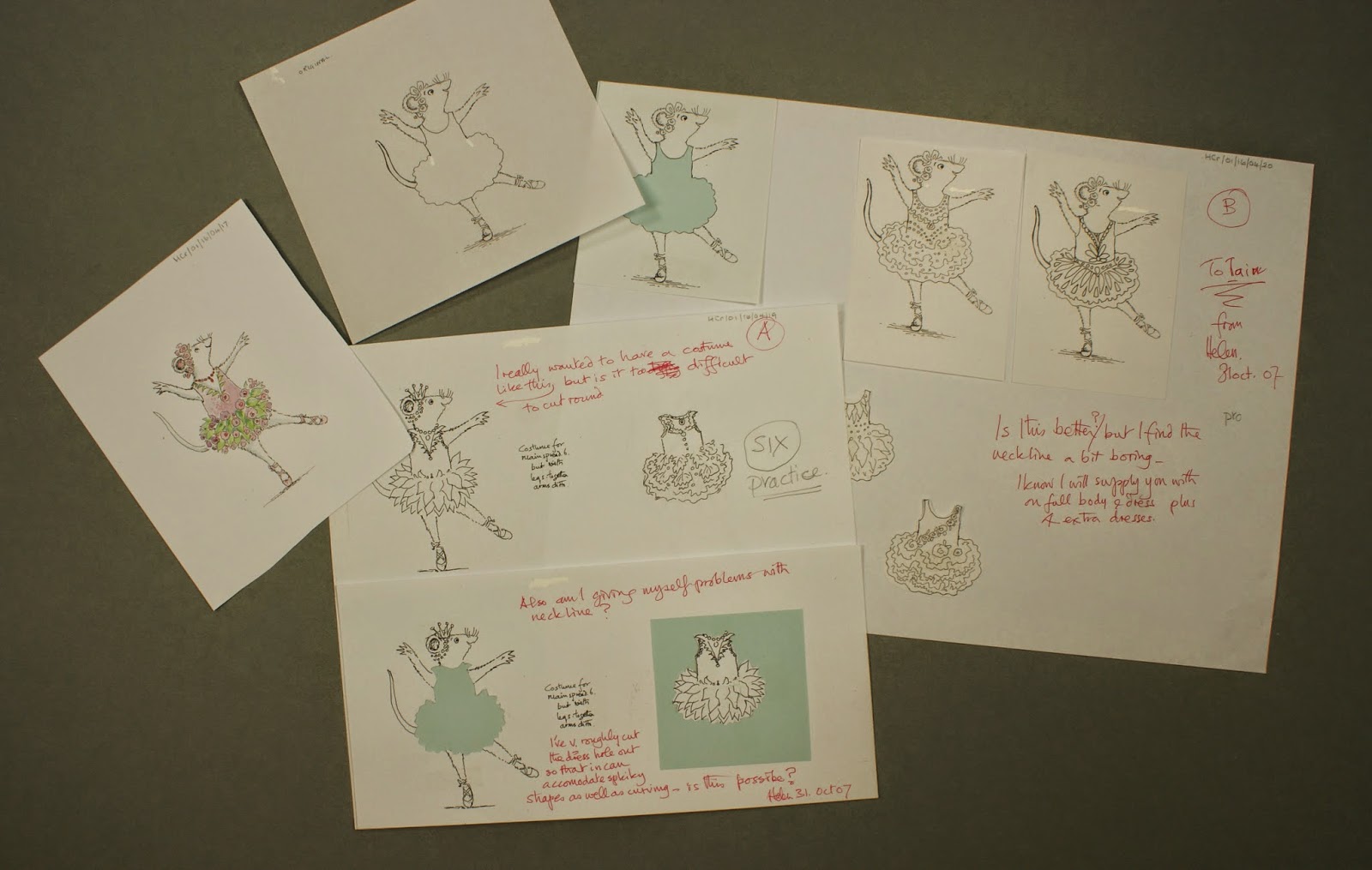

Preliminary drawings for Angelina Ballerina’s Pop-up Dancing School (Puffin, 2007) ©  Helen Craig


The dummies seem to be a very important resource for this process. They make it understandable for the illustrator which areas can be seen at the end and which illustrations or added decorations are needed, so that at the end a wonderful pop-up book can be published.


Part of early dummy book of Angelina Ballerina’s Pop-up Dancing School (Puffin, 2007) 

Part of later dummy book of Angelina Ballerina’s Pop-up Dancing School (Puffin, 2007) 


The creation of pop-up books and bringing well-known characters into this new format demands a lot of creativity and knowledge. A successful pop-up-book that can offer something interesting and different to a traditional book is much more than a simple reuse of existing characters and illustrations. It can be an exciting new artwork. Pop-up books provide multifarious opportunities to create something special and new with already well-known characters and stories.


If you'd like to find out more about the Seven Stories Collection, the Helen Craig archive, or the pop-up (and other!) books we hold, then 
email: collections@sevenstories.org.uk or phone: 01914952707.