Tuesday, 21 July 2015

Seven Stories Visitor Centre is now open! Part 2

 It has been such a long installation, and there were just too many pictures to fit in one post! This is the second installment, where I'll show you people getting in to the galleries for the first time, and what they look like finished and ready for the public.

Some of the very first visitors to see the galleries, before they were quite finished (and before we even had any artwork up!) were for the press photos to market the exhibitions. 
Cathy, our resident vintage expert and Visitor Services Co-ordinator, spent a lot of time in the Collections and Exhibitions team during the time the centre was closed. She researched and bought all the props you see in the galleries, including this beautiful WWII radio, actually built in Gateshead!
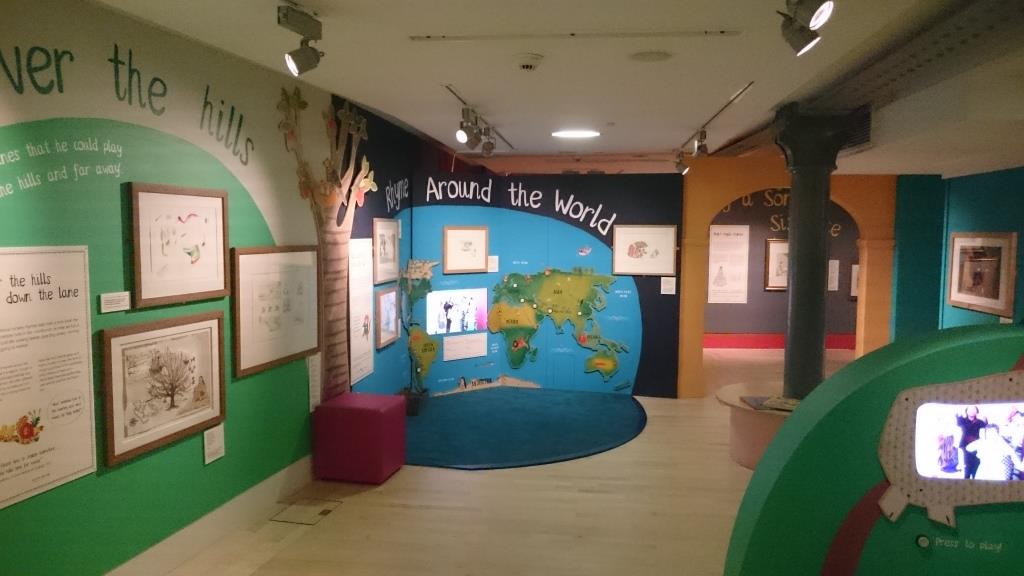
Gwen and Iwan enjoying some of the areas they have spent the last several months designing and building. They are just a few of the team from the wonderful 24 Design in Manchester, who worked tirelessly creating and installing the Rhyme Around the World exhibition with us.
The galleries were just about finished and ready to be explored by staff whilst we did some induction training on the Wednesday before opening. Sarah and I led this session on Rhyme Around the World, and Gill led another session later that day in Painting with Rainbows.
Obviously as part of a Seven Stories training session, there will also be lots of dressing up! 
Gill and I had the privilege of showing around Michael and Louise Foreman, for their first look at the Painting with Rainbows exhibition. We have been in close contact with Michael and Louise through the whole design of the exhibition, and it was lovely to see them both with big smiles looking around the display!
For Rhyme Around the World we hope all our youngest visitors are out and about with their parents and carers enjoying all the rhymes in the exhibition! 
Entrance to the gallery under this wonderful glowing archway!
Entering the gallery
'When the Boat Comes in'
'When the Boat Comes in' 
'Over the hills'
'Over the Hills'
'Whatever the Weather'


'Sing a Song of Sixpence'
'Polly put the kettle on'
'Rhyme Around the World'
'Hush-a-bye'
Sharing Station, at the end of the gallery we would love for all our visitors to share their own favourite nursery rhyme, and tell us why they love it!

Entrance to Painting with Rainbows
'War Boy'
'The Amazing Tale of Ali Pasha'
'Moose'
'Dinosaurs and all That Rubbish'
'One World' and 'Mia's Story'
'One World'
'Say Hello', 'Cat and Dog' and 'The Littlest Dinosaur'
Our little cat and dog family!
The Friendship Zone, where you can watch 4 films made by students at our local Byker Primary school to help achieve their Arts Award.
'Friends' and 'The Seeds of Frienship'
'Wonder Goal' and a few of Foreman's illustrations for classic texts
Map of the world showing Foreman's many adventures all around the world, providing much of the inspiration for his stories.
'A Child's Garden'
Recreation of the vine from 'A Child's Garden', where visitors can tie a ribbon and wish on their hopes for the future.
If you can visit in person, we would love to see you! For more details about opening hours and a host of events, click here.


Sunday, 19 July 2015

Seven Stories Visitor Centre is now open! Part 1

After lots of hard work behind the scenes, we are very glad to announce that the gleaming refurbished building is now open! 

Seven Stories opened almost ten years ago, and hasn't closed since (with the exception of Christmas, Easter and staff training days!), so this past thirteen weeks have felt quite unusual for the behind the scenes team. It has meant huge amounts of work from all staff to make sure the centre is ready on time, and the Exhibitions and Collections team have been on site installing the three new exhibitions since 22nd June.

We will have posts all about the new exhibitions in the upcoming weeks, but for now we will leave you with a few shots of the galleries as they went in.


Gallery on level 4 and 5. During the refurbishment, the galleries were undergoing a mini transformation. The floors were cleaned and resurfaced, the AC units were fitted with attenuation units to reduce the noise, and the walls were resurfaced, ready for many more years of exhibitions.
The gallery on level 6, previously the Storylab Gallery and now the Gillian Dickinson Gallery, has had an entirely new floor installed and new air conditioning installed.
After being allowed back in to the building, we set to work fitting the walls in to place, and painting up all the many different areas of the gallery.
Fitting curved walls. 
Moving cases to their new positions.


Many of the walls in Rhyme Around the World include back panels to access the AV equipment - this is Craig fitting the television in the map area. It will show a series of nursery rhymes from around the world.
Stef showing the unpainted Morrison shelter in the Painting with Rainbows exhibition.
Workstation for the graphic installation in Painting with Rainbows.
Some of the build for Painting with Rainbows arriving. This is the skyline from Say Hello by Michael and Jack Foreman.
Chris putting together Henry Friston's arbour, from the book Ali Pasha by Michael Foreman. 
Dom and Doug putting down vinyl flowers in the War and Peas area of Painting with Rainbows.
Naomi installing some of her beautifully crafted textile works in the galleries. She also made most of the costumes in both galleries! 
Gill exploring the gorgeous new boat, based on Jane Ray's illustration for the cover of Over the Hills and Far Away.
Ben working on AV in Rhyme Around the World.
Gwen painting some final touches to the regal area of Rhyme Around the World. 
Amanda cutting grass to fit on the Dinosaurs and all That Rubbish activity table.
Kris fitting the grass to the Dinosaurs and all That Rubbish activity table.
Gill and Colin installing the beautiful vine in Painting with Rainbows. It is there at the end of the exhibition for visitors to leave with a thought of hope for the future.
Jen setting up artwork in the Paddington exhibition.
Gill and Kris putting up artwork in Painting with Rainbows.  
Artwork laid out ready to be hung in Painting with Rainbows. 
Artwork waiting to be hung in Rhyme Around the World.
See installment TWO of this blog post for the finished gallery images!

If you can visit in person, we would love to see you! For more details about opening hours and a host of events, click here.


Monday, 6 July 2015

Seven Stories on Tour


As part of our touring programme which has seen Seven Stories exhibitions enjoyed by over a million visitors in venues around the country, it is Plymouth City Museum's turn to host the Enid Blyton exhibition. This popular exhibition has travelled to Plymouth following a successful run at the Beaney House of Art and Knowledge,  Canterbury where it was described as  "a blockbuster".

The objects and framed artworks were condition checked by a member of our exhibitions team before being packed in flight cases for transport.


A second condition check took place on arrival at the next venue and it was my turn to travel to Plymouth to do the checks.


Works were thoroughly examined for any change of condition before being carefully stored prior to installation.


I arrived at the museum to find everybody busy painting the walls from their customary white to Noddy's trademark red, yellow and blue. Most of the graphics were in place and more went up during my visit transforming the space into a wonderful sensory experience.


The Magic Faraway Tree was ready to have it's slippery slope added in anticipation of thousands of Blyton lovers sliding down it.


Toyland was taking shape ready for visitors to drive Noddy's car.


Since writing this blog on the train back from Plymouth, the exhibition has opened and runs till the end of August.

Mystery, Magic and Midnight Feasts – the Many Adventures of Enid Blyton  
Plymouth City Museum from Wednesday 17 June – Friday 28 August 2015

Wednesday, 1 July 2015

All About: Dogs

This month we are daft about dogs, in honour of the Seven Stories exhibition tour to Plymouth City Museum and Art Gallery! Our Enid Blyton exhibition - Mystery, Magic and Midnight Feasts: the Many Adventures of Enid Blyton opened on Wednesday 17th June. It will be on display until the end of August, with a further tour venue at Scarborough Art Gallery in spring 2016 to look forward to.


Typescript page from Five on a Hike Together, written by Enid Blyton (Hodder and Stoughton, 1951), pictured with a contemporary proof copy of the same title.
So of course, our first item to explore this month will be one of Blyton's manuscripts, Five on a Hike Together, with a focus on the (best?) Famous Five member, Timmy the dog. He is an integral part of the team, and this selection shows him standing guard over his human friends whilst they are all out on an adventure. Earlier, Timmy had been causing all kinds of trouble after getting stuck down a hole chasing rabbits! The dog is often a uniting force for the group, and one beloved of readers who longed to have pets of their own.

This is one of four typescripts by Blyton held by Seven Stories for the Famous Five; Five Have a Wonderful Time, Five Have Plenty of Fun and the play Famous Five Adventure. The collection also holds one unpublished novel (Mr Tumpy's Caravan), as well as drafts for numerous short stories published in magazines and newspapers.  Seven Stories also holds many of Blyton's diaries, both her personal diaries and her 'nature diaries', in which she documented developments in her garden and kept track of the weather. They both often feature her own pets, she had many cats and dogs over the years. She was a big lover of animals, and her beloved 'Bobs' the dog even wrote a few books of his own!

Find out more about the Seven Stories Blyton Collection here, where you can also see many more digitised pages of typescript.


Preliminary artwork for Time for Bed, Fred, by Yasmeen Ismail (Bloomsbury, 2013)
Our selected artwork this month are some gorgeous ruffs  roughs, created by illustrator Yasmeen Ismail. These vibrant and colourful pages are among several deposited with Seven Stories in 2013, and showcase a brilliant variety in the different kinds of dog which the book could have featured. We see a possible simple blue wash, black outline with a single colour wash, and a simple black outline, close the final look of our hero.

Time for Bed, Fred follows the story of a very mischievous dog who just won't go to bed. He gets himself in all kinds of trouble, jumping in puddles and hiding all over the place, but rest assured, he does find his bed in the end!

Ismail's archive at Seven Stories currently contains a small range of artwork for Inside Out, Upside Down, Specs for Rex, and If I had a Cat. There is also a range of advertising illustrations and commissions, including the Carnegie nominated title by Sarah Crossan Apple and Rain. Find out more about the Yasmeen in the Seven Stories Collection by clicking here.


This month’s printed book is Top Dog by Partap Sharma (with cover illustrations by Caroline Pickles) which was published by Andre Deutsch in 1985.

Partap Sharma's Top dog (Andre Deutsch, 1985)

Top Dog is a collection of short stories set in Bombay.  They are all about the author’s Alsatian dog called Ranjha, who was so skilfully trained in the art of tracking, that he became famous for the crimes he solved.  The stories “… are, in essence true.  The real-life dog, Ranjha, helped solve them.”  Intriguingly, the stories / cases are narrated by Ranjha so give a dog’s eye view of the world.

Top Dog is one of the ‘Armchair Travellers’ collection of 495 books which were donated by the Jayne Truran , Chair of St Albans Children's Book Group, to Seven Stories in 2008.  The collection was originally put together by Joyce Du Cane who was a school inspector and member of IBBY (The International Board on Books for Young People http://www.ibby.org.uk/ ). According to the donor, Joyce Du Cane “… travelled extensively and brought books back from all her journeys. She was very popular with the publishing world and one suspects that people gave her things when they knew about her collection… she devoted her life to the book group and her other charities. She was very philanthropic.”  Further books were added to Joyce Du Cane’s collection when a teacher training centre in Hertfordshire closed and moved to new premises, in the early 1990's.

The St Albans Children's Book Group ran for over 30 years, during the school summer holidays, the ‘Armchair Travellers’ book collection was made available for local children to borrow.  The St. Alban’s Children’s Book Group was in essence a forerunner of the ‘Summer Reading Challenge’ groups offered by local Public Libraries these days, who are keen (just as the St. Albans’ parents were) to keep children reading, and usefully occupied through the summer holidays.

The idea was that the children could ‘travel the world from the comfort of an armchair’.  Between 25 and 50 parents joined the book group each year and brought along their children to borrow books and for events.  On average 30-40 children would attend on a sunny day.  Past Chair, Jenny Stroud held the Armchair Traveller event for many years either in her home or her wonderful garden.  The books were displayed by Continents with each continent having its own table, or space in the garden if the weather was good.  (There were also sections of ‘Folk Tales’ and ‘Journeys’).  Each child had a ‘Passport’ and would get a ‘stamp’ in it for each continent they visited, by reading and rating a book telling a story from that continent.  So, a child reading Top Dog would receive a ‘stamp’ for India / Asia.

‘Armchair travelling’ was obviously a popular, enjoyable and worthwhile pursuit in St. Alban’s -not least for Jenny Stroud’s own son,  Jonathan, the children’s books author of Lockwood & Co. and the Bartimaeus Sequence!

If you'd like to find out more about the Seven Stories Collection, then 
email: collections@sevenstories.org.uk or phone: 0191 495 2707 or comment on this blog.

Sunday, 28 June 2015

Hartlepool Festival of Illustration

Seven Stories have been happy to be involved in a brand new event around illustration in the North East - the Hartlepool Festival of Illustration.

Working with the festival organisers, we loaned several pieces of artwork from the Seven Stories Collection to an exhibition held at Hartlepool Art Gallery. Artwork from the below has all been on display alongside additional loaned works from Chris Riddell, Sara Ogilvie and John McCrea, amongst others. 

  • Edward Ardizzone
  • Shirley Hughes
  • Polly Dunbar
  • Sarah Garland
  • Angela Barrett
  • Helen Craig
  • John Burningham

As part of the festival, we have also been out on a whirlwind tour of the local area, working with an amazing 730 participants over 10 days. The sessions took place in nine primary schools, one college of further education and in Hartlepool Art Gallery itself. Lynn hosted a spectacular 29 illustration workshops over this time - and is now on a well deserved holiday! This is what she has to say about the experience:

Having completed a two week residency in Hartlepool schools, I feel very privileged to have been involved with such an exciting outreach programme, using original materials from the Seven Stories Collection to help inspire the next generation of illustrators and designers.

Knowing that the exhibition would include materials to illustrate the creative processes in the making of a picture book, I was very keen to develop a primary workshop using illustrator Sarah Garland’s sketchbooks, and Polly Dunbar’s sketches and finished artwork for My Dad’s a Birdman, written by David Almond.

Based in a new school each day, I arrived each morning with 90 sketchbooks, HB pencils, graphite sticks and a gross of felt tip pens. Needless to say these were put to great use, the children hugely excited to have their own sketchbook and pencils, all kindly provided by Cleveland College of Art and Design. The workshops were planned to last between 75-90 minutes. Most followed a similar format with variations depending on the age and maturity of the pupils. 

Of courser it  wouldn’t be a Seven Stories workshop if it there wasn't any book chat! We talked about the children’s favourite storybooks, the authors and illustrators they knew and liked. We browsed picture books selection to look at style. Children talked about why they liked the illustrations and considered where authors and illustrators get their ideas from.

I wanted the children to experience quick sketching, and told them:

“We are going to look, talk, listen, draw, draw, draw again, draw some more, more talking, more drawing, more looking, talking, listening and if there is sufficient time, even more drawing!”

We looked at some facsimiles of artwork in the exhibition. They saw how illustrators use sketchbooks, sometimes drawing multiple images on one page. Sarah Garland’s quick sketches of families in the swimming pool show how little information is needed in a sketch for it to work as a preparatory drawing. They noticed how Polly Dunbar uses just a dot for an eye or a line for the mouth in her Birdman sketches. They considered how an illustrator develops a character from an initial sketch. From the slumped posture in the sketch of Lizzie’s dad, they started to understood how an illustrator can portray a character’s emotions in the pose or facial expression. We looked at Angela Barratt’s graphite sketch and finished drawing for The Snow Queen, and Helen Craig’s artwork for Angelina Ballerina.

An illustration workshop needs drawing time! We started drawing birds.

“How many different birds can you draw in a minute?”

We drew more, changing the size of beaks and wings to see how that affected the drawing. We handled feathers and a selection of soft toy birds. Talking about their achievements at the end of the sessions, many highlighted using graphite sticks to draw their real and imagined feathers as a favourite part. Graphite can be used for clean sharp lines or blended and smudged to create featheriness. It was a new medium for most of the young artists.

Examples of the students work
Next: drawing a human. I wanted the children to try drawing a simple human character, with not too much detail, as we would use our experience of drawing feathers and birds to transform our character. There was a real buzz throughout the entire workshops. I read extracts from My Dad's a Birdman or retold parts while the children were busy drawing.

Throughout the workshops children proudly showed back their work to each other and talked about their achievements. Every child participated. No one once said that they "couldn’t" or "didn’t" know how to draw a bird, feather or human. They were working as illustrators.

Next step storyboarding. We compared different approaches to storyboarding. I had included some additional storyboard facsimiles from the original Picture Book in Progress exhibition, held at Seven Stories visitor centre in 2014. The groups compared these with John Burningham’s storyboard which features in the Festival  exhibition. Children pointed out that some of the frames have very little detail, yet the sketches of animals are drawn in greater detail.

We were able to see how Sarah Garland’s storyboard for Doing Christmas was roughly sketched on lined A4 paper, how Judith Kerr used very faint drawings in her storyboards for Mog the Forgetful Cat and The Tiger Who Came to Tea. In contrast, Helen Cooper’s storyboard for Little Monster Did It includes everything she wants on the page including minute text. I heard  “wow” almost every time someone looked closely at this one. There is no right or wrong way in developing a storyboard - illustrators use them as they need.

Everyone had created a new character so the next stage was to think of what happened to them.  Everyone had a go at storyboarding 3 frames to show the participation: Frame 1 getting ready to start. Frame 2 character mid flight, to show the shape they make in the air.
Frame 3 Success? Failure? Cheers or splash?

In the extended workshops children then worked for some time developing one of their storyboard frames into an actual illustration. In her finished artwork, Polly Dunbar portrays   dad and Lizzie tumbling through the air wearing their beaks and feathers. Many of the participants worked on their own version of this scene.

On the second last day of the residency I led the illustration workshops in the Art Gallery surrounded by world class illustration.  I adapted the session for working with the older B Tech Students from East Durham College to include David Almond’s initial character notes for his Birdman, asking them to try to think along these lines when developing their own characters. They considered appearance, their character’s fears and desires. Would they have a special object? Several students annotated their drawings, finding this a useful way to develop ideas.

In addition to exploring the creative process through the original materials from the exhibition, the students were able to compare how different illustrators respond to the same subject, and compared Ralph Steadman’s illustration from Treasure Island with Chris Mould’s interpretation of the same scene.

On display, next to our workspace were several illustrations from Chris Riddell’s Ottoline books.  Chris had been named as the ninth Children’s Laureate days earlier. In his five point plan he includes the joy of sketchbooks and celebration of reading for pleasure. I talked about this with the groups and how Chris had been one of the key speakers at the festival launch.

We were doing just what he was suggesting, doodling with our birds and feathers and enjoying drawing in a beautiful sketchbook.

The  feedback has been  very positive with children reflecting on  what they had learnt or enjoyed,  including finding out how much works goes into the making of a picturebook. I had a thoroughly enjoyable time. When asked to reflect on something they had learnt as a result of the workshops, one 8 year old boy wrote:

“ I learnt I could draw!”

Lynn Telford

The Picture Book in Progress Illustration workshops were part of the Hartlepool Festival of Illustration, a partnership between Cleveland College of Art and Design, Hartlepool Borough Council and Seven Stories.
  

Tuesday, 23 June 2015

Carnegie and Kate Greenaway Medal Winners

Yesterday the big announcement was made!  

The 2015 winner of the Kate Greenaway medal was William Grill for Shackleton’s Journey and this years Carnegie Medal went to Tanya Landman for Buffalo Soldier.  Over the past weeks our steering group have enjoyed reading and discussing all of the books shortlisted for the awards; here they are enjoying words, illustration, tea and biscuits.  

Carnegie and Kate Greenaway medal steering group at Seven Stories

To fill the gap in our reading lists, I thought it would be a great chance to delve into the Carnegie and Greenaway treasure chest to the show you some of the items in our collections that have won prizes in the past. Our book and archive collections at Seven Stories represent work by hundreds of authors and illustrators and among them are many Carnegie and Greenaway prize winners.

This is a very small selection, if you’d like to see some more, or you have a Carnegie and Greenaway favourite that isn’t featured, let us know!

The second ever Carnegie winner was Eve Garnett in 1937 with The Family from One End Street, which was quite ground-breaking for its portrayal of a working class family.  It may not be considered anything revolutionary today but in 1937, children’s literature was dominated by middle-class children.  We don’t hold any original material but we do have multiple editions in our book collections.  

Eve Garnett's Family from One End Street (Puffin Books, 1945)

In 1961 Antony Maitland won the Kate Greenaway prize for his portrayal of Mrs Cockle’s Cat.  This image only demonstrates a small amount of material that we hold in our Antony Maitland Collection; we have the whole dummy book, original illustrations and a draft of the cover for Mrs Cockle’s Cat.  We also hold artwork from his other books.

Original artwork for Mrs Cockle's Cat, Anthony Maitland c. 1961 ©Anthony Maitland 


Seven Stories Visitor centre is based in Ouseburn Valley in Newcastle and our Collections are held at our Gateshead office so, this next winner is close to home.  Set in the fictional Garmouth, quite like our own Tynemouth, is Robert Westall’s 1975 Carnegie winner The Machine Gunners.  Westall wrote his draft for The Machine Gunners by hand in notebooks. Six years later Robert won the Carnegie again for The Scarecrows. We hold a selection of original work within our Robert Westall collection which includes material from the majority of his published books. Alongside the archive we also have an extensive Westall book collection, which includes some interesting translations.   
Draft of Machine Gunners, Robert Westall c. 1975 © Robert Westall Estate

Peter Dickinson also won the Carnegie prize two years running. Tulku won in 1979.  Here is an early, incomplete typescript manuscript which is a possible first draft of Tulku.  There is also preliminary material for City of Gold in our archive, which was Peter’s Dickinson’s second book to win the Carnegie in 1980.  City of Gold was illustrated by Michael Forman whose work you can see in our upcoming exhibition. 

Typescript draft of Tulku, Peter Dickinson c. 1978 © Peter Dickinson 


There are very few authors who have won the Carnegie prize more than once, Berlie Doherty is another.  Her first prize was for Granny was a Buffer Girl in 1986 and the second for Dear Nobody in 1991.  Berlie's books can be found in a number of our book collections and our archive collection includes material from her published books, story books and radio broadcasts. The original material for Granny was a Buffer Girl includes these drafts and photographs which we think were used for inspiration

Drafts and photographs for Granny was a Buffer Girl c. 1984 © Berlie Doherty


Anthony Browne won the Kate Greenaway in 1992 with Zoo, at Seven Stories we hold one preliminary sketch from the book which shows the zoo visitors looking into the orang-utan’s cage.  We also have a preliminary sketch from Gorilla which won Browne his first Kate Greenaway prize in 1983.

Original Illustration for Zoo c. 1992  © Anthony Browne

A lot of Philip Pullman’s collection is digital but this is a typescript draft from the 1995 Carnegie winner His Dark Materials: Northern Lights.  Some of my favourite items in our collections are Philip Pullman’s handwritten notes and drafts which show his doodling and thought process. Philip’s name is very popular, particularly within our ex-library book collections, it’s great to see how the artwork for ‘His Dark Materials’ developed over time into what is the very recognisable Philip Pullman cover. 

Typescript draft for His Dark Materials: Northern Lights c. 1995 © Philip Pullman 

Emily Gravett’s Little Mouse’s Big Book of Fears won the Greenaway prize in 2008.  In our collection we have some original artwork of mice, these drawings were used to create the final artwork digitally.  The drawings were scanned and then digitally positioned into the relevant spreads like a collage.  

Original artwork for Little Mouse's Big Book of Fears c. 2007 © Emily Gravett


Come along to Seven Stories Visitor Centre after our grand reopening in August and you may be able to spot some of Emily’s mice in our Rhyme Around the World exhibition or...If you'd like to find out more about the Seven Stories Collection, then email: collections@sevenstories.org.uk or phone: 0191 495 2707 or comment on this blog.


Monday, 1 June 2015

All About: Tigers

In celebration of our Tiger, Mog and Pink Rabbit: a Judith Kerr Retrospective exhibition opening at The Jewish Museum in London this month, we have a post looking at all the other terrifying tigers hiding in the Seven Stories Collection. If you want to find out more about Judith Kerr, and her archive held by Seven Stories, click here.


Cover artwork by Pat Marriott for Tiger Adventure, by Willard Price (Jonathan Cape, 1979) © Pat Marriott's Estate
This arresting cover illustration was created by Pat Marriott for the Adventure series by the North American novelist Willard Price. Hilary Hinckley, Marriott's niece, donated the full suite of illustrations in 2011, following the illustrator's death in 2002.


"At that time The London Zoo only opened on a Sunday morning to its 'members' and my brother and I used to accompany Pat. She studied and drew the animals, and developed a terrific facility to impart the essence of the creature through simple line drawings, the result of many hours of sketching." 

Hilary Hinkley, June 2011 in a letter written for the Seven Stories archive PM/03/02

Tiger Adventure is part of the 14 part book series by Willard Price. It follows two brothers, Hal and Roger Hunt, as they travel around the world capturing animals to return to the US and their father's wildlife collections. It was based on Price's love of adventure, he even went on expeditions for the National Geographic Society and the American Museum of Natural History! The series has been picked up again in recent years by Puffin, with Anthony McGowan commissioned to produce 3 new titles. In the new books, instead of capturing the animals, the protagonists are conservationists.

Marriott's archive also contains artwork for The Stolen Lake and Is by Joan Aiken, and preliminary artwork for two more books by Aiken. The two had a working friendship for over 40 years, and of Marriott's illustrations, Aiken writes:

"[She] has an absolutely magical gift for presenting landscapes and characters just as they were in my mind. She can get wonderful sympathy and terrific action and pace into her drawings of people... I can hardly envision them other than as Pat draws them.

Joan Aiken, quote taken from joanaiken.com


Notes on the novel Tiger in the Well, Philip Pullman c. 1991 
© Philip Pullman
Our second 'tiger' this month is more of a metaphor, a page of notes from Philip Pullman, written during story development of one of the books in the Sally Lockhart quartet, Tiger in the Well. Key elements of the story shown here actually go on to be published under another title - The Tin Princess. The crucial passage shown above describes a central theme in the story:

What is the tiger? What is the well? A tiger in the well is when a terrible danger prevents your getting to something you need - you can't get to the water unless you take out the tiger but in doing so you may die. But if you don't you'll die anyway because there's only one well. 
So it's a riddle - a sort of Sufi koan.
What's the answer?
Leave the tiger where he is and drink wine.


Philip Pullman, notes on the novel Tiger in the Well, c. 1991

Pullman's archive was donated in 2002 and contains a collection of drafts, draft material and notes relating to fourteen of Philip Pullman's published titles for children.  There are notes and drafts for all other three books in the Sally Lockhart Quartet - The Ruby in the Smoke, The Shadow in the North, and The Tin Princess; and typescript drafts for the first two books in the His Dark Materials trilogy. Pullman also donated material relating to several school plays he wrote when working as an English teacher in Oxford, four of which went on to be developed into full-length novels.


Dinner Time, by Jan Pienkowski, Anne Carter and Marcin Stajewski  James Roger Diaz (Walker Books, 2007)
Finally, this month’s feature book is Dinner time, illustrated by Jan Pienkowski and published by Walker Books in 2007.  The humorously dark text was written by Anne Carter, and the pop-ups were engineered by Marcin Stajewski and James Roger Diaz.  This book was originally published in 1981 and the fact that it has been reprinted and published in different  editions and formats several times since then is testament to its enduring popularity.

Dinner Time tells the story of six animals, a Tiger, a Gorilla, a Frog, a Crocodile, a Shark and a Vulture, who pop out at the reader and teach us about the food chain. Can you work out which order they might eat each other!

Jan Pienkowski has won the prestigious Kate Greenaway medal twice and illustrated and written hundreds of books. In 2009 Jan kindly donated this copy of Dinner Time to Seven Stories Collection along with 80 other books he has illustrated.  His collection includes many more pop-ups (some with sound effects), board books, sticker books, large format and mini editions, Touch & Feel, and Flap books, as well as many of the highly popular Meg and Mog books which he created along with author Helen Nicoll.

If you'd like to find out more about the Seven Stories Collection, then 
email: collections@sevenstories.org.uk or phone: 0191 495 2707 or comment on this blog.