Friday, 1 April 2016

All About: Time-slip

Since we've just changed the clocks and experienced our very own time-slip (be it only one hour forward), I thought we could investigate time travel as a mode of transport this month! I've chosen to look at Berlie Doherty's wonderful Children of Winter (Methuen, 1985), one of several time-slip titles that are represented in the Seven Stories' collection (more of these later). Berlie's collection (donated to Seven Stories, National Centre for Children’s Books in 2006 with an accrual received in 2009) consists of manuscripts, typescripts, draft material and related correspondence for 36 of her published works for children and for both of her adult novels. The collection also includes drafts and related material for several plays and radio broadcasts, and drafts of around 140 poems for adults and children, some apparently unpublished.

The files relating specifically to Children of Winter provide us with a fascinating record of the process of the writing, publishing and enduring impact of this book. Documents included are an early manuscript draft of the story, correspondence, reviews and press cuttings, educational resources, and even photographs taken on set during the filming of the Channel 4 dramatisation of the book. 

Covers of various editions (clockwise from top left) published by: Methuen, 1985 STSLS/01/241; Catnip, 2007 BD/09/04; Mammoth, 1995 BD/07/03; and Fontana Lions, 1986 NTL/03/119. Photograph © Seven Stories – The National Centre for Children’s Books

The idea for this story apparently came to Berlie while visiting Bowsen Barn, near High Bradfield, with a group of school children and writing ghost stories.  When Berlie asked the children who might have lived in the barn in the past one of the children suggested 'It could have been somebody sheltering from the Great Plague' and Berlie 'knew, straight away, that [she] was going to write a story about it'.  Berlie further describes Children of Winter as…

'... set at the time of the Great Plague in 1666, though it begins in the Derbyshire of today. It is loosely based on the story of the village of Eyam, not far from where I live, which lost half of its population to the plague. Eyam cut itself off from the rest of Derbyshire so that no other village would catch the Plague. In my story, three children are taken up to a barn, away from the village, and have to shelter there alone in order to survive. I tried to imagine what it would be like for them to have been so near home and yet not to be able to go there, and not to know what was happening to their family and friends in the village. It is about the Plague, but it could be about refugees from a war or from any kind of disaster. It’s about survival.'
(Extracts from Berlie Doherty’s website www.berliedoherty.com)

Berlie’s early manuscript drafts and notes for Children of Winter are written in two exercise books, under the story’s original title The Old Crook Barn.

Exercise books BD/01/02/01/01 and BD/01/02/01/02.  Photograph © Seven Stories – The National Centre for Children’s Books.

As well as numerous notes and drafts of the story, the exercise books contain a variety of other notes and lists, as well as drafts of several poems, and a partial draft of a story about Tilly Mint.

Exercise book BD/01/02/01/01 open at f31 showing early drafting and chapter planning.  Photograph © Seven Stories – The National Centre for Children’s Books
Exercise book BD/01/02/01/01 open at f33 showing early drafting and chapter planning.  Photograph © Seven Stories – The National Centre for Children’s Books

Berlie made few changes to her draft text in these exercise books but just occasionally she added in some beautiful descriptive text (apparently as it occurred to her) as here…

Exercise book BD/01/02/01/02 open at f26.  Photograph © Seven Stories – The National Centre for Children’s Books
We have one file of correspondence which relates to all aspects of the publication of Children of Winter including editorial changes, illustrations, dramatisation, reprints, contracts and royalties.  The file includes correspondence from: Jane Nissen and Miriam Hodgson (Berlie's successive editors at Methuen Children's Books); television / radio companies TVS, BBC and Carlton UK Television; and Murray Pollinger (Berlie's literary agent). The letter Berlie received from Jane Nissen below (BD/01/02/02/01 7th December 1983) is fascinating in that it shows the editor expressing interest in The Old Crook Barn but also raising concerns about the saleability of historical fiction, the time-slip element, use of colloquial /17th century English and similarities of the plot / theme (barn / plague / flashback) with Jill Paton Walsh’s book A parcel of patterns and Robert Westall’s Devil on the road.

Letter to Berlie BD/01/02/02/01 from Jane Nissen (Editor) Photograph © Seven Stories – The National Centre for Children’s Books.

In a letter dated 9th July 1984 Jane Nissen has obviously moved on from her original concerns about the plot theme and talks about commissioning Ian Newsham to illustrate the OLD CRUCK BARN (one of several variant spellings of the original title the more observant of you might notice!) and is anxious to get on with thinking of a new title (BD/01/02/02/04).  There are several more letters in this file which show how much Berlie and her editor discussed the detail in Ian Newsham’s illustrations, unlike many authors who seem to have little or no influence over the illustrations for their novels.


Berlie’s letter BD/01/02/02/05 to Angela Beeching and BD/01/02/02/08 to Jane Nissen © Seven Stories – The National Centre for Children’s Books

In the above letter to Angela Beeching dated July 13th 1984, we can see Berlie approaching Beeching with the idea of dramatising The Old Cruck Barn and even asking for an opinion about the title!  In her letter to Jane Nissen October 9th 1984 the final title Children of Winter has been agreed, and Berlie refers to discussions with the TV company about leaving the time-slip element out of their dramatisation entirely!  Thank goodness they didn't do that in the end!

Obviously when authors set their stories in the past (or travelling through time between the past and the present), it's important that they portray their settings accurately.  There's plenty of evidence within Berlie's archive of her carefully researching facts however, one letter, sent from a children's librarian, challenges her use of the name 'Tessa' as historically inaccurate! Unfortunately we don't have Berlie's response but interestingly, in the early drafts for this story the character did have a different name!  I'm intrigued as to why Berlie renamed this character and if you'd like to find out what her draft name was, you'll just have to visit us! 

The correspondence file also includes a small amount of letters from fans and school children including this lovely letter and a coloured version of the map drawn by another child who was clearly inspired by the map which appears in various editions of the book.


BD/01/02/02/31 Photograph © Seven Stories – The National Centre for Children’s Books
 BD/01/02/02/42 with Methuen edition of Children of winter, 1985 STSLS/01/241 Photograph © Seven Stories – The National Centre for Children’s Books

There's also a file of reviews and newspapers cuttings relating to Children of Winter, a few of which have been pasted onto card as well as a file of educational resources for teachers relating to both the book and radio broadcasts of Children of Winter.


Photos above show BD/01/02/03/04 and BD/01/02/03/05 and copies of: Author Focus: General Approaches plus Berlie Doherty and Children of Winter, Staffordshire County Council, 2000; and the teachers' notes to accompany the radio broadcasts of Children of Winter published by the BBC in 2003. BD/01/02/04.  Photograph © Seven Stories – The National Centre for Children’s Books


And to top things off nicely, there's even a set of colour photographs taken (perhaps by Berlie herself) on location during the filming of Channel 4's dramatisation of Children of Winter, which first aired in 1994.  The photographs include landscape shots and pictures of the cast and crew.
    

BD/01/02/05 Photograph © Seven Stories – The National Centre for Children’s Books
And finally, here's a letter from Berlie to the local Council raising concerns about an act of vandalism that occurred to the very real Bowsen Barn which inadvertently reveals details about just how far Children of Winter has endured in terms of foreign editions, reprints, TV and radio programmes as so on.

BD/01/02/02/21 Photograph © Seven Stories – The National Centre for Children’s Books

If you are as intrigued about the idea of 'time travel' as I am, you might like to know that other time-slip titles represented in Seven Stories' collection include: Peter Dickinson's Mandog; Philippa Pearce's Tom's midnight garden; Ursula Moray Williams’ Castle Merlin; and Lucy M Boston's The Stones of Green Knowe.  For further information about Berlie Doherty's archive and all these others, please view our online catalogue

     - Paula Wride (Collection Officer).


If you'd like to find out more about the Seven Stories Collection, then 

email: collections@sevenstories.org.uk or phone: 0191 495 2707 or comment on this blog.

Tuesday, 15 March 2016

King Arthur

In this blog post, former school teacher and long-time supporter of Seven Stories, Nick Brown, talks about his love of Arthurian legends and many of his favourite Camelot-based children’s books.

There are few books from my childhood that I treasure but, of these, the one that means the most to me is the Puffin edition of King Arthur and his Knights of the Round Table. This edition will be well known to older reader. It was “newly re-told out of the old romances” by Roger Lancelyn Green and wonderfully illustrated by Lottie Reiniger with a beautiful stained glass window of a cover.


Not only was it the beauty of the book and the captivating tales, it was the wonderful names of the protagonists that were so different from any other stories I’d come across. Arthur, Merlin, Guinevere and Launcelot seemed so mysterious. Also, Green’s introduction invited the young reader to become part of a heritage of storytelling that began with Thomas Malory and continued through to the present day.

Since then, I have ‘progressed’ through reading Malory’s Le Morte D’Arthur;  I have read various medieval romances such as Simon Armitage’s wonderful translation of Sir Gawain and the Green Knight, and I have watched numerous TV programmes and films, including John Boorman’s 1981 film, Excaliburthat have either investigated the ‘historical’ Arthur, retold the tales or used the characters for new adventures.

Arthurian romances have long proved to be popular both for adult and child readers. Children’s editions began to appear from the 1860s and continue to appear up to the present day. Seven Stories’ book collection contains a wonderful range of these stories and I want to mention just a few of them.

The first book I came across on my recent research visit to Seven Stories Collections Department was Rosemary Sutcliffe’s The Lantern Bearers. Set in the time when the Roman legions began to leave Britain, Sutcliffe introduces us to the ‘historic’ Arthur through the characters of Ambrosius and Artos who lead the resistance to the invading Saxons.


Sutcliffe was to continue her interest in all things Arthur with her Arthurian cycle, which deals with the quest for the Holy Grail. In this series of books, as in many retellings, Merlin is both powerful and mysterious. Sometimes, one feels that he is the more important character who uses the other protagonists as his pawns. I’m sure that I’m not the first to think that!

Conversely, in T H White’s The Sword in the Stone, Merlin is not seen as manipulative, but more as a king trainer. The young Arthur, or should we say ‘Wart’, learns, not only about the world of men but also of nature when he is transformed into various animals or fish. Only then is he ready to pull the sword from the stone and set in motion the tumultuous events of his reign.


But it’s not all deadly seriousness in the world of Arthur. Ladybird produced many Arthurian stories, many unrelated to the world of Malory and full of fanciful illustrations not particularly historically accurate, either to the sixth century or the high Middle Ages. Rosemary Manning goes further with the more light hearted exploration of the world of Camelot with her Dragon Quest sequence. These books feature an ancient dragon who knew Arthur and who tells wonderful tales to a girl from modern times.


 For those looking for very much grittier Arthur, Philip Reeve’s 2008 Carnegie Medal winning Here Lies Arthur is the one to read. As with Rosemary Sutcliffe’s novels, Reeves’ book is set in the fifth or sixth century. However, Reeves didn’t set out to write an historical novel. Rather, Reeves himself explains that: “in writing it I did not set out to portray ‘the real King Arthur,’ only to add my own little thimbleful to the sea of stories which surrounds him.” And what a thimble! We have a bard called Myrddin who creates an image of Arthur that will help unite the Britons in their resistance to the Saxons. The story is full of violence: Arthur is no pious hero. Reeves’ also explains that his interest in Arthur began when he watched Boorman’s “brilliant, beautiful and barking mad” film, Excalibur, on 5 July 1981.


 Susan Cooper’s, The Dark is Rising, sequence is a classic piece of British children’s fantasy. Although not strictly Arthurian, Cooper blends in British myths and legends in the protagonist Will’s quest to find a number of magical objects, one much like the grail. At the centre of these novels is Merriman the wizard who is, of course, our old friend Merlin. If you haven't read these books do give them a go (in this blogger’s opinion, the books are far superior to the film of recent times that does Cooper few favours).


 Finally, if you’re a fan of the Arthurian legends and of illustration then Seven Stories Michael Foreman exhibition, Painting with Rainbows, contains two of Foreman’s wonderful original illustrations for Michael Morpurgo’s Arthur, High King of Britain. In Morpurgo’s version, set in modern times, a Cornish boy is rescued from drowning by Arthur Pendragon, who now lives in a cave waiting to be summoned to save Britain in its direst need. Arthur appears to suffer from insomnia and is only too glad to tell the boy of his adventures, although his dog, Bercelet has heard the stories many times before! As many readers will know, Michael Morpurgo has donated his archive to Seven Stories and I’m looking forward to exploring Morpurgo’s original notes and drafts of this particular story.


The appeal of Arthurian legends will long continue to endure in popular culture; no doubt, numerous books, films and TV programmes are yet to be made about him. Who knows when the next Arthurian children’s book comes along but I don’t think we’ll have too long to wait.


If you'd like to find out more about the Seven Stories Collection, then email: collections@sevenstories.org.uk or phone: 0191 495 2707 or comment on this blog.

Tuesday, 1 March 2016

All About: Cars

With this month's post on transport, we are celebrating one of the most popular and recognisable cars in children's books, that belonging to Noddy! 


"The sun is shining
And so is my car,
It's a beautiful morning, 
How happy we are,
Parp-parp-parp"

Extract from the typescript for Cheer Up, Little Noddy, 1960

Although Noddy's little car didn't make its appearance until the second Noddy book, Hurrah for Little Noddy, published in 1950, it became inextricably linked with the character from then on. 

Noddy receives his car in dramatic fashion - foiling a car theft by some naughty goblins. He is gifted a car as a reward by the very generous mechanic Mr Golly, who only claimed a penny each from the thieves! He is the maker of Noddy's new career; throughout the rest of the Blyton's Noddy books, of which there are many, many incarnations, Noddy is the Toyland taxi driver. His car becomes crucial to his adventures; it is how he gets around to see all the other toys, brownies and fairyland creatures and it introduces many car mishap plot lines.

Noddy's car has also been central to some of the biggest debates around Blyton's work. In the fourth book, Here Comes Noddy Again, one of the most controversial scenes is played out;  Noddy is driving through a dark wood when his car stolen by Golliwogs. The artwork and text were amended in later editions (c. 1990), to replace these characters with white skinned goblins, which caused even more debate.

What does Seven Stories hold?


A photo taken the day the archive arrived here at Seven Stories © Seven Stories – The National Centre for Children’s Books
Seven Stories holds the most substantial archive of Blyton's work in any public institution. We have a wide variety of material from much of her career, and plenty on the Noddy books themselves.

Typescripts - We have original typescript drafts for Noddy in his many formats from books, plays and recordings. Included are a draft for Cheer Up, Little Noddy (the twentieth book in the original series), 'Noddy and Naughty Amelia Jane' from the 1958 Enid Blyton Story Book, and Enid Blyton's Noddy Happy Families Game. None of our Blyton typescripts show much development work, she seems to have been a very focused writer with her typescripts being almost identical to her final books. 

We also have drafts for short stories and a Noddy in Toyland play.  

You can see some pages from Noddy transcripts on our Collection Highlights page.


Illustration - We are home to the first ever colour drawing of Noddy. For obvious reasons, his car isn't featured! We also hold other illustrations by Noddy's first illustrator, Harmsen van der Beek, two of which feature the car - in one only the nose is visible as it sinks in to a pond. You can explore our online exhibition Mystery, Magic and Midnight Feasts - The Many Adventures of Enid Blyton to find some of the images. 

The cover artwork by Peter Wienk for Noddy Goes to Sea (1959) also shows the car playfully splashing through water

In 2012 Robert Tyndall, who took over illustrating Noddy from van der Beek, donated a sketchbook for Noddy and the Farmyard Muddle. This was a new classic style Noddy picture book, written by Blyton's grand daughter, Sophie Smallwood.

'Noddy and Naughty Amelia Jane' (1958), for which we hold a full suite of artwork features the car heavily as Noddy picks up Amelia Jane from the train station in his taxi.  The artist for these images is unknown. 

Plays - As Seven Stories is also home of the well known playwright David Wood, we hold material relating to his mid 1990s stage play Noddy. Manuscript and typescript drafts form part of the collection, as well as a large series of correspondence about the play. The letters include some discussion about the portrayal of the more controversial characters in Toyland.

Articles - In 2011 the author of The Blyton Phenomenon Sheila Ray donated her research and correspondence around Blyton to Seven Stories. Part of this was a hugely helpful treasure trove of newspaper cuttings, which shows how British attitudes have shifted and changed towards the author, and Noddy, over a number of decades.

Noddy on Tour

This post also brings news that you can see Noddy's car on display in our Mystery, Magic and Midnight Feasts, the Many Adventures of Enid Blyton exhibition, on display at Scarborough Art Gallery from March 25th - June 26th 2016. This is the very last outing for this exhibition after an exhaustive tour around the country. The exhibition was originally displayed in Newcastle for a year, and then travelled to The Beaney in Canterbury, and then to Plymouth City Museum and Art Gallery during 2015.


Toyland - Mystery, Magic and Midnight Feasts, the Many Adventures of Enid Blyton. This photo was taken in 2013, when the exhibition first opened to the public at the Seven Stories visitor centre in Newcastle. Photo © Seven Stories – The National Centre for Children’s Books
Finding out more

Enid Blyton's Collection is one of our most significant holdings, and we have plenty more material  to explore. When the archive was first purchased, our archivist at the time, Hannah Izod, wrote about the cataloguing process on a special one off blog. To find it, click here

When the exhibition opened at Seven Stories, we also launched a special digital exhibition, which provides access to images of all the exhibition content, so you can see it in plenty of detail online if you can't make it to the exhibition in person. To find it, click here.

And of course, we have written about it on this blog too, to find previous posts, click here.

If you'd like to find out more about the Seven Stories Collection, then 
email: collections@sevenstories.org.uk or phone: 0191 495 2707 or comment on this blog.


The purchase in November 2014 of Noddy artwork and typescripts for the Seven Stories Collection was made possible thanks to our Heritage Lottery Fund ‘Collecting Cultures’ grant. This has been awarded to Seven Stories in recognition of the museum’s national role in telling a comprehensive story of modern British children’s literature. For more information on our HLF Collecting Cultures project see: http://www.sevenstories.org.uk/news/latestnews/hlf.


Monday, 1 February 2016

All About: Castles

If I were going to spend a weekend in the magical world of Ingary I’d want to travel in comfort.  It’s quite far from here so I’d have to think carefully of how I’d make my way. I’d definitely travel by CASTLE.  This week we’re going to dip into our Diana Wynne Jones collection and look at that most inventive and smoke-belching mode of transport: a castle, Howl’s Moving Castle, to be specific.  


[Howl’s castle] suddenly appeared on the hills above Market Chipping, blowing clouds of black smoke from its four tall thin turrets…what made it all the scarier was that the castle did not stay in the same place…You could see it moving sometimes, with smoke pouring from its turrets in dirty gray gusts (Extract from Jones' Howl's Moving Castle, p.2, Methuen, 1986).

Inside this Castle that clunks and smokes through the wastes is a rugby-obsessed Welsh wizard called Howl, his fiery fire-spirit Calcifer and the unsuspecting companion in these adventures, the hat-maker’s apprentice, Sophie. 

This is a story about growing up. Sophie is transformed into an old woman by the powerful Witch of the Waste and leaves the hat shop to find work as a cleaner for the notorious wizard Howl.  The castle is where Sophie learns not only about Howl's unwillingness to clean but about her own magical abilities.  It may sound cliché but the Castle opened up a journey of discovery for Sophie.  In her home of Market Chipping she was a cooperative and compliant young girl who later emerges from the castle as a strong, confident old lady (old until the curse is lifted but still confident).  Diana Wynne Jones believed that all children should be encouraged to discover their own individuality, rather than being expected to follow the rules (Seven Stories Moving Stories text panel). Sophie certainly discovers her individuality on the journey and doesn't quite follow the rules. Howl was rumored to be terrifying - probably somebody a young girl should try to avoid and escape not seek employment from.

[Howl] was known to amuse himself by collecting young girls and sucking the souls from them.  Or some people said he ate their hearts.  He was an utterly cold-blooded and heartless wizard and no young girl was safe from him' (Extract from Jones' Howl's Moving Castle, p.3, Methuen, 1986).

Sophie was not exactly a young girl, thanks to the Witch's curse, but her physical transformation from young to old mirrors a transformation of character.  She grows into a person who is no longer resigned to her fate in a hat shop but who controls her own destiny.  

Howl's Moving Castle area of the Moving Stories exhibition which came to a close in 2015Photography by Damien Wooten © Seven Stories – The National Centre for Children’s Books
It doesn’t exactly seem to be environmentally friendly, but Howl’s Castle allows him to move between worlds. It is his home and his transport. The castle has taken many forms with the Studio Ghibli re-imagining becoming somewhat iconicStudio Ghibli adapted Howl’s Moving Castle for the screen in 2004. The co-founder of the studio, director Hayao Miyazaki's personal views on environmentalism, pacifism and feminism have a strong influence upon his work. So, a wheezing castle and Sophie's personal journey seem an ideal choice for the Studio however, Miyazaki's adaptation shows significant differences to the book. Prior to the release of the film,  Miyazaki visited Jones at her home to watch the film with her.  About the Japanese director she said "I don't think I've ever met anyone before who thinks like I do. It was wonderful. He saw my books from the inside out."

Diana Wynne Jones is represented in many of our book collections; you can almost always count on finding her name in former public library collections. We have two different versions of Howl's Moving Castle and this cover from the Indonesian edition shows a very different portrayal to the wooden-faced castle of Studio Ghibli. I can understand how a Castle running through the hills like it has spontaneously uprooted and grown legs would have been very frightening to those in the Ingary town of Market Chipping. 

Indonesian edition of Howl's Moving Castle.  Reference: DWJ/06/01/18 © Seven Stories – The National Centre for Children’s Books

The second version features my favourite book cover of all time: it's Howl, with his precious blonde mane and his electric guitar.  For me, this cover embodies some of the humour of Jones’ writing even though Howl isn’t quite as I had imagined and Calcifer is nothing short of terrifying (I have to admit to my fandom of Hayao Miyazaki's much more lovable fire spirit). An online search for Howl's Moving Castle book covers reveals so many different editions each with wonderful artwork - if you own a different copy, I would love to see it!  You can leave a picture in the comment section, or tweet us at @7Stories

Howl's Moving Castle Reference: STSLS/01/451 © Seven Stories – The National Centre for Children’s Books
Jones is widely recognised among scholars, writers and fans of science fiction and fantasy as a truly ground-breaking writer so it's not surprising that her collection is one of our most popular among researchers. In 2014 Seven Stories and Newcastle University hosted a memorial conference for Jones, as a celebration of her work and an evaluation of her contribution to children’s literature, fantasy and science fiction. 

Archival material in our collection includes stories written by Jones as a child; draft material for 49 published works; material relating to numerous unpublished works; correspondence and fan-mail.  

Only a small proportion of material relates to Howl’s Moving Castle with two files containing typescript drafts.  One of which is a setting draft, marked up with typesetting instructions for the printer.  The annotations on this draft mostly refer to formatting amendments for the printers, however some do refer to language use for American editions of the book. 

Setting copy transcript.  Reference: DWJ/02/01/01/02 © Seven Stories – The National Centre for Children’s Books

The  second typescript came to us in a brown envelope with a scrawled label reading  'Howl minus by Miriam'.  This draft is what Howl's Moving Castle could have looked like if Diana's editor Miriam had had her way. The draft was sent to Laura Cecil, Diana’s agent, who gave the following explanation when the collection was donated:

This was a joke version of an edited HOWL sent to Laura Cecil by an exasperated Diana Wynne Jones, showing in a reductio ad absurdum version what would happen if she followed Miriam Hodgson’s editorial comments to the letter.  Neither Miriam nor anyone else at Methuen knew about this version.  It was part of Diana’s way of letting off steam when she was having to fight her corner with publishers.  Later on she and Miriam had a very good relationship, but it took some time for her to understand Diana’s work.


Howl minus by Miriam draft.  Reference: DWJ/02/01/01/01© Seven Stories – The National Centre for Children’s Books
The version is incomplete and the majority of red-ink annotations are suggestions for rephrasing and sentence deletions. As an example here is a change made in chapter thirteen 'In which Sophie blackens Howl's name' 


and another from the end of Chapter 10 'In which Calcifer promises Sophie a hint'


These changes aren't huge or structural, they don't change the story but their frequency would change the flow of the book.  So, this typescript is Jones' reaction to edits that she thought would flatten and oversimplify her language.  Judging from her strong presence in our book collections, numerous translated editions and a Japanese film adaptation, Jones' book has clearly had great success without these particular amendments

I may not be able to guarantee that a castle is an efficient mode of transport (with all the billowing smoke and terrified reactions it may not be worth it).  What I can guarantee is that Howl's Moving Castle is an excellent read and our collections shed some light on the stages of its creation, and Diana's popularity as an author.


If you'd like to find out more about the Seven Stories Collection, then 

email: collections@sevenstories.org.uk or phone: 0191 495 2707 or comment on this blog.


Friday, 8 January 2016

"Books have reference numbers too"

This is the second post written by Paula Pintos.  If you haven't read it already her post 'A Twit's story at Seven Stories' was very popular.  Paula spent two months with us on an international student placement and did a huge amount of work for us. Here she gives an excellent account of the Book Collections at Seven Stories. 

Possibly because my brain was trained to focus on librarian-y ideas, I had never considered the role of books in an archive, let alone a literary archive, before coming to Seven Stories for my work placement. That soon changed, though! On my very first day, Collection Officer Paula Wride introduced me to Seven Stories’ book collections, and I instantly found their role fascinating.

One of the first things I absorbed in my time at Seven Stories is that the whole collection grows strategically, in a Lego-like way, in the sense that acquisitions (mostly) follow a structured plan carefully devised to close gaps in areas of interest. Unlike, for instance, a public library, whose role is to offer a collection that fulfils its patrons’ current needs, changing and diverse as they may be. I realised archives collect items in order to build a coherent body of knowledge that is a legacy in itself. Do we have material in the archive that is linked to this potential purchase or donation? Do we already have the artwork for this author’s work? (This is how I picture things, anyway, it may or may not be an accurate portrayal of reality).

Also, archives are (mostly) about preserving and sharing unique things, like an annotated typescript of the first draft for, say, The Gingerbread Man. It is generally not in the nature of books to be unique though, at least since the invention of the printing press! That is, I think, why the book collection's role is often to complement the original artwork and archival material in the collection. They provide a context and show the final result of the creative process, along with subsequent reprints, revised editions and even foreign language versions. (That is also why the books are organised under the name of the donor, instead of some sensible, straightforward system like - I don’t know - Dewey).
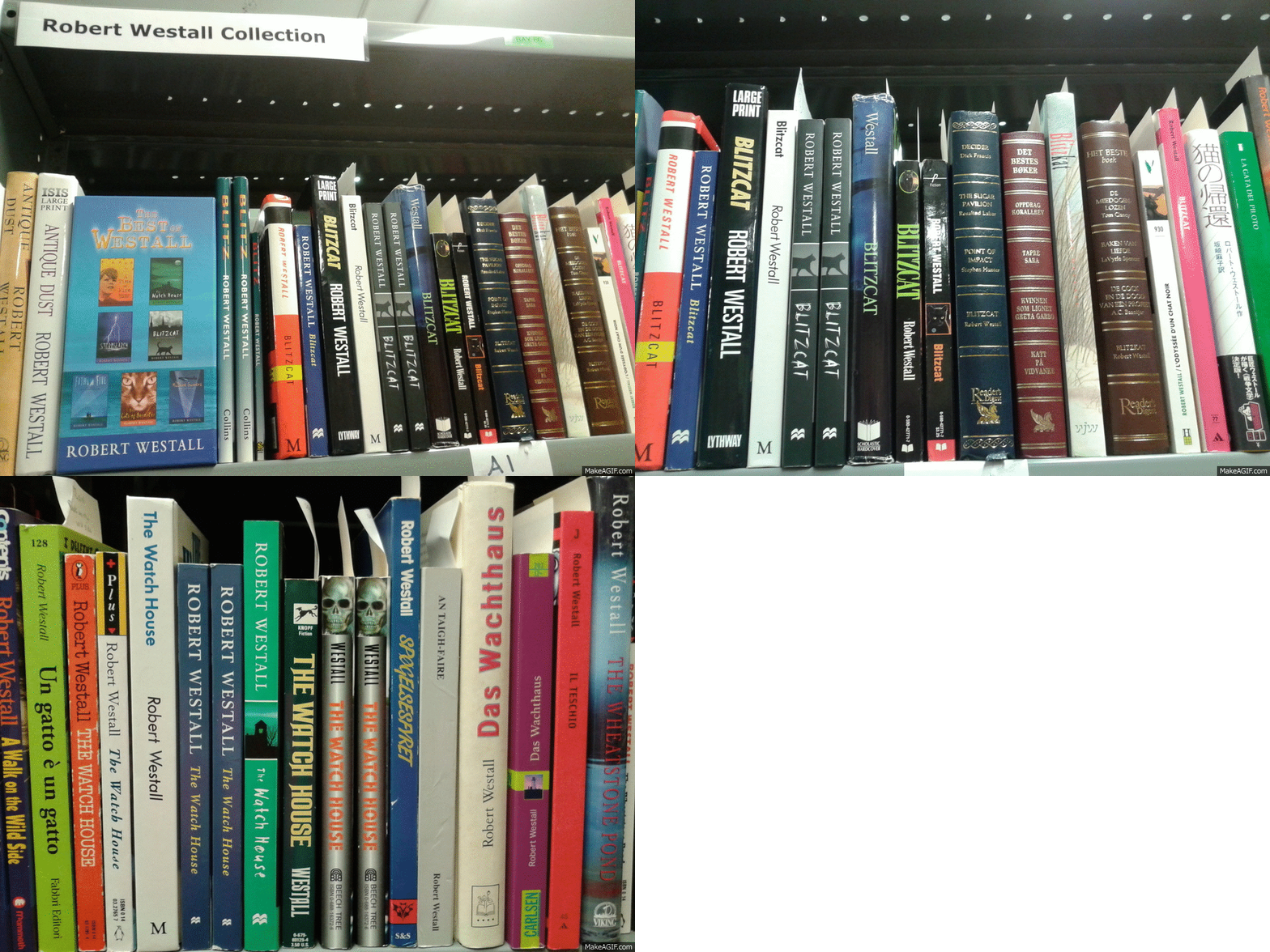
Multiple British and foreign language editions of two of Robert Westall’s titles
It’s important to respect the origin and the links between items, so that researchers are able to follow the crumb trails. The best way to express it that I could think of was to steal for the title the fifth law of library science written by Ranganathan, a librarian with an ability to express abstract ideas quite poetically. Libraries and archives are both growing organisms in their own particular way, and Seven Stories’ book collections are part of an archive, rather than a traditional library.

That was possibly not as clear as I thought it would be, actually. Let me give you some examples!

As I mentioned above, one of the roles book collections have in relation to the archive is to complement a parallel body of original archival material (drafts, notes, correspondence, and other exciting things). Kaye Webb’s and Faith Jacques’ collections are good examples of that, as you can read if you browse through the previous blog posts! I think Faith Jacques’ collection is particularly interesting because of the book collection it includes: books that she illustrated for other authors as well as her own titles; books that belonged to her own personal reading library; and most importantly, a huge number of ‘bookmarked’ reference books that she used for researching all the historical background, that would go into the astonishingly accurate and detailed illustrations she was renowned for by authors such as Leon Garfield. Thus, while the archival material provides a picture of Faith Jacques’ creative process as well as her personal and professional life, the book collection offers a glimpse into her own relationship with books as a researcher, an illustrator and a reader.


Books illustrated by Faith Jaques and some of the ‘costume’ reference books she used.
Some of the book collections, however, are not linked to archival material but stand on their own merit. Sometimes because they consist of a substantial number of books about a core ‘children’s book’ theme, or else because they open a window into a particular era, a significant figure or publishing house of/in Children’s Literature, or because they are unique, out of print or hard to find. They also often offer really valuable information on the evolution of the physical book from design, through printing techniques and marketing strategies. 

Possibly the strongest collections of this particular kind are Pat Garret’s and Thimble Press. The former includes ever-growing collections of alphabet books (585 and still growing!), as well as counting and number books from 1930 to 2010.  The Thimble Press Collections, donated by Aidan and Nancy Chambers, include four different core topics for any children’s books collection: traditional tales (1300), pop-up books (72), children’s literature related reference books (270) and multiple editions of ‘Alice’ (25!) 

Paula wrote a blog all about Thimble Press Traditional Tales Collection, so I suggest you read that first, because I have only been working with Thimble Press Children’s Literature Reference Books. In fact, I have been working with several reference book collections, and it has been fascinating. Seven Stories’ donors are often involved with children’s books in a professional way e.g. librarians and storytellers, publishers, editors, agents and reviewers, each of whom has a set of reference books.  So, there is a strong body of reference material covering children’s literature through the centuries from all sorts of angles, including ideology and diversity in children’s books, literary criticism, literacy promotion and education, and biographies of significant figures in the genre. 
Thimble Press Children’s Literature Reference books.
The Thimble Press Reference Books Collections includes 383 books mainly published between the 1940s and 2010. It covers many areas, but it is particularly strong in early children’s literature, biographies of authors and illustrators (such as C.S. Lewis and Edward Ardizzone), and booklists/annual book guides, including both bibliographies of award-winning books and recommended books, from influential librarians and critics such as Elaine Moss and Naomi Lewis. Since the collection covers such a long period, we can also note research topics changing and becoming more contemporary. For instance, the 70s seem to have brought a new wave of literary criticism centered on social matters, and so Aidan and Nancy Chambers also collected books on how children’s books are affected by class, gender, diversity or the construction of the concept of childhood.

As you can imagine, while browsing through the book collections, questions and research ideas often leap at you from the shelves. They are less shy in person than manuscripts, hiding away in their minty coloured boxes. Still, the one book collection that I was shown on my very first day and, being the language nerd I am, am a bit sad to leave only half-explored, is Colin Ray’s Collection of International Children’s Books. This collection was originally built in the 1970s by Colin Ray (husband of Sheila Ray) and lecturer at the Department of Librarianship of Birmingham Polytechnic (later the University of Central England), in order to collect a sample of the foreign books that were being published around the world, to be used for reference by students of Librarianship and external researchers. It is comprised of more than 3,000 books and journals in various foreign languages including French, Spanish, Italian, Russian and Japanese, but also Afrikaans, Catalan, Czech, Danish, Dutch, Finnish, Hebrew, Hungarian, Persian, Malay, Polish and Swedish. 

The Colin Ray Collection of International Children’s Books and some of the Spanish titles.
This book collection is a bit of a rarity in that it is not attached to an archive and it is not about a particular core topic or a relevant figure, but it offers a fascinating snapshot of what was published, both originally and in translation, all around the world in a particular period. It is quite overwhelming, I could only help to identify some languages (not as easy as it sounds with about 50 of them!) and provide translations into English of book titles that were not in the amazing original ‘old-school’ card catalogue.

Colin Ray’s card catalogue for the International Children’s Books arranged by ‘Author’, Country of publication’, ‘Language’ plus a volume of ‘British Books in Translation’.
I am not immune to its vintage charm, I must say, but what I enjoyed the most is seeing how the Spanish and Catalan books are quite representative of the time, including  familiar names such as illustrator Luis de Horna and author Ana María Matute, and finding a few typed translations of some of the books texts, seemingly for informative purposes.

But moving away from the Spanish-language books, it is easy to notice  some names again and again, with Christine Nöstlinger and Enid Blyton being particularly ubiquitous, and there is a stunning variety of illustration techniques and book designs. Even without being able to compare the contents of that chaotic Babelesque army of children’s books, nosing through the stacks highlights the cultural and social ingredients that go into defining what makes an edition appropriate or appealing for children. I think my 22 year-old self would have regarded this collection as Gringotts, minus the gnomes, so I really hope it sparks at least a handful of research projects on comparative literature and translation! Regardless of the languages you speak, there is bound to be something for you. And, you know, there’s always Enid! 

- Paula Pintos 

If you'd like to find out more about the Seven Stories Collection, then 
email: collections@sevenstories.org.uk or phone: 0191 495 2707 or comment on this blog.

Friday, 1 January 2016

All About: Tramcars

A brand new year, and a whole new theme of blog posts ahead of us! For the new year of 2016, we will be saying farewell to the All About Animal posts of 2015, instead taking an in depth monthly look at transport in the Seven Stories Collection. We will be covering some of the more conventional methods of transport - walking, cars, boats, etc - but will also be delving in to those very special methods of getting around reserved for children's books. Travel by castle, anyone?

More of castles in February. To kick off the new year, we are going to showcase the more humble mode of transport, the tramcar. A transportation not as frequently seen in many towns and cities in the UK as in the past - the only working trams in the north east of England reside at Beamish Open Air Museum - but the story and illustration of this particular tramcar is entrancing nevertheless. Timothy Tramcar, written by Edith Ray Gregorson and illustrated by Barbara Jones, was first published circa 1950 by Railway World. 


Printed edition of Timothy Tramcar, by Edith Ray Gregorson and Barbarba Jones, published c. 1950 by Railway World
Seven Stories holds the majority of the beautiful original pen and ink line drawings for this book, as well as some colour artwork. There is, however, very little related material to tell us about the book. The collection includes some material created by B.C. Bloomfield (1931-2002), who acquired the artwork as part of his private collection of the work of Barbara Jones. Bloomfield can be seen through his correspondence trying hard to discern the date of publication, but no concrete evidence was found, other than it must have been published before the publishing company was taken over in 1960. 

The story of Timothy Tramcar follows the battle within a small town between the old fashioned tram system and the new and controversial buses. Told with an expectedly heavy bias on behalf of the trams, (the book was put out by the publishers 'Railway World' after all!), it sees a local politician try and force out the trams, until a popular campaign and the politician being saved from ice and snow leads to the eventual victory of the trams! 

Printed sheets of photographs of various trams from around the UK. These appear to have been prints collected by Barbara Jones as part of her research for the illustrations. 
The book's illustrator, Barbara Jones (1912-1978), was active in publishing from the 1940s to the 1970s. Known as an illustrator and landscape painter, she studied at the Royal College of Art before going on to contribute heavily to the 'Pilgrim Trust Recording Britain Project'. This employed artists to record life on the home front during the Second World War, collected by the National Gallery, and inspired by a desire to capture and reflect the rapid changes happening within Britain. There is an interesting correlation here to the subject of Timothy Tramcar, and his fight (and victory) over changes in the town. 

The material held in the archive relates purely to the illustration of the book. How the book was written, or even many details about the author, are difficult to find. If anyone reading this is able to let us know more about Edith Ray Gregorson, or how she came to be writing about these tramcars, it would be wonderful to know!


Original artwork by Barbara Jones for Timothy Tramcar, c. 1950. This illustation captures the mood of the trams returning to the depot, at threat of being wiped out!
Original artwork with annotations, by Barabara Jones for Timothy Tramcar, c. 1950. These illustrations show the campaign in favour of the trams, and a bus leaving poor Timothy in his wake.
If you'd like to find out more about the Seven Stories Collection, then 
email: collections@sevenstories.org.uk or phone: 0191 495 2707 or comment on this blog.