Monday, 7 November 2016

David Almond Fellowships 2016/17


David Almond with Michael Morpurgo
David Almond; award-winning North East children’s writer, patron of Seven Stories, the National Centre for Children’s Books and honorary graduate of Newcastle University. It seems only fitting that we named our annual fellowships in children’s literature in David’s honour!
Newcastle University and Seven Stories’ David Almond Fellowships aims to promote high-quality research into the Seven Stories Collection by supporting award holders to make a study visit to Newcastle. And there are so many amazing collections that you could research! You can browse the blog for ideas or check out our collection highlights, catalogue and alphabetical list of represented authors and illustrators
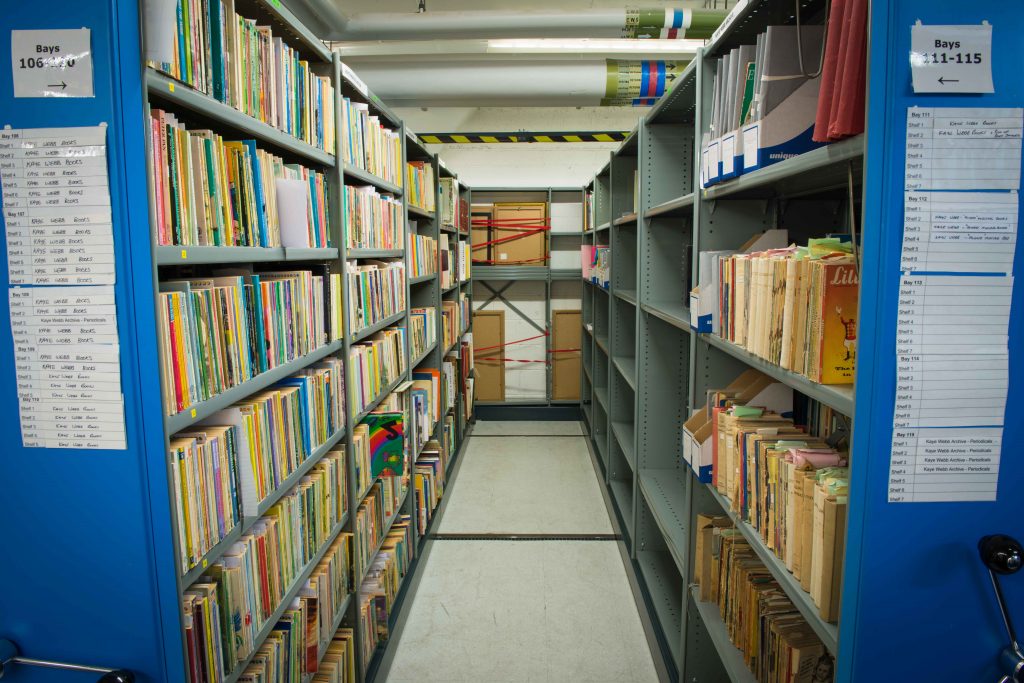
Collections at Seven Stories. Image: Seven Stories, the National Centre for Children's Books. Photography: Damian Wootten.
Seven Stories, the National Centre for Children’s Books. Photography: Damien Wootten

We launched the David Almond Fellowships in 2012 to increase national and international access to Seven Stories’ Collection and build new links with researchers. So far, we’ve awarded 11 Fellowships and over half of our Fellows have come from outside the UK.
Lucy Stone, one of our 2016 award-holders, says of her David Almond Fellowship:

“To take up the pen, pencil or paintbrush proffers the chance to make sense of the beautiful, but also perplexing world into which children are born, grow and find their place as an adult. The Judith Kerr Collection contains a myriad of remarkable drawings, paintings and writings child Kerr crafted pre- and during her family’s exile from Nazi Germany. Thanks to a David Almond Fellowship, I had the wonderful opportunity this summer to examine Kerr’s juvenilia, now part of my doctoral research involving consulting archives across Europe and the US to determine what writing and drawing can offer refugee children. Everyone at Seven Stories and the Children’s Literature Unit were incredibly helpful and supportive; the Fellowship proved invaluable.” 
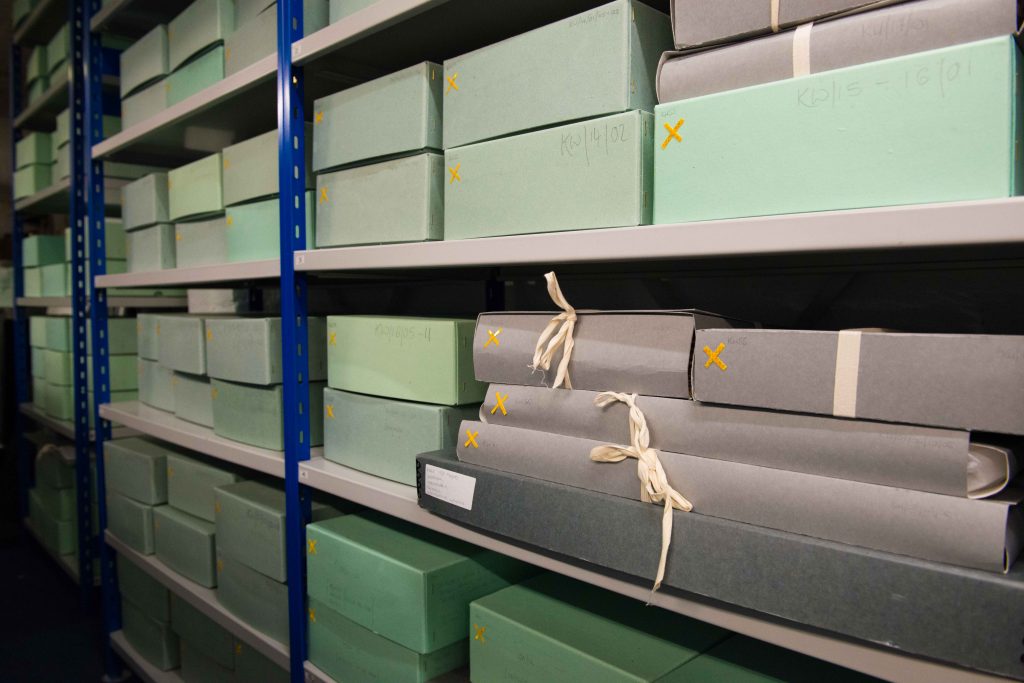
Collections at Seven Stories. Image: Seven Stories, the National Centre for Children's Books. Photograph: Damien Wootten.
Seven Stories, the National Centre for Children’s Books. Photography: Damien Wootten

And, applications for the 2016/17 David Almond Fellowships are now open! You have until 1 December 2016 to apply for visits to be taken before the end of August 2017. Have a look at the David Almond Fellowship Information 2016-2017 for full details of how to apply, and download the David Almond Fellowship Application form.

We would love to welcome you to Newcastle as a David Almond Fellow – and you could even research David’s collection…
For more information about the David Almond Fellowships, visit the School of English Literature, Language and Linguistics website or contact Professor Kim Reynolds.
- Rachel Smith, Vital North Partnership Manager 

Wednesday, 2 November 2016

500,000 Thank yous

Today HLF are celebrating their 500,000th National Lottery grant.  We'd  like to thank the National Lottery players who have helped to support half a million projects including our current HLF Collecting Cultures project. 

Since our last update a lot has happened at Seven Stories thanks to the HLF funding; we've opened new exhibitions, have been documenting our 2015 arrivals and have made some really exciting acquisitions into the collections.  So, in the spirit of celebration we want to share with you our 2016 Collecting Cultures achievements. 
Acquisitions 
Since January we have received seven acquisitions into the collection. These include 
Wombles artwork 
Artwork from two Wombles illustrators are now represented in our Collection and complement our existing Elisabeth Beresford Collection. 
We now hold a full suite of Oliver Chadwick's original pen and ink artwork for the 1970 title 'The Wandering Wombles'.  What makes this collection so fascinating are the Wombles themselves, they look nothing like the Wombles you may be imagining but seem more bear-like. 

Selection of artwork by Oliver Chadwick for Elisabeth Beresford's book 'The Wondering Wombles.' Photograph © Seven Stories – The National Centre for Children’s Books

The Wombles many people will be familiar with, those based on the design of the Ivor Wood television puppets, can be seen in our second acquisition. These are two pieces of final artwork by Barry Leith for the 1975 reissued edition of 'The Wombles'.  
'The Wombles' books had three illustrators Oliver Chadwick, Barry Leith (who also illustrated 'The Wombles at Work') and Margaret Gordon (who illustrated the other four).  


Selection of artwork by Barry Leith for the 1975 reissue of Elisabeth Beresford's book 'The Wombles.' Photograph © Seven Stories – The National Centre for Children’s Books

Kathleen Lines papers
Back in May we received Kathleen Lines papers which includes material relating to her editorial work, anthologies and talks.  Kathleen Lines was a librarian, critic and anthologist who is well known for her selection of classic fairy tales in Lavender's Blue.   Lines' papers are very well situated in our Collections at Seven Stories and help to support our current holdings. In 2008 we received Lines' book collection and we also hold a full suite of Harold Jones' artwork for Lavender's Blue (some of which you can see in our Rhyme Around the World exhibition).  

Ruth Gervis accrual

To build upon our existing holdings for Ruth Gervis we have acquired a box of original artwork, two notebooks and reviews. Already in our Collection is material associated with the book 'Ballet Shoes', illustrated by Ruth Gervis and written by her sister, Noel Streatfeild. We're very excited to start documenting the accrual!

Wes Magee

Wes Magee has published more than 100 books for young readers – fiction, poetry, plays, picture books, and anthologies - and he is now another great name represented in our Collections. We recently acquired eight boxes of material relating to his work and these are currently being processed by our Conservator before we begin documentation. 

Aidan Chambers 

The biggest acquisition of 2016, and probably in Seven Stories history is that of the Aidan Chambers Collections.  A total of 129 boxes were delivered to our store.  We're very excited about this collection; with its representation of Aidan's work, Thimble Press and Signal it offers a fantastic insight into Children's Literature and will no doubt be a rich resource for researchers.  


Selection of shelving containing the Aidan Chambers collection as it arrived earlier this year.  Photograph © Seven Stories – The National Centre for Children’s Books.


Those of you who are counting may have noticed that not all eight acquisitions have been described here - we have a few exciting surprises up our sleeve so keep your eyes open!

Cataloguing
                   
Michael Morpurgo
The catalogue may not be available online yet but so far we have catalogued material relating to
          • 39 Published titles
          • 10 Picture books
          • 24 different screenplays and adaptations
          • and 277 notebooks                                                                                                                   
Beverley Naidoo

The original delivery and later accrual of Naidoo's collection is now fully repackaged and fully catalogued - it is awaiting a few minor adjustments before you can find it online.


Selection of material from the Beverley Naidoo Collection Photograph © Damien Wooton for Seven Stories – The National Centre for Children’s Books.

Exhibitions

The Michael Morpurgo Collection arrived at Seven Stories in 2015 and by July 2016 we opened the doors to our spectacular Michael Morpurgo: A Lifetime of Stories exhibition which you can see at our Visitor Centre


Michael Morpurgo at the opening of his exhibition Michael Morpurgo: A Lifetime of Stories. Photograph ©  Seven Stories – The National Centre for Children’s Books.


Outreach

We don't like our Collections to sit on shelves for too long so some of our Collecting Cultures acquisitions have already been used in educational white glove sessions.  Most notably was Shotton Hall Academy's Beverley Naidoo project in 2015 which worked so well that we're currently planning a similar event using the same material.

Over the year we have shown Wombles artwork, 'Azzi in Between' artwork and Michael Morpurgo and Beverley Naidoo papers to illustration students, budding child writers, academics and researchers. 

Volunteers

Three Seven Stories volunteers hard at work in our store. Photograph © Damien Wooton for Seven Stories – The National Centre for Children’s Books.

At the beginning of 2016 we had five volunteers working on our Collecting Cultures projects - they numbered documents, listed and helped to re-house collections into purpose-made folders. Some of the projects they worked on included the Michael Morpurgo, Beverley Naidoo, Clive King, Gillian Cross and Elisabeth Beresford collections.  Our volunteer Jonathan wrote us a blog post about his experience listing the Clive King papers

Currently we have a work placement student from Newcastle University who is helping to sort the Elisabeth Beresford Wombles material as part of her course. 


It has been a busy year for our Collections and Exhibitions team and we look forward to updating you all on our future achievements.  Keep your eyes and ears open for more exciting acquisition announcements!


If you have any questions please email: collections@sevenstories.org.uk or phone: 0191 495 2707 or comment on this blog.

Thursday, 1 September 2016

All About: Walking

This month's mode of transport isn't technically a mode of transport but it does get people to where they need to be. Walking is a very prominent feature in Beverley Naidoo's Journey to Jo’burg, a story that delivers a subtle and powerful message about apartheid South Africa. 

The story is about two children, Naledi and Tiro, who are frightened that their sick baby sister, Dineo, might die.  They need their Mma’s help to get Dineo to a hospital but Mma works and lives far away in Johannesburg.  To get there Naledi and Tiro begin a 300 kilometre journey. Of course, the children don't walk the entire distance but, the journey is long and one where they begin to realise the impact and injustice of apartheid law.

 Notes by Beverley Naidoo for Journey to Jo'burg which outlines the exact journey Tiro and Naledi take to find their mother. In the first edition of Journey to Joburg (Longman, 1985) there is a map of the journey.  According to Google maps it would take over 60 hours on foot!  BN/01/01/01/27 Photograph © Seven Stories – The National Centre for Children’s Books. 

In a country with a history of Pass Laws – which required black South Africans to carry passes to regulate and control movement – this action of walking to Johannesburg is very significant. Out of an innocent desire to find their Mma the children embark on a journey that is politically dangerous. The book encourages child readers to discover for themselves the wrongs and injustice of apartheid. Naidoo doesn't explain the issues of South Africa but portrays them in a way that encourages us to ask questions. Why does Mma live far away from her children? Why can't they just take Dineo to hospital?  Why do the children avoid the police in Johannesburg, aren't police there to help?  Why can't Mma help them straight away?  These questions alone make the differences between Tiro, Naledi and Naidoo's young British readers striking. These two young innocent children, who just want their Mma, become political beings. It then seems unsurprising that Journey to Jo'burg was banned in South Africa until 1991: 


Thousands of children were reading the book around the world but the apartheid government refused to let South African children read it until 1991, the year after Nelson Mandela was released from jail. Today, it’s not just a story from the past.  It’s a universal story where two children, faced with great injustice, do something very brave as they try to save their little sister (quote from Beverley Naidoo, http://www.beverleynaidoo.com/)


This is the notice sent to Beverley's sister-in-law from the Doeane en Aksyns Customs and Excise to inform of the seizure of prohibited material.  Journey to Jo'burg was considered an  'undesirable' import and was seized when Naidoo sent copies of the book to South Africa. BN/01/01/08/03  Photograph © Seven Stories – The National Centre for Children’s Books. 

You may remember that we received Beverley Naidoo's collection early last year and almost as soon as it was unpacked and listed we took some of the Journey to Jo’burg files to a school in County Durham – you can read about the resulting event here


Beverley Naidoo and local school children for a Journey to Jo'burg event. 

This summer we took a much smaller selection of Journey to Jo'burg material to our Team Creative summer school attendees; this time we only used a selection of Naidoo's research and her drafts. It was a great reminder of how moving the story can be with one of Team Creative explaining to us that the session left him feeling sad and angry that people aren't treated equally. 

Research material from Journey to Jo’burg includes newspaper clippings, notes on plot and language, British children's perceptions of South Africa and correspondence.  This material demonstrates just how meticulous Naidoo is in getting her stories and their message just right. 

Newspaper articles from Beverley's collection with a copy of Journey to Jo'burg which includes two real newspaper articles at the beginning of the story. BN/01/01/08/03  Photograph © Seven Stories – The National Centre for Children’s Books. 

The file of research is like a snippet from time; it shows us what Naidoo, and indeed what the rest of Britain, were reading in the papers and what people were writing and thinking about South Africa at the time. Printed at the beginning of the book are two newspaper articles which draw Naidoo's fiction into reality. These newspaper reports are very similar to the story of Tiro and Naledi - they are the seed of truth from which her fiction grows. Her fictional characters almost share the same space as these real newspaper stories. It presents a very interesting interweaving of real vs. unreal which has its roots in all of this research material. Journey to Jo'burg is a good story but most of all it is informative. Regarding her own experiences Naidoo has written:


"...I became very angry at all the injustice around me - and how I was part of it. I had been brought up with blinkers. Later, when I began to write, I wanted to write stories that would challenge narrow ways of seeing." (http://www.beverleynaidoo.com/faqs.htm)


Children's perceptions of South Africa. Photography © Seven Stories – The National Centre for Children’s Books

The associations from school children, a small selection of which you can see in the above photograph, are a very interesting way to look at perceptions of South Africa. Many paint a picture of South Africa as a sunny place with awesome animals but, many also refer to racism and/or to a division of people.  What Naidoo did with Journey to Jo'burg was to make the reality of apartheid South Africa accessible to a younger audience, and it is sadly a story with persevering relevance.  

The first draft of Journey to Jo'burg which is untitled and heavily annotated (BN/01/01/02). Photography by Damien Wooten © Seven Stories – The National Centre for Children’s Books


There are eight full drafts of Journey to Jo'burg in our collection.  Most of these drafts include extensive annotation, changes and significant developments which give us insight into how Naidoo works as an author.  We may say it a lot on this blog, but everybody has a different approach to writing and Beverley Naidoo's collection is so rich with development work - there are post it notes, letters from her many proof readers and lots and lots of draft material. 

The draft material also gives us an interesting insight into Beverley's intentions and some of the choices she made whilst drafting.  In the image below the post it note reads:

'Essential that in the extract the strength of the black characters is revealed otherwise one just exposes pain' (BN/01/01/02/04/01)

You can also see one of the first titles for Journey to Jo'burg.

A subsequent draft of Journey to Jo'burg (then titled HELP! A South African Story)  however, this is a full draft of the story, the earlier draft is in bullet-point form.  This draft is also annotated.  Photography by Damien Wooten © Seven Stories – The National Centre for Children’s Books

Naidoo's fictional books are built on a foundations of experience and research.  In addition to the research files that complement each of her typescript novels we also have material for her non-fiction work.  Her first published work 'Censoring Reality' analysed the image of South Africa being presented to school children in the 1980s. Naidoo found misleading portrayals of South Africa, racist perceptions and a very limited, one sided view of a country under apartheid law. The files we hold for 'Censoring Reality' demonstrate Niadoo's active stance against biased literature for children, working towards an informed portrayal of world issues and equality. These principles form the basis of Beverley's fictional writing. 

Naidoo's later study, 'Through Whose Eyes', aimed to address racist issues and perceptions in books for young people through dramatic workshops. Naidoo's interest in education is a thread that can be easily followed through her collection.  We have files of material relating to educational workshops and educational resources.  Through letters, resources and school feedback we can see how Journey to Jo'burg (and many of Naidoo's other books) was used from its publication in 1985 to today.  It shows priorities in teaching and how issues of racism, diversity and multiculturalism have been addressed over almost four decades. 

There are also boxes and boxes of fan mail. 

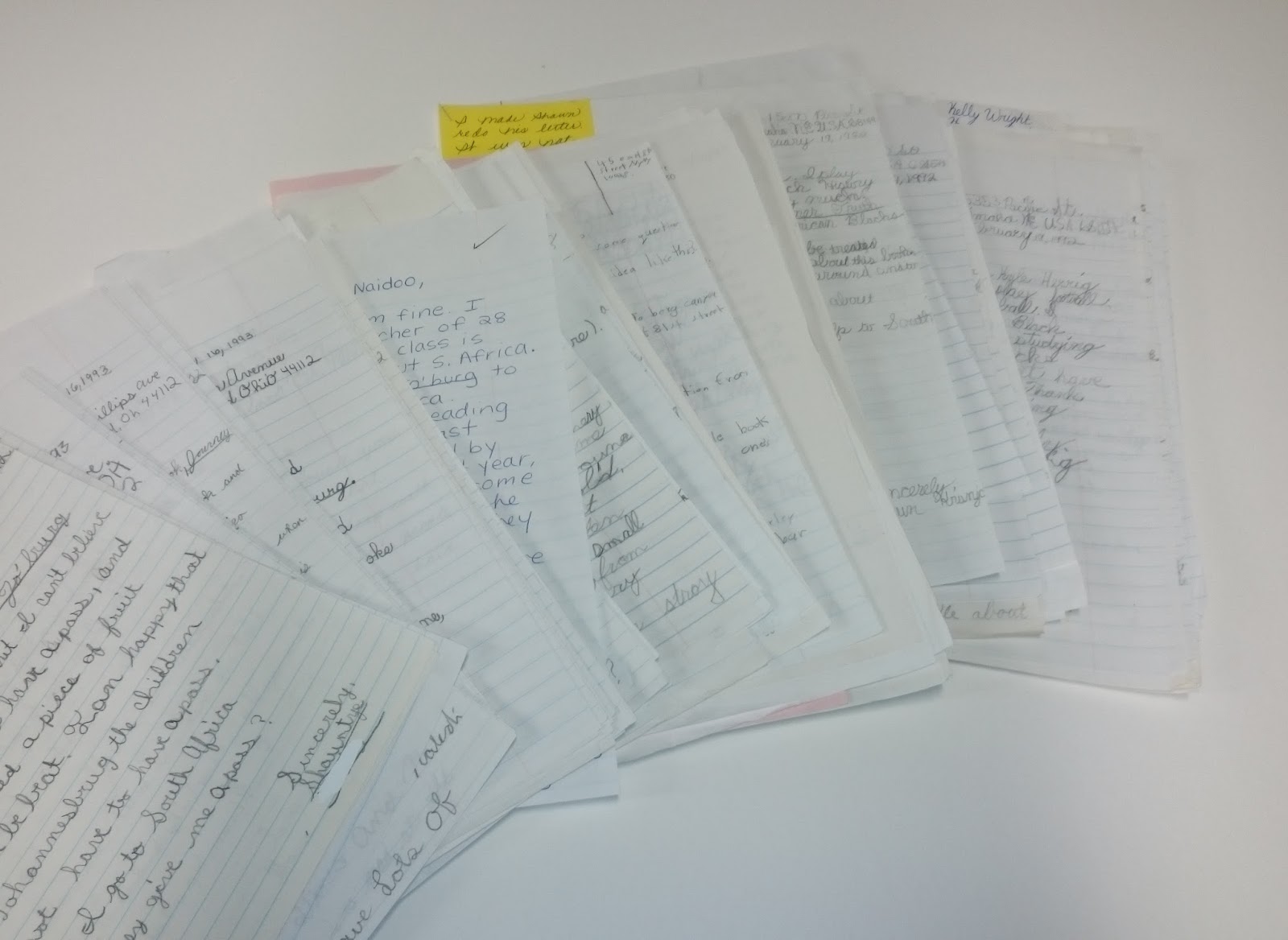
Letters from American children to Beverley about Journey to Jo'burg (BN/12/02/01/03) © Seven Stories – The National Centre for Children’s Books 

Fan mail is something that we would sometimes consider sampling (keeping only a representative selection of material), particularly when there is so much of it but Naidoo's fanmail, as well as being lovely to look at, is particularly interesting in terms of looking at social opinion and reaction to her work over the span of her career. Letters are sent from schools, individuals, children and adults from all over the world.  According to Naidoo the 'Most exciting for me is when I feel my writing has really touched a nerve' (http://www.beverleynaidoo.com/faqs.htm).

In some cases its clear where Naidoo's fiction has changed and challenged opinion. 

From the first notes to the last batch of fan letters it has been a long journey for Naledi and Tiro.  It has been a political journey, a one of social history and opinion, and hopefully a step towards a more equal world.  


Our many editions of Journey to Jo'burg including translated versions© Seven Stories – The National Centre for Children’s Books

Journey to Jo’burg is only one novel in a list of many.  Naidoo's collection covers a large proportion of her career and includes her PhD thesis, novels, short stories, picture books, professional and personal correspondence.  There is a vast amount of information with a great potential for research and learning projects - if you have any questions about the collection  
email: collections@sevenstories.org.uk or phone: 0191 495 2707 or comment on this blog.

Seven Stories was able to support the acquisition of the Beverley Naidoo collection through support from a Heritage Lottery Fund ‘Collecting Cultures’ grant. This has been awarded to Seven Stories in recognition of the museum’s national role in telling a comprehensive story of modern British children’s literature. For more information on our HLF Collecting Cultures project see:  http://www.sevenstories.org.uk/news/latestnews/hlf.


Thursday, 18 August 2016

The Clive King Collection

As part of our HLF Collecting Cultures project we recruited a team of  volunteers to help us list, repackage and number our new acquisitions.  One of these new and very exciting acquisitions which we haven't yet mentioned on the blog is our Clive King Collection.  King's collection came to us in 2015 and our hard working volunteer Jonathan Oscher has been creating detailed box lists of what we have. Here is  Jonathan's insight and overview of the collection so far: 

Clive King, author of the immortal Stig of the Dump, has left a collection of manuscripts, letters and cuttings to Seven Stories.  To classify and list the contents of all these boxes has been a long, though very absorbing, task with each box providing a new historical insights.  In fact the sheer volume of correspondence means that the archive provides a value over and above that of simply being a record of Clive King’s long literary career – impressive thought that is. 

First Edition of Clive King's Stig of the Dump with illustration by Edward Ardizzone. Photography © Seven Stories - The National Centre for Children's Books
It allows the reader or researcher a fascinating glimpse into the ebbs and flows of the literary world in the sixties, seventies and eighties.   Hence there are letters from legendary figures in or around the industry such as Lawrence Pollinger, Biddy Baxter and Kaye Webb.  There are the royalty and advance figures.  Even the procession of old letterheads and typefaces give a good history lesson.

 Selection of letters from Editors in the Clive King Collection. Photography © Seven Stories - The National Centre for Children's Books


One thing that becomes abundantly clear from a long reading of the contents of the archive is just how incredibly demanding publishers are (and seemingly have always been) with regard to the contents – particularly the factual contents – of children’s books.  In 1960 the American publishers Harper & Bros actually rejected Stig of the Dump because of the final chapter set on Midsummer’s night in which Barney and his sister Lou are transported back to Stig’s own time. Harper & Bros, clearly uncomfortable with the direct reference to time travel stated, in a letter, that here the story ‘grew weak, confused and unclear’.  That same chapter, however, is now an integral part of the book’s charm and appeal.

On the same topic, Kaye Webb – the legendary publishing brain behind the Puffin children’s label – writes to Clive King in 1965:

I really don’t think, Clive, that you, as a creative author, quite appreciate the amount of fussing over detail which has to be done with a child’s book.  ...  For instance an absolutely crackingly good book called THE CHILDREN was rejected out of hand in Australia because the author put a lyre bird in the wrong part of Australia and all the people who recommend children’s books ... took it off their lists because of this.

In December 1974, by the same token, Clive King received a letter from Patrick Hardy of Kestrel Books with no fewer than twenty suggestions for change in the book he had submitted for publication, Me and My Millions.   Point two of the twenty suggestions reads a little bizarrely : ‘I am a little unhappy about the transvestite element in the angels.’

Selection of Clive King's notebooks. Photography © Seven Stories - The National Centre for Children's Books
What makes the Clive King collection such a fascinating insight into the travails of being a children’s author is its warts-and-all quality, the feeling that the author has not carefully selected for the archive only the correspondence that is pleasing and flattering to himself.   This cannot help but add historical interest to the collection.  We become acquainted with the disappointments of authorship as well as the triumphs.

- Jonathan Oscher,
Seven Stories volunteer

Look out for further snippets of the Clive King Collection in later blog posts. 


If you'd like to find out more about the Seven Stories Collection, then 
email: collections@sevenstories.org.uk or phone: 0191 495 2707 or comment on this blog.

Seven Stories was able to support the acquisition of the Clive King collection through support from a Heritage Lottery Fund ‘Collecting Cultures’ grant. This has been awarded to Seven Stories in recognition of the museum’s national role in telling a comprehensive story of modern British children’s literature. For more information on our HLF Collecting Cultures project see:  http://www.sevenstories.org.uk/news/latestnews/hlf.


Monday, 1 August 2016

All About: Air Balloons

From Beatrix Potter to Disney the world loves adventurous anthropomorphic 
characters but, the greatest air balloon harvest mouse rescue is surely Judy Brook's Tim Mouse.  


Tim Mouse with model baskets and Tim Mouse himself.  Photograph © Seven Stories – The National Centre for Children’s Books
It's harvest time and the harvest mice face imminent danger; the farmer is cutting corn and there are too many dogs and cats for the mice to make a safe escape from the field.  Its okay though, Tim Mouse and the other country-side animals are quite resourceful. Tim blows up a big red balloon, hops in a basket attached to the bottom and with the help of Robin, he saves the day in the air balloon.  Bravery, recycling and airborne adventure - what more could one ask of a mouse?

It's a simple adventure story but the process of creating a book like Tim Mouse is, of course, not simple at all. 


Judy Brook's original artwork with the book Tim Mouse. Photograph © Seven Stories – The National Centre for Children’s Books

Tim Mouse is the first in a series of Tim Mouse's adventures written and illustrated by Judy Brook. At Seven Stories we have a significant Judy Brook collection which includes drafts, dummy books and final artwork. This range of material is great for demonstrating the development of story and characters from draft to printed book.  

In the image below you can see successive spreads from rough pencil sketches to the final artwork with the same spread from the book.  These three images only represent a small proportion of the Tim Mouse material - we have another two dummy books, sketches and alternative artwork as well as a full spread of final artwork. 

Ideas don't come fully formed and perfect and this collection shows that the creation of a children's book is a process.  Its sometimes easy to forget that such hard work goes into children's books and what may start as a few scribbled lines on a piece of paper can become a beloved story. Here at Seven Stories we find that idea encouraging and we like to encourage everyone to keep on drawing and writing - who knows who you might create! 


Unbound dummy book (JB/01/05/01/02), final art (JB/01/05/05) and Tim Mouse book. Photograph © Seven Stories – The National Centre for Children’s Books

This creative process isn't necessarily linear and it's most definitely not the same for everyone.  Brook's is just one of many illustrators' collections that we hold and shows just one approach to creating a children's book. 

Below you can see some of the images that didn't make it into the final artwork of Tim Mouse.  Another important lesson we can take from this collection is that you don't have to keep everything you create, its okay to make mistakes and to change your mind.  These drawings also show a development from her first rough sketches with notes (in the GIF above), to more detailed graphite drawings that focus on character. 

Photograph © Seven Stories – The National Centre for Children’s Books

Photograph © Seven Stories – The National Centre for Children’s Books
As well as archival material we have models of characters. This means that we have an archive box full of tiny mice - something I'm sure not many archives can claim. 


Its like a little mouse nest © Seven Stories – The National Centre for Children’s Book.
The mice are quite fragile with very long fine tails, they're hand painted and made from gypsum and wood. The models are a little bit of a mystery to us, it is unclear why they were created or whether they date from the creation of the books.

There are also three air balloon baskets with minute details from sandbags, ropes, to real metal anchors. One even includes Tim Mouse watching over the side. 


Tim Mouse in his balloon. Photograph © Seven Stories – The National Centre for Children’s Book.
Like the whole Judy Brook collection these models are intricately and carefully worked.  What I adore most about this collection is the delicacy of Brook's drawings, so the next picture has nothing to do with air balloons, its just a tiny tiny cow cut-out paper clipped to a final spread. 


A tiny cow from a final illustration, its not attached to the main work so has been paper-clipped in place. © Seven Stories – The National Centre for Children’s Books

The mice aren't the only models in the Judy Brook collection, we also have a wooden boat

If you'd like to find out more about the Seven Stories Collection, then 
email: collections@sevenstories.org.uk or phone: 0191 495 2707 or comment on this blog.