Wednesday, 28 May 2014

Moving Stories in the archive: 'The Machine Gunners' and the BBC

In this special blog post to coincide with our current exhibition Moving Stories: Children's Books from Page to Screen, we look at another children's book featured in our collection that has been adapted for the screen, Robert Westall's The Machine Gunners.

First published in 1975, The Machine Gunners was Robert Westall’s very first novel. The story follows a group of north east school children during the Second World War who manage to take the machine gun from a crashed German aircraft. Originally written for Westall’s son, Christopher (who later died in a tragic motorcycle accident), the book draws heavily upon Westall's own childhood on the north east coast (the book is set in fictional 'Garmouth', largely based on Tynemouth where Westall spent the war as a boy). Upon its release, The Machine Gunners was critically acclaimed and brought Westall the first of his two Carnegie Awards. The novel is still a much-loved classic and in 2007 made the list of top ten all time Carnegie winners.


One of the notebooks in which Robert Westall wrote his manuscript for The Machine Gunners,
from the collection here at Seven Stories


In 1981, six years after the book's publication the production rights were bought by the BBC. Television drama made for children and young people was becoming increasingly popular at this time (Grange Hill had only just made its first appearance three years earlier in 1978) and television companies were eager for stories that had potential for serialisation. The much-loved and critically acclaimed, The Machine Gunners, presented an ideal opportunity for the BBC and they set out to secure the rights for a six part drama.


Letters from the BBC to Robert Westall about The Machine Gunners,
from the Robert Westall collection here at Seven Stories


The first episode aired on 23 February 1983. The script was written by another well-known writer originally from the north east, William Corlett - who, as well as being a script writer and playwright, produced a number of successful novels for children and adults. The series director was Colin Cant, a specialist in children's drama who, as well as serving for many years on Grange Hill, went on to direct other children's book adaptations including Moondial (by Helen Cresswell) and The Children of Green Knowe (by Lucy M. Boston).

The series was well received by audiences and is even now fondly remembered by many. Of the adaptation Robert Westall himself wrote:

"I quite approve of the TV serial made from 'The Machine Gunners'.   The script writer was William Corlett, who also writes children's novels.   He loved the book very much – perhaps too much, for he could not bear to leave many incidents out, and at times (as in the Mrs. Spalding incident with her knickers), things got a little rushed and blurred.   The fault lies with the BBC producers, who did not allow more than six episodes.   It takes about ten episodes to do justice even to a children's book, and they just don't seem to have the nerve to allow this many episodes."

('About 'The Machine Gunners'', http://www.robertwestall.com/the_machine_gunners_by_robert_westall.html)
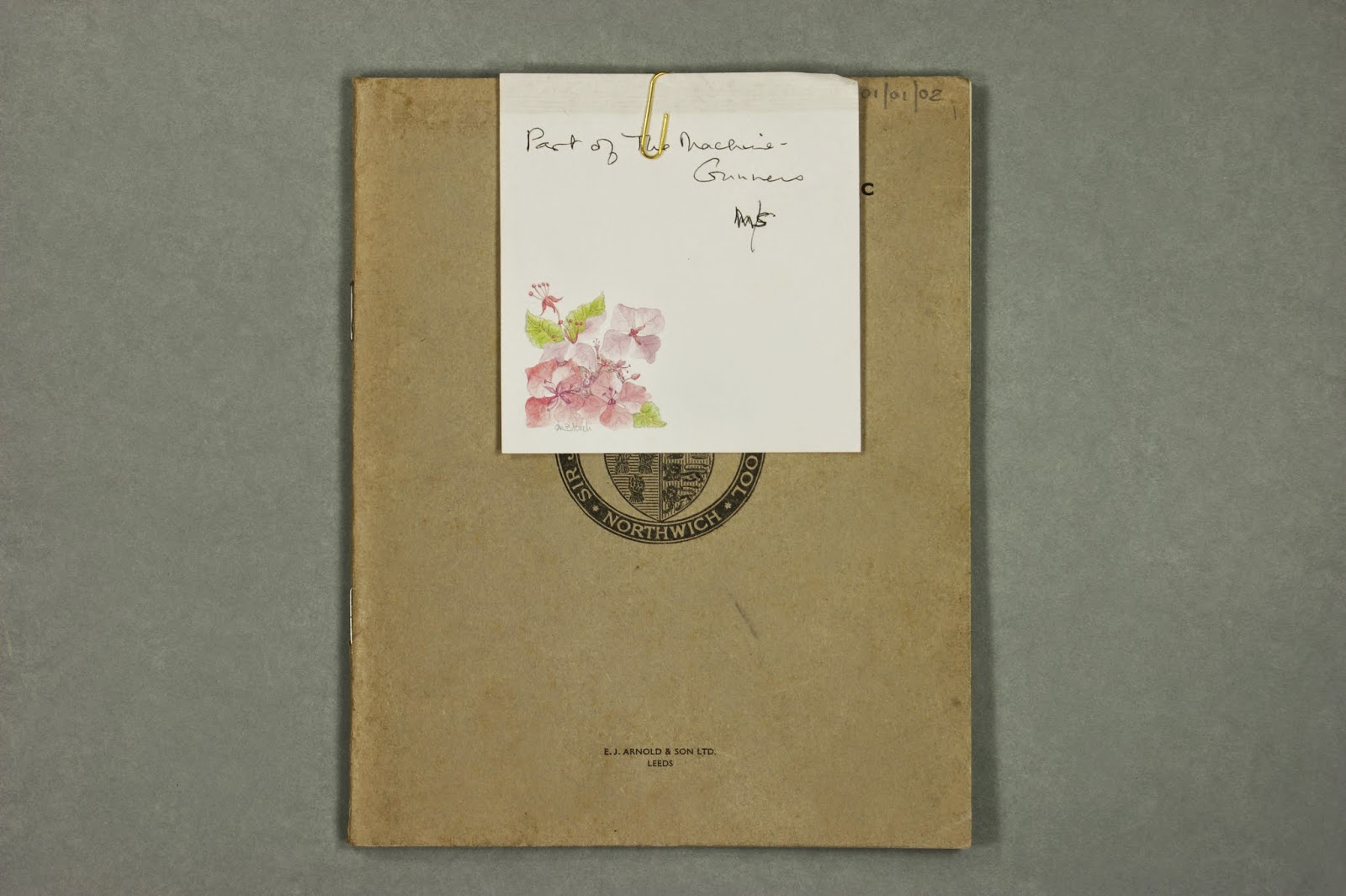

Another of the notebooks in which Robert Westall wrote his manuscript for The Machine Gunners,
from the collection here at Seven Stories

In 2002, The Machine Gunners was again adapted by the BBC but this time for radio. The story has also appeared on stage - in 2011 a stage version was performed at Polka Theatre in London, commissioned by the Imperial War Museum.


The Robert Westall collection is available to consult by appointment at Seven Stories Collections Department. If you'd like to find out more about this collection or others that we hold you can
email: collections@sevenstories.org.uk or phone: 01914952707.

Material from the Seven Stories archive is currently on display at  an exhibition looking at the work of Robert Westall at the Friends of Weaver Hall Museum in Northwich, Cheshire: http://www.fowhm.org.uk/events/exhibition-robert-westall-a-writer-and-his-world/ 

If you'd like to find out more about other children's books adapted for the screen then why not visit our exhibition Moving Stories: Children's Books from Page to Screen at the Seven Stories visitor centre, Newcastle upon Tyne, until April 2015


Friday, 16 May 2014

The 40th anniversary of 'The Trouble with Donovan Croft' - with guest contributor, Bernard Ashley

This month marks the 40th anniversary of The Trouble with Donovan Croft, a book that has remained a children’s classic ever since it was first published in 1974. Bernard Ashley’s first novel appeared at a time when children’s writers were increasingly creating books that challenged ideologies and addressed real issues affecting real children. Firmly in the vanguard of this movement, the novel is well known for addressing a number of big issues including racism, isolation and the challenges faced by foster families. Though the book has taught many children valuable lessons on the destructive impact of prejudice, it is the brilliantly accurate depiction of the key relationships that capture the imagination, particularly the wordless relationship between the selectively mute Donovan and his friend and foster brother, Keith.

The book won The Other Award (an alternative to the Carnegie medal) in 1976 and, since publication, has never been out of print. In 2005 Bernard chose Seven Stories as the home for his original manuscript, which gives a wonderful insight into the creative development of the book. In this special Seven Stories blog post Bernard Ashley talks to us about the real life inspiration for Donovan Croft, the challenges of finding a publisher, and of writing as a means of escape:


Author, Bernard Ashley (photo © Norman Smith)


'I started writing The Trouble with Donovan Croft a year or so after I took up the headship of a junior school in East London in 1971. The school was big and multi-cultural with a large percentage of its children described by the Home Office as ‘immigrants’ because their parents had come to Britain in the previous ten years. One such London-born boy gave us cause for concern: his mother had gone home to the West Indies on family business where she stayed longer than expected. There were no mobile phones, texts, and easy-to-make international calls in those days, and, despite letters from her and whatever his father said to him, the eleven-year-old fretted and seemed to think she was never coming back. He became depressed and shrank into himself.

At about the same time my wife Iris, an Infant teacher, told me of a six-year-old girl in her class who had stopped speaking to everyone: firstly to the adults at school, then to the children, and finally to her family at home.

Since the mid-sixties I had been writing for an educational publisher who published ‘readers’ I’d written for the ‘D’ stream children in my class, and two non-fiction ‘social science’ titles I’d researched for secondary schools. Now, in a difficult job which left neither time nor energy for research, I really needed to start writing again. I had discovered the truth of what Graham Greene says in Ways of Escape: ‘Writing is a form of therapy; sometimes I wonder how all those who do not write, compose, or paint can manage to escape the madness, the melancholia, the panic fear which is inherent in the human situation. Auden noted: “Man needs escape as he needs food and deep sleep.”’ Having a personal life outside work is essential, although for teachers it has become harder and harder in recent years. Perhaps I could write a piece of fiction without the need for research? I knew of two unusual situations no one had written about before. So I started on my first novel, with little planning except knowing there’d be a climax that hinged on whether or not elective mute Donovan could break his silence in a crisis.


A page from the original manuscript of The Trouble with Donovan Croft
by Bernard Ashley, here at Seven Stories


I wrote paragraphs in the car on Saturday mornings while waiting for one of my sons to run out onto a football pitch, and I made time some evenings, often merely revising my weekend efforts be swapping one word of phrase for another.

Although I based the start of my story on his situation, I didn’t write about my troubled eleven-year-old, nor about my wife’s silent pupil - but I did get the girl’s parents’ permission to write a story based on a child suffering from elective mutism. And of course, fired up, I had research to do after all.

As I finished each chapter I’d leave it on the pillow of my eldest son Chris – now also a children’s writer – whose enthusiasm spurred me on.

That was the time when the old quarto paper was being replaced by A4. With the book finished I went to a stationer in East Ham to buy a pack but he hadn’t any in stock; however, I was shown a special box of cream-woven, rounded-corner paper with reinforced binding edges. ‘It’s not quite your A4, sir, but it’s very close.’ And it had a very superior binder to go with it. So I bought it and typed up my story; but my wife, kissing the package for good luck as it went off to Oxford University Press, told me they’d probably reject the story but accept the binder. Which turned out to be halfway true. Having published the book OUP had an office clear-out when they moved from Ely House to Great Clarendon Street and they sent the manuscript back to me. Sans binder.


A page from the original manuscript of The Trouble with Donovan Croft
by Bernard Ashley, here at Seven Stories

The eleven-year-old boy in our school had by now gone on to secondary education, and I came very clean about my book with the staff and children, one of whom, Donovan Richards, willingly lent me his first name for the eponymous central character.

The book received generally good reviews. It was welcomed not only as one of the first school stories to be set in the state system – with which more readers could identify - but for having a black central character and a strong subtext against racism. Its paperback edition went on to win the ‘Other’ Award, an alternative to the Carnegie Medal, which was given annually for non-racist, non-sexist, non-classist children’s literature. And happily it has survived in print for forty years.

The Trouble with Donovan Croft started me on a serious writing career that I managed alongside my teaching, eschewing agents and insisting on long deadlines in order to enjoy my way of escape – writing books that would excite and entertain while giving some reassurance to children going through troubled times that they’re not the only ones. Like real-life Donovans. 
Within a few weeks of ‘Donovan’s’ fortieth anniversary in May my twenty-fourth novel will be published: The Shadow of the Zeppelin (Orchard), a story of the First World War. I’m halfway through my twenty-fifth, and I’ve planned the one after that. So I say thank you to Donovan, to OUP, and to the UK children’s books world for giving me my fruitful way of escape.'


Bernard Ashley's twenty-fourth novel, The Shadow of the Zeppelin (Orchard), is available to buy now. If you'd like to come and see the original manuscript of The Trouble with Donovan Croft or learn more about the Seven Stories Collection, email: collections@sevenstories.org.uk or phone: 01914952707.

Tuesday, 29 April 2014

Picturebook in Progress at Edinburgh College of Art

Last November a group of illustration students from Edinburgh College of Art visited the Seven Stories collections department and visitor centre as part of the Picturebook in Progress project.

The students viewed a range of archive material relating to how homes and families are represented in picturebooks, including work by Sarah Garland, Shirley Hughes and Kim Lewis, amongst others.

After returning to University, the students set to work on a brief to take a secondary character from one of the books they studied and illustrate a new home for them to inhabit. The project culminated in an exhibition of the new work that ran from 4 – 21 April at the College of Art.

There were some fantastically creative responses to the collection on display, including some surprising reinterpretations of classic picturebooks.

Yasmine Pirouz reworked Jan Ormerod’s Sunshine into a contemporary comic book, told from the point of view of a toy.


Laura Darling took a character from David Almond’s My Dad’s a Birdman and developed a new subplot in which he struggles to find a new job after the culmination of the book. In the ambiguous ending to her story, the character seems to be in the verge of a new life in the theatre.


After viewing artwork by Angela Barrett for The Snow Queen, Wenjin Lu took a minor character and imagined how their story might unfold.


Judith Kerr’s classic picturebook The Tiger Who Came To Tea has been interpreted in many ways. Maria Stoian’s version presents the tiger as a metaphor for depression, visiting the character of the mother unannounced.


As well as the illustrators featured here, other students took inspiration from work by Leila Berg, Helen Craig and Faith Jaques.

To see further examples of how the Seven Stories Collection has inspired illustration students, visit the Picturebook in Progress exhibition, on show at the Seven Stories visitor centre until June.

Wednesday, 2 April 2014

Gillian McClure Visits Seven Stories

Last week saw a visit to the Seven Stories Collections Department from author / illustrator Gillian McClure.

Gillian McClure at the Seven Stories Collections Department

Over the years Gillian has donated finished and preliminary artwork for many of her titles to the Seven Stories Collection, giving a comprehensive insight into her creative process, from first ideas through to finished artwork.
Her archive also displays a wonderful mastery of different media, including watercolour, acrylic and coloured glazes.

Gillian was visiting to be interviewed as part of the Picturebook in Progress project, with her insights to be used as part of a digital learning resource currently in development for aspiring illustrators.

One of the main topics of discussion was Gillian’s illustrations for Tog the Ribber, a uniquely scary and innovative picturebook written by her father Paul Coltman.

While discussing the origins of the book, Gillian surprised us all by revealing her early artwork for the first draft of the book which stands in complete contrast to the version which hit the shelves in 1985.


Artwork from the first draft of Tog the Ribber

The black and white crosshatching and colour wash give the first draft a completely different texture to the published artwork, while Gillian went onto explain that the final version’s wonderful depth came from constant experimentation with masking fluid and acrylic paint.

Most interestingly of all, the first draft lacks the outright nightmarish quality of the final artwork, Gillian herself admitting that she felt too protective towards the main character in this early version. A combination of allowing the skeletal character of Tog more prominence in the story and the introduction of page borders dividing safety and peril give the finished book a genuinely haunting quality.

Artwork from the first draft of Tog the Ribber

Final artwork for Tog the Ribber

Gillian has kindly donated the artwork for the first draft of Tog the Ribber to the Seven Stories Collection where it will sit alongside the final artwork, providing a deeper insight into an endlessly interesting book.

Learn more about Gillian McClure by visiting her website http://www.gillianmcclure.com and blog http://gillianmcclure.blogspot.co.uk


To book a visit to Seven Stories Collection department or learn more about the forthcoming Picturebook in Progress Digital Learning Resource, please contact collections@sevenstories.org.uk

Limited Copies of Tog the Ribber signed by Gillian McClure are available to buy in the Seven Stories Bookshop. Please email bookshop@sevenstories.org.uk or call 0191 261 2000 to order.

Friday, 21 March 2014

Finding Your Voice in Children's Books

Our last post offered a brief overview of the fantastic depth in the collections of Helen Craig and Katharine Holabird held at Seven Stories. One of the interesting aspects displayed by these collections is the attention to detail that goes in to creating a series of books as successful as the Angelina Ballerina titles. Particularly noteworthy is the level of research and planning that goes into the books, as evidenced by the stacks of drafts and rough versions of stories and illustrations, created by both Helen and Katharine.

More than anything else, the collections highlight what an absorbing experience it can be to write and illustrate children’s books. The level of work and dedication required to succeed in the world of children’s books is keenly felt by Michelle Robinson, author of picturebooks such as How to Wash a Wooly Mammoth and the forthcoming There’s a Lion in my Cornflakes.


We spoke to her about her experiences finding her way into the industry and developing her own distinct style. In her own words…


“Agents and publishers are always seeking original voices - ones that grab us from the first word and hold us beyond the last. Forget interesting marketing angles, bestselling trends and clever manuscripts - a fresh voice is the only thing that will give you a chance of publication.

So how do you find that voice? Where does it come from? When you do find it, why won’t it leave you alone, even when you’re in the shower? And why must it insist on asking questions instead of providing answers?

I found my voice through hard slog. Like a child learning to ride a bike, I started off writing with the stabilisers on. I read a lot, absorbed a lot and wrote my early stories in the style of other authors. I didn’t mean to, I just hadn’t found my own way into it yet. But I was getting there.

The more I practiced, the better I became. I gained confidence, loosened up, experimented, gathered pace and was soon freewheeling in my own style. I could push the metaphor further and say I fell off a few times (and still do, regularly), but it’s getting rather tired. So, forget bicycles and picture yourself in Devon.

The birds are singing, you’re drifting in a digital-free haven and there’s nothing to do but write. Because if practicing is how I found my voice, a writing course is where. The course came at just the right time. I needed to be challenged. I had to work harder. I relished the chance to show off. I was ready to go, I just needed a captive audience: my tutors. Thanks to them I secured an agent and the first of many book deals. I’d found my voice - and I had an awful lot to say.”


The Seven Stories collection is a unique resource for aspiring writers and illustrators.

For information about research opportunities, please contact collections@sevenstories.org.uk

Michelle Robinson’s next book There’s a Lion in my Cornflakes is due out in July, published by Bloomsbury.

Thursday, 13 March 2014

Helen Craig's studio

At the end of February we visited author and illustrator Helen Craig at her home in Cambridge. Most of you will know Helen as the illustrator of the world famous Angelina Ballerina books (written by Katharine Holabird). We were visiting Helen to pick up artwork for the two latest books in the series: Angelina's Cinderella (published last year) and Angelina's Big City Ballet (which is due to be released in November this year).

It was in the early 1980s that Katharine Holabird first came up with the idea of a story (based on her two daughters) about a ballet loving little girl called Primrose. When Katharine showed the story to her friend and collaborator Helen Craig, Helen drew Primrose as a white mouse. The character's name was later changed to Angelina, due to the fact - as Helen points out - that there was already a little mouse called Primrose in Jill Barklem's popular Brambly Hedge series of books. Angelina's debut story book Angelina Ballerina was published in 1983. The little dancing mouse has since appeared in over 20 books, two animated series, and even on stage with the English National Ballet.


We are delighted that Helen has chosen Seven Stories as the home for her Angelina artwork - over the last few months Helen has donated the artwork for every one of the Angelina titles she has illustrated. Helen's collection includes everything from intricately detailed storyboards and dummy books, right through to her wonderful finished artwork. Seven Stories already holds Katharine Holabird's archive, which she very kindly donated to us in 2012. Katharine's fantastic collection includes, amongst a variety of other things, her drafts for the books, a selection of Angelina merchandise, and papers relating to the Angelina animations. The two collections side by side make for a truly wonderful resource for researchers and Angelina fans alike!


Helen looking through some of her rough artwork


On our visit to Cambridge, Helen was kind enough to show us around her studio. As you might expect in Helen's studio, Angelina pops up everywhere you turn. Helen showed us the very first Angelina doll she made by hand back in 1986 after the publication of the fifth book in the series.


This is Helen holding the very first Angelina doll she made by hand in 1986

Helen also talked us through her creative process and the materials she uses in her work. Most striking was her three layered box of watercolour pencils.


Helen's very neat pencil box

If you'd like to know more about the Helen Craig and Katharine Holabird collections you can email collections@sevenstories.org.uk. Both collections are available to view at the Seven Stories Collections department in Felling, Gateshead (Helen's collection will be searchable on our online catalogue soon). Some of Helen's artwork is currently on display in our Picturebook in Progress exhibition at the Seven Stories visitor centre in Newcastle upon Tyne. Angelina Ballerina will be featuring in other Seven Stories exhibitions and events soon!

Friday, 21 February 2014

Moving Stories Introduction Evening

The next exhibition opening at Seven Stories is Moving Stories, Children's Books from Page to Screen Saturday 5th April. This is an exhibition curated in partnership with the National Media Museum in Bradford, and was on display there during Summer 2013. It will be displayed over BOTH galleries at Seven Stories!

The exhibition aims to show all the fantastic ways that stories can be adapted, be it in a book or on film. The exhibition is divided in to 5 themes; Fairy Tales, Journey of Adventure, World of Fantasy, Overcoming the Monster and Friends and Family.

To find out more about the exhibition, click here or here!

Last night was the introduction event, to show the plans for the exhibition off to all staff and volunteers involved with Seven Stories. We had a fantastic turnout, with a few photos below. Gill (Senior Curator), Beth (Learning Co-ordinator) and I (Alison, Curator) presented all the different elements of the exhibition, our new methods of interpretation and a brand new drama experience for all visitors - watch this blog to find out more about the exhibition content.

The audience broke in to groups to explore different areas of the exhibition, before feeding back their favourite parts of the exhibition and the books involved.
Some of our fantastic textile illustrations from the Judith Kerr Exhibition, exploring the Sensory Explorer Bags being rolled out for the new exhibition.

Alison (Curator)