Wednesday, 1 April 2015

All About: Pigs

After one month off, we are back to the All About series with a wonderful walk through the world of pigs! We will take a look at the Seven Stories archive, finding a piece of illustration, written archive and book to explore on our theme.
This is the dummy book for Garth Pig Steals the Show. It shows Rayner's preliminary sketches for the book, as well as page layout. This is important to create when working out how your book is going to flow.
This month's feature illustration is from one of our most recent acquisitions. It is taken from the well known series of books all about Garth Pig. Created by Mary Rayner in the 1970s, and filled with porcine humour, these stories focus on the anthropomorphic world of Garth Pig and his large family. They live in a world of pigs, with various other farmyard animals making an appearance, particularly the scariest of all in the eyes of little pigs - the wolf. The wolf appears in various guises throughout the books, always as the key threat to the young pig children, in a clever play on the old nursery rhyme.

Rayner's style was well sought after for book covers of children's books in the 1990s, and created new dust jackets for another famous pig you may have heard of, Dick King-Smith's The Sheep-Pig.

The collection consists of suites of final artwork for four of the books in the series - Garth Pig and the Ice Cream Lady, Garth Pig Steals the Show, Mr and Mrs Pig's Evening Out and Mrs Pig's Bulk Buy. It also contains preliminary work for the books, including hand sketched dummy books and amended proofs - all of which provide an insight in to how these books were created. The collection has only recently arrive at Seven Stories, and is currently waiting to be catalogued.


The archive holds some interesting contracts and correspondence about publishing the book beyond the UK, this contract and letter refer to publishing the book in Russia. Complications arose due to the USSR not being part of the Universal Copyright Convention, meaning they weren't signed up to paying writer's royalties on their work. There is talk of Nina receiving a "hand[ful] of roubles" should she go to Russia, in lieu of royalties.
The honour of this month's written archive and book falls to the same title - The Peppermint Pig by Nina Bawden. It was first published in 1974, and adapted for television later in the 70s.  It won the Guardian Award for Children's fiction in 1975, and has since become established as a real ‘modern children’s classic’.

Set in the early 20th century, it tells the story of Lily, George, Theo and Poll, who move from the city with their mother to live with their aunts in Norfolk, while their father seeks his fortune in America.  In typical Nina Bawden style, this is no cosy story: it is set in a world where children die of scarlet fever; blackmail and bullying are common occurrences; and poverty is a fact of life. Into this world comes Johnnie, a 'peppermint pig’ (the runt of the litter), who becomes the focal point for the children's happiness and sorrows.  Johnnie is their confidant and friend, and, despite his often outrageous antics, he is accepted as one of the family.  Returning from school one day though, Poll finds that Johnnie has ‘disappeared’ and the children have to learn to deal with the harsh realities of country life.


In 2005 Nina Bawden donated archive material relating to The Peppermint Pig to Seven Stories, along with four more of her published titles for children.   This archive consists of contracts, correspondence and pre-publication material for the five titles as well as multiple British and Foreign language editions of the published books.  

The Peppermint Pig was published in many different languages across the world.
Many of our book collections include copies of different editions of an individual title, allowing us to extend the story of the books writing and production from the author’s first notes. We are able to see the progression to its first paperback edition, subsequent reprints, TV/ film editions, and so on to its publication life in other languages and countries.  It’s interesting to note that after English, probably the most common foreign language evidenced in our book collections is Japanese, which reflects the interest in and respect for British children’s literature in Japan. It’s also fascinating to see how the various publishers (even within Britain) often re-illustrate the covers for their own editions of a title, and to follow changes in their marketing styles and approaches over the years.

While writing this month's blog post, we found out about the phrase 'peppermint pig' meaning runt of the litter when reading Bawden's book. To our surprise, there was a subtle reference to the same phrase in the Garth Pig series - in Garth Pig Steals the Show, Garth's brother offers him a peppermint!


If you'd like to find out more about the Seven Stories Collection, then 
email: collections@sevenstories.org.uk or phone: 0191 495 2707 or comment on this blog.


Sunday, 1 February 2015

All About: Sheep

For the second in our series 'All About Animals', we are looking at the super world of sheep! Thinking forward to spring and an end to these long dark nights, and also of Chinese New Year with the upcoming Year of the Sheep, we will again explore an artwork, a piece of written archive and a book from the Seven Stories Collection.

Original artwork for Little Baa, by Kim Lewis (Walker Books, 2001) Illustration © Kim Lewis
Original artwork for Little Baa, by Kim Lewis (Walker Books, 2001) Illustration © Kim Lewis
Our featured piece of artwork this month comes from one of the largest collections of picture book illustration in the archive - Kim Lewis. This artwork from Little Baa, first published in 2001, tells the story of the eponymous lamb 'Little Baa' and his separation from his very worried mother, 'Ma'. A well known story to any familiar with the British countryside is the loud baa-ing of ewe and lamb whilst they desperately try to find each other, incredibly evocative. It is also a story close to our heart, as it is based in our nearby Northumberland landscape, where author and illustrator Kim Lewis lives.

The archive holds not only all the beautiful coloured pencil final artwork for the book, complete with annotations for print both in English and Chinese, but also draft text for the book, reference images, sketches, proof copies, and a dummy book with rough sketches for the layout. This is a similar range to the other books from Kim Lewis also held here - Floss, Willa and Old Miss Annie, Friends, the Poppy's Farm series, A Quilt for Baby, Here We Go Harry, Hooray for Harry, and A Puppy for Annie.

This artwork for Willa and Old Miss Annie was purchased for the collection in 2006, and the rest of the archive was very kindly donated by Kim Lewis in August 2008.
Typescript draft for Babe, the Sheep-Pig, by David Wood, May 1997. A play adaptation based on the book by Dick King-Smith.
A well loved sheepy story, Babe, the Sheep Pig, originally written by Dick King-Smith in 1983 and adapted as a play for children by the playwright David Wood. This was shortly after it had been a huge hit in cinemas in 1995. The files on this adaptation contain copious notes on the play, a very detailed synopsis, and 5 different drafts of the final play. 

Shown here is an example from the second - and helpfully typed, occasionally hand written manuscripts can be quite difficult to decipher! - draft. It is open to show the first meeting between our hero Babe, and his first ever encounter with a sheep - also called 'Ma'. One of my particular favourites, as it plays on the ever funny 'ewe'/'you' confusion! Here we get a flavour of the attitude and language the sheep use in this story, and you can even see evidence of David changing the grammar to make it fit better with the accent of the sheep.

The collection holds a huge volume of material from this prolific playwright, with over 40 plays catalogued, and even more in the cataloguing backlog to be added to the system next year, it is a truly overwhelming and fantastic archive. To give you a brief flavour of the other classics Wood has adapted for stage, see this prestigious list: Fantastic Mr Fox, James and the Giant Peach, The Tiger Who Came to Tea, Noddy, Spot's Birthday Party, The Twits and many, many more.
Zlateh the Goat and Other Stories, by Isaac Bashevis Singer and illustrated by Maurice Sendak, (Harper & Row, 1966)
For our book this month, I've chosen Zlateh the Goata book of short stories written by Polish-born, Jewish-American author Isaac Bashevis Singer. This year's Chinese New Year is the Year of the goat or ram, so we thought it appropriate to include. Published in 1966, this was Bashevis' first book for children, it was a runner-up for the Newberry Medal in 1967, and in 1978 he was awarded the Nobel Prize in Literature. The author learned these folk tales as a small boy in pre-World War I Poland, listening to his mother's bedtime stories. Simply illustrated by the famous Maurice Sendak, just three years after the release of his classic Caldecott Medal winning Where the Wild Things Are, the black and white 'pictures' work perfectly with the spirit of the stories.

An appropriate story for this cold month, Zlateh and Aaron set out to market - Aaron has been tasked with selling the poor goat to help his family survive the cold winter, and pay for their Hannukah supplies whilst his father's furrier business is doing poorly. Boy and goat get trapped in a snow storm, and it is only together that they can survive, with Aaron cuddling his goat and drinking her milk. Finally the pair are rescued, and happily the story ends well - Zlateh no longer has to go to market, and because of the cold weather, the family business is now booming!


This book comes from the Vera Coleman Modern Picture Book Collection: award winners and their books. Dating from c. 1930 – 1990 these books were collected together as either each title or its illustrator had been awarded a major (mostly American) prize such as the Caldecott Medal, Newbery Medal, or American Institute of Graphic Arts Award.  The collection (a total of 560 books) was purchased by Seven Stories in 2002. The range of the collection, in terms of styles, genres and design, is extremely varied and includes the work of illustrators across America, Europe and Australasia.

If you'd like to find out more about the Seven Stories Collection, then 
email: collections@sevenstories.org.uk or phone: 0191 495 2707 or comment on this blog.

Thursday, 1 January 2015

All About: Bears

For our very first post of 2015, we are going to talk about the brilliant bears belonging to our bounteous collection. Each of these animal posts will show you a piece of illustration, manuscript or written archive, and a printed book from our large library of children's books.

Original artwork by Robert Ingpen of the Hundred Acre Wood, from the well known series Winnie the Pooh written by A.A. Milne.
Image © Robert Ingpen
Our very first bear is possibly the most famous bear in children's books - Winnie the Pooh. This illustration was created specifically for Seven Stories, displaying lots of the different elements of the Hundred Acre Wood. Pooh is shown in many different scenes around the wood, and all the other famous characters can also be seen - see if you can spot Eeyore, Piglet, Rabbit and Christopher Robin.

It was originally displayed in the From Toad Hall to Pooh Corner exhibition, shown from 2008-9 at Seven Stories in Newcastle. The exhibition featured some absolutely beautiful artwork from Ingpen's 2007 edition of Winnie the Pooh, amongst many other artwork for this series, and other treasures from Wind in the Willows.

The other exciting work held in our collection from this Australian illustrator is artwork created for the Francis Lincoln publication Over the Hills and Far Away, which was released in the UK in October 2014. This book showcases many illustrators, including Ingpen, who created artwork for the rhyme 'The Lion and the Unicorn'. We also hold a beautiful unpublished illustration for 'Humpty Dumpty', which will be on display in the upcoming exhibition Rhyme Around the World (opening July 2015).


Annotated typescript draft of We're Going on a Bear Hunt, by Michael Rosen, c. 1989.
This month's typescript contribution comes from the prodigious Michael Rosen, very well known to all young children from 1989 onwards - We're Going on a Bear Hunt. This is one of the most well known of children's tales, and has been chanted by many a parent, teacher and child for 25 years. Originally a traditional folk tale, Rosen says this is "just one other way" of telling the story. 

In these images you can see a typed version of the story, with plenty of Rosen's hand written scribbles and directions for how it should be performed. It has been heavily edited with tippex - a more definite method of obscuring the original text to uncover than the more traditional crossing out, we wonder what those alternatives could have been!

This typescript comes from the Michael Rosen Collection, which contains 19 different files of material for books for children, including the breathtaking Michael Rosen's Sad Book, another bear story The Bear in the Cave, amongst many others. Also present is a small amount of material from his books for adults, including This is Not My Nose, and some unpublished material. The archive was very kindly donated to Seven Stories by Rosen in the year our visitor centre opened to the public, 2005.

This material is currently on display in Berwick, until Sunday 18th January 2015, click here to find out more.

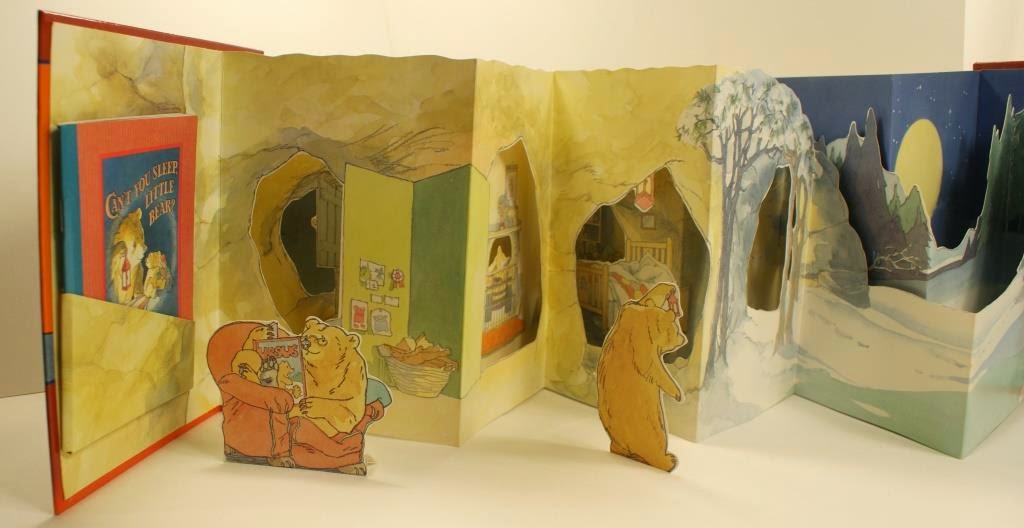
Can't You Sleep, Little Bear? by Martin Waddell, illustrated by Barbara Firth (Walker Books, this edition 1995)
One of the most recent acquisitions to the collection, this beautiful little pop-up version of Can't You Sleep Little Bear, is a lovely wintery example of a duo of bears in winter. Little bear just can't get to sleep, as he is scared of the dark, and it is up to Big Bear to help (even if he really wants to finish his very interesting book!).

This is an example of one of a huge variety of books in our specially purchased collection, which is developed by our Collections Officer to make sure we have copies of all of the books for which we hold any original material. This can often be quite a difficult task, as we really like to have good first edition copies. They are useful for many reasons, particularly when researchers are using the archive, and also for the archivist to correctly organise and identify everything when it first arrives!

We hold the archive of Martin Waddell, which is quite large and covers many of his picture books (over 50 of them!), as well as notebooks and diaries, and Waddell's work for various reading schemes published by a variety of illustrators. It is an interesting and varied collection, with plenty of detail to explore. The material relating to Can't You Sleep Little Bear runs to quite a lot, there is a draft typescript of the text, correspondence between Waddell and Firth, proofs of the illustrations and letters from the publisher, Walker. The file also contains drafts of two unpublished 'Little Bear' stories!

Just in case you were wondering - "Big Bear is the big bear, and Little Bear is the little bear."


If you'd like to find out more about the Seven Stories Collection, then 
email: collections@sevenstories.org.uk or phone: 0191 495 2707 or comment on this blog.

Monday, 22 December 2014

The Thimble Press Traditional Tales Collection

In this blog post Seven Stories Collections Officer, Paula Wride gives an overview of one of our many fascinating book collections. Paula, a former Schools Librarian, looks after Seven Stories' extensive library of books and other publications (currently numbering at well over 35,000 items). Here she looks at the Thimble Press collection - a collection of traditional tales and folklore from around the world.


Thimble Press

In 1969 Aidan and Nancy Chambers set up the Thimble Press in order to publish the journal Signal Approaches to Children's Books, which appeared three times a year from 1970 to 2003, unsupported by subsidy or advertising.
Each issue collected articles about some of the many aspects of children's literature - authors, artists, criticism and reviewing, translation, educational theory and practice, and so on. The writing in Signal led to a number of separate publications, including the annual surveys of new books in the 1980s (The Signal Review and The Signal Selection) and the Signal Bookguides, which were authoritative tools regularly used by librarians, teachers and interested parents.

A library of children's books accumulated over the years, serving as a background and reference source for contributors to Thimble Press publications and their editor.  In 2010 the traditional-tales section, numbering over 1300 books, was donated to the Seven Stories Collection by Nancy and Aidan Chambers.  The collection includes titles recommended in Mary Steele's Traditional Tales: A Signal Bookguide (1989), and copies of these are stickered with the relevant entry numbers.


In Her Own Words

Nancy Chambers says: “To me, poetry (nursery rhymes especially) and traditional tales are the heart of children's books.  We honoured poetry with the annual Signal Award (1979-2001), a Signal Booklist by Alan Tucker and a later Signal Bookguide by Jill Bennett and Aidan Chambers.  We hope the collection now at Seven Stories will be a new focus for the manifold study of the children's-publishing presentation of the tales.”


The Traditional Tales Book Collection

The majority of the 1300 books in this collection were published between 1970 and 2000 and include:
Traditional Folk and Fairy tales from countries from all around the World particularly Africa, America (including Native American stories), Australia (including Aboriginal stories), China, Japan, Russia, the West Indies, India & Pakistan, as well as the British Isles (including Cornwall and ‘the North’)


Over 90 Hans Christian Andersen books (including multiple editions of Thumbelina, The Snow Queen and The Ugly Duckling) and over 120 Brothers Grimm books (including many compilations and multiple editions of individual titles e.g. Hansel and Gretel; Rumpelstiltskin; Snow White; and Little Red Riding Hood)


Myths and Legends from Ancient Greece, Egypt, and Persia as well as from the Norse, Irish, Welsh and Scottish traditions
                
Fables including numerous editions of Aesop’s fables and many other traditional tales featuring animals and Stories from World Faiths  

Tales from the Arabian nights and multiple editions of stories about mythical and magical characters such as: Robin Hood, King Arthur, The Pied Piper of Hamelin, Giants, Mermaids, Witches, Wizards, and Dragons


Many individual Authors / Illustrators / Compilers are strongly represented within this collection including: Kevin Crossley-Holland, Michael Foreman, Errol le Cain, Naomi Lewis, Kathleen Lines, Patrick Lynch, Charles Perrault, Joanna Troughton, and Brian Wildsmith.

Since the donation of the Traditional Tales collection we have received several other wonderful book collections from the Thimble Press library including over 270 children’s literature related reference texts, 72 Pop-up books and boxed book & gift sets, and 25 editions of Alice in Wonderland.

There are strong links between the Thimble Press collection and several of our other book collections most notably: Elaine Moss (Writer, Reviewer, Broadcaster and part-time Primary School Librarian) and Eileen Colwell (pioneer of children's libraries and champion of children's books) both of whom wrote Thimble Press titles (see photo above), and whose personal book collections (of 775 and over 300 books respectively) we hold.  We also have Kathleen Lines’ personal collection of over 350 children’s books which are predominantly Traditional Tales, and include many of the titles she wrote / compiled.

If you would like to find out more about our book collections or the many Children’s Literature journals we hold (including Signal Approaches to Children’s Books), then click here to contact us.

Thursday, 11 December 2014

Exploring the Diana Wynne Jones archive, by Creative Writing student Becky Orwin

When the opportunity came up through my MA course at Newcastle University to take part in a temporary writing residency at a ‘cultural venue’ in Newcastle or Gateshead, I’m not saying I was holding out for Seven Stories. I’m not saying there was some careful avoidance and glossing-over of emails, I’m just saying that I was thrilled when I heard that Seven Stories were happy to have me hang around for a couple of days. As an aspiring writer for children, the National Centre for Children’s Books is a pretty lovely place to me anyway, but I was particularly excited to be given a private look at some of the archive material.


Some of Diana Wynne Jones's childhood notebooks


I’d seen some of the material before at Seven Stories events, but had generally been too worried about sneezing on something important to spend too long hovering over it. But in November at the Gateshead archive, I got to spend a day flicking through papers at my own leisure. I say ‘papers’ as if that’s all they were, but in actuality I was focusing on the Diana Wynne Jones material. The point of this was originally to focus in on fantasy writing for children, but frankly without some kind of parameters I could have locked myself away in there until next summer.


Part of the Diana Wynne Jones archive at Seven Stories


Even just focusing on the Diana Wynne Jones archive I stayed two hours longer than intended, and still had boxes heartbreakingly unopened when I left. As a writer myself, I can’t describe (ironically) how fascinating it was to look through the manuscripts, drafts and notes of an author as celebrated as Diana Wynne Jones. It’s easy to assume as a young, unpublished, would-be author that nobody but you has problems redrafting, nobody but you throws half-formed ideas away in frustration and nobody but you occasionally produces something so genuinely dire not even your mother can find anything nice to say about it. It’s wonderful to know that Diana Wynne Jones made notes for so many eventually unused ideas, and went through so many enormously changing drafts of a book that eventually shaped millions of childhoods, and wrote as precociously as any fourteen year old convinced of their own cleverness. And not just to know it, but to physically hold evidence that not every word that falls from an eminent author’s pen is perfect the first time round, is pretty thrilling!


Page from manuscript of Charmed Life (Macmillan, 1977)


My favourite piece by far was a very early letter from Diana Wynne Jones’s agent. I think it was dated sometime around 1968, so before Jones had published her first novel and long before she was a legendary name in children’s fiction. Stupidly, I didn’t write the contents of the letter down, but the gist was along the lines of ‘I have unfortunately been unsuccessful in selling your article. Sadly, the nature of these things tends to be that unless you are enormously qualified or have a renowned and illustrious name behind you, publishers aren’t interested.’ That, to an aspiring writer with a collection of rejection letters in the dozens and a name my own teachers struggle to remember, was a hugely satisfying read!


Letter from Diana Wynne Jones's agent, 1968


The whole experience was hugely satisfying, in one way or another. The generosity of Seven Stories in allowing me to wander through the archive material at my own pace, the material itself, and the insight it gave me to the life of a professional writer. In an industry as London-centred as writing and publishing for children, to have resources like Seven Stories and the collection here in the North East is an opportunity that should not be missed; you never know what you might find.


Becky Orwin is an MA Creative Writing student at Newcastle University. Becky visited Seven Stories and the archive as part of the 'Write Around the Toon' project - a student-led project, which places students from Newcastle University’s Creative Writing programme in short residencies with cultural venues across Newcastle-Gateshead  (you can read more about it here: http://watt.nclacommunity.org/content/).


The Diana Wynne Jones collection is available to view by appointment at the Seven Stories Collections Department (you can read more about it here: www.sevenstories.org.uk/collection/collection-highlights/diana-wynne-jones). To find out more about the Seven Stories Collection click here. To make an appointment to visit the Collection or to enquire about other collections that we hold then click here to contact us.


Monday, 1 December 2014

All About: Christmas Animals

Now it's the first of December, we can officially start celebrating Christmas here in the Seven Stories Collection. To start off our celebrations, we have a series of Christmas animals to show you, all taken from the material held in our store. This is the start of a new series, next year, on the first of each month we will be bringing you a post on a different feature animal! Leave a comment below with your favourite and we will see what we can do...


Original artwork by Helen Craig for Angelina Ice Skates, story by Katharine Holabird (Puffin, 1993)

Angelina uses her beautiful ballet skills to dance across the ice instead of a stage.

Illustration © Helen Craig
Original artwork by Helen Craig for Angelina's Christmas, story by Katharine Holabird (Puffin, 1985)

This is a heart warming story of Angelina bringing some Christmas cheer to Mr Bell, who has retired from being the village post man. To see more artwork from this book, and many other Angelina Ballerina titles, visit 'Twists and Tails - the Story of Angelina Ballerina' at the Seven Stories Visitor Centre until April 2015.

                                                                                             Illustration © Helen Craig
Original artwork for Tim Mouse and Father Christmas by Judy Brook (World’s Work Press, 1971)
Tim Mouse and children find a little old man with a long white beard lying in the snow.  They know nothing about Christmas, but the old man soon tells them all about Christmas Day, who he was, and how he got lost.  Tim, with the help of his wife, his children and his friends, comes to the rescue and makes sure that no one is disappointed on Christmas Day.
Illustration © Judy Brook's Estate
Original artwork for Tim Mouse and Father Christmas by Judy Brook (World's Work Press, 1971)                                                                                   Illustration © Judy Brook's Estate
Original artwork for Mog’s Christmas by Judith Kerr (William Collins Sons & Co. Ltd., 1976) 

Christmas come to Mog’s household and Mog finds it a little unsettling. There are lots of new people and a walking tree!
                                                     Illustration ©Kerr-Kneale Productions Limited
Original artwork for Mog’s Christmas by Judith Kerr (William Collins Sons & Co. Ltd., 1976) 
                                                           Illustration ©Kerr-Kneale Productions Limited

Original artwork for The Good Little Christmas Tree by Ursula Moray Williams (George G. Harrap, 1943)
Two parents bring home a Christmas tree for their children for Christmas day, but they cannot afford to decorate it with candles and sparkle. When they go to sleep, the Christmas tree goes on a journey to find decorations to delight the children on Christmas morning. He loses many of his needles, and only Santa Claus can help. 
                                                         Illustration © Ursula Moray Williams Estate
Original artwork for The Good Little Christmas Tree by Ursula Moray Williams (George G. Harrap, 1943)How many different animals can you spot in these pictures?
                                                                  Illustration © Ursula Moray Williams Estate

To find out more about any of the items shown in this post, visit the Seven Stories Catalogue. You can also call on 0191 495 2707 or email at collections@sevenstories.org.uk.

Wednesday, 26 November 2014

Charles Keeping's illustrations for 'The God Beneath the Sea' and 'The Golden Shadow'

Earlier this month we were delighted to receive into the Seven Stories Collection a fine set of signed Charles Keeping prints. These prints reproduce a selection of wonderfully dark illustrations made by Keeping for Leon Garfield and Edward Blishen's books, The God Beneath the Sea and The Golden Shadow. The prints were donated to Seven Stories by former school teacher and long-time supporter of Seven Stories, Nick Brown. Here Nick talks about how he came across the prints and the impact the work of Charles Keeping has had on him:

When I was training as a teacher in the early 70s, I came across The God Beneath the Sea by Leon Garfield and Edward Blishen. This retelling of some of the Greek myths was radically different from the ones we usually used on teaching practice by authors such as Roger Lancelyn Green, Barbara Leone Picard or even Andre Lang. I found the stories compelling and used some of them in my teaching.

Detail of Hades Chariot from The God Beneath the Sea. Image © Charles Keeping estate


Whilst the book itself received a mixed critical reception, this was not the case with the illustrations which were almost universally praised and, I suspect, contributed to it being awarded the Carnegie Medal in 1970. In addition, Keeping received a Kate Greenaway Commendation- an award that is no longer given. Interestingly, though, the U.S. edition does not feature Keeping's illustrations and I wonder if they were thought too "strong" for American sensibilities.


Copies of the books


But it isn't  the stories that have stayed with me, it's Charles Keeping's amazing illustrations that have resonated over the years. I was stunned by Keeping's illustrations so much so that when a portfolio of his illustrations for both The God Beneath the Sea and The Golden Shadow became available, I snapped it up. And they have remained with me ever since. I would take them out every so often and admire their power and violent beauty. I've enjoyed these prints for so many years that it seemed fitting to donate them to Seven Stories to add to their archive, where they could be viewed alongside the original Leon Garfield manuscripts.


Pages from Leon Garfield's notebooks for The Golden Shadow here at Seven Stories


On my visit to the Seven Stories Collection I was able to look through Leon Garfield's notebook that contain partial drafts of both novels. At this stage of writing, not surprisingly, there is no indication about illustrating them. It would be really interesting to find out when/how Keeping became a part of the process and how much freedom he had in deciding what to illustrate. But that is for another time.


Detail of punishment of Prometheus from The God Beneath the Sea. Image © Charles Keeping estate


It has to be remembered that whilst both books were promoted as suitable for older children,  one wonders if the illustrations are! Today, we see resonances of Keeping's work in that of Dave McKean (Coraline), Chris Riddell (The Graveyard Book) and Jim Kay (A Monster Calls). Keeping is crucial to our understanding of the development of post war children's book illustration and the illustrations for God Beneath the Sea and The Golden Shadow are an important part of this process.


Leon Garfield's notebooks for The Golden Shadow here at Seven Stories


Both books are lavishly illustrated. As in  most of Keeping's illustrative work, the illustrations are in black and white. They appear as half page and full page but also across a double page in a powerfully dynamic way. The illustrations don't simply accompany the text they propel us through the story. This  can be seen in his illustration of Hades' chariot in The God Beneath the Sea. And for a gruesome rendition of the punishment of Prometheus, we need go no further. Keeping's illustration of the dead Nemean lion is rather ambiguous.  After staring at it for a while it becomes less lionlike and more human. Or do I need an optician's appointment?


Dead Nemean lion from The Golden Shadow. Image © Charles Keeping estate


By Nick Brown

The Charles Keeping prints and the Leon Garfield collection are available to view by appointment at the Seven Stories Collections Department. To find out more about the Seven Stories Collection click here. To make an appointment to visit the Collection or to find out more about the collections featured in this post or other collections that we hold then click here to contact us.