Monday, 1 February 2016

All About: Castles

If I were going to spend a weekend in the magical world of Ingary I’d want to travel in comfort.  It’s quite far from here so I’d have to think carefully of how I’d make my way. I’d definitely travel by CASTLE.  This week we’re going to dip into our Diana Wynne Jones collection and look at that most inventive and smoke-belching mode of transport: a castle, Howl’s Moving Castle, to be specific.  


[Howl’s castle] suddenly appeared on the hills above Market Chipping, blowing clouds of black smoke from its four tall thin turrets…what made it all the scarier was that the castle did not stay in the same place…You could see it moving sometimes, with smoke pouring from its turrets in dirty gray gusts (Extract from Jones' Howl's Moving Castle, p.2, Methuen, 1986).

Inside this Castle that clunks and smokes through the wastes is a rugby-obsessed Welsh wizard called Howl, his fiery fire-spirit Calcifer and the unsuspecting companion in these adventures, the hat-maker’s apprentice, Sophie. 

This is a story about growing up. Sophie is transformed into an old woman by the powerful Witch of the Waste and leaves the hat shop to find work as a cleaner for the notorious wizard Howl.  The castle is where Sophie learns not only about Howl's unwillingness to clean but about her own magical abilities.  It may sound cliché but the Castle opened up a journey of discovery for Sophie.  In her home of Market Chipping she was a cooperative and compliant young girl who later emerges from the castle as a strong, confident old lady (old until the curse is lifted but still confident).  Diana Wynne Jones believed that all children should be encouraged to discover their own individuality, rather than being expected to follow the rules (Seven Stories Moving Stories text panel). Sophie certainly discovers her individuality on the journey and doesn't quite follow the rules. Howl was rumored to be terrifying - probably somebody a young girl should try to avoid and escape not seek employment from.

[Howl] was known to amuse himself by collecting young girls and sucking the souls from them.  Or some people said he ate their hearts.  He was an utterly cold-blooded and heartless wizard and no young girl was safe from him' (Extract from Jones' Howl's Moving Castle, p.3, Methuen, 1986).

Sophie was not exactly a young girl, thanks to the Witch's curse, but her physical transformation from young to old mirrors a transformation of character.  She grows into a person who is no longer resigned to her fate in a hat shop but who controls her own destiny.  

Howl's Moving Castle area of the Moving Stories exhibition which came to a close in 2015Photography by Damien Wooten © Seven Stories – The National Centre for Children’s Books
It doesn’t exactly seem to be environmentally friendly, but Howl’s Castle allows him to move between worlds. It is his home and his transport. The castle has taken many forms with the Studio Ghibli re-imagining becoming somewhat iconicStudio Ghibli adapted Howl’s Moving Castle for the screen in 2004. The co-founder of the studio, director Hayao Miyazaki's personal views on environmentalism, pacifism and feminism have a strong influence upon his work. So, a wheezing castle and Sophie's personal journey seem an ideal choice for the Studio however, Miyazaki's adaptation shows significant differences to the book. Prior to the release of the film,  Miyazaki visited Jones at her home to watch the film with her.  About the Japanese director she said "I don't think I've ever met anyone before who thinks like I do. It was wonderful. He saw my books from the inside out."

Diana Wynne Jones is represented in many of our book collections; you can almost always count on finding her name in former public library collections. We have two different versions of Howl's Moving Castle and this cover from the Indonesian edition shows a very different portrayal to the wooden-faced castle of Studio Ghibli. I can understand how a Castle running through the hills like it has spontaneously uprooted and grown legs would have been very frightening to those in the Ingary town of Market Chipping. 

Indonesian edition of Howl's Moving Castle.  Reference: DWJ/06/01/18 © Seven Stories – The National Centre for Children’s Books

The second version features my favourite book cover of all time: it's Howl, with his precious blonde mane and his electric guitar.  For me, this cover embodies some of the humour of Jones’ writing even though Howl isn’t quite as I had imagined and Calcifer is nothing short of terrifying (I have to admit to my fandom of Hayao Miyazaki's much more lovable fire spirit). An online search for Howl's Moving Castle book covers reveals so many different editions each with wonderful artwork - if you own a different copy, I would love to see it!  You can leave a picture in the comment section, or tweet us at @7Stories

Howl's Moving Castle Reference: STSLS/01/451 © Seven Stories – The National Centre for Children’s Books
Jones is widely recognised among scholars, writers and fans of science fiction and fantasy as a truly ground-breaking writer so it's not surprising that her collection is one of our most popular among researchers. In 2014 Seven Stories and Newcastle University hosted a memorial conference for Jones, as a celebration of her work and an evaluation of her contribution to children’s literature, fantasy and science fiction. 

Archival material in our collection includes stories written by Jones as a child; draft material for 49 published works; material relating to numerous unpublished works; correspondence and fan-mail.  

Only a small proportion of material relates to Howl’s Moving Castle with two files containing typescript drafts.  One of which is a setting draft, marked up with typesetting instructions for the printer.  The annotations on this draft mostly refer to formatting amendments for the printers, however some do refer to language use for American editions of the book. 

Setting copy transcript.  Reference: DWJ/02/01/01/02 © Seven Stories – The National Centre for Children’s Books

The  second typescript came to us in a brown envelope with a scrawled label reading  'Howl minus by Miriam'.  This draft is what Howl's Moving Castle could have looked like if Diana's editor Miriam had had her way. The draft was sent to Laura Cecil, Diana’s agent, who gave the following explanation when the collection was donated:

This was a joke version of an edited HOWL sent to Laura Cecil by an exasperated Diana Wynne Jones, showing in a reductio ad absurdum version what would happen if she followed Miriam Hodgson’s editorial comments to the letter.  Neither Miriam nor anyone else at Methuen knew about this version.  It was part of Diana’s way of letting off steam when she was having to fight her corner with publishers.  Later on she and Miriam had a very good relationship, but it took some time for her to understand Diana’s work.


Howl minus by Miriam draft.  Reference: DWJ/02/01/01/01© Seven Stories – The National Centre for Children’s Books
The version is incomplete and the majority of red-ink annotations are suggestions for rephrasing and sentence deletions. As an example here is a change made in chapter thirteen 'In which Sophie blackens Howl's name' 


and another from the end of Chapter 10 'In which Calcifer promises Sophie a hint'


These changes aren't huge or structural, they don't change the story but their frequency would change the flow of the book.  So, this typescript is Jones' reaction to edits that she thought would flatten and oversimplify her language.  Judging from her strong presence in our book collections, numerous translated editions and a Japanese film adaptation, Jones' book has clearly had great success without these particular amendments

I may not be able to guarantee that a castle is an efficient mode of transport (with all the billowing smoke and terrified reactions it may not be worth it).  What I can guarantee is that Howl's Moving Castle is an excellent read and our collections shed some light on the stages of its creation, and Diana's popularity as an author.


If you'd like to find out more about the Seven Stories Collection, then 

email: collections@sevenstories.org.uk or phone: 0191 495 2707 or comment on this blog.


Friday, 8 January 2016

"Books have reference numbers too"

This is the second post written by Paula Pintos.  If you haven't read it already her post 'A Twit's story at Seven Stories' was very popular.  Paula spent two months with us on an international student placement and did a huge amount of work for us. Here she gives an excellent account of the Book Collections at Seven Stories. 

Possibly because my brain was trained to focus on librarian-y ideas, I had never considered the role of books in an archive, let alone a literary archive, before coming to Seven Stories for my work placement. That soon changed, though! On my very first day, Collection Officer Paula Wride introduced me to Seven Stories’ book collections, and I instantly found their role fascinating.

One of the first things I absorbed in my time at Seven Stories is that the whole collection grows strategically, in a Lego-like way, in the sense that acquisitions (mostly) follow a structured plan carefully devised to close gaps in areas of interest. Unlike, for instance, a public library, whose role is to offer a collection that fulfils its patrons’ current needs, changing and diverse as they may be. I realised archives collect items in order to build a coherent body of knowledge that is a legacy in itself. Do we have material in the archive that is linked to this potential purchase or donation? Do we already have the artwork for this author’s work? (This is how I picture things, anyway, it may or may not be an accurate portrayal of reality).

Also, archives are (mostly) about preserving and sharing unique things, like an annotated typescript of the first draft for, say, The Gingerbread Man. It is generally not in the nature of books to be unique though, at least since the invention of the printing press! That is, I think, why the book collection's role is often to complement the original artwork and archival material in the collection. They provide a context and show the final result of the creative process, along with subsequent reprints, revised editions and even foreign language versions. (That is also why the books are organised under the name of the donor, instead of some sensible, straightforward system like - I don’t know - Dewey).
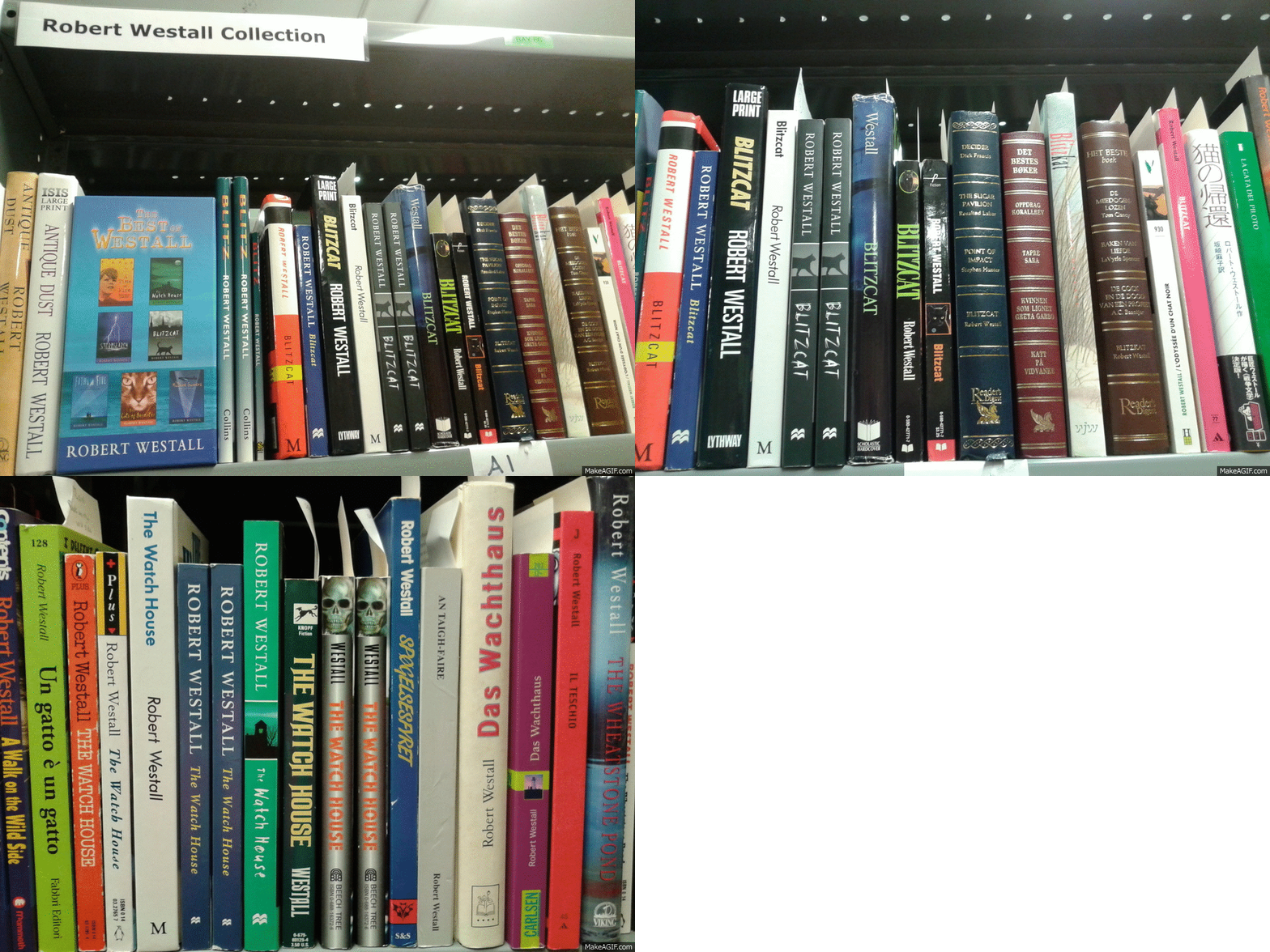
Multiple British and foreign language editions of two of Robert Westall’s titles
It’s important to respect the origin and the links between items, so that researchers are able to follow the crumb trails. The best way to express it that I could think of was to steal for the title the fifth law of library science written by Ranganathan, a librarian with an ability to express abstract ideas quite poetically. Libraries and archives are both growing organisms in their own particular way, and Seven Stories’ book collections are part of an archive, rather than a traditional library.

That was possibly not as clear as I thought it would be, actually. Let me give you some examples!

As I mentioned above, one of the roles book collections have in relation to the archive is to complement a parallel body of original archival material (drafts, notes, correspondence, and other exciting things). Kaye Webb’s and Faith Jacques’ collections are good examples of that, as you can read if you browse through the previous blog posts! I think Faith Jacques’ collection is particularly interesting because of the book collection it includes: books that she illustrated for other authors as well as her own titles; books that belonged to her own personal reading library; and most importantly, a huge number of ‘bookmarked’ reference books that she used for researching all the historical background, that would go into the astonishingly accurate and detailed illustrations she was renowned for by authors such as Leon Garfield. Thus, while the archival material provides a picture of Faith Jacques’ creative process as well as her personal and professional life, the book collection offers a glimpse into her own relationship with books as a researcher, an illustrator and a reader.


Books illustrated by Faith Jaques and some of the ‘costume’ reference books she used.
Some of the book collections, however, are not linked to archival material but stand on their own merit. Sometimes because they consist of a substantial number of books about a core ‘children’s book’ theme, or else because they open a window into a particular era, a significant figure or publishing house of/in Children’s Literature, or because they are unique, out of print or hard to find. They also often offer really valuable information on the evolution of the physical book from design, through printing techniques and marketing strategies. 

Possibly the strongest collections of this particular kind are Pat Garret’s and Thimble Press. The former includes ever-growing collections of alphabet books (585 and still growing!), as well as counting and number books from 1930 to 2010.  The Thimble Press Collections, donated by Aidan and Nancy Chambers, include four different core topics for any children’s books collection: traditional tales (1300), pop-up books (72), children’s literature related reference books (270) and multiple editions of ‘Alice’ (25!) 

Paula wrote a blog all about Thimble Press Traditional Tales Collection, so I suggest you read that first, because I have only been working with Thimble Press Children’s Literature Reference Books. In fact, I have been working with several reference book collections, and it has been fascinating. Seven Stories’ donors are often involved with children’s books in a professional way e.g. librarians and storytellers, publishers, editors, agents and reviewers, each of whom has a set of reference books.  So, there is a strong body of reference material covering children’s literature through the centuries from all sorts of angles, including ideology and diversity in children’s books, literary criticism, literacy promotion and education, and biographies of significant figures in the genre. 
Thimble Press Children’s Literature Reference books.
The Thimble Press Reference Books Collections includes 383 books mainly published between the 1940s and 2010. It covers many areas, but it is particularly strong in early children’s literature, biographies of authors and illustrators (such as C.S. Lewis and Edward Ardizzone), and booklists/annual book guides, including both bibliographies of award-winning books and recommended books, from influential librarians and critics such as Elaine Moss and Naomi Lewis. Since the collection covers such a long period, we can also note research topics changing and becoming more contemporary. For instance, the 70s seem to have brought a new wave of literary criticism centered on social matters, and so Aidan and Nancy Chambers also collected books on how children’s books are affected by class, gender, diversity or the construction of the concept of childhood.

As you can imagine, while browsing through the book collections, questions and research ideas often leap at you from the shelves. They are less shy in person than manuscripts, hiding away in their minty coloured boxes. Still, the one book collection that I was shown on my very first day and, being the language nerd I am, am a bit sad to leave only half-explored, is Colin Ray’s Collection of International Children’s Books. This collection was originally built in the 1970s by Colin Ray (husband of Sheila Ray) and lecturer at the Department of Librarianship of Birmingham Polytechnic (later the University of Central England), in order to collect a sample of the foreign books that were being published around the world, to be used for reference by students of Librarianship and external researchers. It is comprised of more than 3,000 books and journals in various foreign languages including French, Spanish, Italian, Russian and Japanese, but also Afrikaans, Catalan, Czech, Danish, Dutch, Finnish, Hebrew, Hungarian, Persian, Malay, Polish and Swedish. 

The Colin Ray Collection of International Children’s Books and some of the Spanish titles.
This book collection is a bit of a rarity in that it is not attached to an archive and it is not about a particular core topic or a relevant figure, but it offers a fascinating snapshot of what was published, both originally and in translation, all around the world in a particular period. It is quite overwhelming, I could only help to identify some languages (not as easy as it sounds with about 50 of them!) and provide translations into English of book titles that were not in the amazing original ‘old-school’ card catalogue.

Colin Ray’s card catalogue for the International Children’s Books arranged by ‘Author’, Country of publication’, ‘Language’ plus a volume of ‘British Books in Translation’.
I am not immune to its vintage charm, I must say, but what I enjoyed the most is seeing how the Spanish and Catalan books are quite representative of the time, including  familiar names such as illustrator Luis de Horna and author Ana María Matute, and finding a few typed translations of some of the books texts, seemingly for informative purposes.

But moving away from the Spanish-language books, it is easy to notice  some names again and again, with Christine Nöstlinger and Enid Blyton being particularly ubiquitous, and there is a stunning variety of illustration techniques and book designs. Even without being able to compare the contents of that chaotic Babelesque army of children’s books, nosing through the stacks highlights the cultural and social ingredients that go into defining what makes an edition appropriate or appealing for children. I think my 22 year-old self would have regarded this collection as Gringotts, minus the gnomes, so I really hope it sparks at least a handful of research projects on comparative literature and translation! Regardless of the languages you speak, there is bound to be something for you. And, you know, there’s always Enid! 

- Paula Pintos 

If you'd like to find out more about the Seven Stories Collection, then 
email: collections@sevenstories.org.uk or phone: 0191 495 2707 or comment on this blog.
Friday, 1 January 2016

All About: Tramcars

A brand new year, and a whole new theme of blog posts ahead of us! For the new year of 2016, we will be saying farewell to the All About Animal posts of 2015, instead taking an in depth monthly look at transport in the Seven Stories Collection. We will be covering some of the more conventional methods of transport - walking, cars, boats, etc - but will also be delving in to those very special methods of getting around reserved for children's books. Travel by castle, anyone?

More of castles in February. To kick off the new year, we are going to showcase the more humble mode of transport, the tramcar. A transportation not as frequently seen in many towns and cities in the UK as in the past - the only working trams in the north east of England reside at Beamish Open Air Museum - but the story and illustration of this particular tramcar is entrancing nevertheless. Timothy Tramcar, written by Edith Ray Gregorson and illustrated by Barbara Jones, was first published circa 1950 by Railway World. 


Printed edition of Timothy Tramcar, by Edith Ray Gregorson and Barbarba Jones, published c. 1950 by Railway World
Seven Stories holds the majority of the beautiful original pen and ink line drawings for this book, as well as some colour artwork. There is, however, very little related material to tell us about the book. The collection includes some material created by B.C. Bloomfield (1931-2002), who acquired the artwork as part of his private collection of the work of Barbara Jones. Bloomfield can be seen through his correspondence trying hard to discern the date of publication, but no concrete evidence was found, other than it must have been published before the publishing company was taken over in 1960. 

The story of Timothy Tramcar follows the battle within a small town between the old fashioned tram system and the new and controversial buses. Told with an expectedly heavy bias on behalf of the trams, (the book was put out by the publishers 'Railway World' after all!), it sees a local politician try and force out the trams, until a popular campaign and the politician being saved from ice and snow leads to the eventual victory of the trams! 

Printed sheets of photographs of various trams from around the UK. These appear to have been prints collected by Barbara Jones as part of her research for the illustrations. 
The book's illustrator, Barbara Jones (1912-1978), was active in publishing from the 1940s to the 1970s. Known as an illustrator and landscape painter, she studied at the Royal College of Art before going on to contribute heavily to the 'Pilgrim Trust Recording Britain Project'. This employed artists to record life on the home front during the Second World War, collected by the National Gallery, and inspired by a desire to capture and reflect the rapid changes happening within Britain. There is an interesting correlation here to the subject of Timothy Tramcar, and his fight (and victory) over changes in the town. 

The material held in the archive relates purely to the illustration of the book. How the book was written, or even many details about the author, are difficult to find. If anyone reading this is able to let us know more about Edith Ray Gregorson, or how she came to be writing about these tramcars, it would be wonderful to know!


Original artwork by Barbara Jones for Timothy Tramcar, c. 1950. This illustation captures the mood of the trams returning to the depot, at threat of being wiped out!
Original artwork with annotations, by Barabara Jones for Timothy Tramcar, c. 1950. These illustrations show the campaign in favour of the trams, and a bus leaving poor Timothy in his wake.
If you'd like to find out more about the Seven Stories Collection, then 
email: collections@sevenstories.org.uk or phone: 0191 495 2707 or comment on this blog.

Friday, 18 December 2015

Merry Christmas 2015!

A few members of staff and a volunteer from the Collections and Exhibitions Team that I managed to take a festive photo of! Paula, Jess, Danielle and Eleanor.
Hello to all of our loyal blog post readers! We are all preparing for the festive celebrations here in the Collections and Exhibitions office, and thought we best wish you all a Merry Christmas and Happy New Year!

Thank you to everyone who has contributed posts to the blog over the past 12 months, and we look forward to sharing lots of exciting news with you over 2016.

As a little wrap up for the year, here are just a small sample of a few of our favourite posts from 2015 - happy reading!


Our very first post of the year 'All About Bears'

Seven Stories annual shadowing bonanza and the 'Carnegie and Kate Greenaway Medal Winners'
Behind the scenes in to our grand building reopening in July 'Seven Stories Visitor Centre is now open! Part 1' and 'Part 2'
A post from one of our award winning volunteers 'Ann numbers and remembers'
Our wonderful placement student over the summer, Paula, writing on her experience with the David Wood Collection 'A Twit's Story at Seven Stories'
One of our biggest collection donations of the year! 'The Michael Morpurgo Archive' Photograph (c) Damien Wootten for Seven Stories, National Centre for Children's Books
One of our (many!) November posts linked to Explore your Archive Week 'Foraging through Fickling's Archive Part 1', 'Part 2' and 'Part 3'
And a look back at our very busy 12 months with 'A Year in the Seven Stories Archive'
If you'd like to find out more about the Seven Stories Collection, then 

email: collections@sevenstories.org.uk or phone: 0191 495 2707 or comment on this blog.

Tuesday, 1 December 2015

All About: Horses

For the very last in our All About Animal series, this festive month we are going to explore the horses that appear in the Seven Stories Collection. After you have read this post, why not click on the tab at the bottom to bring up all the other posts from this year long series. Just a tease - next year we will be exploring the terrific territory of transport!

We hold material for some very famous literary horses, as you will see below when we take a look at an item from the archive, an artwork, and a book from the store.

Line and colour illustrations by Charlotte Hough for the cover of Black Beauty, written by Anna Sewell (Puffin Books, 1954)
One of the best selling books of all time, and arguably the most well known book told from the perspective of a horse, Black Beauty was originally written, not as a children's book, but as a treatise on the need for better treatment of horses in Victorian England. It was the author, Anna Sewell's only book, and she died before knowing quite how popular the book would become.

The illustrations for the very first Puffin edition, chosen by editor Eleanor Graham and published in 1954, were created by Charlotte Hough. The two black and white, pen and ink line drawings shown in the image above would have been used by the printer to reproduce the black lines for the cover of the book. The colour elements of the cover would have been created separately, using the colour sketch, also shown in the images alternating above. The different elements would have then been merged together in the final printing.

The collection holds the complete suite of finished artwork, the cover, as shown above, as well as 18 black and white internal illustrations. The rest of the Charlotte Hough Collection consists of original artwork for 13 published titles for children, including complete suites of illustrations for the Puffin edition of Five Proud Riders, written by Ann Stafford. The collection also includes a hand-made dummy for an apparently unpublished picture book. The whole collection was donated in 2009, by two of Hough's children, Alexandra Hough and the novelist Deborah Moggach, following Hough's passing in 2008.

Black Beauty's Family, (Hodder and Stoughton, 1978)
Following on from this month’s featured illustrations for Anna Sewell’s Black Beauty, this month’s printed book is Black Beauty’s Family, written by Josephine, Diana and Christine Pullein-Thompson.

This book was published in 1978 and is the second of three volumes of historical stories by the most famous ‘pony story’ writing dynasty of all time, the Pullein-Thompson family, which follow ‘in the hoofprints’ of Black Beauty. Told from the horse's point of view, these stories tell of the lives of a number of Black Beauty's relatives. This particular volume includes 3 short stories, one by each of the sisters: Nightshade by Josephine, Black Romany by Diana, and Blossom by Christine Pullein-Thompson.

This copy of Black Beauty’s Family is to be found in the ‘Warwickshire Libraries Award Winning children's books’ Collection, which was donated to Seven Stories in 1997. This collection is made up of 260 books published between 1936 and 1996, predominantly past winners of the Carnegie and Kate Greenaway medals. This book won neither of these awards, although Josephine Pullein-Thompson was awarded the Golden PEN (Poets, Essayists and Novelists) Award in 2007 for "a Lifetime's Distinguished Service to Literature” and was appointed MBE in 1984. We haven't yet been able to ascertain which award Black Beauty’s Family might have won - if any - and thus why it appears in this ‘Award Winning’ collection! Can you help?


We hold a couple of other ‘prize winning’ book collections which you might like to find out more about: Vera Coleman’s ‘Modern Picture Book Collection: award winners and their books’; and our own collection of Carnegie and Kate Greenaway medal shortlisted titles 2006-date. If you want to find out more about Seven Stories shadowing of the awards, and our holdings of Carnegie and Kate Greenaway medal winners, click here

Manuscript for The Little Wooden Horse, by Ursula Moray Williams, (G.G. Harrap & Co., 1937), shown alongside a 1959 Puffin edition of the book.
This small wooden toy represents one of the oldest books represented in the Seven Stories archive, as our collecting period runs from the 1930s to the present day. It is also one of the earlier pieces donated, given to us by the creator, Ursula John (nee Moray Williams), in July 2005, just before Seven Stories opened its doors as a visitor centre.

This amazingly legible manuscript follows through the whole story, and is complemented in the archive by the later typescript, a further version of the story which was sent to the publisher. The manuscript does contain occasional notations and crossings out, but, as seen above, these are relatively few. The story follows the little wooden horse on many adventures - gathering pirate treasure, working in a coal mine, walking a tightrope in the circus, and other such adventures you can imagine a toy might have! Throughout the book, the little horse longs to return to his maker, Uncle Peder, whom he wished never to leave.

The Ursula Moray Williams Collection represents her long career, from the 1930s to the 1990s.  It contains manuscripts, typescripts and related draft material for 36 of her published works, as well as original artwork relating to nine of her published books (including Gobbolino the Witches Cat, and unpublished sketches for The Further Adventures of Gobbolino and the Little Wooden Horse). The archive also contains personal and professional correspondence spanning Williams' career as a children's author, including correspondence from family and friends, fans, schoolchildren, publishing houses, professional organisations, literary agents, other children's authors, illustrators, and others active in the field of children's literature; and a small quantity of personal papers which includes royalty statements, press cuttings and reviews, notes for articles and talks, and book jackets.

That is it for this year, if you have you missed any of our All About Animal blog posts, click here to find them all together for your reading pleasure!

If you'd like to find out more about the Seven Stories Collection, then 
email: collections@sevenstories.org.uk or phone: 0191 495 2707 or comment on this blog.

Friday, 27 November 2015

CILIP NE visit

Our archives had a lot of attention during Explore Archive Week, we think that its about time that we talked about books. 

Anne Sharp writes about her visit to Seven Stories Collection Store, along with 8 other North East based Library staff, as part of an event organised by CILIP NE (The Chartered Institute of Library and Information Professionals).

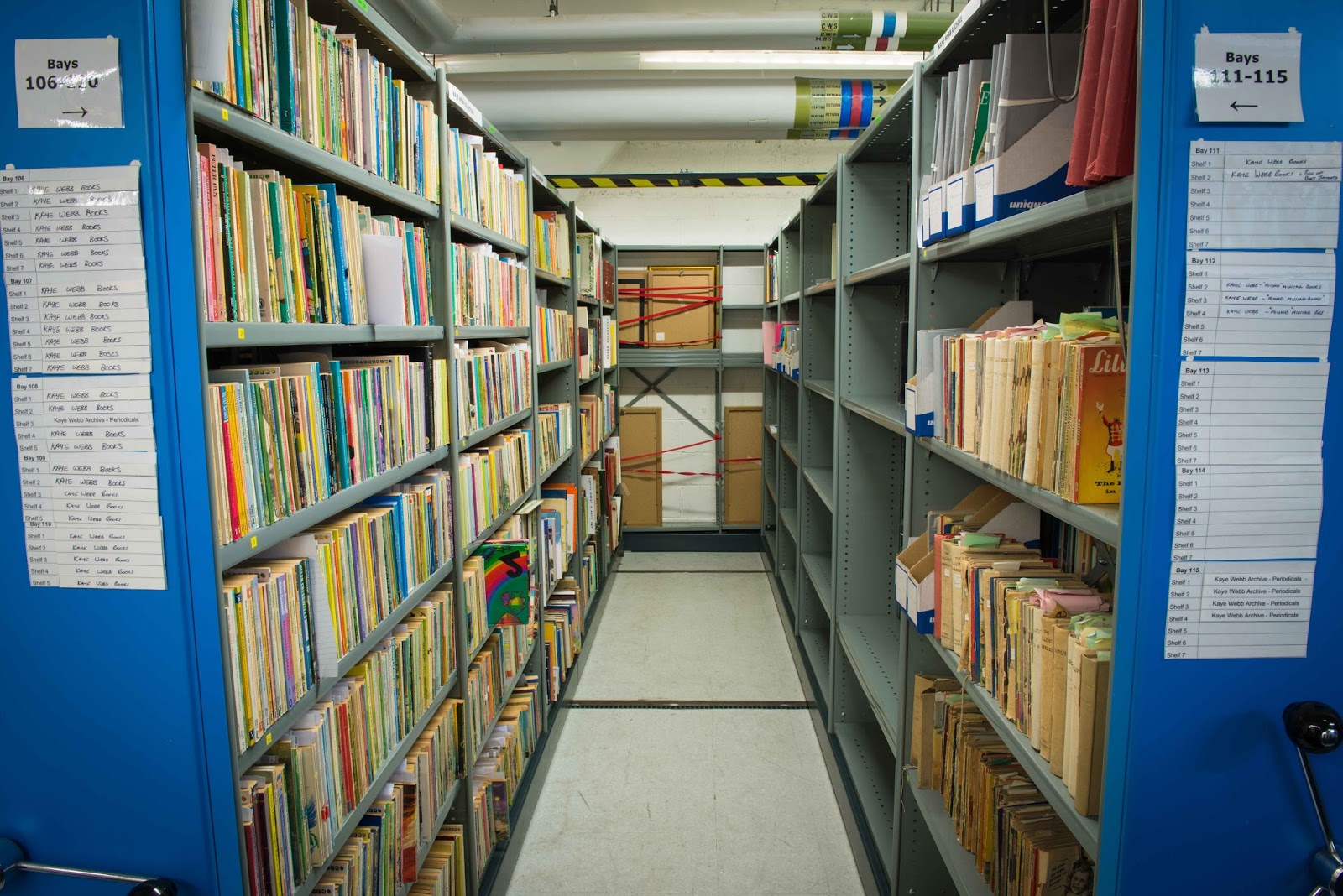
A visit to Seven Stories, National Centre for Children’s Books had been on my wish list for some time, so I wasted no time in responding to an invitation to do so, sent out through the CILIP NE network.  The visit was not to the wonderful visitor centre on the Ouseburn in Newcastle, but to the less visible, but equally wonderful Seven Stories Collection Store, which is housed at Design Works Business Centre, across the River Tyne, in Felling.  

©Damien Wootten for Seven Stories, The National Centre for Children's Books
Visiting a warehouse of books may not sound particularly exciting however, Collections Officer, Paula Wride, who hosted the visit, had taken great care to select and display items which represent the range, scope and purpose of the book and archive collections.  As well as books, she included examples of hand-written notes and notebooks, typed manuscripts annotated with amendments (or comments and doodles), story-boards, sketches, engravings and water-colours.  These demonstrated some of the creative processes and stages, authors (including Enid Blyton, David Almond, Philip Pullman, Martin Waddell, and Katherine Holabird), illustrators (including Helen Craig, Faith Jaques, Polly Dunbar, Barbara Firth, Edward Ardizzone, and John Lawrence) and publishers work through, and the challenges of effectively conserving and storing different formats.  Correspondence between authors and publishers provided an insight into the formal nature of communications in the past, and prompted discussion on the less formal and more ephemeral nature of communication that email generates. 

Although the collecting policy focuses on children’s literature and illustration from 1930 onwards, earlier books are kept in the context of specific archives donated to the collection, and include a copy of one of the earliest children’s books, (Comenius’ Orbis Sensualism Pictus or Visible World in pictures, written in Latin and English) in its 12th edition published in 1777. 


Great care is taken to conserve, store and catalogue each item in the collection, with formats ranging from handwritten notes to floppy-disk, and combine the expertise, perceptions and insights, of Librarian, Archivist, Conservator and Curator, to support in turn the Learning and Participation teams at the visitor centre, and the needs of researchers and schools.   In addition to collections donated by specific authors, illustrators, or book collectors, several library collections have also been saved, preserving examples of works by less well-known authors and illustrators, book jackets, library bindings and practices.  Among the book collections there are special collections of ABC books, paper engineered (Pop-up) books for children, counting and number books, a relatively small collection of factual books, and so on.   In addition to being used in exhibitions and school visits (at the Visitor Centre), the book collections are used by researchers for a wide range of purposes – tracking the history of the book (paper, print, binding), book publishing, marketing, and specifically children’s books illustration; the works of a particular author or illustrator, period or genre; and even ballet and theatre companies for costume and set design.
                               
©Damien Wootten for Seven Stories, The National Centre for Children's Books
From my perspective, I studied Childhood and Children’s Literature and Public Library Services to Children at Loughborough Library School, and as a Children’s Librarian working in libraries and on mobile library services, I witnessed the sheer joy that books bring to children – as pleasing objects to handle, with pages to turn, lovely illustrations to draw you in and stories to engage and absorb you.  I’d see their confidence grow week on week – confidence in choosing, handling, reading and enjoying the journeys and worlds that books drew them into. Does that still happen?  I love the digital world, but I still love books.  Are children still getting that opportunity and responding as they did before?  Or differently?

A former Children’s Specialist in Public Libraries, Paula volunteered many hours before landing a paid role at the Centre, and now coordinates the work of a number of loyal volunteers (including ex-librarians) with the book collections.  She clearly cares about the collection, her colleagues and the volunteers, the authors and illustrators, and the needs of researchers and schools.  Her talk demonstrated a clear passion and dedication to her role, and was enlivened with anecdotes, which I would share with you here… but who am I to spoil a good story, for you really should visit yourself:  http://www.sevenstories.org.uk/collection

Thanks again to CILIP NE, and in particular to Jennie Hillyard, Librarian at the North of England Institute of Mining and Mechanical Engineers, for organising an excellent visit.  

Here’s a link to Jennie’s own blog post about the visit: https://mininglibrarian.wordpress.com/

- Anne Sharp


If you'd like to find out more about the Seven Stories Collection, then 

email: collections@sevenstories.org.uk or leave a comment.